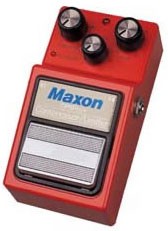
 The last review I wrote was on the Demeter Opto Compulator, a great compressor that I had the chance to A/B a couple of weeks ago. In the review, I said that that was the comp I was going to buy, but that was until I did a side-by-side comparison with the Maxon CP-9 Pro+ today. Now it looks like the winner of my search for a good, transparent compressor is the Maxon CP-9 Pro+. But I’ll have to admit, I’m very torn between the two.
When I heard Buford play through the Demeter, I loved its transparency. The compression is so subtle, you hardly notice that it’s there. But my side-by-side comparison with the CP-9 really got me hooked on it instead of the Demeter – for now (I’ll explain in a bit). Let’s look at the features, shall we?
Like the Demeter, the Maxon CP-9 Pro Plus is fairly straight-forward to use. It has three knobs to the Demeter’s two, adding a threshold knob to the ratio and makeup gain knobs, and this is what got me hooked on this pedal. I really liked having that threshold knob to control when the compressor kicked in – that made this pedal much more versatile in my eyes. I set it to about 10-11 o’clock, set about 2.5 to 1 ratio, then set the gain to match the uncompressed signal volume as closely as possible. What this pedal did for the Strat’s sound that I was playing was very sweet. The tone stayed the same, it was just fatter. And for low-volume applications, this is EXACTLY the effect I was looking for. It’s not as subtle as the Demeter, but it’s still transparent as all get out.
Since the shop I tried the CP-9 at also had a Demeter as well, I decided to try out the Compulator for myself, since I didn’t get to play Buford’s guitar that night at the casino. So here’s my feedback. The Demeter is incredibly subtle in its compression. It squeezes your signal just right, but in the quiet environment where I was testing, I noticed a distinct, but very pleasing high-end shimmer that was produced by the Compulator that I couldn’t hear in the crowded environment in which I first heard the Compulator. Talk about ear candy! Unfortunately, what I’ve been looking for is a compressor that doesn’t add any artifacts. It just squeezes. So I was faced with a bit of a dilemma: Go with the Maxon’s versatility, or go with the Demeter’s subtlety and beautiful high-end shimmer. I’ve decided to go with versatility for now.
Mind you, these two compressors are very different beasts. The Demeter employs an optical circuit for compression, while the CP-9 uses a Voltage Controlled Amplifier (VCA) and a RMS sensor. Click here for a great article covering that various electronic approaches to compression. The reason I mention this is because the different approaches yield different sonic results. Optical comps tend to be the most subtle of the compressors, while the VCA type compressors offer the most versatility and highest attack response. That said, it’s possible to use different types of compressors to achieve specific types of tone. Oy Vay!
I’m not sure if I’ll ever get the Demeter, though it will always remain in the back of my mind. And even though I was totally blown away by that high-end shimmer, my practical side made me err on the side of versatility.
 Guitar Gear
Success in business requires training and discipline and hard work. But if you’re not frightened by these things, the opportunities are just as great today as they ever were.
WTF?
Trevor was probably a bot. Anyway, how do you like the Maxon comp now, after about half a year’s usage? They all seem to be great, high quality pedals. I’m planning on getting a CP-9 Pro+. Thanks for the review!
Yeah… Been getting those A LOT more since the blog has picked up in traffic.
In any case, I still love it. When I need a compressor, which isn’t often as of late with the guitars I’m playing, it really comes in handy. But when I’m playing my Strat, it’s really a necessity. To me, it’s still the most transparent compressor out there. I know there are really good ones, but the Maxon is well worth the price you pay for it.
Thank you very much for the reply. It sounds convincing. Thanks again!
@GoofyDawg
The point of blasting message forums and blog comments with postings from bots is to help defeat any anti-spam filtering you have. Nowadays, spam filters for blogs/boards assume you’re more likely to be legit if you’ve already had some comments go through successfully in the past. So, the bot makers post generic comments non-specific to any topic (because the bot doesn’t know the context of the real conversation), hoping it will go through and that the worst that will happen is that the moderator will allow it but be like, “WTF was that about?”. Another reason is that the generic comments might contain words and phrases that can later be used for advertising, such as “success”, “business”, etc. If those words have been allowed in comments before, your spam filtering is less likely to reject it later from spammers.
@GoofyDawg
Anyway, sorry for the long post about spammers and bots.
Concerning the CP-9…
I heard of people like David Gilmour supposedly using the Ibanez version of this, which I can no longer find under that brand, which is understandable considering it was most likely Maxon that manufactured it anyway. (Before 2000, Maxon and Ibanez were part of the same parent company, with different branding in the U.S. versus Japan.).
What I want to know is, if you used the CP-9 and a DBX 160A as inserts on your mixing console (so both are at line level and unbalanced), would they sound comparable (considering the CP-9 is based on a DBX circuit)? I know Mike Clink uses the DBX 160 for tracking, and Slash’s tone has always sounded good to me…
That’s a good question Rob, and something that I can’t really answer, since I’ve never done it. But if the impedances on the console match what the pedal expects, I don’t see why it wouldn’t work.