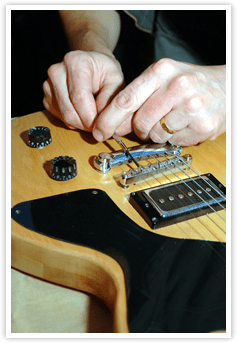
 My blog buddy IG wrote this article on a DVD for guitar maintenance the other day, and as oftentimes happens, his article sparked an idea – what if I set up my guitars myself? So, guitar tools in hand, I set off to do it. In short, now I know why I’ve sent my guitars to a tech… 🙂 Well… now that I’ve done it a couple of times, I think I’ll be doing it myself from now on.
While IG’s article did play a huge role in motivating me to set up my guitars, I had a pressing need to set the action and intonation of a my brand-new PRS SE Soapbar II. When I got it, it played like a dream, but the action was set a little high for my liking. I knew I’d have to have it set up, but I didn’t have the time to bring it down to my tech, and I was going to gig with it this coming weekend! So with a deep breath (actually several to calm myself down), I set up a clean, padded workspace, and went to work.
Thirty minutes later, I was done! It really didn’t take all that much time to dial in after all. A few twists of a screwdriver and allen wrench, and I had my SE ready to go. That said, I was lucky because there wasn’t any bow in the neck that I had to adjust – this time. But I’m really jazzed that I finally did some instrument maintenance myself – other than changing strings. I immediately went to work on my Strat and ES-335 guitars, and they’re in top form again!
So for all of you who have even the slightest inkling of working on your own guitar(s), let me share some things I learned from this experience:
- First of all, it’s totally worth it to learn this skill. Not only is it personally rewarding, you’ll save yourself tons of money. Think of action, neck bow and intonation adjustments like doing simple maintenance on your car. That said, if I need fretwork done, I’ll still bring my guitars to a tech. I don’t trust my feeble skills with major work.
- Lots of small adjustments are way better than a few big adjustments. You’ll make minute tweaks anyway to get your adjustments spot on, so have the patience to make your adjustments in small increments.
- After each tweak, re-tune all your strings. This will ensure you’re measuring against playing tensions. I didn’t do this at first, and would have to tweak and re-tweak a few times.
- I mentioned patience above. I’ll mention it again. For someone like me, if patience was a virtue, I’d be a slut. It really took all of my will power to just relax and go with the process.
- Floating bridge adjustments are much harder to dial in than fixed bridge adjustments – you really have to make very minor, incremental tweaks with a floating bridge (my SE and 335 both have floating bridges). Fixed bridge axes have individual saddles, so they’re a bit easier to dial in
ROCK ON!!!
 Guitar Gear
Good going!!
Well Done, Sir! I decided to do the same recently after being frustrated with the action on my Tele. It really is rewarding and fun.