Feeds:
Posts
Comments

Archive for January, 2010

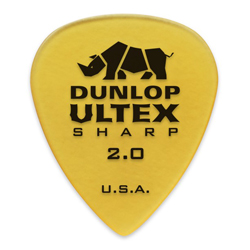
Dunlop Ultex Sharp 2.0 mm

Summary: It’s sharp alright; nice and pointy, and it feels great in your hand!

Pros: Like any sharp pick, this pick is accurate. It’s super lightweight, and made of a material takes a lot of pressure to even slightly bend. The pointy end makes pick harmonics a breeze!

Cons: It’s a small nit, but I wish the butt-end were just a bit wider.

Features (from the web site):

Based off of a coveted vintage tortoiseshell pick in our collection, the Ultex Sharp delivers a pick with a rigid body tapering into a thinner and sculpted tip for intense control and speed. The seamless contoured edge surrounds the pick for more playing surfaces and tones. Engineered of Ultex—the Ultex Sharp is virtually indestructible and delivers a crisp tone and quick release attack. Available in .73, .90, 1.0, 1.14, 1.40, and 2.0mm gauges.Price: 50 cents street

Tone Bone Score: 4.75 – Real nice-sounding and nice-playing pick. If you want to step up to a thicker, more rigid pick, but don’t want to shell out for high-end picks, this is a winner!

Okay, I’ll admit it: I’m a bit of pick snob. Ever since I started playing with V-Picks and Red Bear picks, I’ve mildly eschewed mainstream picks in favor of the insanely awesome picks those two companies produce. But I have to tell you that I was taken by complete surprise by the Dunlop Ultex Sharp pick! I wasn’t really looking to explore new picks, but a buddy of mine was looking for some Ultex picks at a local store, and offered to buy me a couple. Hell! They were only 50 cents apiece! I carried them around for a couple of days before I actually got to try them; not because I was dubious of them, I just couldn’t find time until this evening to sit down with an axe. Life happens, you know?

Anyway, I slung “Blondie” my trusty Squier Classic Vibe Tele, dug an Ultex out of my pocket, and started to play. Admittedly, I had a bit of trouble playing with the pick at first. Even though it’s slightly thicker than the thinnest pick I play – a Red Bear Tuff-Tone – it’s decidedly narrower in shape; something to which I’m no longer accustomed. But being the hard-headed type, and because I wanted to give the pick a fair shake, as it were, I kept at it, playing scales and riffs to get used to it.

I have to say that I’m really impressed by this pick! First of all, the material feels great in your hand, and like any real good pick, you forget about it. I love the rigidity of the material as well. Contrary to what you might think, a rigid pick actually makes you relax your hand. I know, it’s counterinuitive, but any player that plays a rigid pick will attest to this.

I spent quite a bit of time playing with this pick, and it’s a fast pick, though what I really missed was how my high-end picks really glide over the strings, like they’re lubricated. The Ultex material is pretty smooth, but there is a difference. Mind you, I’m not saying it’s bad in the slightest; it just has a different feel on the strings.

Most importantly though, the Ultex Sharp produces a nice, bright tone. That’s what I really dig about this pick! Part of it is due to it being rigid, but the other part is because of the pointy end. It really makes the strings snap in a very nice way!

Will the Ultex supplant my V-Picks and Red Bear picks? Probably not, but I will be using it for sure. It’s not even a small wonder why these picks are so popular among guitarists. They’re great playing and sounding picks at an insanely cheap price. I’m sold! Buy a few, and you’ll see for yourself!
Read Full Post »

I was perusing Solid Cables site this morning, and couldn’t find any pricing, so I surfed their dealer list to see how much I could get a 10′-12′ cord for. I found this site that had one of their Dynamic Arc Ultra cables listed for $135.95! OMG! I think the most I’ve ever paid for a cable was $80, and I still have that cable – it’s great; well-made with solid construction. People have raved about real high-end cables in the past, and I’m wondering how big of a difference they make. In any case, I put together a poll to see what people would pay for a cable. Here it is:

Read Full Post »

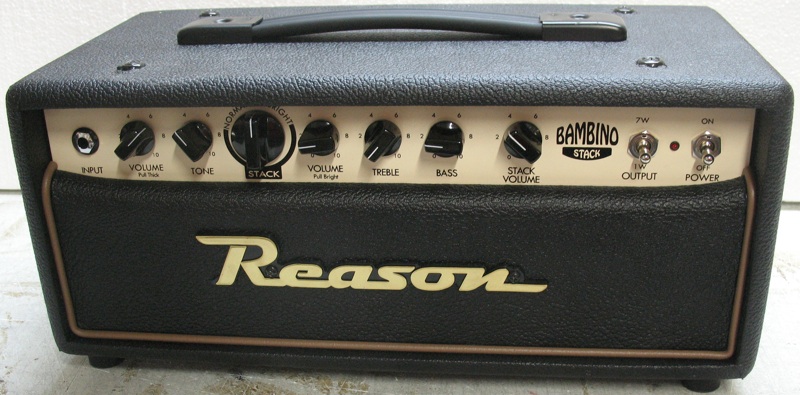
I’ve been extolling the virtues of the Reason Amps Bambino for several months, and how great it sounds. Among the things that I’ve mentioned is that for a little amp, it has a BIG sound. That was a design objective with Obeid Kahn, Reason’s amp designer, when he was designing the amp. He didn’t want to just build yet another affordable, low-powered amp. He wanted to build a great amp. Period.

Despite the sound though, what has really turned me on about this amp is its versatility. For instance, last Friday I did my regular, weekly solo gig at a local restaurant. I haven’t been very happy about my Stratacoustic’s tone into my DigiTech Vocalist Live box, so I decided to bring the Bambino to provide some pre-amplification and use its balanced line out to go directly into the restaurant’s board. What I was greeted with was simply put, a spectacular sound, and this from a line out directly from the amp! I’ve mentioned using this in the past, but this time, I had no speaker. I went direct into the board, and the only monitoring I had was from the PA. A couple of days later, I used it for my weekly church gig, with my 1 X 12 speaker cab, and also using the line out to plug into my church’s board.

For a church gig, minimal stage volume is important because voices are reinforced through the house audio, not from the band area. So to have this kind of amp where all I have to get is my stage volume, then use the house to get my sound out, it’s simply a boon.

The only other amps I’ve ever used that have this kind of versatility are acoustic amps. I realize that there are probably other tube amps that may have this capability, but getting all the great sound and versatility AND boutique quality in a $699 package is just unheard of! If you’re looking for a great amp that’ll work in variety of places, look no further!

Read Full Post »

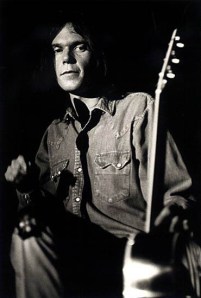
I got inspired to write this entry from none other than Neil Young yet again. Back in July, I wrote another post about how much I love Neil Young’s playing. It’s raw, it’s untrained, and it’s absolutely in your face. It’s not very good playing at that, but for some reason, it’s incredibly appealing to me – and I’m not the only one who thinks this! That article was inspired by an interview he gave and the commentary he made about his playing. Then, lo and behold, I read an old interview recently that really got me thinking about expression versus technique. Here’s an excerpt of what he said (courtesy of Guitar Player mag):

“First of all, it doesn’t matter if you can play a scale. It doesn’t matter if your technique is good. If you have feelings you want to get out through music, that’s what matters. If you have the ability to express yourself, and you feel good when you do it, then that’s why you do it. The technical side of it is a complete boring drag, as far as I’m concerned. I mean, I can’t play fast. I don’t even know scales… …I appreciate these guys who play great. I’m impressed by metal bands with their scale guys. I mean, Joe Satriani and Eddie Van Halen are genius guitar players. They’re unbelievable musicians of the highest caliber. But I can’t relate to it. One note is enough…”

While I don’t entirely agree with Mr. Young about technique, I do get the gist of what he’s saying: It’s YOUR musical expression and feeling good about it that’s important; no matter what speed that is or the technique(s) you use to express yourself.

Personally, I believe in being serious about learning new techniques and honing what limited skills I have only for the sake of opening up different ways to express myself. But that’s kind of the rub. How far do I take technique? Sooner or later I have to apply it; hence, the title of this article. Make no mistake, technique is important, but the music you make from that technique is even more so.

As eternal students of the guitar, it is so easy to fall into a rut with “how” to play as we discover our instrument – hell, I’ve been exploring for many years, and I feel I’ve only scratched the surface of possibilities – but as musicians, I will submit that once you’re playing, “how” is irrelevant, and that “what” you’re playing is far more important.

For instance, I recently saw a video of the guy who broke the Guinness world record for guitar speed by playing “Flight of the Bumblebee” at 320 beats per second. The student in me appreciated the work and focus that went into being able to play that fast; I could never play that fast, that clean. But the musician in me said, “So what? It ain’t music at that speed.” You can watch the video here. Granted, the technique that went into being able to play that piece that fast is absolutely incredible! But at that speed, the guitar sounds like a Formula 1 race car revving its engine as the player ascended and descended the neck of his guitar! From a musical standpoint, it made no sense whatsoever.

That’s why what Neil Young said resonates with me as a musician. I personally don’t think technique is a complete boring drag, but when I’m playing, what I’m playing is far more important than how I’m playing it.

Read Full Post »

« Newer Posts