Feeds:
Posts
Comments

Archive for July, 2012

Important Lessons…

Yesterday, the power supply on my pedal board (Dunlop DC Brick) went out. It sucked because it’s a great power supply that isolates and regulates the power to each individual pedal. But luckily I had a Visual Sound 1-Spot plus two 5-pedal extensions. With that, I could use one plug on an extension to power up the other extension, and that would cover all nine pedals on my board. So I removed all the wiring from my DC Brick, removed the brick, then got ambitious and took off all the pedals so I could clean my board and get all the wiring right. The result is to the left. Click on the picture and you’ll see. It’s not pretty, but it works, and everything flows.

In any case, I decided to experiment a little bit with my pedals and swapped out a couple of stalwarts for pedals I hadn’t used for awhile. I first swapped my Tone Freak Effects Abunai 2 for a Doodad Guitars Check-a-Board red overdrive. I then swapped my beloved BOSS CE-2 Chorus for a Homebrew THC, then swapped out my trusty Hardwire RV-7 Reverb for a ToneCandy Spring Fever. I got everything wired back up, then did a sound check. Everything sounded great. Then I went to my gig, and that’s where I learned the important lessons that I’ll share here; lessons that I’ve spoken about in the past, but hadn’t experienced them in awhile, so I needed to relearn them.

Lesson 1: Your Rig Never Sounds the Same On Stage

Once I got my pedal board squared away, I ran a test through the amp I would use for my gig yesterday. I was sitting three feet away from the amp. But at my gig, I was 10 feet away, and the settings that I had used for sound check sounded like CRAP! The bottom end was all loosey-goosey, and my overdrive pedals sounded extremely harsh. Ouch! Puzzled, I moved closer to my amp, and everything sounded great, which was good because I rely on the PA for sound projection. But it made me extremely uncomfortable to have it sound so bad; especially with my overdrive pedals. So my solution was actually to turn down slightly and turn the amp a few degrees – and I’ll talk about that in a second. But the lesson here is that until you get on stage, it’s a whole different ballgame; and if you’re relying on the projection of your amp for your gig, be prepared to tweak.

Lesson 2: Floor-Bounce Effect Can Totally Screw Up Your Sound

Floor-bounce is a well-known audio effect that has to do with sound reflecting off a floor that causes cancellation or emphasis of certain frequencies; mind you, that’s fairly simplistic explanation, but the effect is that it could make your tone sound harsh as certain frequencies cancel out and others get emphasized. Actually, reflectivity off any surface could cause your tone to sound harsh, which is what happened to me at my gig yesterday. Close up, there was no reflectivity, but my speaker sits on the floor, plus I had it closer than normal to a low wall, so reflectivity off the wall was coming into play. Because I stack my amp, attenuator and wireless base station on top of my cabinet, tilting the cab back wasn’t much of an option. But turning the amp slightly away from the wall helped quite a bit. Also, turning down my volume (increasing attenuation, not reducing gain) helped as the reflectivity effect was much less pronounced. Since I use the church’s PA for projection, turning down wasn’t an issue. Our sound guy would balance that lower volume into the mix.

It’s hard to describe exactly what it sounded like, but the effect was as if I had ripped my speaker cone. The bottom end was extremely farty, and even at low- to medium-gain settings on my overdrive pedals it was like sanding with 50 gauge sandpaper which is super rough and used for stripping paint versus 400 gauge sandpaper which is gritty but leaves a much smoother finish.

Lesson 3: Affirmation of the Effects Loop

When I got my DV Mark Little 40, it was the first time in a long while that I had an amp that had an effects loop, and now I’m completely sold on the importance of having one. Running mod effects in front of an amp is fine if you’re running into an amp set for max clean headroom, and you put your drive pedals in front of them. But mod effects in front of a distorting pre-amp sounds really harsh – at least to me. Not sure the technical details behind all that, but I do know that running my mod effects in my loop sounds so much better to me. With my current board setup, I run four wires out to my board. Two are for the effects loop, then two are for input from my wireless base station through my drive and wah pedals into the front of my amp.

Lesson 4: Boost Placement

Another important lesson I learned was something I picked up a few months ago from Gene Baker of Fine Tuned Instruments and luthier of the B3 guitar. In a demo he did of the Xotic Effects EP Booster, he said he ran the booster at the end of this effects loop chain. He said it “steps out a lot nicer than trying to hit it on the front end.” I’m a big fan of power tube overdrive, so I tried it out, and put my trusty Creation Audio Labs Mk.4.23 transparent clean boost at the end of my effects loop chain. OMG! It’s never leaving that position. The cool thing is that it’s like adding a separate gain stage after the pre-amp to slam the power tubes, but not necessarily with a more pronounced volume boost. It also provides a different kind of distortion than the pre-amp distortion on my amp which tends to be a bit bright. When I slam the power tubes, I get a beefier overdrive sound. It’s very cool for doing solos. So now, I put my OD’s in front of the amp, then when I want “more,” I slam the power tubes.

Read Full Post »

Stuff For Sale

I’ve got lots of gear, and lots of stuff that I’m just not playing. So I’ve decided to put some stuff up for sale. If you’re interested, send me a message. By the way, I’m offering this gear at good prices, so I’m not going to negotiate. Also, I won’t be doing any trades. All prices include shipping


Gear: MXR M-169 Carbon Copy Analog Delay Pedal
Description: I have only gigged with this three times, and it’s in great condition. There’s a little adhesive on the bottom from a velcro strip that I put on it, but other than that, there are no scratches or dings on it whatsoever, and it still has the rubber tabs on the bottom. I bought this as a second delay pedal to put on my other board, but I have since gone to a small board, and only use my Mad Professor Deep Blue Delay, so I’m selling this one.
Comes in original box.
Price: $110

Gear: VOX Time Machine Digital Delay

Description: Again, I have only gigged with this a few times. It’s a great delay with tap tempo and lots of features, but once I went to analog, I just stopped using the Time Machine. Comes in original box.
Price: $140

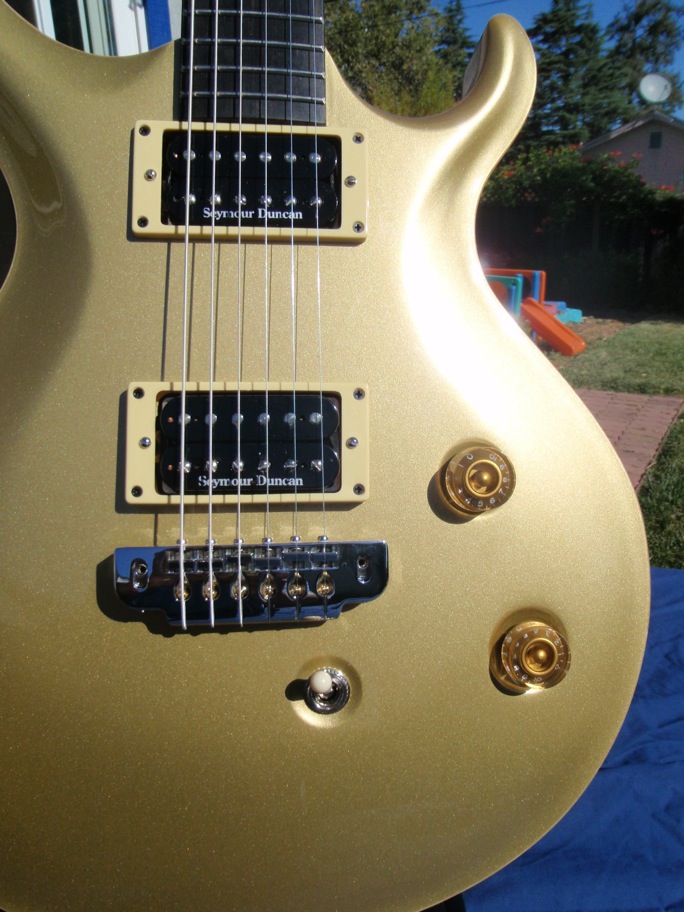
goldie41Gear: Custom Saint Guitars Messenger Goldtop

Description: I have a whole page dedicated to this for more information. Check it out here…

Price: $1500 – priced to move. The guitar is in pristine condition. Add $50 for shipping.

Read Full Post »

Like I have been doing practically every morning for the last few years, I peruse my favorite gear forums and came across this thread discussing whether or not 4 X 12 cabinets are a dying breed. There were lots of responses both pro and con, but a sidebar discussion ensued about loudness; specifically SPL (sound pressure level) and perceived loudness. So that got me thinking about the mechanics behind loudness and that led me to the title of this article. So how can a 1 X 12 be louder than a 4 X 12? Well it has to do with a combination of several things, but at least from what I understand, you can boil it down to two things: Speaker efficiency and frequency response. In any case, I found a great article that discusses this subject in detail here. It has some good technical information while maintaining a chatty, conversational tone. It’s a good read, and actually explains how a 1 X 12, given the right combination of amp, speaker sensitivity and frequency response can be louder than a 4 X 12. Pretty cool.

But all this ruminating on loudness also got me thinking of how I got pissed at one of the guitarists in my church band who kept on stepping on everyone this past weekend with the volume of his amp. It got to the point where I finally said, “Look! I’ve had it with your volume; either turn it down or I’ll turn it off.” Thinking back on that situation and the information that I read this morning, I realized that the frequency response of the speaker of his amp – a California Blonde – is probably heavy in an area where he can’t hear it, so he cranks it up so he can. Plus, its spread is really narrow and as he has the amp right in front of him, he probably can only hear only a slight portion of the volume that amp can produce (I have one as well, and that amp really projects). The point to bringing this up is that perceived volume also has to do with where you are in relation to the front of the speaker, and that frequency response plays a huge role. If your speaker produces lots of sound in an area that’s not or less perceptible by the human ear as compared to other frequencies, you’ll perceive it to be not as loud.

For myself, I’m pretty sensitive about the frequency response of my speakers because as the lead guitarist, I need to cut through the mix. The interesting thing about this is that I don’t have to be loud to hear myself as my tone tends to be on the bright side – though I will admit that I like to be loud just because there’s nothing like SPLs. 🙂 However, that said, as of late, I’ve been much more sensitive to my stage volume, so I’ve reined in the volume a bit. My thinking is that as long as I can hear myself through the mix, it’s all good.

Read Full Post »

…and it’s not just her looks, which are incredible, to say the least. She’s a great musician that plays a mean organ as well as slinging a guitar. And her voice? Rock goddess like Ann Wilson of Heart. Though I dig her looks (who wouldn’t?), what I find even more sexy is that she’s a great musician, not just eye candy. My friend Ignacio Gonzales who had the long-running but now defunct IgBlog was in love with Tal Wilkenfeld (bassist for Jeff Beck), but I’m in love with Grace Potter.

I admit that I had never heard of her before today. But I went to the Gibson site and their homepage banner sported an ad for the new Grace Potter Signature Flying V. Curious, I surfed for videos, and was immediately impressed with her music. It’s hard-driving, classic-style, blues-infused rock and roll. And the music doesn’t take a back seat to her persona or beauty. Her beauty is her music. Makes me want to dance.

Here’s a video:

Read Full Post »

For several years, many people, including myself have been asking Jeff Aragaki, owner of Aracom Amps when he was going to build a 100 Watt amp. After all, Jeff specializes in vintage Marshall-style amps, so it made sense to have a 100 watt amp in his lineup. Having experienced Jeff’s development process first-hand, I knew that it would probably take awhile for him to come out with one mainly because he never settles for simply duplicating a particular circuit design. He finds places where he can make improvements or comes up with things that just don’t occur to us mere mortals.

Well, Jeff finally built a 100 Watt amp. It’s called the PLX100 Custom. But don’t be fooled by the name. Though “PLX” implies “Plexi,” this amp is way more than that. A two-channel amp, Channel 1 sports a Plexi-style circuit, while Channel 2 goes into the high gain territory of the JCM-800. Here are some initial features Jeff has provided:

  • Channel 1: JMP “Plexi” channel, switch selectable between Bright/Dark + Boost Mode
  • Channel 2: High Gain JCM channel, with multi-position rotary Tone Control + Boost Mode
  • Global Controls: Presence, Bass, Mid, Treble
  • Master Volume Control with bypass switch
  • “Fat” Switch – Boosts the lower mid-range frequencies, which provides a real fat tone
  • “Bite” Switch – Slight boost to the mid and high frequencies
  • Configured for EL34, 6L6GC or KT66 power tubes

True to Jeff Aragaki’s style, the features above form a foundation, as he has anticipated that people would want some custom features like an active effects loop, footswitching, or NOS mustard caps; hence the “custom” in the name. But get this: The base price is only $2900. That’s incredible to me because other vintage Marshall builders that pretty much just do circuit duplication charge almost as much for their 100 Watt heads. What you’re getting with PLX100 is two amps in one for just a bit more. For instance a Germino Monterey 100 JCM45/100 head costs $2750. For my money, I’d go for versatility every time, and the PLX100 is a no-brainer choice.

For more information, check out the Aracom PLX100 product page. I’ve basically provided the same information here, but Jeff will be updating that page very soon.

I tried out a prototype of this amp awhile back, and I knew Jeff was onto something. The tones I got from a Les Paul were simply astounding. The cleans are deep and lush as you’d expect with a high-powered amp, and the drive tones are just incredible. Thank goodness Jeff makes attenuators because this amp simply screams when pushed! Anyway, here’s a demo YouTube (audio only) of the amp:

Read Full Post »

As a Web UI Engineer – not to be confused with a designer – my job is to craft great web sites, and though web engineering doesn’t involve itself in the artistic side of web development process, an integral part of the job is ensuring that the user experience and application flow makes sense, and that the artwork doesn’t get in the way of the user. That said, it doesn’t mean I don’t have a strong sense of aesthetics, I do, but my focus is on engineering a great user experience.

From that perspective, for years I’ve been following the guidance in Steve Krug’s book, “Don’t Make Me Think,” in which he shows example after example of great user experience and posits that the best interfaces are ones which are so self-revealing in how to use them that they don’t require the user to think about what to do; or at least limit the amount of thinking the user has to do to use the interface.

So what does this particular subject have to do with guitar gear? Actually lots. Gear manufacturers large and small could learn quite a bit from reading this book. Control interfaces on some amps are so confusing that it makes it extremely difficult to dial in a great tone, and it takes hours to get a feel for them. That’s not necessarily a bad thing because part of the fun of playing around with a new amp is learning its various functions. But sometimes it can be downright frustrating.

One manufacturer that I think “gets it” is Hughes and Kettner. Though I don’t own any of their amps, I’ve looked at their control interfaces on their various amps, and it’s easy to figure out. If you look at the HK Switchblade and click on the magnifying glass to view the details, you’ll see what I mean. This is a very sophisticated amp with lots of different features, but they’ve kept the control interface very simple and streamline. That kind of simplicity speaks to me.

Another manufacturer who “gets it” is DV Mark. The Little 40 is a lesson in “don’t make me think.” The control interface is very simple and straight-forward, but one place where this little amp shines is in swapping power tubes. A feature that sold me was the power tube auto-bias. This amp automatically biases and matches power tubes on a continuous basis to ensure that the power tubes operate at their optimal level as long as the power tubes are matched within 10% of each other. I DIG THIS FEATURE. It means that as long as I buy reasonably matched tubes, I can swap them out at any time, and not have to bias them myself; no chance for operator error!

For instance, last week during my church gig, I noticed that the amp was sounding really harsh, and when I cranked the amp up, it occasionally stuttered. So after the gig, I tapped on the power tubes with thin kabob stick, and sure enough one of them was microphonic. So this morning, I took the cover off the amp and swapped out the EL34’s for a pair of awesome Groove Tube 6L6’s which are new production tubes made from NOS parts. I was purely overjoyed that I didn’t have to bias the tubes myself, and that the amp just does it. Talk about not making me think! This was a dream come true!

To some, this might be a trivial matter, but admittedly, I’m deathly afraid of screwing around with electronic components and screwing things up. An amp the Little 40 makes tube maintenance absolutely idiot-proof. But on top of that, the amp sounds killer, so needless to say, I’m a happy customer!

NOS Does Matter

While I had the cover open, I also decided to swap out the JJ 12AX7’s, with a couple of spare NOS 12AX7’s. I put in a 50’s Bugle Boy and a 1959 RCA 12AX7. oh… My… GAWD!!!! Combined with the GT 6L6’s, the tone of the amp is incredible, with subtle overtones and harmonics that the other tubes didn’t have. When I first put all the tubes in, I couldn’t believe what I was hearing. But I confirmed this by swapping out all the tubes twice!

The fundamental tone of the amp with the NOS tubes is basically the same, though the 6L6’s do provide for a bit more headroom as they don’t break up quite as early as the stock EL34’s; plus they don’t seem to compress as much. The preamp tubes really smooth out the front-end breakup, but they also have so much more sonic content – especially in the high frequency range. And when those 6L6’s saturate, the tone becomes almost cello-like. I’m flippin’ out!

There is something to be said about NOS tubes. Unlike other things like power or speaker cords that to me are essentially snake oil, at least to me NOS tubes provide a marked difference in tone. All my amps have NOS tubes in them – though I’ve kept the JJ EL84’s in my Aracom PLX18 because they actually sound better to me than NOS EL84’s. One thing that seems to be an earmark with NOS tubes is the smoothness of their breakup. I think that smoothness comes from the higher amount of sonic content that they produce. Especially with preamp tubes, I’ve found new production preamp tubes to be harsh a bit on the harsh side in comparison.

Mind you, NOS tubes don’t come cheap. But to me, they’re a solid investment in your tone.

Read Full Post »

I was perusing the Premier Guitar site for their NAMM coverage and came across a video of the new Four Force EM-1 amp from new builder Four Force. This is a solid state amp that Four Force claims comes about as close to tube sound as solid state can get. Don’t they all say that? 🙂

But I do have to say that based upon several demo videos I’ve seen of the amp, it doesn’t sound half bad at all, and at $159 – no, that’s not a typo – it might just be worth checking out as a practice amp. Some people have actually run this through a full stack, and apparently it rocks.

The amp weighs just 13 lbs. That makes sense since solid state doesn’t require huge transformers, but the amp packs 4 gain stages into its design, so it apparently can get some hefty high-gain – at any volume.

My concern with any solid state amp isn’t sound – heck, my Roland Cube 60 sounds great – it’s response and dynamics with gain, and it’s a reason why I only used my Cube 60 for acoustic. The EM-1 could very well be a different story, but only a live test will determine that. So to be fair, I’ll reserve that judgement until I actually try out the amp.

For more information check out the Four Force site! It’s a single page, but it has a bunch of demo videos on it.


Read Full Post »

Because I like to play nice in the gear world, I rarely post rants or complaints. But today, I was perusing an amp maker’s site – I will play nice here and not mention any names – and there were no prices posted! I understand that boutique gear normally runs much higher in price than mainstream gear, but when I’m looking a gear, nothing ruffles my feathers more than a manufacturer who won’t post their prices – or at least approximations. To me, it’s as if they have something to hide, and it also plants a seed that I’m going to get gouged. More likely than not, that’s not going to be the case, but I feel that being cagey about pricing – whether or not intentional – is simply a bad business practice.

I understand that especially with small, boutique amp builders that prices will vary from amp to amp, but I’ve been around long enough and have met and created relationships with enough manufacturers over the years to know that the best folks I’ve worked with at least provide a base price. That pricing could start out with the bare amp on a chassis, then build up from there, or start out with the pricing for a complete, no-frills amp, with modifications to the basic design costing a certain amount depending upon what you want.

Someone who’s great about this is my friend Jeff Aragaki of Aracom Amps. Yeah, I talk about him a lot, but not only is he one of the nicest guys you’ll ever meet, he’s really upfront about what stuff will cost. He has a detailed price list on base models and options, but will also do custom work. He and I have talked about this very subject in past, and he questioned why people would hide their pricing because if you personally source the components, you can get an approximate material cost. Of course, the magic is getting the components to work well together, and that’s the value-add. As for me, I have no problem with someone posting a $3000 price tag. My philosophy is that good is good at any price, and I’m willing to pay for great sound. And I’m not alone in this…

So yeah, I was a bit irked by the manufacturer this morning. I just don’t see why they couldn’t be on the up and up….

Read Full Post »

Got a press release from Pigtronix yesterday on the new Philosopher’s Rock pedal, which is an optical compression-sustainer/germanium distortion pedal. Normally I’d say, “Yeah? So what…” but this time I’m a bit intrigued, partially because I’ve been thinking about getting another compressor, and partially because I’ve been looking for another pedal to use distortion into a clean amp. So it’s nice that this pedal combines both. Here’s the press release:

Pigtronix Announces Release of the Philosopher’s Rock Pedal

The Philosopher’s Rock is a compressor sustainer and germanium overdrive pedal that expands the already notorious line of Philosopher pedals from Long Island’s Pigtronix effects.  The Philosopher’s Rock is the over-achieving little brother of the company’s top selling sustain pedal, the Philosopher’s Tone.  Simplified down to offer up the best sounds of its predecessor, the Philosopher’s Rock sports a streamlined control layout plus the added benefit of germanium enhanced overdrive, along with an unbeatable price point.

The Philosopher’s Rock utilizes Pigtronix award winning compression circuit that has been acclaimed by the likes of Andy Summers, Dweezil Zappa, Johnny Hiland and Billy Sheehan.  On this new unit, the controls have been paired down to a classic compressor layout of just 2 knobs (Volume & Sustain) plus a single toggle switch for layering in a refined, vintage flavored germanium overdrive.

With a four times wider range of compression, endless sustain, germanium overdrive and a new vertical footprint and idiot proof control layout, the Philosopher’s Rock is destined to become a future classic.

“The Philosopher’s Rock is Killer. It must go in my rig stat!” – Ian Thornely of Big Wreck

“The Philosopher’s Rock is incredible!” – Brad Whitford of Aerosmith

Pigtronix Philosopher’s Rock carries a list price of $175 and is available now at Pigtronix dealers everywhere.  Check out the Philosopher’s Rock and the entire 2012 lineup of Pigtronix effects at: www.pigtronix.com

All hyperbole aside, this pedal seems to be pretty cool…

Here’s demo video of the pedal:

For more information, visit the Philosopher’s Rock page!

Read Full Post »

For years, I’ve lugged various binders from gig to gig that stored my music. Most of that has been in the form of single-sided sheets of chord charts, and as I have been actively gigging for the past 12 years, you can imagine how thick my main gig book has gotten. Well recently, I was at a funeral service where the musician used her iPad to display her music. After the service, I went to talk to her and she told me she was using an app called “forScore.” It’s a brilliant little app that is essentially a PDF viewer. It has gotten some rave reviews, and I _almost_ pulled the trigger on it. BUT, most of my stuff was in chord charts.

So I looked for guitar-related score apps, and came across some really cool ones. There were several in the Apps Store, but I couldn’t really choose; that is, until I came across a demo of LinkeSOFT SongBook. While all the apps out there had some great features, SongBook has some key features that got me to spend the measly $5.99:

  • All song files are in ChordPro format. Files in this format are text files that contain formatting tags that affect the printed and display appearance. This is also a fairly ubiquitous format for sharing chord charts.
  • SongBook also has a built-in web browser that searches for files with .pro, .chopro, and .txt extensions. But not only can it find the files, you can import them directly into SongBook!
  • Because SongBook works on the ChordPro format, transposition is instantaneous, as the app simply parses the chord tags and makes the appropriate pitch changes.
  • SongBook will also sync with DropBox (http://www.dropbox.com), which you can create for free for 2GB of space – more than enough to store literally thousands of text files!
  • Finally, SongBook has a highly flexible Playlist manager. For instance, I had a bunch of my church songs in ChordPro format on my local drive. I dropped all of them into DropBox, synced SongBook with DropBox, then created a playlist of sacred music. Now when I play at Mass and need a song I wrote, it’s a couple of taps away! So awesome!

Here’s a great demo of SongBook:

Mind you, I’m not making a marketing pitch for the product. But this really has me excited because it means that I don’t have to lug my binder around any longer. Funny thing is that I don’t even use the chord charts any longer for songs I’ve done for years because I simply page through the book, find a song I want to do, and because I’ve memorized the song, I just start playing. I’ve tried to print out lists and go off them for gigs, but that has been tedious because I never do songs in the same order. Plus the damn book is 4-inches thick with songs! But now, I have an iPad that’s less than a 1/2-inch thick. And I won’t printing out pages any longer! So not only am I saving on gig weight, I’m also going green! Too cool!

Now, for sheet music, I think the best app out there is forScore, but I probably won’t get it until I’m back playing inside with the piano. Since I’m playing guitar exclusively for the summer, I really don’t need sheets. But hey! $4.99 is pretty cheap!

Read Full Post »