Feeds:
Posts
Comments

Archive for February, 2013

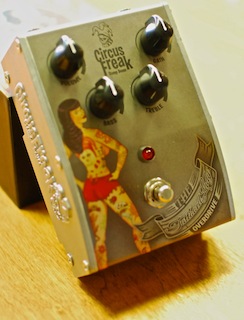
DSC_0344I’ve been on this reggae kick lately, and was tooling around with a riff the other day. Not sure if it’ll ever become an actual song, but while I was laying down the track, I thought that it would be cool to lay down a solo track with a dirty guitar. I was thinking about a singing lead with lots of sustain. So I pulled out the Circus Freak Tattooed Lady overdrive, and let ‘er rip. Up to that point, I had only used the pedal with my Les Pauls, and was thoroughly impressed with it. But with my Slash L “Katie May,” the sound was other-worldly!

It had a crying-like quality to it that literally stunned me. It’s hard to describe what I was feeling when I heard it, but it’s akin to the feeling you get when hearing something so completely unexpected and so completely beautiful that you have to stop and say, “Did I REALLY hear that?” Then playing it again just confirms that yes, you really did hear that.

I must’ve played over the loop for a couple of hours before I decided to track it. The sound that this pedal creates is simply incredible. Here’s a clip:

When I got up above the 14th fret, I couldn’t believe how the pedal created this wailing sound. To me, it’s breathtaking.

Anyway, I know that I’ve mentioned that this pedal is fantastic standalone, but in this case, I actually used it to help drive my DV Mark Little 40, so the breakup that you hear is a combination of the clipping of the pedal with the clipping of the front-end of my amp. I have the amp set at the edge of breakup with the pedal disengaged. The volume on the pedal is set to about 11am, with the drive between 2 and 3 pm. Bass and Treble are both at about 1pm.

Read Full Post »

Adventures in Looping

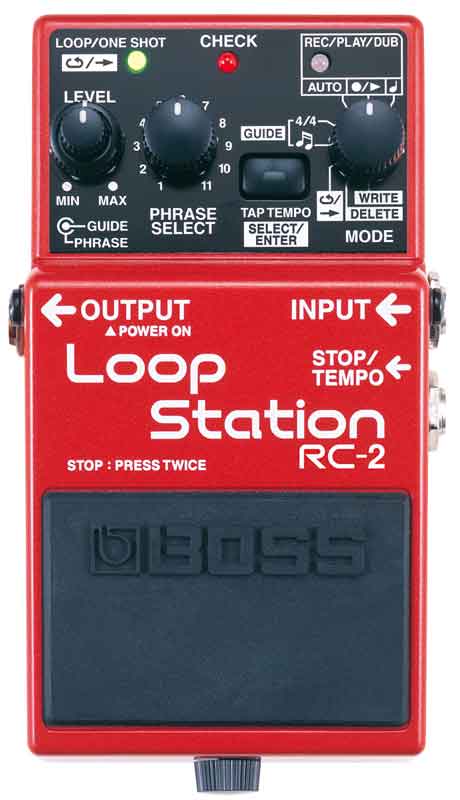
boss-rc-2I’ve had my BOSS RC-2 Loop Station for almost three years now, and it has only been in the last month or so that I’ve actually put it to use on a regular basis. Frankly, I’m not too sure why I hadn’t used it. But since I’ve started using it, I’ve been having a blast!

I think what inspired me to start using it was the release of the TC Electronic Ditto Looper. I was very impressed by its simplicity, and then it occurred to me that the RC-2 was actually very simple to use if memory served. So I set up the RC-2 with my VHT Special 6, and started to play around with it for a few days.

To be honest, when I first started using it in those practice sessions, I was a little overwhelmed and intimidated, even with such a simple looper! But after awhile, I started to get the hang of it, and worked up the confidence to use it at my solo gig.

I now use it quite a bit. Most of the time, I use it for specific songs like Bill Withers’ “Ain’t No Sunshine” or Clapton’s “Wondeful Tonight.” But lately, I’ve had some riffs pop into my head during my gig, and I’ll tap out a rhythm, lay down the rhythm guitar, then just jam over it. It has added a lot of life into my gig; mind you, I’m into my 13th year playing this weekly gig, so any way I can add a new dimension to it breaks up the monotony.

Frankly, I don’t know if I’ll get another, more sophisticated looper. I’ve seen some amazing things people do with them, but for me, simple is good for right now.

Read Full Post »

crossroads_collection

So I get this press release from Guitar Center that says they collaborated with Eric Clapton to come up with a 5-guitar series in partnership with Fender, Martin and Gibson called the “The Crossroads Guitar Collection” commemorating the Crossroads music festival. The Strat is a reproduction of “Brownie,” the Les Paul that of “Lucy,” and three Martin acoustics.

I thought to myself, “Pretty cool stuff…” until I saw the price tag of “Brownie” which is $14,999.

I know, it’s that whole issue of owning a piece of history bit with an exacting reproduction of a an iconic guitar, etc., etc., etc.. But that’s the issue for me: It’s a reproduction of a piece of history. Things like this are like those late-night commercials you see from the American Coin Company or some coin collectors outfit hawking authentic Buffalo nickels. “And you can have one of these rare pieces of blues history for only fourteen-thousand-nine-hundred-ninety-nine dollars. Visa, MasterCard, and American Express all welcome. Don’t wait! Only a few will be made available, so don’t miss YOUR chance!”

“Lucy” is the same price. The Martin 000-45 Brazilian though takes the cake at $49,999.

Look, if you’re a collector and have that kind of money to invest in one of these guitars, more power to you! Maybe I’m being naive like Tom Hanks in the movie, “Big,” but I don’t get it! 🙂

Read Full Post »

A good buddy sent this eBay auction to check out: http://www.ebay.com/itm/271149509473?_trksid=p5197.c0.m619. As of this writing, the bidding is up to $50k. Yikes!

I’ve played a Dumble ODS. The sound and dynamics are, in a word, magic, and I haven’t found anything in all the amps I’ve played since capture that magic. In the videos I made of the amp, I said that I think based upon playing it that it was worth the money.

But here’s the catch: while I think it is certainly worth the money, I’m not sure if my audience would be able to tell the difference. Up close and personal, the amp is absolutely incredible. But on a stage mixed in with a band? Not sure that playing a Dumble versus a Fuchs or Two Rock would make much of a difference. The only person who would be able to tell would be me. But if another amp inspires me while I’m playing, then having a Dumble wouldn’t make a difference in any case. I guess the point is that inspiration doesn’t have to cost fifty grand…

Read Full Post »

When it comes to creating music for songs, I’ve usually had a pretty easy time of it. I hear a melody in my head, think of what chord changes would fit with the melody, and put a simple track together. It’s a different story with lyrics. I have to admit that that isn’t my strong suit, even though once I’m done, I’m usually satisfied with them. But even still, writing lyrics isn’t all that difficult.

But what is hard is actually putting the song together and getting all the parts right. I used to be a bit embarrassed by the fact that especially with guitar riffs, I’d sometimes take 20-30 takes to make it right – or even more if I didn’t know how to play the riff that I heard in my head in the first place. It wasn’t about being a perfectionist; it was all about learning how to play. Period. Used to drive my poor family insane. My wife would sometimes burst into my man-cave exclaiming, “Why the hell do you have to play that phrase over and Over and OVER AGAIN?!!!”

With a sheepish grin, I’d almost invariably reply, “‘coz I’m not good enough to play what I’m hearing in my head, and need to get it down.”

Of course, her reply would be, “Well then, why don’t you just practice it quietly until you’ve got it, then record it?”

“Because I’m so close to getting it, but I screw it up along the way. I’m banking on hitting it one of these times, honey,” I’d reply.

“Oh my gawd! You’re driving us CRAZY!”

Years down the line, I’m a much better player, so I can usually hit it in one or two takes, or I now tend to experiment with different approaches to a particular phrase, rather than have my recording session be part learning session. But I will tell you this: All that time spent repeating and repeating paid off. That repetition made me a better player, and actually made my song arrangements much better. But nevertheless, I still do a LOT of repeating, especially with lead breaks.

In a song I wrote several years ago, I shared with a friend that the solo was actually composed. He was (and still is) a great guitar player, so he had a hard time fathoming how I didn’t just improvise over the changes. I was actually a little embarrassed so I made up some lame excuse. And I remember that conversation to this day. But yesterday, I was reading Bob Lefsetz’ latest installment where he was raving about the Eagles’ documentary, and in a passage in his article he wrote this:

Glenn hooks up with J.D. Souther and they form Longbranch Pennywhistle. They end up befriending Jackson Browne and move in above him in Echo Park. Where at nine every morning Jackson makes tea and starts to write. Playing the same riffs twenty times in a row. THAT’S WHAT IT TAKES TO MAKE IT! You don’t see the hard work at home, only the result, but the dues being paid are hefty.

Talk about reading something encouraging! Jackson Browne is one of my all-time favorite singer/songwriters, and to find out something about his writing process having even a slight similarity to my own simply blew me away!

I’ve always been of the mind that you have to practice, practice, practice to be good, and that practice has be driven by somewhat of a single-minded purpose. I wrote about this in a recent post, but that point was really driven home by that short passage.

Now I don’t feel so bad about driving my family crazy with my playing something over and over and over again. 🙂


Read Full Post »
Just got an email from a company called Chaos Sound who’ve created a new pedal, The Anti-Effect, which essentially F’s up your sound by simulating a burning amplifier or shorting cable. I can’t even begin to describe it, so I’ll let you view the video demo:

I don’t know whether to like it or absolutely HATE it. 🙂 I do have to tell you that it’s completely different than anything I’ve ever seen or heard.

My first though upon reading the email was, “Who the f%&k would want to mess up their sound.” Then I realized that an uber-weirdo (in a good way, of course) like Jack White might dig something like this. I actually liked the kind of stuttering effect that pedal introduces when engaged, though I did not like the MAX setting; too messed up.

So if you want to check out something totally different, check out their site: www.chaosound.com

Read Full Post »

It Bugs Me When…

I read threads like this where the discussion turns to artists selling out. Who’s to know what motivates the creative process of an artist? Only the artist. This particular thread focuses on Maroon 5 and what happened to them. Invariably, considering it’s The Gear Page, there will be those members who only have negative things to say, and accuse the band of selling out; or one respondent saying Adam Levine is a douche, and doesn’t substantiate as to why he or she thinks that. In my opinion, those who make those kinds of statements are the real douche bags, and frankly, I think their negativity is borne more out of jealousy than anything else.

The plain fact of the matter is that no one but the artist really knows what drives them. And many songwriters will actually say that they don’t know how they come up with songs. They just come, and they write them down. If that’s what happened to Maroon 5, that’s what happened. It’s pretty arrogant for people to throw out the oft-repeated phrase “they sold out.” Maybe Adam Levin wanted to explore a different direction; maybe songs like “Moves Like Jagger” written with Christina Aguilara was just something fun to do. WHO ARE WE TO JUDGE?

Several years ago, I remember being at a cast party of a community theatre production after a show and this aspiring “starlet” (I say this facetiously, mind you) said, “I only want to work in theatre because the actors in TV and movies have sold out, and they don’t really care about the craft.” I just looked at her in amazement, then somehow blurted out, “You are SO full of shit! But if it gives you any comfort, I can guarantee that people like Tom Cruise (that’s who she was talking about) are so upset with the opinions of ‘real’ actors like you that they’re crying all the way to bank.”

And so it goes with the musicians who are perceived to have sold out. Let me tell you, with their millions of fans, they’re more relevant than you could even imagine. Of course, with the finicky public, that could change in a heartbeat. As for me though, I celebrate the success of hard-working musicians.

That said, I do need to draw the line between those musicians who’ve worked their tails off and write their own stuff versus those who are invented. I have much more respect for people who perform their own creations. A good example of this is Taylor Swift versus Britney Spears. The former writes much if not all of her own stuff, while the latter was pure invention by someone else. I’ve never liked either one’s music, but I can appreciate people who originate their art. Taylor Swift has done a great job of bouncing back and forth between country and pop. What has Britney done lately? Talent judge? Hmm… 🙂

But then again, I can’t fault Britney for wanting to make a buck, and heaven knows she’s had great commercial success, but in my mind, if I were a fan, I’d be much less concerned about her “selling out” because she didn’t create the songs in the first place.

Anyway, sorry for the rant. I’m know I’m known more for my positive and upbeat tone, but some things just piss me off…

Read Full Post »

You Wanna Make It? Work Your Ass Off!

Love him or hate him, agree with him or not, or even question his credibility, Bob Lefsetz has something to say. “The Letter,” which apparently started out as a way to help Lefsetz get a job in the music biz, has become a close commentary on the music industry to which industry execs pay attention. I discovered his blog a few months ago purely by accident while doing a search of sort, and loved what he was saying; especially with respect to making it in today’s music industry.

One thing that I’ve noticed after reading him daily or even twice daily – he’s a prolific poster – is that he often talks about making it in the industry, and how hard it is to make it. It’s not about talent; hell, I know a lot of talented people who’ve never made it. It’s about working your ass off. For instance, here’s an excerpt from yesterday’s letter:

These musicians practiced for years. There were no short cuts to stardom. Sure, there were some teenybopper acts, but we didn’t take them seriously, unlike the way the industry and the media fawn over today’s TV stars, made famous overnight by “Idol, ” “The Voice” and “X Factor.” A rock star of yore literally rose from the streets, there was almost never an overnight success. And your audience never made fun of  you, they loved you, they were thrilled by you, you were the reason they kept on living.

The operative phrase in the excerpt is “There were no short cuts to stardom.” Unfortunately, the shows Bob mentioned in the same paragraph have led millions of people to think they can indeed take shortcuts to stardom. It just isn’t so. Making it that way is akin to winning the lottery. As Bob also said, “A rock star of yore literally rose from the streets.” In other words, they worked their asses off, playing small clubs and venues and building up a fan base.

But the same principle applies to any profession. You don’t become good at any profession without putting in the time, without developing and honing your skills through repetition and practice; also making mistakes and learning from them, which again circles back to doing enough repetition to make mistakes.

Over the years in my career as a software engineer, I’ve occasionally taken some new developers under my wing to mentor them in their early years. When we first start working together, I share with them an incident that happened in 2000 when I was working on the highly visible CarsDirect.com project (at the time, it had set the record for largest VC funding at $300 Million). At a meeting the day after our initial, major release, the CTO asked me to put together an architecture for the upcoming major release which would move the technology from ASP to Java. I had two hours to draw up an initial architecture so I could present it at the kickoff meeting  which included the execs and all stakeholders. I completed the mini-project, and gave the presentation. After the kickoff meeting, one of the young engineers fresh out of college asked me, “How did you come up with that architecture so quickly?” I replied, “That’s over 20 years of working in the industry, my friend. I’m not saying that to brag. But my experience allows me to do this kind of stuff without really thinking about it too much. I can see most of the relationships in my head, so I spend little time discovering what the relationships might be.”

The point to the above is that I’ve worked my ass off to get to where I’m at today. I look back on my career and I’ve accomplished some incredible things – some of my ideas on software design and architecture even made it on the Space Shuttle – and I’ve made some incredibly huge gaffes and mistakes. But that’s how you build a career. It doesn’t happen over night. Your fate isn’t determined by a panel of judges. You’re the captain of your destiny, and you have to have the mental fortitude, dedication, perseverance and passion to make it!

Read Full Post »

In Search of Authenticity

When I first started this blog as a diary of the gear I had purchased or evaluated in my endless search of “tone,” I have to admit that many of my purchases were made based upon their cool factor; as in how cool they sounded. As I was still new to tube amps, and electric guitars in general (having spent almost 35 years playing nothing but acoustic), I was like a kid in candy store, and as such, the decisions I made with respect to gear didn’t have the depth of thought applied to them that my later purchases have had.

Not to take away from the process. I’ve got some great gear as a result, but I also have lots of gear that’s just collecting dust because they just don’t fit my sound, or as in the case of my small collection of overdrives, there’s quite a bit of overlap in capabilities. For instance, I have three or four overdrives that are modeled after the venerable Tube Screamer. But it’s all good. I had to get all that out of my system. But now that I’ve refined the definition of my sound, I’m much more careful about the gear purchase decisions I make. Plus, I’m a lot more careful about the discretionary income I have as I share my passion for gear with my passion for fine wine.

But on top of that, the refinement of my sound has also compelled me towards authenticity in all aspects of my music; that is, being true to myself and what pleases me. I want the gear that I buy to allow me to authentically express myself and whatever musical message I may have, whether I’m playing my own music or covering someone else’s. My feeling is that I can’t be anyone else but me, so when I perform, I want to perform as me and not the personification of someone else.

Especially with doing covers – whether in my solo act or with my church band – I cover the music, not the artist. I arrange the tunes to fit my own interpretation of the music. It’s not about trying to be different just for difference’ sake, but to me, it’s more about ownership, and making a song my own. And from that perspective, I’m pretty careful about the songs I choose to cover. I have to feel as if I can own the songs and not just do them because they’re popular. If a song doesn’t really appeal to me, no matter how popular it may be, or even how well I might be able to perform it, I won’t do it because its lack of appeal to me won’t let me own it. Yeah, I suppose it would be a different story if I was in a show where I wouldn’t have a choice of singing a particular song. But since I do have the freedom, I can do the things I like to do.

Authenticity is important to me as an artist. It’s something I share with young people who sing with me. I tell them that it’s one thing to sing a song, but it’s an entirely different matter when you own a song. The difference in performance is like night and day. I give them an example of a friend of mine that I accompany at the restaurant I work at. She does this one Tuck and Patti song called, “You Take My Breath Away.” I personally don’t like her rendition of it, but our audience does, and the reason they do is that she owns that song hands down. So I appreciate what she’s does with it, even though I don’t happen to like her approach. After all, it’s about pleasing the audience, and she does that. Someone else who would just go through that song would simply pale in comparison.

None of this may make any sense, or you might think I’m completely off my rocker. But ask yourself if you’re being true to yourself with your performance. If you take a hard, honest  look and see that you aren’t, you may surprise yourself by trying to be authentically you.

Read Full Post »

les_paul_cc_7So being a fan of Gibson, I of course subscribe to their Facebook page where I get regular updates on what they’re releasing. The latest is another Custom Shop guitar in the “Collectors Choice” series, Number 7. The original is owned by John Shanks, a singer/songwriter/producer, and is a 1960 model. You can get all the details here.

I know, I’ve raved about these in the past, but I’m back-stepping a little bit; not necessarily refuting what I mentioned before, as from an appreciation perspective, the Collectors Choice guitars give me shivers. They’re freakin’ gorgeous!

BUT…. with a MSRP of about $9400, which translates to $4500-$5000 street, that’s not a price I’ll pay for a Les Paul. Okay, I get that it’s made to exacting specs of the original. But it’s still a brand-new guitar. I think it’s the relic thing. I’ve never been a big fan of relics (yeah, I have one, but it’s very lightly relicked, and I got it for a steal). Or actually, let me qualify. I don’t want to pay the huge sums that some relicked guitars somehow command. The exception, of course, are the Roadworn Series guitars from Fender, which are pretty reasonably priced.

But then again, I’d rather beat the shit out of my guitars myself…


Read Full Post »

« Newer Posts