Feeds:
Posts
Comments

Archive for May, 2020

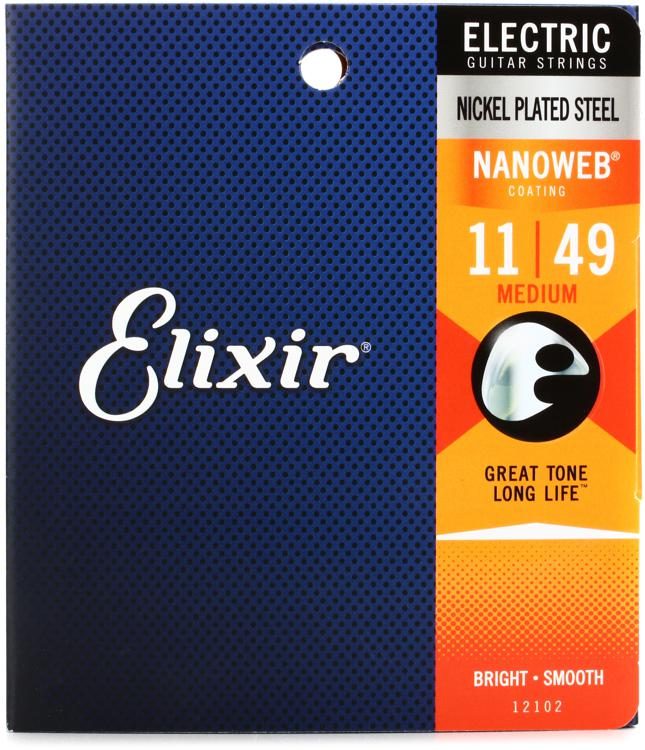
Summary: Smooth. That’s the one word I can describe these strings that applies to both sound and feel. Amazingly enough, even Elixir describes the feel as “smooth” on their website. They’re no making baseless claims. These feel and play as smooth as silk.

Pros: It’s a coated string, so it’s going to have a longer life by its very nature. Time will tell just how long. The sound and feel are dynamite, but its in the feel department where this string stands out.

Cons: None that I can think of other than these strings lose their brightness pretty quickly. So Elixir’s marketing that states these strings are bright, well, at least for me, that may just be initially. But for me that’s a good thing because I hate playing new strings.

Tone Bone Score:

I’m taking just a little off because I don’t quite agree with the tonal description from Elixir that these are bright strings. They become smooth-sounding pretty quick (I’ll talk about this more below). But as I mentioned above, that’s not necessarily a bad thing.

It’s Practically Impossible to Be Objective with a String Review…

…so I won’t attempt to be objective, though I’ll do my best…

The thing about strings is that my experience with them is incredibly binary. I either like them or I don’t. For me to like a string I need to give a thumbs-up in two departments: feel and sound. If I give a thumbs-up to both, then I like the string.

But ‘Dawg, your rating suggests a degree…

True. But the degree I apply in this case is an indication of how much I like the string – and I really like these strings! Yes, I took a quarter point off because my personal experience with the string is completely different from how Elixir markets the string. I don’t think they’re bright at all; maybe in the first few minutes. But once they stretch, their tone – at least to me – is very well-balanced, and they really come into their own after several uses.

But then, as they say, YMMV.

How They Feel

For me, I really dig these strings; especially how they feel with my Taylor T5z. Combined with the silky-smooth feel of the ebony fret board, the perfect action and jumbo frets, it’s like butter. And they’re 11s!

When I was evaluating the guitar at Guitar Center, I asked the very helpful sales guy what gauge the strings were. He knew the product and said that it was strung with 11s, but immediately added, “But they don’t feel like 11s.” I laughed at that remark because I totally agreed.

Apart from the functional characteristics of the T5z, the strings have a soft feel. I do start feeling the gauge when I’m trying to bend above a whole note, especially in the upper bout. But around the 12th fret, these strings bend like 10s.

So if you go for a lower-gauge string, you’re in for a treat with these!

How They Sound

Here’s where it gets really subjective. The T5z is a semi-hollow body electric guitar with a body sensor to give it acoustic guitar-like qualities. In other words, you really can’t hear how the strings perform until the guitar is plugged in. Yeah-yeah, people say it sounds good unplugged, but sorry, to me, that’s BS. It’s like saying an ES-335 sounds good unplugged.

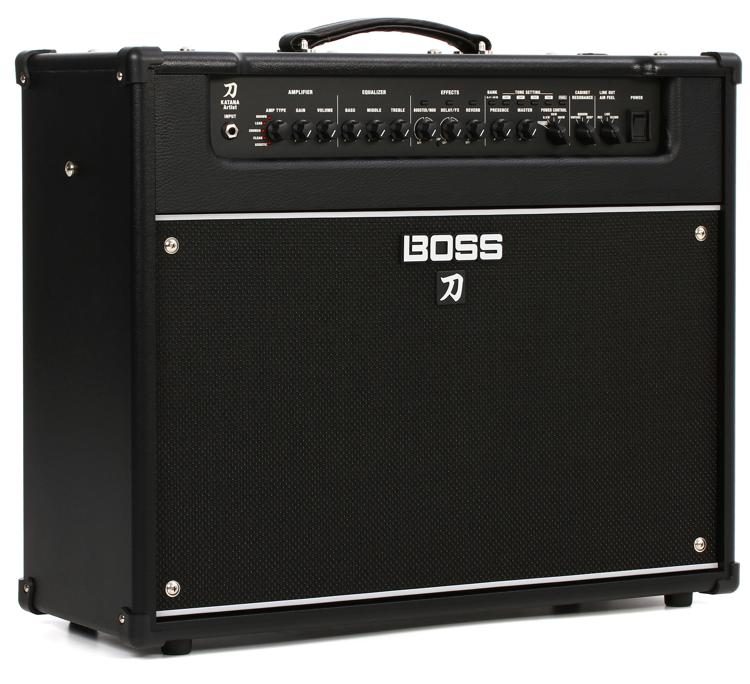
And then considering the amps I use with the T5z, it’s not a surprise why I feel their sound is balanced. I gig with the guitar using two different amps: An SR California Blond with a 15″ speaker, and my 100 Watt Boss Katana Artist. Both of these amps have big, round bottom-ends and the T5z sounds absolutely incredible through them.

On top of that, the T5z comes with independent bass and treble EQ knobs, so that affects the tone of the strings as well. Given that and the fact that I use fairly warm amps, my personal experience with the Nanoweb strings is that I perceive them as warm-sounding. Even my Les Paul which is strung with Ernie Ball Cobalt strings – which are super-bright – sounds full and rich when I’ve got the EQ balanced through the Katana that I have to bump the highs up. In other words, my signal chain makes the strings sound warm.

But in spite of that, my personal experience with the strings is that even with the rich sound of my amps, the strings get warm-sounding all on their own after several uses. That’s a GREAT thing for me because I prefer a smoother sound. But again… YMMV!

Overall Impression

I’ve already said it: I like these strings. And I will submit that I probably won’t play any other set on my T5z – at least until I go through the extra sets I bought. So it won’t happen any time soon because I bought a couple of extra sets. Plus, I just don’t go through strings that fast – never have.

To me, I feel Taylor tuned the T5z specifically for use with these strings, so I’d be hard-pressed to try anything new. But on their own, I think I may just try out a set on my Les Paul or maybe my Godin Artisan ST-V.

Read Full Post »

Look no further than Miles Davis’ Kind of Blue album released in 1959. I’m not even close to being a fan of jazz, but I could listen to that particular album over and over again. The reason for this is that the entire album was a study in modes.

In Kind of Blue, Miles Davis had his musicians play completely out of their comfort zone to push them to explore territories outside the conventional scale patterns, ultimately producing unexpected melodies that up to that point, no one had really heard.

The album is known for what is called modal jazz, which loosely means that the melodies fall out of the standard major and minor scales. I’m sure someone has taken the time to listen to the music and pick out the exact modes like, “Hey! There’s a mixolydian! There’s a dorian!” For me though, listening to that album as much as I have has helped me in trying out different things than the conventional.

Mind you, this isn’t meant to be an academic analysis and I’ll be the first to admit that I’m not a jazz player by any stretch of the imagination. But despite that, modal theory fascinates me. But for me as a learner, especially with music, I absorb information better if I have a context. Take the Dorian mode for example. If you asked me, “What’s D Dorian?” I’d intellectually know it as the second mode of the C major scale and its tonal center is D and it has a flat-3rd and a flat-7th.

Well, so what? It’s fine from an academic perspective and sure, I can drone a C, then play the D Dorian to hear it, but it’s not very musical. But on Davis’ Kind of Blue, you can hear it applied to the track entitled, So What. What those cats do with that mode is nothing short of incredible. Check it out…

Just listening to that puts the mode in perspective and clearly demonstrates what is tonally possible. I could never get that with just droning a note and playing a mode over it.

And that’s the point of this post. For me at least, no matter how many modes tutorials I’ve seen, it wasn’t until I actually heard them applied to a song that it clicked. What I wish some of these tutorials did was to have a section where they would apply a mode to an actual piece of music – maybe 32 bars or something like that. But instead they focus almost entirely on the note spelling.

That said, the academics are important. But I will submit that what we’re all trying to do is play music. And that goes way beyond academics.

P.S. Joe Satriani makes heavy use of Lydian mode in his music, so there’s another source to listen to how a particular mode is applied.

Read Full Post »

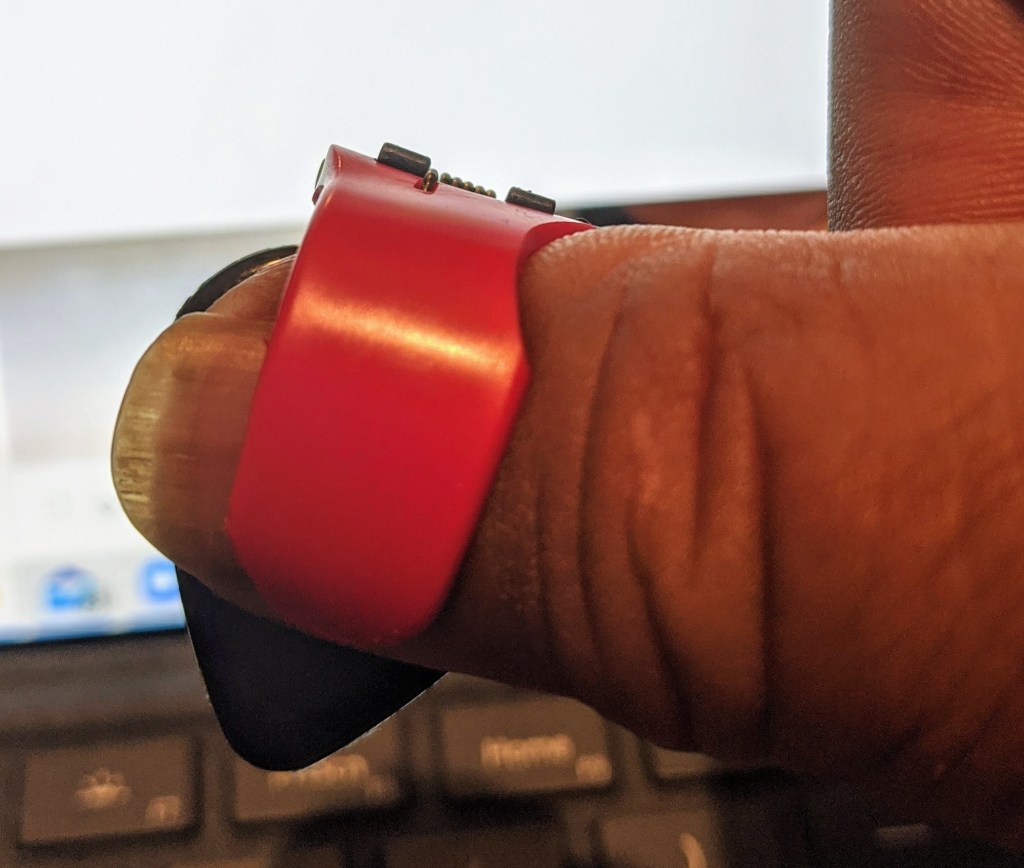
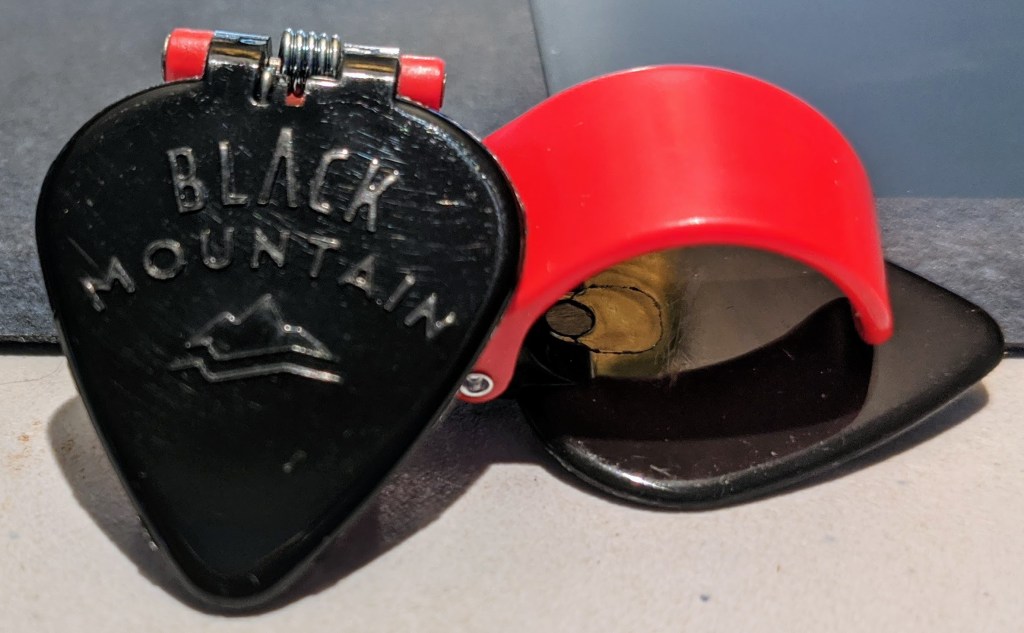
Summary: When I first saw ads about this, I thought: It’s just another thumb pick. But the spring-loaded “holster” changes the game, allowing you to move the pick to a comfortable position on your thumb – something traditional thumb picks can’t do. Plus, the pick is a regular guitar pick, so for flat pickers, it feels like you’re playing with a regular pick.

Pros: Nice, thick 1.5mm pick. For those that prefer thicker picks, you’ll feel right at home playing with this. As mentioned above, the spring-loaded “holster” allows you to move the pick to the most comfortable position on your thumb.

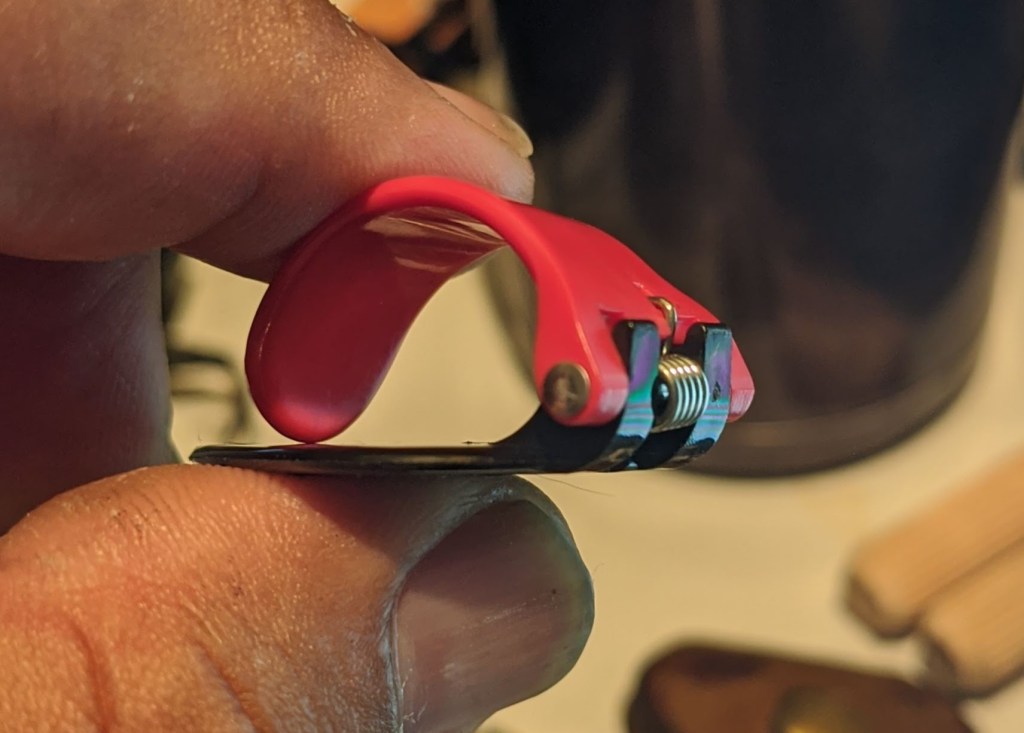
Cons: I can understand the design constraints in creating the hinge, but it would be nice to have the hinge be at a slight angle instead of perpendicular to the long side of the pick (see below).

That said, this is just a tiny issue and doesn’t take away from the pick’s usefulness. Perhaps in future versions, we’ll see righty and lefty thumb picks.

Price: 3 for $19.95, 7 for $49.95, and 12 for $74.95

Tone Bones:

Even with my little issue, this is a solid product. If you’ve avoided using a thumb pick in the past, this might be something worth checking out. I don’t give this rating lightly. I will be using this pick – a lot!

It shouldn’t work, but it does. I shouldn’t like it, but I do…

When I first saw a video of this pick on my Facebook news feed, I kind of rolled my eyes, thinking it was just some sort of gimmick. But the more I thought about it, the more it made sense to me because like many players, I’ve avoided using thumb picks.

One thing that really intrigued me was that I often switch back and forth between flat picking and fingerstyle within a song. And though I’ve become fairly adept at tucking my pick and holding it with my index finger when I want to switch to playing fingerstyle (kind of like Brian Setzer), when I was first learning to do it, I hated the fact that I’d lose the use of my index finger because it was holding the pick! With the Black Mountain Pick, I can strum along or play a solo, then immediately transition to playing fingerstyle without losing the use of my index finger.

But I think the thing that really did it for me was that the Black Mountain pick is shaped like a standard plectrum. I’ve never liked the shape of a regular thumb pick. That the Black Mountain pick is a standard, familiar shape makes it feel much more natural to me.

I’ve been playing around with it for last few days, and I’ve taken to it rather quickly. But I think a lot of that has to do with the fact that I’ve been playing fingerstyle and clawhammer for so long. So it wasn’t much of a stretch for me to start using the pick effectively. But if someone is new to fingerstyle playing, like learning any new technique, it’ll take time to learn and practice to become proficient, and let’s be clear: That lack of proficiency will not be due to the pick.

Fit and Finish

The pick is very well-made. As you can see from the picture, the hinge is fairly hefty. I was a bit concerned about this when I first inspected it, but it doesn’t get in the way at all. And it helps that the spring is fairly tight – this won’t fall off while you’re playing!

The plastic doesn’t feel cheap at all. I’ve gotten some evaluation picks in the past that felt like they were made from the same plastic that’s used for toy soldiers. Needless to say, I didn’t write a review about them. But this pick’s materials are solid.

One thing I did do with one of the picks that was sent to me was to use some fine-grain sand paper to smooth out the sharp edge of the pick. Some players like a sharper edge, but I personally prefer a rounder edge to my picks.

How It Sounds

Just like with any heavier gauge pick, it’s going to bring out the mid-range a bit more. Sanding down the edge for me dampened the highs a bit and put even more emphasis on the mid-range which, again, I prefer.

Plastic picks are notorious for making squeaking sounds sometimes, but since I’ve been playing with this pick, I haven’t experienced that at all. But I also attack the strings at an angle, so the chance of making a squeak is minimal.

Why Would You Want to Use a Thumb Pick?

For me, the only answer to that question is one word: Tone. If I want to brighten up my bass notes when playing fingerstyle, there’s really no better option. It could be argued that I could get a brighter sound with my thumbnail. Absolutely. But a nail is much softer than a pick – well, at least this particular pick – and while I could get a brighter sound with my nail, it’s not nearly as bright as with a thumb pick.

Here’s a quick demo I put together that demonstrates the tonal differences between using my thumbnail vs using the Black Mountain pick:

The tonal difference is pretty stark. And at least for that particular song, Toulouse Street by the Doobie Brothers, the Black Mountain pick is totally appropriate. But that said, while I mentioned that I’ll be using it a lot, it will depend on what kind of tone I want out of a song, so I won’t be using it full-time when playing fingerstyle. But I like the fact that I have another tool in my tonal arsenal that I can use for fingerstyle playing!

Overall Impression

Other than my little nit with the angle, what’s not to like? I kind of solved that by cutting and sanding a notch in the holster so I could rotate the pick a few degrees. I have to admit that I kind of felt like Ian Roussel from Full Custom Garage, but on a much smaller scale when I did that. But the result was that I could rotate the point of the pick forward which also meant that I could lift my palm a little higher off the strings, which brings my fingernails more into play. My right hand position tends more to the classical position rather than a country style which has a flatter positioning. So being able to lift my palm is important.

But as far as the actual pick is concerned, I love it! And like I said above, I’m happy to have yet another tool in my tonal arsenal!

In closing, I’ll just say this: This is not a gimmick. This is a good, solid product that can do the work of a flat pick as well as a thumb pick. For songs such as Something in the Way She Moves by James Taylor where there’s both strumming and picking, this is a great tool to have!

Read Full Post »

The Lockdown

My Gibson J-45 Avant Garde

With the lockdown, it has been such a great time to play guitar. But even before the lockdown, I’d normally play at least a half-hour a day. However, over the last several days, I’ve been putting in some serious time on my guitars, especially my Gibson J-45 Avant Garde acoustic.

One of the things I’ve been doing is recording videos to share on Facebook. Yesterday, I recorded a video with my daughters where we sang a song I wrote for church. This past Sunday, I recorded an old church song since I wasn’t able to play at Mass.

At the beginning of the lockdown, I purchased Carol Kaye’s Jazz Guitar book and CD. This ain’t no step-by-step manual. She just dives right in, assuming you already know what she’s talking about. Thank goodness I already knew my chords and note numbers!

The point to all this is that ever the optimist, playing my guitar and finding things to play has had an enormous positive impact on me during this lockdown.

Think about it: You go on social media and it’s nothing but talk from the shelter-in-place crusaders. It’s ads from news sources talking about the death toll (though they avoid discussions of comorbidities and percentages). It has been fear and panic. Then there are the anti- and pro-Trump factions at each other’s throats.

I certainly have my own views of this situation – and sorry, this isn’t the platform to share them – but in light of all of this, I’d rather play my guitars. Yeah, I share a lot of the stuff I produce, and frankly, it’s not meant to be a counterpoint to the Covid-19 hustle and bustle. My thought is just to do what I do, and let it loose. I couldn’t care less whether people watch it or comment on it.

For me at least, even though I’m working from home, it’s a perfect time to let my creative juices flow.

Read Full Post »

I love my BOSS Katana Artist. It has such a great sound. And on top of that, it’s incredibly versatile. I can use the Line Out and go directly into a board and keep my stage volume low. It has totally changed the way I approach live performance.

But there’s the rub. For live use, the Line Out is great, but I’ve discovered that for anything kind of dirty, it’s not so good. Or I should correct myself. It’s good enough for playing something dirty underneath the mix, but front and center, well… It’s a little lifeless.

I’ve had the amp for a while now and I only discovered this discrepancy this afternoon when I used the amp to record a track that required some overdrive. I was thinking that I could record silently and just tweak the sound like I always do. But for the life of me, I couldn’t get a good sound out of it, no matter what guitar I used.

I was a little nonplussed about this because I’ve used the amp on stage and my sound has been stellar through the PA. But into my audio interface? Eek!

I ended up just miking the cabinet, which is probably what should’ve done in the first place. Even at quiet volumes, the amp has a big sound. At one point, I looked down at the amp and it seemed to say to me, “Moron… You know I like to push SPLs.” Ha!

When I’ve performed, sure, the amp volume is not as loud as I’d normally have it when I don’t have good sound reinforcement. But I have to cut through the drums, so it has to push some air. And when it does push air, it’s magic.

For cleans, the Line Out works great, and I’ll continue to record clean guitar sounds with it. But there’s nothing that beats letting the amp breathe.

Read Full Post »