Feeds:
Posts
Comments

Archive for the ‘accessories’ Category

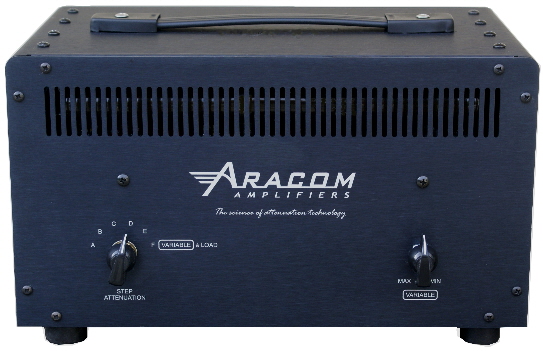
PRX-front-543Ever since I started this blog, I’ve talked about attenuators, and how they’ve enabled me to get tones out of my amp at reasonable volume levels that I could only previously get at super-high volumes. But before I get into the discussion part of this article, take a listen to this clip (it’s the same clip I recorded with my previous article on the Mullard ECC83):

Here are some details about the recording:

  • I plugged directly into my Aracom VRX22, which then fed into my Aracom PRX150-Pro, then out to a custom 1 X 12 with a Jensen P12N
  • The amp was in the drive channel with master at 6, volume (gain) at 6, and tone at 6 (the tone on this amp adds a little gain as well as an edge)
  • The PRX150-Pro was set at maximum attenuation
  • Volume-wise, this was talking conversation level!!!
  • No EQ was applied to the guitar – what you’re hearing is the raw tone.

With respect to “maximum attenuation,” I was in variable mode with the variable sweep pot all the way to its left extent. I shared my amp and PRX settings with Jeff Aragaki this morning, and he estimated that the output power was approximately 0.04 Watt!

Many people are apt to talk about how the speaker needs to move air, and that an attenuator doesn’t allow that to happen. But that clip simply demonstrates that with the right combination of equipment – and in my case, also a great set of tubes – you don’t necessarily need that speaker cone breakup to get great tone for recording purposes. Yes, SPL’s do play a big role in your overall tone, but to be able to achieve the kind of tone I was able to get at that very low volume level is nothing short of amazing!

So what about an attenuator being life-changing?

Maybe that’s a bit strong of a phrase, but ever since I’ve been using attenuators, and especially since I’ve gotten my Aracom PRX150-Pro, I’ve been able to explore tonal territory that I could previously only achieve using pedals – and only simulating at that! Take overdrive pedals for instance. If you’re a regular reader of this blog, you know I’m crazy about them. I probably will still be nuts about overdrive pedals, but there’s one thing an overdrive pedal can’t do that an attenuator allows me to do, and that’s to get the thick, natural overdrive tone of my amp. Don’t get me wrong, I still use them, but I use them now more for tonal accents to my drive tone rather than giving me my drive tone. That’s very profound; especially for an overdrive pedal freak like me!

Here’s a good example that I just recorded. This clip is part of a new song idea I’ve been playing around with. Setup is pretty much the same as above, but for the rhythm, I’m running Strat into my Kasha overdrive pedal to get a jangly, crisp tone. The lead is Goldie plugged straight into my VRX22. I did mix and do a simple master on the recording, but the guitars were all recorded raw, with no EQ. In my DAW, I added some reverb to both parts and a touch of delay to the lead, but that’s it.

Speaking of pedals, since I’ve started using a high-end attenuator (there are others such as Alex’s and the Faustine Phantom), I’ve actually started using pedals in general much less. I’ve really relying on the natural tone and sustain of my amp. For instance, I’ve found that I’ve only been using reverb in the studio. When I play out, I just don’t bother. In fact, for the last few weeks, I’ve only been taking two pedals to gigs with me: My BOSS TU-2 Tuner and my VRX22’s channel switcher. Same goes with my Reason Bambino.

Life-changing? Probably not, but definitely approach-changing. I may personally endorse the PRX150-Pro, but there are others out there. If you really want to hear what your amp has to offer when it’s fully cranked with the power tubes glowing, then you owe it to yourself to get a good attenuator!

Read Full Post »

Just put in a re-labeled 1960’s-era Mullard ECC83 into my Aracom VRX22 this afternoon. I had a JJ 12AX7 in there, and make no bones about it; that’s a great pre-amp tube. But the difference in tone between the two is immense. Where my JJ had a great tone, one thing that I noticed was that the highs tended to be rather harsh when the tube was overdrive, and I found myself turning my Tone knob left of center – a lot – to bleed off some of the highs.

But after I installed the Mullard, I was absolutely blown away! The overdrive seemed so much more focused, with zero high-end harshness. It was some of the smoothest overdrive I’ve heard, and definitely the smoothest the VRX22 has sounded since I got it. That’s saying quite a bit because I love the tone of this amp immensely, even without the NOS Mullard. Which brings me to the crux of this entry…

As a tube amp aficionado, I’ve gone through lots of pre-amp tubes, and almost invariably, I’ve gravitated towards NOS tubes to get the tone I like. Some people I’ve spoken to say it’s all hype but, at least to me, it’s not. I suppose for some types of tubes, there’s not much of a difference. For instance, I almost invariably use JJ’s for power tubes because they just sound great to me. They’re well-made, and run pretty hot, and they break up nicely.

But with respect to pre-amp tubes, I’ve found a marked difference between NOS and new tubes. I love Mullard and JAN Phillips tubes for pre-amp tubes. They’re just so smooth sounding, smoother than all the new make tubes I’ve played. Plus, they were made during a time when most electronic devices were run with tubes, so the build expertise, equipment and materials for making tubes was abundant. According to my friend Jeff Aragaki of Aracom Amps, the alloys used in NOS tubes are not as readily available nowadays, and that could account for the difference in tone. Not sure if this is true, but it certainly makes sense. The only drawback is the price. That Mullard sells for $129 retail, and that is by no means inexpensive.

But I look at buying NOS tubes very much like buying a great pair of shoes. For instance, I spend almost $200 a pair for my everyday shoes. These are absolutely comfortable, and not only that they last a long time because they’re constructed so well. In fact, it takes me about 4-5 years to really wear them out. This in contrast to lower priced shoes that I’ve worn out within a few months. After a long period of time, I’ll spend more on the cheap shoes. A better case is my father. His shoes cost at least $500. But they last almost 20 years! He just gets them resoled every few years until the shoe repair guy says that it’s not worth it.

NOS tubes are similar. I’ve had the same NOS tubes in my Hot Rod Deluxe for almost five years, and they still sound great! I play that amp a lot. On the other hand, the new Tung-Sol tubes I put in another amp lasted all of two months before they started to lose their character, with one becoming microphonic. Granted, they’re fairly inexpensive tubes and they sound great, but if I have to shell out $25 every couple of months, that starts to add up. NOS tubes, especially the mil-spec tubes that I prefer were made for military usage, which means they had to be well-built and durable. That’s a huge advantage NOS tubes have over newer tubes.

Jeff also shared a story with me today about a friend of his who used to be stationed on an aircraft carrier. He was telling Jeff that when the ship replaced electronic components, they’d dump boxes of tubes – good ones, mind you – over the side of the ship. So the ocean has NOS tubes littering its bottom.

In any case, please do not just take me at my word! πŸ™‚ This is simply my perception based upon my experience. In the end, as I am often apt to mention, you’re judge of what sounds pleasing to you. So only buy what makes sense to you!

Read Full Post »

5 Tone Bones - Gear has stellar performance, value, and quality. This is definitely top of the class, best of breed, and it's a no-brainer to add this to your gear lineup!stagetrix_riser StageTrix Pedal Risers

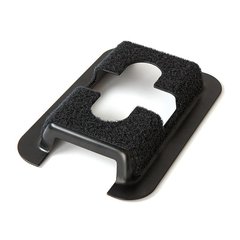
Summary: Definitely one of those “why didn’t I think of that” kinds of products. Elevates pedals 1 inch and makes reaching your back row easy. Routing allows you to keep your wires out of the way!

Pros: Very well made, with convenient fuzz to attach your Velcro’d pedals.

Cons: None.

Features:

  • Raises the second row of pedals to the perfect height.
  • Front, back and side openings enable effective cable routing.
  • Premium 18-gauge steel.
  • Attaches to board via heavy duty hook-and-loop fastener on base, which holds firm up to 200Β°F.
  • Designed to withstand temperatures of up to 200F without melting, so leaving your pedal board in your vehicle on a summer day won’t result in a gooey mess with all the Velcro peeling off.
  • Works with most pedalboards. To be sure, check that you have an extra 1″ of clearance when case is closed. The vast majority do.

Price: $16.99

Tone Bone Score: 5.0 – I dig these things. No, they don’t improve my tone nor technique, but they sure make it easier to tap dance on my pedal board!

This will most likely be a short review because this product doesn’t do much at all – that’s not a bad thing, either… It simply elevates your pedals. But as an accessory, since I’ve installed a set of four on my board, it has proven invaluable to me! In one fell swoop, the StageTrix Pedal Risers made the back row of my board instantly accessible AND cleaned up my cable runs! Where I used to have to run my cables along the sides if my pedals, I now run them underneath the risers because of their built-in routing. My board hasn’t looked this good – EVER!

Admittedly, I was a bit dubious about their ruggedness when I first discovered them. But once I got them, that opinion changed quickly. These risers are heavy and it’s obvious a lot of attention was paid to the details in their construction. They won’t bend, and that’s a testament to their construction. I even stood on one (I’m not a small man), and the pedal riser didn’t budge!

On top of that, the Pedal Risers are set up for immediate and easy use. The entire base is covered with velcro out of the box, and the top is covered with a thin fuzz for attaching your pedals. No assembly required! I hate to attach velcro tape to stuff. It’s a pain in the ass!

Once I got my board set up, I hooked it up to my amp and started tap-dancing. I immediately started smiling because for the first time, I didn’t have to put my foot in an awkward position to engage one of my pedals in my back row for fear of messing up the settings of a pedal on my front line – or heaven forbid, engaging a pedal that I didn’t want to engage. Nothing like doing a clean solo, clicking on my vibe and simultaneously engaging an overdrive. No doubt, it’s a little unsettling. But that won’t happen any longer. The StageTrix Pedal Risers completely eliminate that possibility!

Currently, they’re sold out, so you can’t get them directly from StageTrix Products at the moment. But they should soon make it to retail stores. Check their site often, as they often update it with news!

Read Full Post »

« Newer Posts