I was perusing The Gear Page this morning, and saw one of Anthony’s postings of the colors the Bambino comes in. CHECK IT OUT!!!
I have the blue tolex model shown at the bottom right. It is SO cool looking.
BTW, if you missed the sound clips, here they are again:
Clean fingerstyle in neck position of my Strat:
Clean, blues progression, with Strat in neck/middle position with just a minute amount of breakup:
All out, wide open with channels 1 and 2 dimed and StackMode volume at 3pm. I’m playing my Prestige Heritage Elite with ‘buckers in the bridge position:
This little amp has created quite a buzz on the forums, and at $699, it’s a deal. It has been so popular, that they haven’t been able to keep up with the demand, and that’s a good thing! To place an order or to get some information, contact the guys directly at info@reasonamps.com.
Did my weekly church gig this evening and took the Reason Bambino along. Didn’t bring a pedalboard; just a 1 X 12 cabinet and a couple of cables. I wanted to test out the amp in its pristine state, with no added accoutrements. I also wanted to test the balanced line out to see how it worked with the building’s PA.
I have to tell you, Obeid Kahn being a noted Strat guy, even though the Bambino sounds killer with a guitar with ‘buckers, this amp seems to just love a Strat. It really makes it come alive. Whether I played fingerstyle or funky, the Bambino really made my Strat sing. Well… nothing helps to inspire me to play better than great tone. Like I mentioned in my review, the tone of the 6AQ5 sits right between an EL-84 and a 6V6, and that tone seemed to bring out the best of my Strat. The cleans were classic Strat, and the drive, oh yeah, the overdrive was open and bright, and just floated in the air. I may have been in worship, but I was also in tone heaven!!!
As for the balanced line out, oh man! The tone coming through my church’s PA was great! We have a pretty nice PA system, and the tone, whether clean or dirty, didn’t sound any different than what was coming through my cab. That was a concern for me because I’ve played through amps with line outs that just didn’t sound like the amp. The Bambino’s line out is very transparent, and that’s especially important with this amp because it’ll give you plenty of volume to monitor your tone on stage, but the line out going into your PA will ensure that it’ll get out faithfully to the audience. Make no mistake. This amp may only have 8 Watts, but it has plenty of volume to be used as a stage amp. I suppose it’s another way to approach performance. Especially in a church setting where lower stage volume is critical, having the ability to keep your stage volume down but knowing that it’ll get out to your audience is just so awesome. The Bambino rocks in this department!
***Quick Update*** I just spoke with Anthony this morning and he nor Obeid didn’t anticipate the DI to be plugged directly into a PA, so he was pleasantly surprised to hear my application of it. Note that I went direct out and into my cab at the same time! This amp has versatility written all over it!
And if ever the 8 watts isn’t enough, the Bambino can be used as a reference amp to define your tone, and with the line out, you can re-amp into another amp or a power amp to boost your output power. I’ve tried this, and it works great. I can’t wait until I get to try this at a real gig!
So what’s the verdict? The Bambino rocks – plain and simple.
To get a Bambino…
I don’t think Anthony and Obeid anticipated the popularity of the Bambino, and the positive response has been enormous. If you’re interested in getting this $699 tone monster, contact the guys directly either through e-mail at info@reasonamps.com. They also hang out at the Gear Page (http://www.thegearpage.net/board). Search for “bambino” or find the users “Reason” or “OKahn” and send a private message. There will probably be a bit of a wait time to get the amp as it has create quite a buzz and they’re already getting orders. The amp is just out of prototype and review for goodness’ sake! It’s amazing!
What three word phrase begins with an “O” and ends with an exclamation mark (!)? You guessed it, OH MY GOD! That was my reaction when I first turned on the Reason Bambino I got for review today. For the unfamiliar, the Bambino is Reason’s brand-new entry into the sub-10 Watt amp market, and if this little monster doesn’t make a big splash, I’ll be very disappointed!
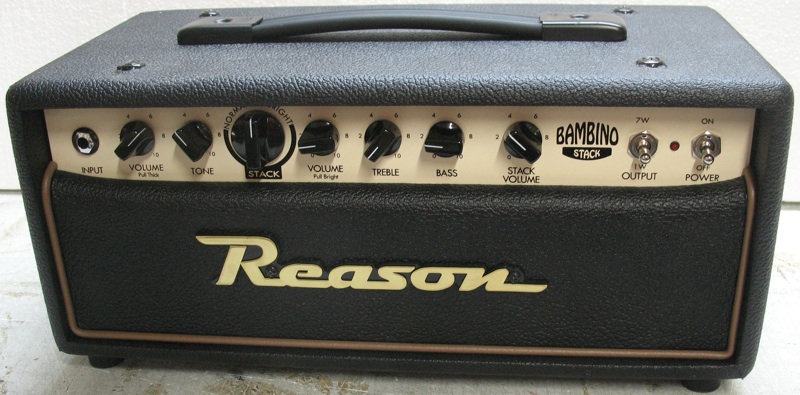
I won’t go in-depth into the features since I covered those in my recent pre-release announcement, but the Bambino is simply a miniaturized version of the Reason family of amps, sporting three modes: Normal, Bright, and Stack. Stack Mode ROCKS folks, as it runs the Normal and Bright channels in series, adds an extra gain stage, while retaining full EQ control over the individual channels. Can you say, “High Gain?” 🙂 The volume knob on Channel 1 is a push-pull fat booster, while the volume knob on Channel 2 is a treble booster to add top-end sparkle. And of course, the Bambino is powered by two 6AQ5 power tubes. But enough of the features…
I opened up the shipping box and pulled out the amp to find a Navy Blue Levant tolex-covered amp. I just smiled as that is the exact color of my Aracom Amps! Talk about matching a set (though I don’t get to keep this eval model)! I’ve been so excited to get this amp as I’ve known about it for months, and couldn’t say a word about it. So despite the fact that I just finished a 4-hour solo gig tonight, how could I not open it up and try it out!
So I checked the tubes to see if they got unseated during shipping (they were fine), hooked it up, plugged in my Strat, and being that it was 10:30pm, switched the amp to 1 Watt mode (it’s switchable between 7 Watts and 1 Watt). I put the amp in Stack Mode, cranked the two channel volumes, turned the amp on, and got the Stack Mode volume to a reasonable level; that is, loud enough to move a bit of air but soft enough so as not to wake the neighbors (my studio is in my garage).
I struck an A chord on the fifth fret, and almost jumped out of my shoes! I could not believe what I was hearing! As expected, like all Reason amps, the Bambino is brightly voiced. But the 6AQ5 has a sound all its own. The overdrive tone is sizzling, with a nice, open character, incredible touch-sensitivity and dynamics, but it’s amazingly smooth at the same time. I liken that type of overdrive to the way 6V6’s break up, but the Bambino with its 6AQ5’s has a tone that is wholly unique! I LOVE IT!!! I did a few legato runs, and tested out the sustain and feedback. All I can say is that I was totally blown away! And I got this tone running the amp at bedroom levels in ONE FREAKIN’ WATT MODE!!!
Now, before you go thinking that 1 Watt doesn’t seem like a lot. In amp vernacular, it’s not much at all. But from an audio perspective, a 1 Watt amp running through a 1 X 12 speaker is as loud as a jack-hammer! That’s where the Stack Mode Volume comes into play as it is a PPIMV (Post Phase Inverter Master Volume), which effectively controls the amount of signal going into the power amp. At the volume I was running at, I was probably down to 1/2 or maybe even a 1/4 Watt, and that was at about loud conversation level.
But the gain that I was getting in Stack Mode was plenty for my needs, and as a home studio recording amp, being able to get that kind of tone without needing an attenuator, is incredible! I do have to say, that if I really want to take advantage of the third gain stage, I’d have to run the amp through an attenuator. Even at 1 Watt, with Stack volume cranked, it’s very loud, and that’s a testament to Obeid Kahn’s genius with power management.
As far as cleans are concerned, from what I can perceive with my Strat, the tone sits between an EL-84 and a 6V6 clean tone. It’s not as glassy as an EL-84 clean, and not as rich as a 6V6 clean. But what I like is that the clean tone has a real nice three-dimensional quality about it. There’s nothing flat about the cleans this amp produces. Adding just a touch of reverb accentuates this quality. It’s pure ear candy. While I love high-gain, to me, the real test of the amp is how it sounds clean. From that perspective, the Bambino totally delivers!
It’s almost midnight, I’m incredibly exhausted, but I have to play a little more before I turn in. So, in summary, my first impression of this amp is that it KICKS F-IN ASS! I haven’t even begun to explore all its features like its balanced line out (can’t wait to re-amp this with my Aracom VRX22 or do direct recording). All I know is that this is one special amp, and one that I am definitely adding to my collection! It’s a no-brainer at $699 for a hand-wired, US-made amp. Like the Aracoms amps that I love so dearly, I’ll take this amp over any name brand boutique amp out there!
Here’s a hypothetical situation we’re all familiar with…
Imagine your wife or significant other walking into your music room or space recently…
“Honey,” she said, “You have a studio full of gear, and from where I’m standing, I can see six amplifiers. Just how many do you need?”
“Just one more,” was my facetious reply.
“C’mon! You can’t possibly play all of those amps at once,” she retorted with a slightly annoyed tone at my sarcasm.
“I know, but when I need a particular sound for a track I’m recording, I can pick out one of these little babies, and get the tone I need,” I said.
“Oh yeah? What about when you gig? You usually only bring one amp with you. So Mr. Picky Tones, if you’re so sensitive about your tone, why don’t you lug a few amps with you?” she said with a smirk.
“That’s why I have these pedals!”
At that she rolled her eyes, gave me a stern look and said, “You’re absolutely hopeless.”
I like to keep track of where my visitors come from, and I was surprised to see a YouTube URL that was a referrer to GuitarGear.org. Curious, I clicked on the link, and lo and behold was a video demo of the brand-new Reason Amps Bambino! Check it out!
The guy on the guitar is none other than Obeid Kahn, the designer of the amp, and absolutely SICK guitarist in his own right. That dude can make a Strat do just about anything! What chops!
I was noodling around the other day, and came up with a riff. The riff turned into a jam track, then the jam track turned into a full song. I’m still working on the song, but thought I’d post it for folks to give it a listen. Here it is:
Here’s what I used:
Rhythm Part: Clean Strat in Neck/Middle position. My Aracom VRX22 in the Clean channel, with the Master cranked and volume at halfway. Used a Red Bear Trading Tuff-Tone pick to get that percussive sound out of the chords.
Part 1 Solo: Strat in Neck Position into my MicroVibe and the same amp settings. Also, used the Tuff-Tone pick to get a more percussive attack to the notes.
Part 2 Solo: Strat in Bridge Position into MicroVibe. Amp was set on Channel 2 with the Master dimed and volume at 6 for some nice, but not over-the-top breakup. I love that 6V6 breakup! Here I used my V-Picks Psycho to smoothen out the attack and give the bright bridge pickup a bit of extra oomph.
Part 3 Solo: Strat in Neck position, nixed the Vibe, into the clean channel with Master and Volume fully dimed. Used the Psycho here as well, but used a percussive attack.
In order to get those kind of high power settings from the amp, I used a soon-to-be-released Aracom attenuator that’s like NOTHING I’ve played through before! This thing is completely transparent because it maintains reactance between the amp and speaker; something that a lot of attenuators have a problem with (please don’t get me started on the UA, which I think is the biggest bunch of hype I’ve ever run across as far as attenuators go).
Another word about the VRX22. When the Master is fully open, and the power tubes are getting lots of juice, this amp just oozes all sorts of tone. And as the rectifier circuit kicks in, this amp feels as if it has built in reverb! As you can tell, I love this amp! Check it out at: http://www.aracom-amps.com.
I know that you might think I’m a bit nutso for using different picks; obviously in a live situation I’d probably only use one. But the in the studio where I can do pretty much anything I want, using different picks to affect my tone is totally cool. Check out Tuff-Tone picks at http://www.redbeartrading.com and the Psycho pick at http://www.v-picks.com. I swear by these two brands, and while I don’t work for either of these companies, like the Aracom Amps, they’ll always be part of my “rig.”
Summary: Need a quick, portable way to get your guitar ideas down on track, with an incredibly easy-to-use USB interface for performing live through software models? Look no further. Amplitube Fender Studio will get you rocking in minutes!
Pros: The inclusion of Fender Studio SE, RiffWorks T4 and Amplitube X-Gear, provide you with a full-featured experience to develop and track your song ideas, and are well worth the price of admission!
9’/2,5m length cable with integrated audio interface
1/4” jack connector MONO IN
1/8” mini-jack Headphone STEREO OUT (suitable also for Amp/Powered Speaker OUT)
USB 1.0/2.0 connector
Activity LED
Volume UP/DOWN buttons
USB bus powered
16 bit A/D -D/A converter
44KHz/48KHz Sampling Frequency
Ultra-low latency ASIO and Core Audio Drivers
Hi-Z direct Guitar and Bass-IN (suitable for any instrument with line out also)
Price: $99.99 (street)
Tone Bone Score: 5.0. Being constantly on the go as I am it can get frustrating having to wait all day to get a riff or song idea down. With the Amplitube Fender Studio, I can quickly hook up my axe, switch on my laptop, and get an idea down before I lose it!
I’ve been getting some pretty cool gear and software from IK Multimedia as of late, and so far, I’ve been nothing short of impressed with what I’ve evaluated. I totally dug AmpliTube Fender, and the StealthPedal blew me away with its high-fidelity signal processing. So it was with great anticipation that I’d do a review of Amplitube Fender Studio with the StealthPlug. I wasn’t disappointed in the least!
Amplitube Fender Studio: Be Anywhere, Record Your Axe Anywhere
I received AmpliTube Fender Studio with the included StealthPlug a few days ago (it’s always nice to come home to find a delivery box), immediately opened the box, plugged the StealthPlug into the USB port of my laptop, plugged my headset into the StealthPlug, fired up AmpliTube X-Gear, chose an amp, and started to play. Just as I expected, the device worked as advertised; and also as I expected, it worked with practically no latency. I immediately thought, “Man, I could gig with this…” But I’m jumping ahead… As fortune would have it, I could only spend a few minutes playing as I had to leave, so I unhooked everything and placed the StealthPlug in the pocket of my gig bag.
This morning, I loaded up my axe into my car, wanting to practice a little at lunchtime, as my work has kept me from playing regularly for the last several days. As I was driving into work, just letting my mind wander as I traveled down the freeway, out of nowhere I got a song idea. I played it over in my head for a few minutes, then anguished a bit because like many song ideas I’ve had in the past, I would have to wait until I got home to get the idea tracked; more often than not, by the time I got home, I’d lose the idea. Then I remembered that I had put the StealthPlug in my gig bag!
I immediately exited at the next exit and found a good place to park. I jumped out of the car, with laptop in hand, opened up my rear hatch, pulled my axe and the StealthPlug out of my gig bag, hooked up to my laptop, opened up GarageBand, created a new track, and hit record. I had the song idea down in less than five minutes. Sorry, I’m still working on the song, so I don’t have a clip. But the point of this is that the StealthPlug enabled me to get my song idea down soon after I got the idea. It meant that the idea didn’t get relegated to another “one that got away.”
Performance
I needn’t go into any diatribe of the StealthPlug’s fit and finish nor how it sounds. How it sounds is based upon what amp and effect models you apply in your software. But here’s one thing I did notice, and it’s a huge thing: I could barely detect any latency at all while I played through the StealthPlug, even when recording in GarageBand, which can be a real resource pig. That kind of instantaneous response is absolutely to die for! I suppose the near-zero latency of the StealthPlug probably has a lot to do with the simplicity of the signal route. It’s a USB cable, for goodness’ sake! But that bodes well for using the StealthPlug in a live situation. I’ve often wanted to use my computer in a live situation using nothing but software models for amps; especially in my church gig where controlling output volume is essential. The only thing that has kept me from doing this is latency. Even tiny amounts of latency can throw you off while you’re playing. But with the StealthPlug’s near-zero latency, I think I’m going to have to give it a go.
Funny thing, I perused the web for other reviews, and all seemed to have a much more tepid response to this wonderful piece of gear; especially with respect to latency. Mind you, I have 4 GB RAM in my Mac, so that probably has a lot to do with my lack of latency, since the computer rarely has to go to the hard drive once things are loaded.
Another thing I tried with the StealthPlug was running it from my pedal board, to see how it would react, and see how the amp models I have on my laptop would react. After tweaking some levels, I was amazed at how well it worked! Admittedly, the tone produced seemed a little thin in the highs, but a little EQ to boost the highs remedied that right quick. But there are other ways to employ the StealthPlug. Here a few ways you can use it.
Amplitube Fender Studio: It Simply KICKS ASS!
So I’ve established that I dig the StealthPlug… On a standalone basis, I’d give it a 5.0 Tone Bone score by itself because of the effect it had on my songwriting, but used within the context of the included Fender Studio software well, the whole package gets a 5.0! And it’s due to a little software package called Riffworks T4 that’s included with Fender Studio. I had heard of Riffworks by following Todd Rundgren who recorded his latest “Arena” album using the full version of this software.
Basically, Riffworks, as the name implies, is a software where you can create layered riff loops. Unlike programs like GarageBand or Ableton or the like, you construct songs in Riffworks by linking together riff loops that you can create. I won’t go into a lot of detail about it here, but I will say that it makes songwriting very very easy. For those of you familiar with digital recording, riffs are built using a “loop recording” methodology; that is, a phrase is played over and over again with a new “layer” added with each iteration of the loop. It’Add to the fact that Fender Studio and X-Gear or whatever amp plug-in you have on your computer is readily available in the software, and creating music is absolute freakin’ breeze. Here’s a clip that I recorded just a few minutes ago using Riffworks with Fender Studio:
For the rhythm part, I used ’59 Bassman model, then applied a Riffworks Filter and Shaper to it to give it that “vibey” sound. For the lead, I used driven ’57 Deluxe model. But for this, I ran my guitar into my pedalboard first, then into the StealthPlug. I only used a single pedal, and that’s my beloved Tone Freak Effects Abunai 2 to add some slightly compressed and sustaining overdrive to the signal. The result was magnificent!
Once I was done with recording in RiffWorks, I outputted the clip to a WAV file, then imported it into GarageBand, so I could add a bassline. If I had a bass handy, I could’ve done everything in RiffWorks, but alas, I can only use MIDI for now. But here’s the cool thing: The StealthPlug was my only audio interface into my computer! How incredible is that? And I just had my headphone attached to the StealthPlug, and it all worked amazingly well. Talk about having a portable studio! All I need is a couple of guitars, the StealthPlug and my laptop! Save the guitars, all I need will fit into my laptop bag. Granted, I wouldn’t have access to my pedalboard if I was on the road, but adding effect plug-ins to Amplitube if I need them is not a problem.
Overall Impressions
Amazingly enough, response to the StealthPlug has been just okay… Not sure what that’s all about. But for me, I have a recording solution wherever I go. I don’t need to bring amps, just my laptop and a couple of guitars when I want to get away for a remote songwriting adventure. And RiffWorks plus Amplitube gives me everything I need!
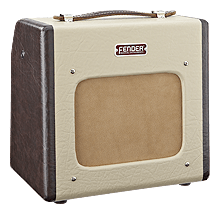
As much as I have been ranting about Fender gear pricing as of late, and their latest “supposed” price drop (who knows for how long), my Champ 600 has been a tried and true companion in my studio ever since I got it. I’ve even used it at small venue gigs hooked to a 1 X12 cab, and it has performed wonderfully! This is a great amp!
Folks, this is phenomenal! While diminutive in size, this amp packs tone! You want classic Fender tone at a lower volume for home recording or just futzing around, this is the amp to get! And because it’s a low wattage amp, you can push it and not worry that your eardrums will start to bleed.
For my own purposes, this has been one of most pedal-friendly amps I’ve ever owned, so I retubed it with a NOS JAN-Philips 12AT7 and a JJ 6V6 to get maximum clean headroom out of the amp. Now, I have to open up the amp full to get even mild breakup. But that’s why I have my OD pedals. My thought behind this is that I want to get as pure character out of my OD’s as possible, so playing through a really clean amp will accomplish that.
So what’s the point of all this? As I mentioned above, this is a GREAT amp, and at $149, it’s a steal. Go get one at GC today!
Here’s a sample I recorded with the amp hooked up to my 1 X 12 extension cab:
Disclaimer: I’m not in any affiliate program with GC, so I get nothing out of announcing this. 🙂
I’ve had a love/hate relationship with Fender over the years. When I’ve loved Fender, I’ve really loved them, and when I’ve hated them, I’ve really hated them. Right now, I’m really hating them. I’m just aghast at the prices they’re charging for their new gear! This Champ ’57 Reissue from the Fender Custom Shop lists at $1295 with a street price of $999! This for a 5 Watt amp with a diminutive 8″ speaker.
Make no mistake: The parts for this cost less than $400! This pricing is absolutely outrageous. Yeah, I’m familiar with its history, blah, blah, blah. And even though I’m no electronics dude, and couldn’t possibly construct an amp myself, I know a few manufacturers who build hand-wired amps with more power and GREAT sound for even less!
Take for instance, the Aracom VRX22. This is a hand-wired, 22 Watt amp that simply kicks freakin’ ass, and the head sells for $895! Then, there’s the upcoming release of the Reason Bambino. This is an 8 Watt amp that will sport that distinctive Reason sound. This head costs $699! It’s my next amp.
I’m sorry folks, this is the same issue that I had with the Fender Roadworn series of guitars. I’m not really in to reliced guitars, but there’s no way I could justify paying $999 for a freakin’ MIM guitar, especially when I paid less than $400 a couple of years back for my MIM Strat.
MAYBE Fender’s production costs are much higher than the smaller run manufacturers (not likely), which is how they justify the price-point for this amp. But this amp is nothing special from my point of view, and as I mentioned above, the parts for this cost less than $400. Lots of people have built 5F1-based amps. Look at the Valve Train Amps Concord. This is a 6 Watt point-to-point, hand-wired combo with a 10″ speaker. It sells for less than $500.
Go ahead, you can argue all you want about the classic sound and history of the Fender ’57 Champ reissue. But to me, Fender’s just again trying to trade on nostalgia. If that’s what floats your boat, more power to you – and mind you – I’m not questioning the quality or the tone of this classic. It has done much to contribute to the sounds of rock and roll. I just want to make it very clear that there are clear alternatives out there that may not have the name but undoubtedly have great tone, and watt-for-watt, and dollar-for-dollar have A LOT more value.
Note that I have the Champ 600 and it is one of my all-time favorite amps. But it has limited usability outside of my home studio. And that’s another thing that bugs me about the ’57 re-issue. It’s a hefty price to pay for an amp that would see limited if any use outside of my studio.
Like I said, if this floats your boat, and the price of this classic reissue, more power to you. For me, I demand a lot more value for the money I pay.
Recent Update
I’m still not sold on this amp, even though I have indeed played it, and it has some real vintage mojo. The sounds it produces are fantastic, but I still can’t justify buying it for the price Fender wants for it. Besides, I’ve seen some late-50’s originals that sell for the same price on EBay! I would buy one of those before I’d buy the re-issue.
What’s handmade, black and gold, and has the potential to catapult you into tonal heaven without breaking the bank and more importantly busting your eardrums? Simple: The soon-to-be-released Reason Amps Bambino! This article is the first news glimpse of this brand-new 7 Watt amp from the Reason guys that has all the tonal goodness you expect from a Reason amp but at volume level that won’t make your ears bleed, and almost as importantly, is easily within the financial reach of most cash-strapped gear sluts.
When I first reviewed the Reason SM25 and the Reason SM40, I knew that what I was hearing was something special. These amps weren’t clone designs, and didn’t sound like anything that I had played before. Yes, they were based on classic 6V6 and EL84 power tubes, but the thing with those amps was that the power handling was magic, and either of these amps sounded way louder than you would expect with low to medium wattage amplifiers. Make no bones about it, what Obeid Kahn has figured out in the power transformer section of his amps is totally proprietary and SICK! Even as well as I’ve gotten to know Anthony and Obeid, that’s a subject they hold close to their chests.
So imagine my excitement when they shared with me several months ago that they were coming out with a brand-new low wattage amp. I wasn’t allowed to say anything about it at the time because Obeid was still working out the design, and hadn’t decided on the power tube he was going to use. All they would tell me was that it would be a sub-$700 amp that would have all the tonal goodness you’d expect from a Reason amplifier. Yeah, really definitive… ☺
But as luck would have it, I happened to give the Reason guys a call to see how they were doing, and much to my extreme pleasure, Anthony mentioned that they were almost ready to release the new amp, and that they were calling it the Bambino. After Anthony described the amp’s features, I started salivating. I LOVE LOW-WATTAGE AMPS! And this amp’s features totally kick the shit out of a lot of the low-wattage amps on the market, boutique and production alike. So let’s go over the features, shall we?
Reason Bambino Specs
Preamp Tubes: Three 12AX7’s
Power Tubes : Two 6AQ5’s in a push-pull configuration.
Output Power: 7 Watts, switchable to 1 Watt
Channels:
Normal – British cleans to Vox-like top-end. Includes a “thick” setting via pull-switch to get thick “Beano-like” grind.
Bright – Very American, SoCal type of bright and scooped tone, with smooth overdrive when pushed. Bass knob scoops the mids when you dime it, and the pull switch will add extra shimmer to the top end.
StackModeTM – As with all amps in the Reason Amps family, the Bambino also sports StackMode, which runs Channel 1 into Channel 2 plus an extra gain stage in a series. Want to get over-the-top grind? StackMode is it!
Sounds basic enough, but wait! There’s more!
Built-in Speaker Load Box Simulated Line Output with Level Control – The line output is not just another line output. It starts with a fully inductive speaker impedance simulator, which then goes onto a complex frequency shaping network that simulates the sound of a classic 2×12 speaker cabinet. The fully balanced TRS ¼” connection allows for connection to any recording devices or slave amplifiers. Can you say “re-amp” anyone? ☺ You can also use this output to perform true silent recording. Of course, nothing beats a speaker moving air, but when you need a straight guitar sound to record, now you have it.
Separate Headphone Output – Want to practice and not wake up the significant other? No problem, mahn!
If you’ve followed this blog for awhile, you know how much I love Reason Amps! They don’t pay me anything for telling their story – all you have to do is play a Reason Amp and you’ll be hooked! And at the price-point that the Bambino is coming in at, there is NO reason (excuse the pun) that you shouldn’t seriously consider this amp when it’s ready for shipping!
Not Your Daddy’s Oldsmobile
It would be so easy to dismiss this amp as yet another boutique amp. But you’d be wrong. One of the reasons I dig Reason amps so much is because they have a sound all their own. It’s also the reason I dig Aracom Amps so much. Manufacturers like these don’t settle for making copies of classic designs. They’re true innovators, taking the classic designs, improving on them, and adding their own special touches. The net result is that you get amps that have tones that are uniquely theirs.
And on top of that, Obeid Kahn is one of the leading amp designers around, the meticulous care and innovative spirit he has put into his designs is evident in the amps he has produced over the years, and with Reason Amps, that skill and innovation are at their paramount. These amps are special!




 As much as I have been ranting about Fender gear pricing as of late, and their latest “supposed” price drop (who knows for how long), my Champ 600 has been a tried and true companion in my studio ever since I got it. I’ve even used it at small venue gigs hooked to a 1 X12 cab, and it has performed wonderfully! This is a great amp!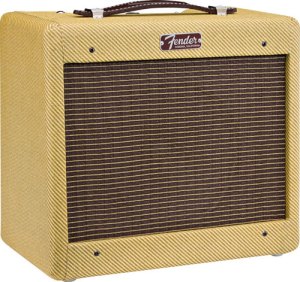
 Guitar Gear