Feeds:
Posts
Comments

Archive for the ‘buying gear’ Category

4 Tone Bones - Excellent gear, that exceeds expectations of its performance, value, and quality. Strongly consider purchasing this. Fender® Champion 600

Price: $149 (street)

Summary: Great tone can come in small packages, and the Fender Champ is a great example of this. Simple and straight-forward, it’s easy to use, and even easier on the pocketbook. Not really meant to be used as something you’d gig with (though you could easily add an extension cabinet), it’s a great amp for practicing and for the home studio recording artist looking for a low-wattage solution.

Pros: Vintage looks and great sound and quality for a small price.

Cons: You sacrifice a bit of low-end for the diminutive size.

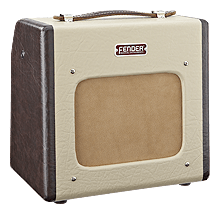
Fender Champion 600 Re-issue

Recording in a home studio presents various challenges to the DIY recording artist. But no other challenge is greater than controlling the output volume of amps, especially if you want to push them into breakup. To get even a small amount of breakup, you’ve got to increase gain to push the pre-amp and/or power tubes; and invariably, this is accompanied by a boost in output volume. There are various ways to deal with this from creating amp enclosures to using attenuators or even installing tube adapters to use lower wattage output tubes, and they all work reasonably well. Another approach is to simply get a smaller wattage amp in the 5 – 15 Watt category. Most have much smaller speakers than their larger counterparts, so their output volume is naturally lower, plus with the smaller wattage, it’s easier to overdrive them at lower volumes, thus producing breakup without shaking tiles loose.

Among the 5 Watt amps available, the two seemingly most-popular amps are the Fender® Champion 600 and the Epiphone Valve Junior Combo. I recently had the chance to try out the Champ.

Vintage Roots, Great Sound: Bargain Price

First of all, let’s be real honest: The Champ is a $200 amp, sporting a single volume knob and a standby switch. That’s it. This is not an amp that you compare to a boutique amp in any respect, so don’t try to compare it to something like a Carr mini-Mercury – they’re in two completely different classes! A re-issue of the original 1950 Fender Champion, it employs modern mass-production techniques as opposed to the hand-wired, point-to-point construction from which most boutique amps are built. But for what you pay for this amp, and for the quality of sound that it produces, you just can’t go wrong. Bear in mind that the Champ is a no-frills amp whose sole purpose in life is to amplify the natural sound of your guitar. It’s not meant for gigging with a full band. On the other hand, it creates really nice tone (albeit with a little loss of the bottom-end). As long as you don’t try think of this amp as any more than what it is, it’ll make you pretty happy.

Looks

This is a very retro-looking amp, with the original two-tone brown on beige tolex design. It actually looks like a mini television! and the leather handle is a real nice touch – though I’d be careful not to strain the handle too much… It’s a little weird to see a single volume knob, but that just tells you that this is a no-frills amp, as I mentioned before.

Sound Quality

I’ve already mentioned that the Champ produces really nice tone, and even though I missed the bottom-end that you’d get with a larger speaker, the quality of the sound that it does produce is stellar. Besides, in a recording application, you can always tweak the bottom-end a bit with EQ, but I digress. I tested the Champ out with a G & L Comanche, a Strat, and a Les Paul Standard. As expected, the amp reacted very differently with each of the different guitars, but surprisingly, it retained the character of each guitar, which I thought might be lost because of its diminutive size. The Strat played clean and smooth, and position 4 (center/bridge) was twangy and ringy as expected. What surprised me even more was with the Strat, I couldn’t get the amp to break-up until I cranked the volume past 9 (it goes up to 12). There’s lots and lots of clean headroom with single coils, so if you want to get break-up, you’d be best served using an overdrive pedal of sorts.

It was far easier to get amp to break up with the Comanche and Les Paul, as expected. It was a bit more difficult with the Comanche as it uses the hybrid Z-coil pickups, but it was still easier to get breakup than with he Strat. The LP broke up nicely with volume at about halfway, and the volume knobs pegged.

From a distortion standpoint, the Champ produces distortion similar to a Fender Deluxe. It’s not creamy smooth, but it’s also not too gritty – though it does get really ugly at high volumes – probably due to speaker distortion, which is never nice. But dialed in just right, the Champ produces really subtle breakup which is very ringy and pleasant.

Being that you can’t really do much tone shaping with the amp itself, it’s up to you to throw whatever boxes you need to achieve the tone you’re after. But that shouldn’t be too much of a problem for most folks. Besides, in lots of cases, you may not want to put any boxes in your signal chain before this amp. Here’s a decent-sounding YouTube video that demonstrates how the Champ sounds. I think you’ll be surprised:

Value

For the money, it’s hard to go wrong with the Fender Champion 600. A cheaper alternative would be the Epiphone Valve Junior which costs only $129.00 for the head. I’ll be writing a review for that as well in the very near future, but if you’re looking for that nice, Fender clean tone in a low-wattage application, but don’t want to shell out several hundred dollars for even a small deluxe, the Champ is a great way to go!

Update: As you can see at the top, the price listed is $149. Fender dropped the price after I wrote the article. Of course, I paid the original $200+ for the damn amp, but there you have it…


Read Full Post »

After I wrote my last review on the DigiTech Bad Monkey, I realized that I needed to change the format of my reviews, so readers could get an at-a-glance impression of the review, and choose to read the full review. As a professional web developer, “stickiness” is always a big issue, and especially with reviews, some people just don’t want to take time to read a full review. But studies have shown that if they’re intrigued by some quick summary information, they’ll read on. So, starting now, all the reviews on GuitarGear.org will start out with a 1-5 rating called “Tone Bones,” plus a quick summary of the review. Here are the descriptions for each rating:

5 Tone Bones Gear has stellar performance, value, and quality. This is definitely top of the class, best of breed, and it’s a no-brainer to add this to your gear lineup!
4 Tone Bones Excellent gear, that exceeds expectations of its performance, value, and quality. Strongly consider purchasing this.
3 Tone Bones Satisfactory performance, value, and quality, and meets most expectations, but doesn’t have many standout features or qualities.
2 Tone Bones Sub-par performance, value, or quality. Gear may have some standout features, but they’re outweighed by negative qualities, or the application of this gear is so narrow that you’d only use it in very rare circumstances. Take a lot of time to evaluate whether or not you want this gear! Caveat emptor!
1 Tone Bone Poor performance, value, and/or quality. Don’t even consider getting this!

Mind you, any rating system is going to be subjective, but I try to be as fair as possible, and for the most part, a lot of the gear I review I test in real-life situations. As I said above, what I want to accomplish with the rating system is to provide an at-a-glance summary of what I think of the gear in question!

Now on to reviewing!

GoofyDawg

Read Full Post »

GAS Comic

CHECK OUT THE AUTOMATED G.A.S. EVALUATOR I BUILT AFTER YOU READ THE ARTICLE!!!Every tone freak goes through phases of GAS; that is, Guitar (or Gear) Acquisition Syndrome. You hear a sound or lick, or you have a sonic vision of a tone you want to produce, and you’re suddenly overcome with an urge to go and buy that piece of gear that will satisfy your craving. If you’ve been playing for a number of years like I have, you probably have a garage full of gear that you don’t use any longer. You see, the worst thing about GAS is that it never goes away because over time, your playing style and gear needs change. It’s unavoidable. Another fallout of GAS, is that it’s a very impulsive behavior. You might be completely satisfied with your current rig, but something sparks in your brain, and BAM! You’re ordering new gear online or going down to your local music equipment store.So the question is: Is there away to control GAS? Sure. The obvious “controllers” are easy to identify:

  • You don’t have the money – that’s a great control.
  • Your partner won’t let you – I get this all the time, but I have my own “gig-money” bank account that she’s not allowed to touch, and since it gets depleted, I usually end up at point 1 anyway. 🙂

Those are certainly practical ways for controlling GAS, but they operate only on the physical plane. What about the psychological plane? After all, GAS is an impulsive behavior. For that, I’ve developed a series of questions that I ask myself before I press the “Order Now” button, or bid on an eBay item. They’re tough questions that require a lot of thought, but they definitely help to bring me back to earth, as it were; and I’ve avoided a lot of what turned out to be unnecessary purchases. Here they are:

  1. Does this gear solve a real issue right now, or is this something I just want to try out? Solution = +1, Experiment = -1
  2. Am I playing anything right now that requires this piece of gear? If yes give yourself a +1. If no, give yourself a -1
  3. Have I really taken the time to research and evaluate this product and make comparisons to competing products to determine if it’s a right fit for me to integrate into my overall tone? If yes, give yourself a +1; otherwise a -1.
  4. Now be honest: Do I really have the skill to use this gear effectively? Yes = +1, No = -1
  5. If I don’t have the skill, but have answered positively to the previous questions, do I really have the time to put into getting to a level of expertise with this where I can perform in front of people? Yes = +1, No = -1
  6. Am I trying to sound like somebody else with this? No = +1, Yes = -1
  7. Again, be honest: Will this gear truly expand my tonal palette? Yes =+1, No = -1
  8. Will this purchase have a significant impact on my available funds? No = +1, Yes = -1
  9. Finally, do I want pay for this with credit or cash? Cash = +1, Credit = -1, I can afford the monthly payment = 0

Now add up the pluses and minuses. You’ll either get a positive or negative value because there are an odd number of questions. With anything on the minus side, even if it’s a -1, I don’t buy the gear. But that’s just the discipline I’ve placed on myself. For positive values, I will only buy the gear if I score a 6 or 7, and it usually has to be a 7 because I have limited funds. Again, that’s just personal discipline. With respect to the last question, it doesn’t factor (gets a 0) if I’m willing to afford the monthly payment. But my personal philosophy is to only pay for my gear if I have the cash to pay for it.Ultimately, controlling GAS is about personal discipline; having the discipline to not react to our natural proclivity to be impulsive. With this series of questions, I’m not trying to cure GAS at all. In fact, I embrace the fact that we all get GAS. But after purchasing thousand of dollars worth of gear over the years, I’ve come to realize that I’ve got to have some discipline, and take some time to give my purchases a thought, so I can take action based on information, not emotion. That action can either be purchasing the gear or passing on it. I’ve passed on a lot of gear using these questions.Now here’s a sample evaluation for my latest purchase of a pair of THD Yellow Jacket tube adapters:

  1. Yes, this solves a real problem for me in that I need to get into breakup at a lower volume. As it stands, I’ve got to crank up my gain to get a smooth overdrive from my amp, which means a huge jump in volume. Reducing my output to 5W will allow me to do this at a much lower volume.
  2. Absolutely, at all my gigs.
  3. It doesn’t necessarily add to my overall tone as it helps me achieve the tone I want, but at a lower volume.
  4. n/a in this case
  5. n/a in this case
  6. Nope – just a quieter ME. 🙂
  7. This will expand my tonal palette because I can do the hard-driving stuff without having the rafters crash down from the ceiling. This is especially applicable at Church and in my home studio. With recording, I have to wait until the weekend to drive my amp hard.
  8. Little impact. At $100 bucks, we’re good.
  9. Cash for sure. I’ll pay for it with my debit card.

Admittedly, you can probably reason anything away, and I used a fairly simple purchase. But I’ve applied this “reasoning” to my desire to purchase a Les Paul Double Cutaway or a PRS DGT (as of late). In both cases, I scored a -6! No way am I going to buy either of these any time soon.So there you have it: Not a cure for GAS, but definitely a sane and reasonable way to control it.

Read Full Post »

For several years I’ve had a love/hate relationship with E-Bay. I’d gotten burned a few times by dishonest people, so I stayed away from buying really expensive things, save some trinkets that I’d get for the wife. But being a tone freak, and a gigging musician, I’m always in need of gear, either to replace worn out stuff, or add to my tone. As you know, gear ain’t cheap if you buy it retail. But there are some great deals to be had if you look for them, and you have a bit of trust. The trust part was tough for me, especially with EBay, as I’ve had some really bad experiences. But the need for gear has outweighed my reluctance of late, so I’ve decided to go back to using EBay as a way to get new gear.

This year, I’ve bought three things off of E-Bay sellers:

  1. Dr. Z AirBrake Power Attenuator. Retail: $329. I got it for $150
  2. Maxon CP9 Pro+ Compressor/Limiter. Retail: $230-$250. I got it for $150
  3. BOSS TU-2 Tuner. Retail $139/Street $99-$129. I got it for $70.

All in all, I’ve saved around $300 bucks on gear by going this route! I’ve been totally satisfied. But I was also pretty careful about how I went about the purchases. Here are some tips to make sure your purchases are safe.

  • Research the seller as much as you can – don’t make the mistake of ignoring the ratings other people give, especially the negatives. Sellers may have a 98-99% positive rating, but read through the negatives, because some negatives are REALLY bad. If a seller has even a couple of these, and especially if they have not responded to the negative feedback, I don’t even bother dealing with them.
  • Buy only “mint” and “excellent” condition products.
  • I’m reluctant to buy things that don’t have a picture of them taken by the seller – especially guitar equipment. Buyer beware!
  • Don’t be afraid to contact the seller and ask questions about the product they’re selling, and pay close attention to how quickly they respond. I usually give sellers a full day to respond. But if they take more time than that, and don’t have an explanation, then I’m usually reluctant to deal with them. Here, I’m thinking ahead. If I win the sale, how long will it take them to process the order? If they don’t keep on top of their messages, then how will they keep on top of their sales?
  • Power Sellers are usually the safest, but they’re not necessarily the cheapest. Again, look at the ratings and reviews.
  • If you’ve won an auction, don’t hesitate to give the seller a call to settle up and confirm the payment and shipping terms. I’ve saved a lot of time by doing this, and it also puts a voice to the name. It also sends a subtle signal – “I know who you are, and I know how to contact you.” I know that that may sound a little devious, but the way I figure it, I’m spending money, and I want my investment protected.
  • Don’t get caught up on the bidding process! Set a maximum that you will spend, and don’t go over it. Period. With the BOSS TU-2 I won, my limit was $75, and I got it for $70. That’s almost 50% off retail, and not as good as a deal with mail-order, but it still beats the mail-order price with shipping. To set my limits, I check prices on the item my local retailers, then set my limit at 40% off of the lowest local price. This usually means I’ll save 25%+ off mail-order. If my winning bid comes in even lower, then I’ve really gotten a deal. With my CP9 Pro+, the cheapest I could find it locally was $225, and mail-order was even higher at $232. My winning bid of $150 made it a steal! Plus I got free shipping because I won the TU-2 from the same seller, and he shipped both of them in the same box!
  • Finally, be mindful of shipping costs. Some sellers of sub-$50 stuff tack on outrageous shipping costs. For instance, I want to buy a small powered pedal board. Several list the item at $38.99, but add $15-$19 worth of shipping! Another seller is selling it for $49.50 with free shipping. It’s a much better deal!

So, be smart, be safe, and you’ll get great deals on gear on EBay.

Craigslist is another place I look, but I’m even more wary there because there’s no way to research the sellers. So I tend to look at local people where I can just pick up the gear directly from them, and save on shipping – and time.

Read Full Post »

« Newer Posts