Feeds:
Posts
Comments

Archive for the ‘Effects’ Category

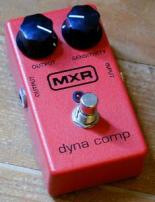
379_image_med_mxr-dynacomp.jpgI’ve been searching for a decent compression/sustainer for a long time, and I’ve tried out a bunch over the last year. Surprisingly enough, it wasn’t until recently that I decided to check out the MXR DynaComp. The DynaComp has been around for a long time, and has several faithful followers. Unfortunately, I’m not one of them. It’s not that this is a bad pedal – it’s pretty rugged, very simple to use, but it just doesn’t have what I need for the type of music that I play, which at the moment is bluesy and I use minimal overdrive. But I digress. This won’t be a long review. I’ll just give you my assessment…

I tried this out with a LP Double Cutaway and an American Standard Strat. For amps, I used a Fender Twin Reverb and a Marshal JCM 600 combo. Here’s what I found:

For clean playing, if you want a transparent box, this is not the box for you. It colors your tone quite a bit, even at lower compression levels. This is okay, if that’s your aim, but for me, since I prefer a bright sound, the amount of squeeze with this box was just too much for my tastes (though my dad who was with me liked how it sounded with the LP DC running clean through the Fender Twin). On the positive side, there was lots of headroom with this pedal, and no noticeable signal noise unless I cranked the intensity.

Where this box did shine was with the JCM in the high gain stage. The DynaComp really added a nice level of definition when used with heavy distortion (Note: my dad’s 75 year old ears couldn’t take the loud distortion so he waited outside the sound room :)). That was something I really dug about this box. The JCM 600 is one of those Marshall classics that has lots of crunch. The DynaComp smoothed that out a bit, but didn’t ruin the tone in the process. Nice.

Overall, this is a nice pedal if you regularly play in overdrive mode. But as I said, if you’re looking for a transparent compressor to use in your clean channel, I’d look elsewhere.
Read Full Post »

I just noticed something: This blog is called Guitar Gear, but I haven’t reviewed much gear! That’s going to change right now! The first piece of equipment I’m going to introduce is the BBE Sonic Stomp.

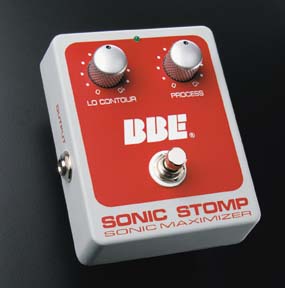
sonic_stomp_4in.jpgBased upon BBE’s very successful line of “Sonic Maximizers” – the Sonic Stomp actually uses the same technology from its 482i rack mount unit – this is a very unique pedal, and I’m going to go as far as saying this: YOU MUST HAVE THIS PEDAL. It’ll be the best $99 you’ve ever spent. So what makes it so special?
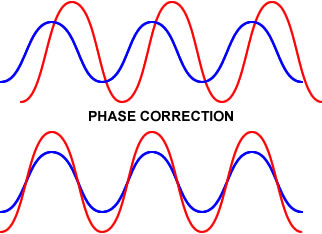
Without going into technical details, the Sonic Stomp corrects phase differences that occur between low and high frequencies coming out of an amp’s speakers; technically called “envelope distortion;” the net effect being that dramatic phase differences between low and high frequencies can produce what we perceive as a “muddy” or in some cases a “muted” sound. By time-aligning the frequencies, the signal is restored to a more accurate state, thus producing a much clearer, cleaner tone, and this is the gist of what the BBE Sonic Stomp does.

Now here’s the catch to this box. Unlike other pedals that either add drive or modulation to your signal, this pedal does signal correction, and in most cases you won’t even notice that it’s on! However, you’ll miss it when it’s off. It’s hard to articulate what that difference is. Let’s just say that with this pedal on, your already good tone just sounds that much better.

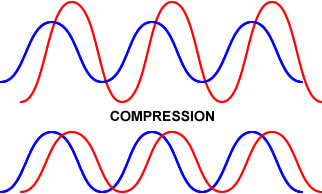
Now don’t confuse what this pedal does with a compressor. A compressor flattens gain, limiting the louder sounds and loudening the quieter ones (with makeup gain), thus creating a perceptibly fatter tone. This is very different than phase correction. See the figures below:

phase.jpg comp.jpg

I realize this is a fairly simplistic perspective, but as you can see, phase correction aligns the waves without acting on their amplitudes, whereas compression corrects amplitude but doesn’t work on phase.

So why might people confuse the two? Simply because when you correct phase, tonal qualities that you didn’t realize existed suddenly come to life. For instance, before I got this box, my amp had a real big, boomy tone. When I introduced the Sonic Stomp into my chain, my amp lost some of its boominess, which resulted in a much richer tone. It’s easy to mistake this as tone fattening as the lows got smoothed out and there seemed to be much more midrange, but I wouldn’t call it fattening – it’s more tone clarification – and this box it great at that!

So if you’re thinking about getting a tone shaping box, give the BBE Sonic Stomp a good look.

Read Full Post »

No, I’m not talking about the gastrointestinal waste product, I’m talking about Guitar Acquisition Syndrome. It’s an affliction that plagues guitar players the world over, forcing them to buy more and more equipment so they can achieve the perfect tone. Wonder why guitar players are always broke? Look no further. It’s because they’ve sunk all their money into their gear.

Some people have likened GAS to obsessive compulsive disorder; considering the amount of money some people spend, it could be highly likely that it comes close, but really, it’s not that bad. It’s just that in the quest for attaining the ideal sound, you need to get equipment – and that costs money.

Is there a cure? Not as long as you’re trying to tweak your tone. But it goes away once you get close to your ideal. For instance, I’ve pretty much stopped buying gear since I’ve achieved my ideal – at least for now; and that’s the catch. GAS comes back when you want to change your tone, and the amount of GAS you get is in direct proportion to how big of a change you want to make. For me, last year was a year of complete re-invention. I went from being a primarily acoustic-electric guitar player, to being almost entirely electric, and the equipment I had just didn’t suffice. So, two electric guitars, three amps, and a set of stomp boxes later, not to mention a new PA and recording equipment, I’m pretty much over my GASeous period. I’m pretty satisfied… at least for now… 🙂

Can you control GAS? Actually, yes. I have a very supporting wife who sang for me in a music group before we started dating, so she was pretty familiar with my need for more equipment. Once we got married, we had several debates about me getting equipment, since the money was coming out of our family budget. So after going back and forth, and not getting any resolution, she one day said she’d like to make a deal. Since my regular job provided enough money to support the family and pay the mortgage, I could set up a separate account and deposit all my gig money into it to use as I pleased. But a huge part of the deal was that I couldn’t buy anything on credit or financing. I had to use the cash I had. That was a very fair deal, and it was also a way to curb my GASeous urges.

Anyone else have GAS? Share your thoughts!

Read Full Post »

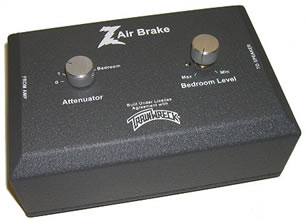
The Dr. Z Air BrakeAfter many years of using solid state amps, I finally started looking at tube amps; specifically, boutique tube amps. I’ve looked at and played several from folks like Dr. Z, Mesa, King Amplification and a bunch of others. But boutique amps are VERY EXPENSIVE. And upon the recommendation of a very knowledgeable acquaintaintance (mentioned previously), I purchased a Fender Hot Rod Deluxe to tide me over until I could afford the $2500-$3500 for a boutique amp.

But no matter what boutique tube amp I decide to buy, one thing that struck me about about tube amps is that they’re LOUD!!! Yeah, I know, a lot of that comes from the types of volume pots installed on many amps, but irrespective of that little issue, tube amps just rock the house with their tonal clarity and their ability to punch through a mix. Unfortunately, they can get so loud that they squash the rest of your band (let alone shatter the eardrums of your audience), and that’s the bad part because most tube amps, especially Mesas and Marshalls just don’t sound right until they’re cranked and really pushing their power tubes. But in small to medium-sized venues, you’ll have people running for the door!

So I went looking for a solution where I could push my power tubes but not break windows (or in a specific personal instance, not have the next-door-neighbor calling me at 1 am to “turn my f&*king amp down”). In any case, the answer lay in a box called a power attenuator. There are several types, and I won’t bore you with technical details, but the gist of a power attenuator is just that: it attenuates the signal coming from your amp. You simply place it between your amp and your speakers and it outputs a lower signal – thus lower volume. What this means is that you can crank your amp to the level that you’d like and achieve an overdriven tone, but do it at a significantly reduced volume level.

The hot ticket right now seems to be the THD Hot Plate. But there are others out there as well. Personally, I like the Dr. Z Air Brake because it has a very simple set up (just two knobs), and is much more versatile right out of the box than the Hot Plate. This is because it automatically adjusts to the proper impedance of your amp; whereas you have to get a specific Hot Plate model that matches your amp’s impedance level. Choose the wrong one and you could be in a world of hurt! So I’ll be going with the Air Brake.

However, since I have a home studio, I will also be purchasing the Weber Mass 100 because it has a EQ’d DI direct output that I can run directly into my MBox 2. That’s very useful for studio work, but way too complicated for stage work. Besides, even though I only play with 4 effect pedals (BBE Sonic Stomp [you gotta get this – or better yet, get a rackmount sonic maximizer], Ibanez TS-808 Tube Screamer, Boss DD-3 delay, and Boss CE-5 chorus), I have more than enough knobs to twiddle with, and the Air Brake is simple enough to use on stage – two knobs. I tend to be a set it and forget it kind of guy and only like to channel switch to my gain stage or switch the TS-808, so the less I have to play around with, the better.

Anyway, if you’re a guitar player who’s in search of maintaining your tone but saving your eardrums – as well as those in your audience – then a power attenuator is the thing for you.

Read Full Post »

« Newer Posts