Feeds:
Posts
Comments

Archive for the ‘gear’ Category

About a month ago, a friend of mine asked me to update his web site with some minor text changes, and to help him drive more traffic to it. As I’ve been doing web development professionally for the last ten years, it was natural for him to ask me, and since he’s like an older brother to me, how could I refuse to do it? I finished the task in an evening, and didn’t think once about getting paid for the job. But his wife insisted that they pay me because my work helped produce income from their site.

But in lieu of them writing me a check for my services, I suggested that they order some gear for me and have it shipped to my house. So, I pointed them to the Voodoo Lab Micro Vibe pedal that I’ve been wanting, and it should arrive within the week!

So if you don’t have the clams to buy gear, see if you can trade services with people to get some gear that you’d like!

Is it realistic? Sure it is. I bartered building a web site for my architect for a lower architectural fee when we were rebuilding our house. I also built a web site for our contractor in exchange for his labor in laying our hardwood floors. Bartering works.

Read Full Post »

5 Tone Bones - Gear has stellar performance, value, and quality. This is definitely top of the class, best of breed, and it’s a no-brainer to add this to your gear lineup! Sennheiser e835 Dynamic Microphone

Summary: A fantastic and versatile, and super-affordable mic with a wide field that is equally at home with vocals, and instrument/amp sound reinforcement.

Pros: Nice, flat response, with built-in presence boost produces very clear sound.

Cons: None

Price: $99 Street

Sennheiser e835

One of the underlying themes in the reviews I write here at GuitarGear.org is that cheap doesn’t necessarily equate to low quality, and as a gear freak, saving money where I can means I have more money to get more gear. I totally dig on finding excellent gear that doesn’t break the bank, and the Sennheiser e835 falls squarely into that camp.

I discovered this mic a few years ago when my trusty, but tired SM-58 stopped working. By chance, Guitar Center was having one of its blowout sales, and the e835 happened to be on sale for $79.00. So I decided to try it out, and am kicking myself for not buy 4 or 5 of these at the sale price. Oh well…

One thing that I couldn’t stand about the SM-58 was its boomy lows. I’m the type of singer that has the mic close to or touching my lips so that I’m right in the capsule. But with the SM-58, I couldn’t do that because the over-abundance of lows would muddy my vocal tone – and forget about using it to mic a cab!

On the other hand, I found that the e835 has a much flatter tonal response, and close-mic’ing anything is pretty easy, with very little EQ tweaking. It has a built-in presence boost that flattens out the EQ compared to the more scooped EQ of the SM-58. With that kind of flat response, the e835 becomes a very versatile tool that’s usable on-stage, in the studio, and can even be great for mic’ing guitar cabs! At $99 street price, you just can’t go wrong with this mic!

To prove how nice the e835 sounds, let me point you to a song I just recorded using e835. In this song, I used the e835 for both guitars and vocals. With the guitars, I wanted to add a little spacial depth to the guitar tone (I was using a Fender Champ 600 amp with only a 6″ speaker, so I needed a bit of depth), so I close-mic’d the amp with the e835, and used a Nady RM-200 ribbon mic placed off-axis about 10″ away. The Nady only adds a bit of depth, as the e835 does the bulk of the tonal work. But regardless of guitar or vocal, from the song, you can tell that the e835 really shines as a super-versatile mic.

Read Full Post »

Reunion with Rusty

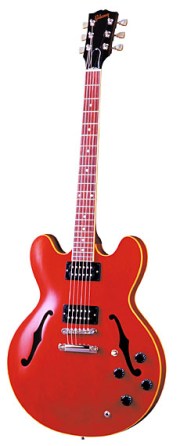
Rusty - My ES-333

Meet “Rusty,” my Gibson ES-333. It’s essentially a 335 without the jewelry (pickup covers [which I don’t like anyways], pick guard, translucent volume and tone knobs, mother of pearl inlays, etc). In other words, Rusty’s a straight-up, no-frills guitar, and out of all my guitars, he’s the most playable and most tonally diverse. I can go from sweet and clean, to gritty, to singing super-sustained distortion – with just the volume knob!

Recently, I was actually thinking about selling Rusty and using the proceeds to get another guitar, but Rusty sings so well, that I just couldn’t think of parting with him. You can hear Rusty as the main rhythm parts in this song:

Praise the Lord My Soul:

In that song, Rusty was plugged straight into my amp, and I recorded him using a Nady RM200 ribbon mic. I actually used him in both rhythm parts: The main G7-C9 riff, and the little funky ditty that’s played over the riff. With the main riff, I’ve got Rusty just at the edge of breakup so I can get a bit of a dirty sound. With the overlay, he’s played completely clean with just a touch of spring reverb. He’s got such a sweet, clean voice with just the touch of an edge. Very cool.

Rock on, Rusty!!!

Read Full Post »

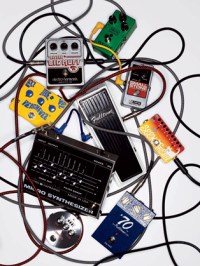
dear01_stompbox.jpgI walked into my garage this morning, which also doubles as my home studio and I looked around and saw several items that I’m not using at all right now. This includes a couple of solid state amps, a few pedals, and a sweet, digital recording workstation that I inherited from my brother that I never use because GarageBand is so much easier. My wife is great about all this, but she recently told me I have to do some spring cleaning. “Look at the big amp,” she said, “You haven’t gigged with that in a couple of years, and I haven’t seen you record with it either. Maybe you ought to get rid of some stuff… Besides, you need to make room for the shelving I want to put in here this spring”

Yikes! Looks like I have to take an inventory of what I can part with, but there is a rub to this. My friend Phil of Phil ‘n the Blanks said to me last week, “Don’t try to hide it, you’ve got GAS. I read your site all the time, and I’m amazed at all the s&*t you buy. Besides, if you get rid of some stuff, you’ll just replace it with other stuff…” OMG!!! How true. I found a place nearby that trades good-condition used gear for store credit. Damn! And on top of that, they’re a G & L guitar dealer! Maybe if I sell enough stuff…

The point? Sure, we gearheads go through periods of spring cleaning, but it’s more like gear rotation, as we rotate in new stuff for the stuff we no longer use.

Why not share your “spring cleaning” story?

Read Full Post »

Fender Hot Rod Deluxe

My Hot Rod started making a bit of a humming sound a couple of weeks ago, and I figured out that it was one of the preamp tubes. So instead of replacing the bad one, I decided to replace all of ’em. Not knowing what was best, I called up The Tube Store because I knew they’d know what would work best in my amp. After a nice, long conversation with Paula, I got two Tung-Sol 12AX7 and one Jan-Phillips 12AY7 – all three for about $49. I put one TS in my first stage, put the JP in the second stage, and the other TS in the phase inverter. What are the results? A lot more clean headroom in my clean channel, and a much smoother distortion in my drive channel. I had already tamed my drive channel a bit by getting THD Yellow Jackets and using EL-84’s in place of the 6L6’s I put in last year. But combined with the JP, we’re talking sweet, beautiful sound!

I’d heard of the virtues of NOS (New Old Stock) tubes, but I’m now a true believer! If you’ve got one of the Hot Rod series amps and are looking to tame your drive channel, and get a sweeter clean sound, do yourself a favor and replace your preamp tubes. You’ll welcome the change!

Read Full Post »

4 Tone Bones - Excellent gear, that exceeds expectations of its performance, value, and quality. Strongly consider purchasing this. Fulltone Mini Deja Vibe

Summary: Fulltone makes some of the best pedals in the world, hands-down. You pay for the quality, but you’ll almost never walk away disappointed for the coin you have to pay for a Fulltone pedal. The Mini Deja Vibe is a great take on the original UniVibe, and faithfully reproduces the old ‘Vibe sound.

Pros: Fulltone quality, and pure ‘Vibe sound. Chorus setting is intense and sweeping, and mixed with reverb and just a little breakup, you can easily get that Hendrix and Trower sound. Vintage/Modern switch provides great versatility.

Cons: Pricey for what you get. Vibrato is too subtle and intensity knob belies the narrow range of intensity this pedal should be capable of – at least for me.

Price: $249 Street

5 Tone Bones - Gear has stellar performance, value, and quality. This is definitely top of the class, best of breed, and it’s a no-brainer to add this to your gear lineup! Voodoo Lab Micro Vibe

Summary: The MicroVibe does one thing and one thing only, reproducing the orignal UniVibe sound quite faithfully. A bit darker in presentation than the MicroVibe (think David Gilmore).

Pros: Super simple to dial in a great tone, plus awesome value for the tone that this box produces.

Cons: None

Price: $149 Street

With some of the songs I’ve written, chorus just doesn’t seem to be enough, so I’ve been looking at going the “vibe” route to get a more psychedelic sound. Over the past few days, I’ve listened to sound clips and read reviews, and narrowed my search down to two ‘vibes that I’m considering: The Fulltone Mini Deja Vibe, and the Voodoo Lab Micro Vibe. Both pedals’ manufacturers claim to faithfully reproduce the original UniVibe circuitry. And, at least to my ears, both do a great job. I recently had the chance to A/B boxes at the same time.

img10292143013.jpegFulltone Mini Deja Vibe

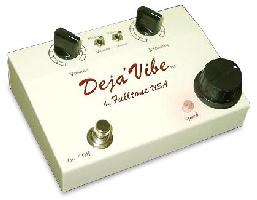
The “Mini” is a stomp box take on Fulltone Deja 2 pedal, with the same circuitry as its expression pedal counterpart. It has three knobs for Volume, Intensity, and Speed, plus two toggles: One to switch between a Modern and Vintage sound and the other to switch between Vibrato and Chorus. In general, I dig Fulltone pedals, and in general, I’ve been really blown away by the tones they can produce. So I was a bit surprised that this particular pedal just didn’t have that kind of impact on me. Mind you, the tone’s incredible, but to my ears, not spectacular – at least not enough to justify the $249 price tag. No doubt that it does psychedelic really well. On the “chorus” setting in the vintage mode, the tone was spectacular. But on the vibrato effect in either modern or vintage mode, was so subtle as to be practically undetectable. It’s there, you notice it, but there’s just not much to it.

I suppose it could be argued that you’re getting this for the chorus mode, which is what the ‘Vibe is all about. But I have a problem with expensive toys that have features that are practically insignificant. Mind you, I didn’t have the expectation that the vibrato should be more like a tremolo. But my expectation was that it would be quite a bit more profound. So combine with the high price, the Mini Deja Vibe gets 4 Tone Bones.

Voodoo Lab MicroVibeVoodoo Lab Micro Vibe

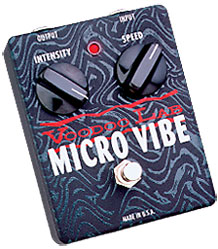
By comparison, the Micro Vibe is a lesson in simplicity. It does one thing and one thing only: It creates that sweet, Vibe tone. As with the Mini Deja Vibe, Voodoo Lab claims to faithfully reproduce the circuit of the original UniVibe, and like the Mini, it does it very well, though with just tad bit darker shading. But it wasn’t so dark that a little EQ adjustment couldn’t make it ring sweetly.

With just two knobs for Intensity and Speed, it’s very easy to dial in the right tone to fit your needs. I was really impressed with this pedal. It sounded great, it was very quiet, and I had a ball playing with different knob positions. I don’t know if it could’ve helped to have a volume knob like the Mini Deja Vibe, I certainly didn’t miss it. On top of all this, the pedal has true bypass switching. All these features together, plus the nice price of $149 gets the Voodoo Lab Micro Vibe 5 Tone Bones.

Now I know there are going to be some purists out there who will probably think I’m crazy for choosing the Micro over the Mini. But like I said, the Mini doesn’t sound bad at all. In fact, tone-wise in Chorus mode, the sound was spectacular. But if I could get what I was looking for in a smaller and less expensive pedal, and all I have to do is EQ a bit to make it sound a little brighter, the Micro Vibe makes so much more sense to me.

Read Full Post »

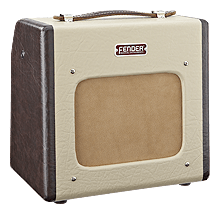
Fender Champion 600 Re-issueYou really don’t get a taste for how well gear actually performs until you use it in a performance or recording situation. After all, doing tests is one thing; mixing it up in a band or recording a track with it are entirely different animals. This past weekend, I had the chance to put my new Champ 600 through its paces in both a recording and performance situations. Before I go into specific details, let me just sum up for those who don’t want to read on: In my book, for what the Fender Champion 600 has to offer, it is an absolute champ! Don’t let the diminutive size fool you. Even in stock livery, the Champion 600 produces beautiful tone; that is, it produces the natural tone of your guitar. As long as you don’t expect it to be more than what it is and what it offers, this little amp will make you very happy! I’m very tickled by this amp and the experience I just had with it.

Let’s dive into how I actually used it, shall we?

Into the Studio

As some of you may know, I have a home studio, and if you’ve read my past articles, I’ve written several articles centering on gear that could be used in low-volume/small venue applications. I purchased the Champ specifically for this purpose. From the standpoint of volume, the Champ is a dream come true! It’s quiet when idle (some people have mentioned that it hums and cracks – thank goodness I didn’t get one of those), and amazingly enough, it’s a very expressive amp, despite its tiny six-inch speaker. With the single knob to control volume, this amp is meant to produce the natural tonal character of whatever guitar is plugged into it, and it does this incredibly well. But because it has zero bells and whistles such as reverb and EQ, those are things you have to provide, but it takes to pedals quite nicely.

Obviously because of its small size, there are some limitations. You lose a lot of the bottom end you’d normally get from a larger speaker in a bigger cabinet. But if you’re looking to record a high-midrange, ringy tone, the Champ performs like an ace in this range! The tone is gorgeous! Which actually puzzled me when I recorded with it this weekend because I read several reviews where people swapped out the stock speaker because they felt it was too flat. I recorded with it and absolutely loved the tone it produced – and the speaker’s not even broken in yet! Maybe my ears just aren’t as sensitive (which is a huge possibility) as the other reviewers…

Now addressing the lack of bottom end in the Champ, I decided to drive my Hot Rod’s speaker with it, using an extension cord. This is where the amp really shined, in my opinion. You still get the ringy tone, but with a larger speaker, the tone is oh so very rich.

Click here to listen to the song I recorded using just the Champ with three different guitars:

  • Gibson ES-335: I used this for the main rhythm track using the stock amp with the little 6″ speaker. For effects I added a smidgen of reverb, and layered chorus on top of that. The result was a gorgeous ringing tone!
  • Fender Strat with ’57 Tex-Mex Reissue pickups – This provided the second rhythm track with mild distortion. For this track, I drove my Hot Rod’s cab with the Champ. To fatten out the tone a bit, I employed about a 2.5 to 1 compression. Because my Strat doesn’t have a lot of natural overdrive, I added just a touch of drive using a combination of my TS-808 and OCD pedals, both set to very low drive levels.
  • Epiphone ’58 Korina Explorer Reissue – Again, I used my Hot Rod’s speaker cab. But there’s so much natural drive and sustain with this guitar, that I didn’t have to use ANY effects with it. This added the extra kick in the chorus of the song.

Of course, no sound engineer – amateur or pro – would be worth their salt without some mastering tricks. But truth be told, the ONLY thing I did with the guitar tracks on the song was to adjust their volume levels, and add just a touch of reverb (about 7%) to the Strat track. That’s it! I’m very pleased.

Live Performance

As a test, I brought the Champ to play at my weekly Church service. I figured that I mic my amps anyway, so it would be a great test to see how it performed. In this venue, I’m not worried about cutting through the mix – just having enough volume so I can hear it. Since we employ active mixing, our sound guy knows to pump up my house volume when I do leads or play the main rhythm parts for a song. So how did it perform? Well… a lot better than I expected, but I did miss the bottom end in my output signal. It wasn’t that I was dissatisfied, but in a performance situation, this amp will sound A LOT better driving a large speaker in a bigger cab. Other than that, I was generally pleased with how it sounded.

So to sum it all up, the Champ is a dream in the studio, and with the help of an extension cab, will perform great in small-venue/low-volume performance situations.

Read Full Post »

4 Tone Bones - Excellent gear, that exceeds expectations of its performance, value, and quality. Strongly consider purchasing this. Fender® Champion 600

Price: $149 (street)

Summary: Great tone can come in small packages, and the Fender Champ is a great example of this. Simple and straight-forward, it’s easy to use, and even easier on the pocketbook. Not really meant to be used as something you’d gig with (though you could easily add an extension cabinet), it’s a great amp for practicing and for the home studio recording artist looking for a low-wattage solution.

Pros: Vintage looks and great sound and quality for a small price.

Cons: You sacrifice a bit of low-end for the diminutive size.

Fender Champion 600 Re-issue

Recording in a home studio presents various challenges to the DIY recording artist. But no other challenge is greater than controlling the output volume of amps, especially if you want to push them into breakup. To get even a small amount of breakup, you’ve got to increase gain to push the pre-amp and/or power tubes; and invariably, this is accompanied by a boost in output volume. There are various ways to deal with this from creating amp enclosures to using attenuators or even installing tube adapters to use lower wattage output tubes, and they all work reasonably well. Another approach is to simply get a smaller wattage amp in the 5 – 15 Watt category. Most have much smaller speakers than their larger counterparts, so their output volume is naturally lower, plus with the smaller wattage, it’s easier to overdrive them at lower volumes, thus producing breakup without shaking tiles loose.

Among the 5 Watt amps available, the two seemingly most-popular amps are the Fender® Champion 600 and the Epiphone Valve Junior Combo. I recently had the chance to try out the Champ.

Vintage Roots, Great Sound: Bargain Price

First of all, let’s be real honest: The Champ is a $200 amp, sporting a single volume knob and a standby switch. That’s it. This is not an amp that you compare to a boutique amp in any respect, so don’t try to compare it to something like a Carr mini-Mercury – they’re in two completely different classes! A re-issue of the original 1950 Fender Champion, it employs modern mass-production techniques as opposed to the hand-wired, point-to-point construction from which most boutique amps are built. But for what you pay for this amp, and for the quality of sound that it produces, you just can’t go wrong. Bear in mind that the Champ is a no-frills amp whose sole purpose in life is to amplify the natural sound of your guitar. It’s not meant for gigging with a full band. On the other hand, it creates really nice tone (albeit with a little loss of the bottom-end). As long as you don’t try think of this amp as any more than what it is, it’ll make you pretty happy.

Looks

This is a very retro-looking amp, with the original two-tone brown on beige tolex design. It actually looks like a mini television! and the leather handle is a real nice touch – though I’d be careful not to strain the handle too much… It’s a little weird to see a single volume knob, but that just tells you that this is a no-frills amp, as I mentioned before.

Sound Quality

I’ve already mentioned that the Champ produces really nice tone, and even though I missed the bottom-end that you’d get with a larger speaker, the quality of the sound that it does produce is stellar. Besides, in a recording application, you can always tweak the bottom-end a bit with EQ, but I digress. I tested the Champ out with a G & L Comanche, a Strat, and a Les Paul Standard. As expected, the amp reacted very differently with each of the different guitars, but surprisingly, it retained the character of each guitar, which I thought might be lost because of its diminutive size. The Strat played clean and smooth, and position 4 (center/bridge) was twangy and ringy as expected. What surprised me even more was with the Strat, I couldn’t get the amp to break-up until I cranked the volume past 9 (it goes up to 12). There’s lots and lots of clean headroom with single coils, so if you want to get break-up, you’d be best served using an overdrive pedal of sorts.

It was far easier to get amp to break up with the Comanche and Les Paul, as expected. It was a bit more difficult with the Comanche as it uses the hybrid Z-coil pickups, but it was still easier to get breakup than with he Strat. The LP broke up nicely with volume at about halfway, and the volume knobs pegged.

From a distortion standpoint, the Champ produces distortion similar to a Fender Deluxe. It’s not creamy smooth, but it’s also not too gritty – though it does get really ugly at high volumes – probably due to speaker distortion, which is never nice. But dialed in just right, the Champ produces really subtle breakup which is very ringy and pleasant.

Being that you can’t really do much tone shaping with the amp itself, it’s up to you to throw whatever boxes you need to achieve the tone you’re after. But that shouldn’t be too much of a problem for most folks. Besides, in lots of cases, you may not want to put any boxes in your signal chain before this amp. Here’s a decent-sounding YouTube video that demonstrates how the Champ sounds. I think you’ll be surprised:

Value

For the money, it’s hard to go wrong with the Fender Champion 600. A cheaper alternative would be the Epiphone Valve Junior which costs only $129.00 for the head. I’ll be writing a review for that as well in the very near future, but if you’re looking for that nice, Fender clean tone in a low-wattage application, but don’t want to shell out several hundred dollars for even a small deluxe, the Champ is a great way to go!

Update: As you can see at the top, the price listed is $149. Fender dropped the price after I wrote the article. Of course, I paid the original $200+ for the damn amp, but there you have it…

Read Full Post »

G & L Guitars Comanche Solid Body

Review Setup: Solid Swamp Ash Body, Hard Rock Maple Neck with Rosewood fretboard. Z-coil pickups.

Price as configured: $1700.00 (custom setups available)

Summary: I give this 4.5 Tone Bones! The G&L Comanche is an excellent, hand-made, versatile guitar from the shop Leo Fender and George Fullerton started after Leo sold the Fender company. Incredible playability, and sweet, sweet sound from the Z-coil humbuckers. Not only that, with the flick of a mini-switch, you can engage all three pickups at once for a truly aggressive sound. This is a guitar that is not for the faint of heart. It wants to be played, not babied. Read on!

G&L Guitars Comanche

I love writing this blog because it forces me to check out gear that I wouldn’t otherwise take a second glance at, and sometimes make new discoveries of gear that I didn’t even know existed. This entry is the result of one of those chance discoveries.

I thought I knew my guitar builders beyond the mainstream and semi-mainstream such as Gibson, Fender, PRS, etc. So it came as a HUGE surprise to walk into a small shop in Sacramento yesterday and see what looked like Stratocaster and Telecaster knock-offs hanging on the walls, only to be informed by the shop owner that the guitars were made by the prototype shop that George Fullerton and Leo Fender (hence, G & L) started after Leo sold the Fender company. Building on the traditional Fender body shapes, their creations extend the lines with solid and semi-hollow versions with various pickup configurations that reach far beyond their corporate counterparts. The results are guitars that push the envelope with design and innovation, while retaining the visual pedigree that made George Fullerton and Leo Fender famous in the first place. Also, all G & L’s are hand made. I know that alone may deter some players from even considering this brand, but amazingly enough, they’re not as expensive as you might think; more on that later. I had the chance to play the solid-body Comanche with tobacco sunburst through a ultra-sweet Rivera Venus 3 (I’ll write a review on that later 🙂 ).

At a distance, when you first the see the Comanche, you recognize the familiar body shape and pickup positioning, and you might say, “Hmmm… nice Strat.” Then, as you move forward, you see that the headstock is slightly different from a Strat, the bridge is really different from a Strat. The body is also a little narrower. Then you notice the absolutely weird-shaped pickups. These are an invention of Leo Fender. They’re actually two, hand-wrapped and offset three-string, single coil pickups with reverse polarity to eliminate hum. They’re almost like hybrid humbucker.

Look and Feel

The Comanche I played had a gorgeous tobacco sunburst finish overlaying a swamp ash body, with a hard rock maple neck and a rosewood fretboard. Surprisingly, this wasn’t a light guitar. In fact, it felt a little heavier than my own Strat, but the feel was luscious. The only ding that I gave the Comanche was that the back of the neck is gloss-lacquered. I personally prefer a silk finish, especially with a maple neck. It might be psychological, but that’s what I like. Speaking of the neck, it was a nice, C-shape, and the rosewood fretboard was a dream to play. I’m a big fan of rosewood fretboards. They provide great tactile feel, plus add warmth to the overall tone.

Sound

The best way to describe the tone of the Comanche is “a bit thicker than a Strat, but thinner than a Les Paul.” It’s this balance that is very appealing about this guitar. Just like the body style, with the sound, you recognize the pedigree, but it’s… different. Since I’ve played it , I’ve read some other reviews and most mentioned that the Comanche has an aggressive tone. It does, but that aggressiveness can be easily tempered by dialing back tone and volume controls; plus, tone also depends on the amp you’re using. I happened to test the Comanche out with a Rivera Venus 3, and the tones it produced were sweet and clean, owing a lot to the high amount of clean headroom available in the Venus 3. In typical Class A fashion, increased input gain produced nice pre-amp clipping, and with all three pickups engaged, this guitar could get as dirty as the best of ’em.

Unlike a Strat, the “hybrid” Z-coil pickups add nice amounts of sustain, which is further helped by the resonant swamp ash body. Bends and slow vibrato created nice, subtle overtones. On top of that, the touch sensitivity, even at lower volume levels, was very, very nice. All in all, I didn’t find the Comanche as aggressive as other reviewers found it; certainly more aggressive-sounding than a Strat, but as I mentioned, not as fat as a LP.

Click here to listen to some audio clips.

The audio clips sound really Texas-twangy, which is actually quite cool, but the clips don’t really show what this versatile guitar can do. The Comanche is capable of showing many faces, depending upon how you adjust it.

Playability

As I mentioned above, this baby wants to be played. The action is just right, and the neck is real fast despite the glossy lacquer finish on the back. The rosewood fretboard is especially nice, providing excellent tactile feedback. As I mentioned above, this guitar is not for the faint of heart. It’s meant to be played and coaxed and caressed to produce its wonderful song. While it’s easy to coax incredible tones from this guitar, its versatility might scare away those who won’t take the time to discover all its virtues.

I recommend this guitar for serious tone freaks who are in search of a “fatter” Strat sound, but want to retain that natural high-end ring. While not cheap, it’s also not unreasonable, especially for a completely hand-made instrument!

Read Full Post »

After I wrote my last review on the DigiTech Bad Monkey, I realized that I needed to change the format of my reviews, so readers could get an at-a-glance impression of the review, and choose to read the full review. As a professional web developer, “stickiness” is always a big issue, and especially with reviews, some people just don’t want to take time to read a full review. But studies have shown that if they’re intrigued by some quick summary information, they’ll read on. So, starting now, all the reviews on GuitarGear.org will start out with a 1-5 rating called “Tone Bones,” plus a quick summary of the review. Here are the descriptions for each rating:

5 Tone Bones Gear has stellar performance, value, and quality. This is definitely top of the class, best of breed, and it’s a no-brainer to add this to your gear lineup!
4 Tone Bones Excellent gear, that exceeds expectations of its performance, value, and quality. Strongly consider purchasing this.
3 Tone Bones Satisfactory performance, value, and quality, and meets most expectations, but doesn’t have many standout features or qualities.
2 Tone Bones Sub-par performance, value, or quality. Gear may have some standout features, but they’re outweighed by negative qualities, or the application of this gear is so narrow that you’d only use it in very rare circumstances. Take a lot of time to evaluate whether or not you want this gear! Caveat emptor!
1 Tone Bone Poor performance, value, and/or quality. Don’t even consider getting this!

Mind you, any rating system is going to be subjective, but I try to be as fair as possible, and for the most part, a lot of the gear I review I test in real-life situations. As I said above, what I want to accomplish with the rating system is to provide an at-a-glance summary of what I think of the gear in question!

Now on to reviewing!

GoofyDawg

Read Full Post »

« Newer Posts - Older Posts »