Conventional tube-amp wisdom states that you get the most bang for your buck by replacing your pre-amp tubes. I’ve been a believer of this for quite awhile, and have tried out all sorts of pre-amp tubes in my amps over the years. A couple of days ago, I wrote that I had installed a new Mullard ECC83 (12AX7) into my Aracom VRX22. This particular Mullard is a Zaerix-labled ECC83 that probably came from the GDR (I didn’t look at the numbers – I really don’t care, for that matter). All I know is that it made a HUGE difference in the way my amp sounds. The overdrive instantly became smoother and more focused without top-end artifacts, and the notes are still very defined even at high overdrive settings on my amp.
The clip below says it all. I recorded this clip playing in the bridge pick up of Goldie, plugged straight into the VRX22, which then fed into the ever-so-awesome Aracom PRX15-Pro attenuator. The amp’s master, tone, and volume knobs were all set at 6 (about 2pm on the amp), and the clip was recorded at bedroom level!
To my ears, the VRX22 sounds like a much bigger amp than its 22 Watts! I’m really in tonal heaven right now!
In yesterday’s little adventure at Guitar Player Magazine, I got a chance to play the new Dr. Z Remedy amplifier. This amp is based upon a classic Marshall JTM circuit design, but with a twist: Instead of 4 inputs that allow you to jumper the two channels, the Remedy has a single input and the channels are already jumpered. You then have the ability to blend the amount of high and normal channel amounts via the two loudness knobs.
This amp is a lesson in simplicity. It has a three-band EQ, and the volume knobs for the High and Normal channels, plus Power On/Off and Standby toggles. That’s it. With this amp, you dial in your tone and sound levels, and play!
The amp is powered by a quad set of 6V6’s, and man they sound sweet! The power tubes are JJ’s which have kind of a “hybrid” 6V6 tone – I use these myself, and I love them. They’re brighter-sounding than the classic 6V6, and they’re extremely durable. I’ve never had one of these fail on any of my 6V6 amps, so it’s not a surprise Dr. Z uses the JJ’s for their reliability.
How It Sounds…
In a word, it sounds “big.” A lot bigger than I expected from just a 40 Watt amp. I played a Gibson ’59 Les Paul Special Re-issue through it and was really taken by the big sound that the Remedy produces. For classic rock and blues tones, this is an ideal amp. It responds incredibly well to picking dynamics and volume knob adjustments as well, which is why I mentioned you set your EQ and volume where you want it, then play. You can then adjust the cleanliness or dirtiness with your volume knob or attack. Very cool. You might dismiss the Remedy as another JTM clone as the circuitry is based upon that. But it has a sound all its own. The cleans are lush and defined, and the overdrive is nice and crunchy, and very little to no top-end raspiness. I think that’s an earmark of the 6V6’s. They just don’t get fizzy.
A Great Half-Power Mode
I played around with the half-power switch a couple of times, and it works as expected. But I wanted to find out more about how Dr. Z does his half power mode, so I gave him a call this morning, and found out some interesting things about how he does his half-power mode – very interesting things, indeed. There are a couple of ways I’m familiar with that amp manufacturers introduce half-power modes in their amps. A common way is to shut down half a tube, essentially going from pentode to triode. According to amp builders I’ve spoken with, this is the easiest, but it also changes the tone significantly between the two modes.
The second common way is to adjust the B+ voltage down, then provide some compensation so the correct heater voltages are maintained. This is what Jeff Aragaki does with his amps, and this technique is very transparent.
Dr Z. takes a completely different approach and leaves the front-end alone entirely, and works his magic from the power transformer, something he worked with the late Ken Fisher to produce. I won’t go into details – and Dr. Z didn’t go into a great deal of depth – but he effectively bypasses the power from two of the power tubes then does some other stuff to compensate for the impedance mismatch to half the power. The end result is a very tonally transparent switch from full power to half power, using a method no one else is using; at least according to Dr. Z.
I love stuff like this! I’m no electronics guy, but I love it when people think out of the box to handle common problems, and come up with approaches that no one else thought of, or didn’t try because they thought it was too hard! Kudos to Dr. Z for doing something like this!
I truly wish I had more time to spend with it so I could explore the amp’s capabilities more. Perhaps in the near future I’ll get that chance.
Just put in a re-labeled 1960’s-era Mullard ECC83 into my Aracom VRX22 this afternoon. I had a JJ 12AX7 in there, and make no bones about it; that’s a great pre-amp tube. But the difference in tone between the two is immense. Where my JJ had a great tone, one thing that I noticed was that the highs tended to be rather harsh when the tube was overdrive, and I found myself turning my Tone knob left of center – a lot – to bleed off some of the highs.
But after I installed the Mullard, I was absolutely blown away! The overdrive seemed so much more focused, with zero high-end harshness. It was some of the smoothest overdrive I’ve heard, and definitely the smoothest the VRX22 has sounded since I got it. That’s saying quite a bit because I love the tone of this amp immensely, even without the NOS Mullard. Which brings me to the crux of this entry…
As a tube amp aficionado, I’ve gone through lots of pre-amp tubes, and almost invariably, I’ve gravitated towards NOS tubes to get the tone I like. Some people I’ve spoken to say it’s all hype but, at least to me, it’s not. I suppose for some types of tubes, there’s not much of a difference. For instance, I almost invariably use JJ’s for power tubes because they just sound great to me. They’re well-made, and run pretty hot, and they break up nicely.
But with respect to pre-amp tubes, I’ve found a marked difference between NOS and new tubes. I love Mullard and JAN Phillips tubes for pre-amp tubes. They’re just so smooth sounding, smoother than all the new make tubes I’ve played. Plus, they were made during a time when most electronic devices were run with tubes, so the build expertise, equipment and materials for making tubes was abundant. According to my friend Jeff Aragaki of Aracom Amps, the alloys used in NOS tubes are not as readily available nowadays, and that could account for the difference in tone. Not sure if this is true, but it certainly makes sense. The only drawback is the price. That Mullard sells for $129 retail, and that is by no means inexpensive.
But I look at buying NOS tubes very much like buying a great pair of shoes. For instance, I spend almost $200 a pair for my everyday shoes. These are absolutely comfortable, and not only that they last a long time because they’re constructed so well. In fact, it takes me about 4-5 years to really wear them out. This in contrast to lower priced shoes that I’ve worn out within a few months. After a long period of time, I’ll spend more on the cheap shoes. A better case is my father. His shoes cost at least $500. But they last almost 20 years! He just gets them resoled every few years until the shoe repair guy says that it’s not worth it.
NOS tubes are similar. I’ve had the same NOS tubes in my Hot Rod Deluxe for almost five years, and they still sound great! I play that amp a lot. On the other hand, the new Tung-Sol tubes I put in another amp lasted all of two months before they started to lose their character, with one becoming microphonic. Granted, they’re fairly inexpensive tubes and they sound great, but if I have to shell out $25 every couple of months, that starts to add up. NOS tubes, especially the mil-spec tubes that I prefer were made for military usage, which means they had to be well-built and durable. That’s a huge advantage NOS tubes have over newer tubes.
Jeff also shared a story with me today about a friend of his who used to be stationed on an aircraft carrier. He was telling Jeff that when the ship replaced electronic components, they’d dump boxes of tubes – good ones, mind you – over the side of the ship. So the ocean has NOS tubes littering its bottom.
In any case, please do not just take me at my word! 🙂 This is simply my perception based upon my experience. In the end, as I am often apt to mention, you’re judge of what sounds pleasing to you. So only buy what makes sense to you!
For a long time, I’ve had this thing for getting a big guitar sound in my recordings. I’ve done a bunch of different things like doubling, overdubbing, signal splitting between two amps, and the like. But recently, I got a couple of pieces of gear that is allowing me to explore yet another way to get a big guitar sound: Re-amping. Re-amping is essentially taking an already amplified guitar signal, and running it through another amplifier. This is not like adding a gain stage because that usually involves multiple pre-amp sections. With re-amping, you’re building on a fully amplified signal that has passed through the power tubes. The result is VERY different in tonal character from just moving the signal through another gain stage.
There are lots of ways to re-amp, so I won’t go into a lot of detail. But I will share how I do it. Ever since I got my Aracom PRX15-Pro, I’ve been contemplating this very thing because of its line out which could be used in a variety of ways; such as running the signal into a PA (since it’s unbalanced, you need a DI box), or taking that line level, and running it into another amp to re-amplify the signal yet again. The cool thing about the PRX150-Pro is that I can simultaneously run an output to a speaker, then the amp that’s doing the re-amping can also have it’s own audio output.
Now here’s something even more cool! I have a Reason Bambino, which also has a line out. It’s a balanced line out, so it can go directly into a board, and doesn’t need to be hooked up to an external cab. The tone coming from the line out of the Bambino is very nice. I suppose that I could’ve miked the Bambino from another cabinet, but I did want to test the line out.
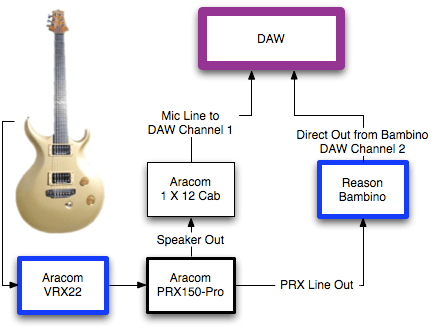
In any case, here’s a diagram of how I had everything hooked up:
In a nutshell, I plugged my guitar directly into my Aracom VRX22, which ran into the PRX150-Pro. I hooked up an external cab to the attenuator, placed a mic in front of the cabinet that ran into Channel 1 of my audio interface. Then, I ran the line out of the attenuator to the input of the Reason Bambino. From there, I went directly from the Bambino into Channel 2 of my audio interface.
I set up a clip from a song I wrote and added two tracks that took input from the two channels. I also panned Channel 1 full left and Channel 2 full right. Once I had the levels worked out, I recorded a solo over the existing music. Once the recording was finished, I took the Bambino’s signal slightly out of phase with Channel 1, to make it sound like two guitars are playing simultaneously. The effect is totally cool, and it creates a very in-your-face, big guitar sound! Here’s the clip:
Note that this is a kind of a different way to employ re-amping, which basically runs two amps in a series then out a single output. The way I employed it, the re-amped signal is a component of the overall package.
I’m falling in love again with my Aracom VRX18. This was the amp that first got me introduced to Aracom and my good friend Jeff Aragaki. My amp is actually a tweaked version of the stock VRX18 as it sports an EZ81 tube rectifier, plus a tweaked circuit that adds a bit more sag and sustain. The result is just a gorgeous overdriven tone that really brings out the best of the EL84 power tubes.
One thing about EL84 amps is that if they’re done right, they have a distinctive overdrive tone that creates a subtle top-end fizz when they’re overdriven. I’ve played others that drive the power tubes too much, and they sound very harsh and incredibly compressed. Jeff did this amp right, and while the power tubes do indeed compress a bit, the overdrive tone retains its open character, while adding that nice top-end fizziness that EL84 amp lovers have come to appreciate.
The clip below is an excerpt from a slow blues song I wrote. It features my beloved Goldie plugged straight into the Aracom VRX18, and it also features the insane Aracom PRX150-Pro attenuator! Believe it or not, the amp was recorded at just above loud conversation levels! We’re talking less than 1/10 of a Watt, and the amp still retains its tone and dynamics! Anyway, here’s the clip:
Summary: For what it brings to the table, this is a great little amp. While it’s mainly touted as a practice amp, you can easily gig with this at small venues, or attach an external cab to it, and you could easily keep up with a drummer!
Pros: Classic VOX ACx cleans, and nice, warm overdrive via the Class A EL4 power section.
Cons: 1/4 Watt setting really narrows the bandwidth. The amp sounds pretty lifeless at this level, but that’s why I have a great attenuator. I would play this at 4 Watts all the time. No need to ever use the built-in attenuator.
Valve/Tube Complement: 1 x 12AX7 (pre) / 1 x EL84 (power)
AC4TV Dimensions: 13.78″ x 8.46″ (D) x 14.76″ (H);
AC4TV Weight: 19.84 lbs.;
Power cable included
Price: ~$249 street
Tone Bone Score: 4.75 – I was very surprised by this little amp. The 10″ Celestion speaker really packs a nice punch, and the controls are dead simple. I would easily add this to my growing stable of amps!
I’ve been on this low wattage amp craze for awhile, and it’s wonderful to see all these great low wattage amps entering the market! Orange has the Tiny Terror, and VOX also has the Night Train. Those amps just mentioned are all pretty much modern styling, but I should qualify my craze. I love the old vintage styled low wattage amps.
It all started out with the Fender Champ 600, which I reviewed awhile ago here. I was looking for a low wattage tube amp that I could get some serious overdrive tone from without making my ears bleed. I immediately fell in love with that amp, and since I’ve had it have only made some minor changes, like putting in NOS tubes. But other than that, this amp has served me quite well, both in the studio and even in small venue gigs (using a 1 X 12 of course).
So it was a very nice surprise to encounter the VOX AC4TV in a store yesterday. This is a sweet looking little amp, with the classic TV type of box harkening back to yesteryear. The blonde vinyl is a very nice touch!
How it sounds…
The AC4TV is little tone monster. This single-ended amp packs quite a punch, despite its diminutive size and 10″ speaker. Surprisingly great tones are to be had with this amp, from your classic VOX EL84 cleans to some very nice crunch and grind when you push it. As a single-ended amp, it’s simple as expected, just a volume and tone knob, plus a selector switch for choosing 4, 1 and 1/4 watt output.
At 4 Watts, the amp puts out a great clean tone. With a Strat it starts mildly breaking up at about noon on the volume knob, and at about 10 o’clock with a humbucker – for that, I used a gorgeous sunburst finish Gibby ES-335 – damn I wish I hadn’t sold mine! Cleans with the ES-335 were incredibly lush as expected from that semi-hollowbody, yet they were also very chimey due to the natural character of the EL84 power tubes. It was a very good combination!
Going into grind, you get that classic EL84 crunch, but it’s obvious VOX must’ve installed a filter cap to prevent the power tubes from over-saturating and creating a compressed, squishy mush. The overdrive remains nice and open, with great dynamics and touch sensitivity.
At 1 Watt, the amp still retains a very nice tone, though the tone bandwidth is slightly narrowed. It’s not bad at all, and at this power setting you can crank the amp up (but keep in mind that sonically, 1 Watt is still pretty loud), but the volume will be fairly reasonable.
The 1/4 Watt setting was not really pleasing at all, though in a pinch, if you really have to be quiet, it’ll do as a reference point for practicing. At this setting, the tone gets muddy and the dynamics are abysmal. Were I to get one of these, I’d get the head and cabinet version so I could use a proper attenuator with this, and keep the amp in its 4 Watt mode to get all the gorgeous tones that the full power setting has to offer.
I any case folks, this is classic VOX tone. The EL84 are bright and chimey as expected, and when pushed, the amp doesn’t produce over-the-top overdrive. It’s nicely controlled and surprisingly smooth.
Overall Impressions
The rating says it all. I love the tones that this amp produces, and I love that classic blonde look. At a street price of $249, it’s a very nicely priced amp to boot! You can use this for practice or, with an external cab, there’s no reason it will not fit right in at a small venue gig. The custom power transformer has a lot to do with the power handling here, and it helps the amp produce a big voice for such a small package. Definitely a thumbs up for the VOX AC4TV!
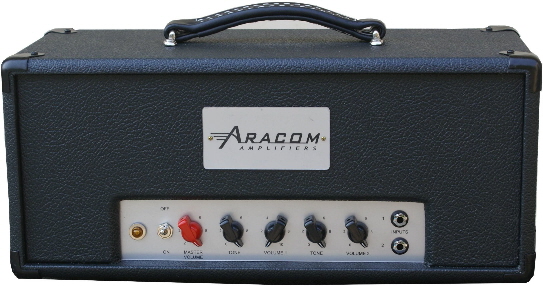
 Conventional tube-amp wisdom states that you get the most bang for your buck by replacing your pre-amp tubes. I’ve been a believer of this for quite awhile, and have tried out all sorts of pre-amp tubes in my amps over the years. A couple of days ago, I wrote that I had installed a new Mullard ECC83 (12AX7) into my Aracom VRX22. This particular Mullard is a Zaerix-labled ECC83 that probably came from the GDR (I didn’t look at the numbers – I really don’t care, for that matter). All I know is that it made a HUGE difference in the way my amp sounds. The overdrive instantly became smoother and more focused without top-end artifacts, and the notes are still very defined even at high overdrive settings on my amp.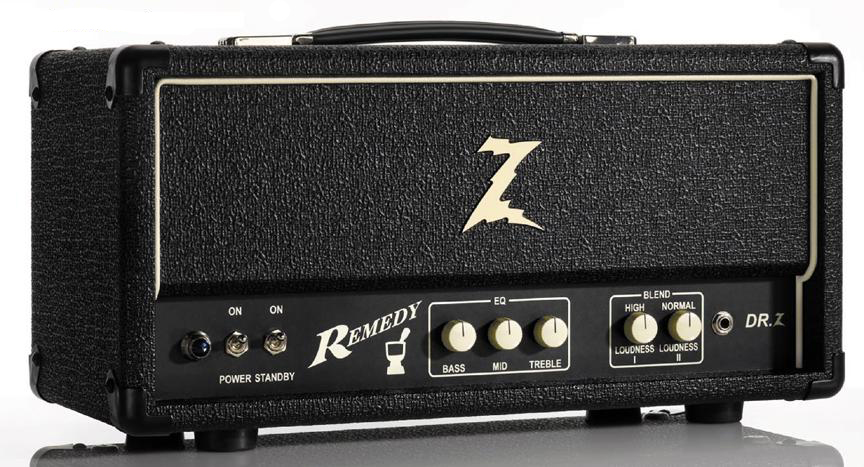


 x 8.46″ (D) x 14.76″ (H);
 Guitar Gear