Feeds:
Posts
Comments

Archive for the ‘guitar gear’ Category


Kasha KA-ODP-A

Awhile ago, I was perusing a forum where one of the members mentioned in a reply that it’s a good time to be a guitarist. There’s so much varied gear out there that guitarists have all sorts of options to choose from. One area of guitar gear that certainly seems to get regular entries is the overdrive pedal.

The OD pedal is something of which I never tire. There are so many great ones out there – I just can’t get enough of ’em. One such pedal that has just recently caught my eye is the KA-ODP-A 4-Channel Overdrive Pedal from Kasha amps. This pedal promises to be something special. Check out its features:

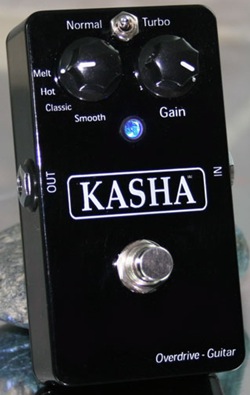
– 4 channels with separate voicing and gain structure
– Analog design
– 10 dB clear boost
– True bypass switching
– Very low power consumption (3mA and runs on a single 9V battery)
– No tone change, only enhances sound
– Compact standard aluminum chassis (4 3/8″x2 1/4″ x 1 1/4″)
– AC power jack (uses standard Boss DC power supplies)
– High gloss mirror black powder coat
– Hand made in the USA
– Low noise
– Crystal Blue LED (high intensity)
– Weight: 1.5lb

Built By an Amp Builder

There’s something about gear that’s built by an amp builder, especially when it comes to pedals or other peripheral devices. Amp builders have an innate understanding of the electronics behind tone, and how peripheral devices interact with their amps. A great example of this is Jeff Aragaki from Aracom Amps and his brand-new attenuatore, the Power Rox PRX150-Pro. Jeff totally gets it with how an amp interacts with a speaker, and the Power Rox is a testament to that. The same may be said of the Kasha overdrive in front of an amp. I had a chance to speak with John (Kasha’s owner and builder) this afternoon about the pedal, and it was clear from our conversation that this guy really understands the interplay between effects and an amp – especially with respect to overdrive.

Kasha has been around awhile, having been building the famous ROCKMOD line of amps since the 80’s, so they know something about amps, and their tone is well-known. Guitarists such as George Lynch and Davey Johnstone (Elton John), and tons of session guitarists have been playing ROCKMODS for years. So when John decided to build an overdrive pedal, he didn’t want to model it off of traditional circuits, so he created his own. The result is the 4-Channel Kasha Overdrive.

What’s very intriguing about this pedal is that it doesn’t have an EQ. John designed the pedal in such a way that it preserves the tone going in and outputs it with some OD “flavor” as John puts it. The thinking is that you don’t need an EQ if you’re not doing anything to the EQ of the signal. Smart.

The Kasha overdrive is a lesson in simplicity, having only two knobs: An overdrive selection knob to choose from one of the four different overdrives, and a gain knob. Very simple. But it also sports a “Turbo” switch at the top which will add a 10db clean boost to slam your pre-amp tubes with even more gain. But despite all that, this thing operates on 3 milliamps and only requires a standard 9V power source! That is incredible! My beloved Holy Fire requires a special 48V power supply! So what John has created is definitely special.

I’m going to be trying this pedal out in the next coming weeks, and I’m excited! I’ll keep you posted!

For more information, go to the Kasha product page (scroll down to the end to see the overdrive)

Read Full Post »

5 Tone Bones - Gear has stellar performance, value, and quality. This is definitely top of the class, best of breed, and it's a no-brainer to add this to your gear lineup!

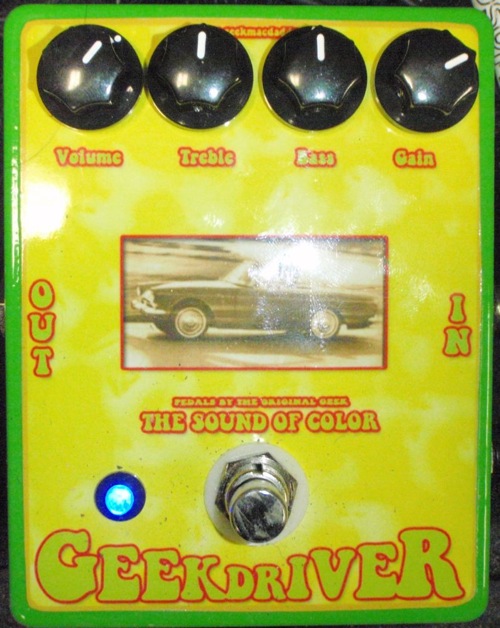
GeekDriver by the Original Geek

The GeekDriver by the Original Geek

Summary: Is it a booster? Is it an overdrive? No! It’s the GeekDriver.

Pros: From gorgeous, slightly fat boost to searing, face peeling overdrive with tons of overtones and harmonics, this pedal does it!

Cons: None.

Features:

  • Hand-wired and soldered in the US
  • Volume, Treble, Bass and Gain Controls
  • Neutrik and Switchcraft jacks
  • True Bypass

Price: $205 direct

Tone Bone Score: 5.0. I’m absolutely blown away by this pedal! I can’t say for sure, but this is a pedal that I’d almost always have on.

I don’t give 5 Tone Bones away lightly. I have to be so totally blown away by some gear that I have to give it my highest rating. When I first heard the GeekDriver on Geek’s Premier Guitar Video, I immediately became intrigued. Then when I finally met the Geek himself at the shop he shares with Tonic Amps, and he demonstrated the GeekDriver in person, I knew I had to have one, so I told him I wanted one, and tonight I picked it up.

What exactly is the GeekDriver?

As the Geek will tell you, the GeekDriver is based upon the ColorSound Overdriver that was popularized by Jeff Beck. At its core, it’s a clean booster, but the Gain knob changes the game significantly, giving you anywhere from mild breakup to ugly, snarling dog overdrive, replete with tons of overtones and harmonics. At high gain levels, it’s like the ugly dog that’s so ugly you can’t help but love it, if you catch my drift.

One thing’s for sure, it’s not transparent, nor is it meant to be. When active it adds a slight compressive fat boost at all volume levels. The effect is incredibly subtle, almost visceral, in that  you “feel” that coloration more than you hear it. This aspect alone made me give this pedal the 5 Tone Bones. The effect is so sensual and appealing. I know I’m using a lot of flowery adjectives here, but it’s because it’s so hard to articulate the emotional effect that compressive boost has on me. When I get that feeling, I know I’m onto something good.

Then you turn the gain up, and in addition to that colored boost, you get layers of overdrive which become this ugly fuzz as you increase the gain that’s total ear candy. But despite the cacophony of distorted signals, the tone is still incredibly defined and articulate. Unlike a pedal like the OCD which can get pretty muddy when you crank the gain, the GeekDriver just oozes thick fuzz, but never gets muddy. Nice.

How it sounds…

In a word, it sounds awesome. It is very hard to describe what it actually sounds like. It’s like a colored overdrive with fuzz attached. In any case here are a couple of clips (BTW, both clips were recorded at bedroom level using my Aracom PRX150-Pro attenuator. That thing ROCKS, retaining all my tone and dynamics):

In this first clip, I was just noodling, switching back and forth a couple times between the clean tone of my amp and the GeekDriver. Note that I set the Gain pretty high on the GeekDriver on the first section to show how ugly it can get – I love that sound!

In this next clip, I start the solo out only with the GeekDriver, with a very light pick attack. In the second part of the solo, I add my Abunai 2 to the chain to demonstrate how delicious the GeekDriver sounds when another overdrive pedal is stacked on top of it.

I believe the GeekDriver was meant to be stacked. I placed it first on my board, then ran my Tone Freak Effects Abunai 2, and my Creation Audio Labs Holy Fire after it. With both pedals, the GeekDriver just FREAKIN’ ROCKED THE HOUSE!!! Oh, it’s sounds f-in’ awesome by itself, but used as a “base” pedal in front of another OD or distortion pedal, and the mix is like nothing you’ve experienced!

Overall Impressions

As you can tell, I freakin’ love this pedal! I’m not surprise why Jeff Beck dug the original ColorSound Overdriver. This is definitely Geek’s unique take on that classic pedal, and what a unique take that is! It may not be for everyone, especially if you’re looking for a transparent boost. But if you’re looking for something totally different from your typical boost or drive pedal, the GeekDriver has a voice all its own. Like I said, it freakin’ rocks the house!

About the Original Geek

Meeting Geek was pure serendipity. I originally was going to Tonic Amps to meet Darin Elingson about his cabs and Fane speakers. I didn’t know the Original Geek shared a shop space with him. That’s serendipity for you.

For those who are familiar with Jeff and his creations, he is known as “GeekMacDaddy,” and for years, his pedals have been by GeekMacDaddy. But his company has gone through a recent name change, and is now known as the “The Original Geek.” But who cares about the name? I certainly don’t. I just know his pedals kick f-in’ ass!

For more information, and to order one, go to http://www.geekmacdaddy.com.

Read Full Post »

5 Tone Bones - Gear has stellar performance, value, and quality. This is definitely top of the class, best of breed, and it's a no-brainer to add this to your gear lineup!
Aracom Amps PRX150-Pro Attenuator
Aracom Power Rox PRX150-Pro Attenuator

Summary: This is hands-down the best attenuator on the market! I’ve played a lot of attenuators, and no other has been able to retain tone and dynamics at high attenuation levels as the Power Rox!

Pros: The Power Rox isn’t just an attenuator. It packs extra features that’ll just blow you away, making a it versatile part of your stage or studio rig!

Cons: None.

Features:

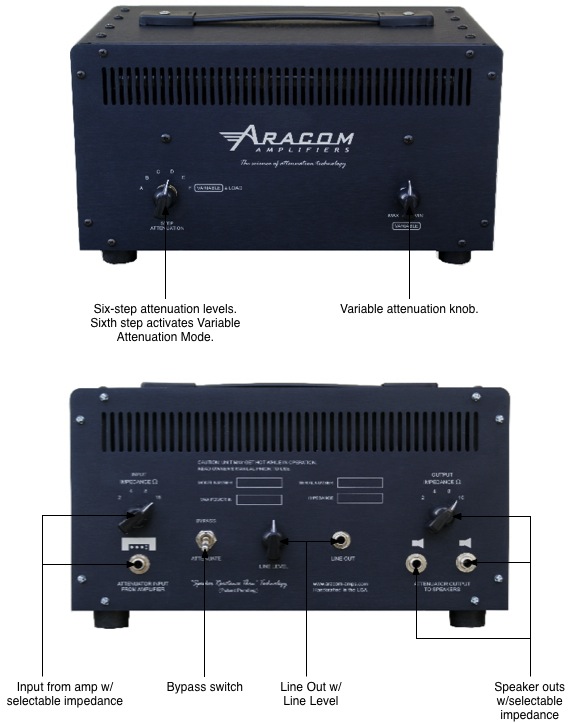
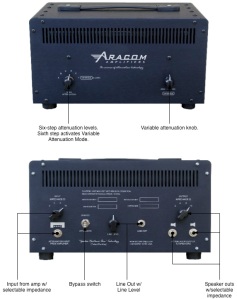
  • Rotary Switch provides (6) Step Attenuation Levels, plus
    the Variable Mode allows continuous variable control of “bedroom” level adjustment
  • 33dB attenuation range
    * Attenuates 100 watts down to well under 1 watt (0.05 watt).
  • 150 watt (continuous average) power rating
  • Independent Input Impedance Switch: 2, 4, 8, 16 ohm
  • Independent Output Impedance Switch: 2, 4, 8, 16 ohm
    * Uniquely allows mismatched amplifier and speaker impedances to be used.
  • Attenuator Bypass Switch
  • Load Mode
  • Line Out with Level Control
  • 2 Speaker Jacks (wired in parallel)
  • Passive design, does not require AC power
  • Rugged, black anodized aluminum housing
  • Heavy duty, steel reinforced handle
  • Handwired and Handcrafted in the USA.

Price: $649 direct

Tone Bone Score: 5.0. Jeff Aragaki of Aracom Amps never ceases to amaze me with the stuff he comes up with! This time, it’s an attenuator invention that blows away the competition in safety and tone and dynamics with its patent-pending Speaker Reactance Thru (SRT) technology, plus extra features that make it unmatched in versatility and usability.

I’ll admit it: As much of gear nut that I am, I’m also a huge techno-geek. I dig new technologies and the engineering behind them; and when someone comes up with some new approach to something, with completely awesome engineering, it’s hard to control my GAS. I just have to have it.

I recently took delivery of a brand new attenuator invented by Jeff Aragaki of Aracom Amps, called the Power Rox PRX150-Pro. This, by far, is the best attenuator I have ever used, and will be a fixture in my rig for years to come. That’s right. This will always be in my chain. But not just because of its ability to transparently attenuate an amp signal. This attenuator has features that no other attenuator has such as two speaker outs, and a Line Out that you can use to go direct into a DAW, or even another amp! Talk about versatility. Not only that, because you can match impedance in both the input AND the output, combined with Jeff’s patent-pending Speaker Reactance Thru (SRT) technology, you can squelch down the power of your amp and not worry about ever blowing our your tubes and ruining your amp. The SRT technology just kicks ass!

Talking the Talk AND Walking the Walk: Speaker Reactance Thru Technology

Jeff is a very humble man, so he’d never say anything like this, but I’m not nearly as humble, so I will say it: There’s not a better attenuator than the PRX150-Pro. Even if Jeff didn’t include all the extra features you get with the Power Rox, this attenuator simply kicks the shit out of all the attenuators I’ve ever tried – and I’ve tested several, including the Ultimate Attenuator that seems to be the most popular attenuator; and with respect to safety, tone and dynamics, all others simply pale by comparison.

Where other manufacturers make bold claims (read: brag) about their attenuators’ transparency, not only can Jeff Aragaki make the claim (in his quiet and humble way), he backs it up with detailed discussions of his SRT technology and the engineering behind it and what makes it so transparent. Jeff’s SRT technology is absolutely incredible. At any level of attenuation, the Power Rox retains your tone and dynamics. This is because instead of just dealing with amp power reduction through a series of resistors or a dummy load, which also have the added effect of flattening out the impedance curve and changing tone, the SRT technology ensures that reactance between the amp is maintained throughout the entire spectrum of attenuation; hence, the name “Speaker Reactance Thru.” This means that the impedance curve is kept intact so that the continuity of reactance between the speaker and the amp are maintained. Jeff discusses this in a detailed article about the advantages of the PRX150-Pro.

Let’s talk a bit about safety…

As I mentioned, the PRX150-Pro will not burn out your amp. You can crank your amp up all the way, getting that wonderful power tube drive, and not worry about your amp blowing a tube, or worse yet, frying some circuits from flyback voltage. We’ve all heard the horror stories about people using attenuators, cranking their amps, and blowing power tubes. A lot of this has to do with impedance mismatching. Some manufacturers have added options to match impedance from one direction, but the Power Rox has impedance matching in both the input and output jacks! But the point of this is that with impedance matching on both sides, you don’t have to deal with any type of mismatch. That is very comforting to know.

I’ve actually been playing with the Power Rox for the last couple of months regularly before it hit the shelves, and to date, I haven’t had any power tube problems. And we’re talking running my amps down to less than a watt for a few hours straight. I could never do that even with my Dr. Z, which is one of the more safe products out there. I’ve burned out power tubes using my Dr. Z by cranking power too much. It’s not pretty, and I’ve been lucky so far that only my tubes got burned out. It could’ve been a lot worse.

This ain’t yer Daddy’s Buick…

When Jeff first spoke to me about the Power Rox, I thought, “Okay, it’s another attenuator. I’m sure it’ll be great considering what a whiz Jeff is…” But when he delivered the unit, I couldn’t believe what he had added! I was already impressed that it had both input and output impedance matching. That was simply awesome. But he added some awesome features that I was not at all prepared for:

  • Bypass Switch – This is a mechanical bypass that completely bypasses the attenuation circuit.
  • Line Out – This one thing is just so cool! I used it to go both direct into my DAW, and also used it to re-amp into my Hot Rod Deluxe! Talk about versatility! For a test, I ran a cable to my 1 X 12 cab, then ran another cable to my Hot Rod. I could’ve easily just run direct into my Hot Rod without going out to another speaker as well, but you can see how useful this is. I could get my amp’s tone and combine it with the Hot Rod’s tone. So cool!
  • Two Speaker Outs – This is yet another cool thing. You have multiple cabs that you want to drive with a single amp? This makes it easy.
  • Input AND Output Impedance Matching – No other attenuator matches impedance in both input and output, but the Power Rox has it. It’s all part of the package to ensure continuous reactance between the amp and the speaker.

So as you can see, the added features make this oh so much more than just an attenuator, and it’s a testament to Jeff’s creativity!

The proof is in the pudding…

Unfortunately, doing sound clips of an attenuator’s effect is fruitless, because it is difficult to hear the changes, and moreover, it is difficult to describe the change in dynamics on a recording. However, the Power Rox was tested side-by-side to a number of popular attenuators, and even at low levels of attenuation, compared to Power Rox, all the other attenuators had an effect on tone and dynamics. To date, several people have performed head-to-head comparisons between different attenuators and the Power Rox, and they all come to the same conclusion: The Power Rox is truly transparent; not just the most transparent of the lot, but truly transparent. To me, this box sets the standard by which all others must be measured now.

I used my own transparency test procedure to compare attenuators, but Jeff has also provided a very detailed, and in-depth transparency test that you can view on his site.

I know, I must sound like a twitterpated schoolgirl with how I’m raving about this product, but for the very first time, I’ve been able to record my amps fully cranked without pissing off my family and neighbors, and more importantly, without having to worry that I’m going to blow a tube. Even with my Dr. Z, I’ve had to settle with less drive on my recordings for fear of burning out my amps. But with the Power Rox, I can crank my amps and get that wonderful power tube drive! And even better yet: I can trust that my tone and dynamics will not change, no matter the volume!

For more information on the Power Rox PRX150-Pro attenuator, go the Power Rox Product Page!

Read Full Post »
PRX-front-543You ever have an itch you can’t scratch? Well, it has been like that keeping my mouth shut about the Power Rox PRX150-Pro. Ever since I played with the early prototypes, I’ve been completely blown away by this attenuator! This is a totally new take on attenuator technology, folks, and I’m hoping it takes the industry by storm. Why? Simply because what we’re talking about with the Power Rox is true transparency in tone when this is in your signal chain; not “almost” transparent, but truly transparent.
Check out the Power Rox PRX150-Pro page at Aracom Amps!

Most comparisons between attenuators revolve around what’s the “most transparent” attenuator, indicating that really none of them are transparent, so people pick the best of the lot. And frankly, I’ve tested out several attenuators and ended up with the Dr. Z Airbrake, as I felt it was the most transparent out of the ones I tested. But nothing could have prepared me for the transparency of the Power Rox.

I could go on and on, but I won’t. In fact, I had already written a significant amount of text, but decided to just point you in the right direction. Go to the product page. Read through the product description, but more importantly, read the supplementary documentation behind the links at the bottom of the page. Jeff Aragaki has graciously provided some very in-depth articles on how attenuators work, and also provides a high-level explanation of the technology behind the PRX150-Pro.

Other manufacturers may brag about the safety and transparency of their attenuators, but none is willing to back up their claims with the engineering behind their attenuators (and if you knew what some were doing, believe me, if you care about your tone and the safety of your amp, you’d get worried). If you’re interested in or even use an attenuator, you owe it to yourself – and your tone – to check this unit out!

Read Full Post »

minutiae

I asked myself this question this morning while having my morning cup. I was ruminating on various ways to make my signal chain a cleaner. It’s pretty clean as it is, and I pride myself on having little to no electronic noise when my rig is at rest. But I still want it dead quiet. I don’t know if it’s entirely possible, but I knew there were things that I could do. So I started coming up with a punch list of things including getting high-quality cables with good shielding; replacing any non-true-bypass pedals on my board that often cause noise; things like that.

Then I stopped and asked myself, “Where am I at with my tone? Am I reasonably satisfied with it? Is there any specific thing that really needs addressing?” And the answer to those questions was no. I looked at my list and decided they were nice-to-have’s but not really addressing and particular problem or “hole” in my tone. Truth be told, as of late, I’ve been using pedals A LOT less as of late. While I may kick in an overdrive pedal occasionally, and usually have my reverb on, I’ve been doing without pedals. In fact, for the past couple of gigs I’ve played, I haven’t used pedals at all, except for a tuner!

I guess this is the dark side of being a gear slut; it’s really a borderline addiction; an urge akin to an itch you can’t scratch, a unicorn that can’t be caught. Like the cursed pirates in the Pirates of the Carribean, the desire for gear is a lust that is never slaked, or at least easily slaked. At times it gets to the point of not even having a reason for getting the gear – I just have to have it! 🙂

I was actually surprised by my moment of lucidity, and actually relieved that I pulled myself back from the brink of investing yet another few hundred dollars into gear. I also realized that as far as my rig is concerned, I’ve sort of reached a point where the law of diminishing returns is starting to kick in. Yeah, it would be nice to have high-end, expensive cables (I still may do that just for my pedal board), but at this point, it doesn’t really buy me much – even my pedal cables. And while I believe I would get an improvement in my tone, I think the improvement would be more subtle than anything else.

So here’s some food for thought: The next time you want to buy some gear, ask yourself if you’re already satisfied with your tone. Be honest. You may be surprised to find that you are.

Read Full Post »

perplexed Visit any online forum and you’ll see countless topics in the form of, “How can I get this sound?” or “Tell me what I need to sound just like ______________.” These are quite popular threads as people will chime in with their knowledge; however complete or incomplete, with the gear that a particular guitarist used. The discussions sometimes get quite lively as some personalities collide in an ego-fed frenzy. Okay, I’m exaggerating… 🙂 But they do get quite lively. I read through those threads both for pure amusement, but also to get educated about others’ approaches to achieving a particular kind of tone. It’s amazing the gear that I’ve discovered just because of these kinds of threads.

One of the most amusing topics I’ve run across in the recent past is people asking how they can sound like The Edge from U2. Let’s face it: The Edge’s rig has got to be one of the most complex arrangements of gear around. No one really knows what his complete signal chain is except his techs who set all his gear up, yet so many people chime in (albeit in an effort to assist, and that’s a great thing) with their suggestions. Unfortunately, all they can really produce is a fraction of the picture, and considering The Edge’s rig, probably a minute fraction at best. For instance, I once read he runs something like a 40 foot cable between some devices so there is a built-in lag. Damn!

Mind you, I’m not trying to put anyone down, but to me, discussions about how to faithfully, flawlessly reproduce a particular tone is almost futile; and as much I hate to rain on anyone’s parade, and as much as someone would like to produce a tone exactly as they’ve heard, they may get close – real close – but they’ll never get there 100%. Why? Because there are lots of factors that contribute to tone; not the least of which is the guitarist who originally created the tone in the first place! On top of that, you’d have to have the same guitar, with the same strings, with the same amp, with the same pedals (if applicable), the same pick; not to mention the exact same cables that were used. Then you’d have to try to produce live what was a recorded sound, and you can bet that guitar signal went through quite a bit of audio processing to produce the recorded tone. Get the picture?

Like I said, I’m not trying to rain on anyone’s parade, and perhaps these questions asked on the boards are purely out of curiosity, but I’m of the mind that if you truly aspire to be a great musician, let alone a great guitarist, you need to find the tone that pleases you. You may end up sounding similar to someone, but I think the best guitarists out there – no matter what their technical level is – are the ones that sound like themselves.

Read Full Post »

Sweetwood Guitar Company Ever since I started this blog back in 2007, I’m always tickled by how I sometimes just stumble upon gear manufacturers. With Tone Freak Effects, I happened to do a search on “tone freaks” to see if there were any interesting site out there. I found Red Bear Trading picks at a local guitar shop, and bought a couple after trying them out as I was curious what a $20 pick would play like (it was wonderful, of course). In other cases like Saint Guitar Company, a visitor to GuitarGear.org happened to mention that he had just got one in a comment. I at first thought the comment was spam, but decided to do some research. I’m glad I did because I’m going to soon take delivery of my first custom Saint Guitar Company Goldtop Messenger!

A couple of days ago, I was viewing a video of Tonic Amps, and noticed a guitar that I had never seen before (click on the video link, and you’ll see it at about 1:50). It was gorgeous! Birdeye maple top, solid maple body and neck from a company I had never heard of before called Sweetwood Guitar Company. Of course, The Dawg rarely passes up the opportunity to sniff out new gear to activate his GAS, so I did a search and found the Sweetwood Guitars site. These are VERY NICE guitars! Very simple and straight-forward in their design, with a real vintage vibe going on.

Not wanting to stop at just looking at pictures, I went to the contact page, and was blown away! Sweetwood Guitars is local to me! In fact, they’re only about 15 minutes away from my house! Shit! I’m in trouble! 🙂 But it’s a good trouble!

Anyway, I gave Glenn, Sweetwood Guitars’ owner and luthier a call, and will soon be doing a test run on a couple of his guitars. When I called him, he was on the road traveling back up to the Silicon Valley from LA, where he has the finishes done, and he was bring back a bunch of guitars! I can’t wait to hook up with him and try out these beauties!

For more information, check out the Sweetwood Guitar Company web site!

Read Full Post »

Guitar_shop_by_Stockholm__Syndrome Lots of people – manufacturers and end-users alike – boast about the “transparency” of a particular device. Manufacturers like to use that buzz-word as a marketing ploy, but after spending the last few years evaluating tons of gear, I’ve learned to be very wary of manufacturers,’ and especially end-users’ claims of a device’s “transparency.” So to test out their claims, I’ve come up with a little test that doesn’t require measuring voltages or impedance curves or force you to perform complex mathematical analyses to prove a device’s transparency.

In fact, the test is so simple that when I tell you how to perform it, you’ll probably laugh! But believe me, to me this test is the ONLY transparency test that matters!

First off, let’s establish what we mean by “transparency” so we have a common reference from which to build. What seems to be the prevalent perception about transparency is that it is a function of both tone and dynamics; that is, a device’s transparency means that when it is engaged, you still hear your original tone, and you feel or perceive the same or similar dynamics of your original signal. Notice, no calculations or measurements. And mind you, I’m not just making this up. Go to any gear discussion board and search on transparency, and invariably the descriptions you will be given will be based upon what people hear. So given that reference point, let’s get into the test, shall we?

The Transparency Test

  1. Attach your device where it is supposed to sit in your signal chain, but do not engage it.
  2. Play a simple riff or strum a chord and remember what you just played with the device disengaged to establish your base tone.
  3. Engage the device.
  4. Play exactly what you played in Step 2 in exactly the same way.
  5. Make a note – either mentally or by writing it down. Are your tone and dynamics retained?
  6. Repeat steps 2 to 5 with a variety of settings on the device.

The test is so simple, you may be chuckling right now. But once you’ve done the test, if you’ve detected an audible difference in tone and dynamics, then the device isn’t transparent. I’m sorry, but there’s no arguing that. But lack of transparency is not necessarily a bad thing. But what we’re really talking about then is what’s acceptable tone, and there is a HUGE difference between what’s acceptable and what’s transparent.

Take, for instance, the Ultimate Attenuator. I hate to keep on picking on this device, but I’ve always had problems with the manufacturer’s and user’s claims of the Ultimate Attenuator’s transparency. This is an incredibly popular attenuator – probably the most popular out there. People love it, and as you know, I will never fault people for purchasing gear that sounds pleasing to them. So if the tone that the UA produces is acceptable and pleasing to you, keep on using it!

But let’s be clear here: The UA is NOT transparent. There is no way it can be transparent simply because once you hook up your amp to the UA, you are immediately hit with a non-reactive, 30 ohm, fixed resistor that essentially flatlines the load that your amp sees. This is compensated for by the UA’s built-in solid state amplifier, but that is the amp that is now reacting with your speaker. All the original amp is doing at that point is providing a base signal that is then re-amped with the solid state amplifier to produce the output signal. An amp’s tone is a function of its reactance with the speaker. In the case of the UA, it is the solid state amplifier that is providing the reactance with the speaker. But hey! The UA sounds good to lots of people, so I won’t knock the device itself. But what I’m illustrating here is the difference between acceptable tone and transparent tone.

So let’s circle back a bit. The point of this article is that you should be wary of people’s claims of a device’s transparency. If you do the test above, and find that the device really isn’t transparent, then you have to ask yourself if the tone it produces is acceptable to you? If it is acceptable and pleasing to you, that’s really all that matters!

Read Full Post »

Tonic AmpsFane

I love living in the Silicon Valley. While it might not be considered a “destination” for music and culture like San Francisco, New York, Nashville, and Saint Louis, it is a destination for technology, and for decades has led the world in many of the technological advancements we enjoy today. Having lived in the Silicon Valley all my life, and watching it transform from a largely agrarian economy to the mecca of high-tech and venture capital, one thing has remained the same: The Silicon Valley has a certain magic about it that inspires innovation and invention.

So it is no surprise that there are several boutique amp manufacturers in the area. I’ve written about a couple in the past, namely Aracom Amps and King Amplification, but recently, I hooked up with Tonic Amps, located in Mountain View; less than 10 minutes from my home!

Darin Ellingson contacted me  last week, and invited me to come to his shop. While I knew he built amps, what I didn’t know until I did a bit of research is that Darin is Fane International’s North American distributor for Fane speakers! That got me really interested in Tonic – especially Darin’s cabs. Over the years, I’ve heard so much about Fane speakers, but have never had the chance to hear how they sound. And what great fortune that the North American distributor is 10 minutes away from my house!

In a nutshell, I played through three types of Fanes in 2 X 12 and 4 X 14 cabs: Studio 12L, AXA12, and Medusa 150. Plus, I got a sneak peak at some prototype Fanes Darin is having specially made. Through Tonic cabs, the Fanes sound drop-dead gorgeous! I hooked up three different amps to various Tonic Amps: A Reason Bambino, Aracom VRX18 (tube rectified), and a Tonic Torpedo. No matter what amp I played through, the Fanes sounded crisp, articulate and incredibly dynamic. Folks, this is the way to evaluate speakers. Frequency response charts are useful, but until you’ve got the speakers loaded into a cab, you will never know how they truly perform. Tonic cabinets are absolutely top-notch, and if you’re in the market for a great cabinet, you can’t go wrong with these. They’re all solid wood (no pressboard here), and the dimensions Darin has specified really bring out the best character of the Fane speakers.

What was my favorite? It’s a toss-up between the Medusa 150 and Darin’s prototype that he will hopefully bring into production soon. I love the scooped tones of the Medusa and the mid-ranginess of the prototype. Hmmm… can you say 2 X 12 cab with these in it? HAHAHAHAHAHA!!! Dammit! Gave myself GAS again! It’s probably a good thing I can’t afford them right now – I will have to save my pennies. The speakers and cabinets don’t come cheap, but for this tonal quality, it’s worth every penny. You wouldn’t put a great speaker in a cheap cabinet… maybe… No, I won’t even get into that debate… 🙂

Torpedoes Away

Based upon the classic Trainwreck circuitry, the Torpedo is a pedal lover’s wet dream! I played the 50 Watt version, which is powered by a pair of EL-34’s! Folks, we’re talking clean headroom with this amp, with minimal breakup at the top end of the volume sweep. The tone is thick and rich and very well-balanced. I didn’t notice an overabundance in any part of the EQ range… well… it did have just the slightest amount of midrange, but that’s good though, because this amp’s tone will play nicely in a mix.

At any volume level, the amp sounds great, but its true character comes out when you dime the volume and play it through a 4 X 12 cabinet. Throw a couple of pedals in front of it (we used the British Ball Breaker and a prototype GeekDriver/GeekRanger pedal in front of the amp), and the amp’s tone combined with the 4 X 12 will knock you across the fuckin’ room! Can you say wicked overdrive that makes the hairs on the back of your neck stand up? It was amazing to witness!!!

The “Torpedo” moniker is totally appropriate for this amp. It is meant to fire out a shot of gorgeous tone, blow you out of the water, and knock you into tone heaven! Even at the volumes we were playing at, this tone isn’t a face-peeling raucous. Granted, a lot of that quality had to do with the Fane speakers we were playing through, but just as with you not putting great speakers in a shitty cabinet well, you don’t play a great amp with shitty speakers either.

If you live in the Silicon Valley, I encourage you to contact Darin and check out his workshop. It’s set up for jamming, so bring an axe or two! Darin’s even got beer! Though next time I go to his shop, I’ll bring a 12 pack. BTW, he like Tecate. 🙂  For more information, check out the Tonic Amps web site! To get a reference for how great Tonic Amps sound, check out Darin’s YouTube site at: http://www.youtube.com/user/MrTonicAmps.

Read Full Post »

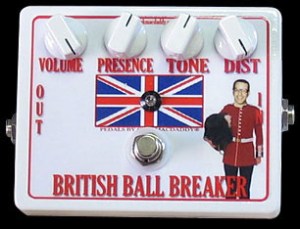
GeekMacDaddy British Ball Breaker

I had such a great evening tonight! Darin from Tonic Amps invited me over to his shop to try some amps through his excellent speaker cabinets (be on the lookout for a review in the next day or so). He has a very cool workshop that he also shares with “GeekMacDaddy,” who makes some absolutely KICK-ASS pedals! I got to try out a few of them tonight, and absolutely fell in love with the British Ball Breaker, which GeekMacDaddy touts as a classic Marshall Plexi in a box. He’s not kidding, either. This is a helluva pedal, with rich, thick, overdriven Marshall tone. Just set your amp on clean, crank the master volume, engage the British Ball Breaker, and you’ll be rewarded with gorgeous Marshall-esque overdrive!!! YOWEE!!!

You gotta check out these pedals! They just rock! In addition, GeekMacDaddy is just about to release another freakin’ fantastic pedal called the GeekDriver that is a totally awesome take on a drive pedal. It sounds awesome by itself, but this pedal was built to be stacked, providing the foundation tone, then driving another fuzz or overdrive pedal. Rockin’!!!

Damn! Two freakin’ awesome pedals that I will have to get – as if I need more! But hey! You know me and overdrive pedals! I just can’t get enough of them!

Here’s a great demo video of both the British Ball Breaker and the GeekDriver from PremierGuitar:

Notice that GeekMacDaddy’s playing through a Tonic Amp! Those amps just rock as well! However, I’m getting ahead of myself!

For more information, go to the GeekMacDaddy site!

Read Full Post »

« Newer Posts - Older Posts »