Feeds:
Posts
Comments

Archive for the ‘guitar gear’ Category

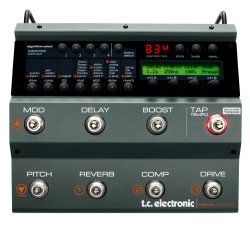
…that is the question. I recently had the chance to check out the TC Electronic Nova System, Multi-Effects processor, and it has given me pause. Over the years, I’ve been a bit of purist regarding effects, and my response to multi-effects has been, shall we say, tepid at best. My thought is that a ME unit is a compromise. What you get is a decent collection of effects; or in the case of the Roland ME-50, a boatload of effects. But they’re mediocre at best. It doesn’t seem to be so with the Nova System, which has some very nice features. It doesn’t have near the number of effects that other ME boxes have, but what it brings to the table is the high quality you expect from TC Electronic.

This is a very intriguing ME system – but I’m not sure that I’d spend $699 for one. It’s a bit steep, and though I do love the drive on this pedal, I love my Tube Screamer and OCD boxes more. Who knows? I’ll have to play around with it at the shop before I draw any more conclusions. For now, if you’re curious, check out the video from I believe the Winter NAMM show:

Read Full Post »

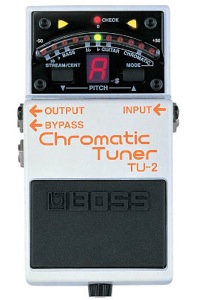
BOSS TU-2 Chromatic Tuner

BOSS TU-2 Chromatic Tuner

BOSS TU-2 Chromatic Tuner
Summary: Basic, no-frills chromatic tuner in a convenient stomp box that can also double as a power source.

Pros: Super-convenient stomp box makes on-stage tuning a breeze. Tuning mode automatically cuts off signal to the rest of your board for relatively “silent” tuning.

Cons: Only has 11 total LED’s, so fine adjustments aren’t possible.

Price: New $99 Street

Features (fr. BOSS site):

  • BOSS world-renowned TU-Series tuner accuracy in a convenient stompbox design
  • Mute/Bypass select for silent tuning with a single stomp
  • 11-point LED indicators and new “stream” meter display tuning discrepancy via speed and direction of LEDs (speed of LED movement gets slower as pitch becomes more accurate)
  • 7-segment LED displays string and note names, easily visible on dark stages
  • Seven easy tuning modes include Chromatic, Guitar Regular, Guitar Flat, Guitar Double Flat, Bass Regular, Bass Flat, Bass Double Flat
  • Tuning mode setting and display style choice stored in memory
  • Adjustable reference pitch from 438 to 445Hz
  • 8-octave tuning range–the widest in its class
  • Footswitchable Tuner Off mode preserves battery life by disabling LEDs

Let’s face it: Tuning is a fact of life when you play any musical instrument. And if you’re like most gigging musicians, you don’t have a guitar tech at your gigs to tune your guitars in between songs. For that, you need a tuner. For years, I used a cheap, hand-held analog tuner with a sweep meter for tuning. It was very accurate and did the job well, but as I started to gig more and more, having to turn the volume down on my amp to tune soon became irritating.

So I decided to get a stomp box tuner, and went down to Guitar Center and bought the TU-2. Now I will be the first to admit that I didn’t do much research before buying the TU-2. I’d recently read an interview with Joe Satriani and he had a TU-2. I figured if something’s good enough for Satch then it’s definitely good enough for me. It was a safe bet then, and it’s a safe bet now. The TU-2 is solid performer that’s fairly accurate, though no LED-based tuner could even possibly suss the accuracy of a strobe or analog tuner. But for what it does, I’m pretty satisfied with it.

Another nice feature about the TU-2 is that it can also act as a power source for up to either other pedals. I power up my board with a Dunlop DC Brick, but once I used up the 6 available 9V ports, I couldn’t add more
pedals without having to get another brick. For one or two pedals, that’s just not a good justification when you’re spending 100-bucks. The TU-2 comes with both a DC-in and a DC-out port. You can use a standard 9V cable to hook up another pedal, but it probably makes more sense to spendΒ  the $12.99 and buy the BOSS PCS-20A power cord, which will route power up to eight pedals. Caveat: The cable runs between connectors are short. BOSS assumes you’ll be using nothing but BOSS pedals, but with tone freaks, that’s rarely the case. But it is a cheap, convenient solution nonetheless.

So what’s my verdict? I wouldn’t have it if I didn’t think it was useful. It’s not in any way, shape, or form something to do cartwheels over, but it’s a solid pedal that gets the job done. At Harmony Central, when you write a review, they ask you what you’d do if it the gear you’re reviewing gets broken or lost. Were I to review this pedal there and answer that question, I’d probably take a serious look at the Korg stomp box tuner that sports more LED’s and is a bit more accurate than the TU-2. The only thing that would probably keep me from switching is the ability of the TU-2 to provide power to other pedals.

Rock on!!!

Read Full Post »

Roland Cube 60 Amplifier

Roland Cube 60 Amplifier

Roland Cube 60 Amplifier
Summary: Built like a tank, great-sounding and versatile, the Roland Cube 60 is at home on the road and in the studio.

Pros: Built-in Roland COSM modeling technology to mimic 9 British, Vintage and Modern amps, plus an added Acoustic mode. The Cube 60 also sports Recording Out, Line Out and Speaker Outs, plus a Tuner Out that can feed a Tuner independent from Volume control. Very loud for a small amp!

Cons: Reverb sounds hollow and a muddy at higher settings, with a definite loss of clarity.

Price: New $300-$359 Street ($250-$275 used)

When I bought my Cube 60 a three years ago, I wasn’t even looking for an amp. At the time, I was using a Line 6 Flextone III that served my purposes beautifully. But when you’re a gear freak and you just happen to have a bit of coin to spend well, some things just can’t be passed up.

Such was the case when I was perusing my favorite local gear store. I sauntered into the cramped guitar area, and saw this tiny black cube amp sitting against the wall. Intrigued, I picked it up by its handle and marveled at not only its diminutive size, but also its light weight (it weighs only 25 lbs.). Then Jordan, the guitar guy walked up and said, “I just got me one of these. It sounds awesome, and you can use it anywhere.” Normally, when I hear stuff like this coming from a salesperson’s mouth, I just nod, smile and say, “Cool.” But I’ve known Jordan for awhile, and I’ve learned to trust him. After all, he’s a gigging guitarist who knows his gear. When I hear him even slightly rave about something, I know it has got to be something cool (not that I can always afford the stuff he says is cool, but that’s another story).

So instead of my usual reaction, I silently pulled a Strat down from one of the hangers while Jordan went to fetch a cord. Big mistake! πŸ™‚ It took me no longer than 10 minutes to know that I had to have this amp. Plus it was on sale for the Christmas season, so I got it for $50 less than normal retail!

I won’t go into the technical details of this amp because you can google for them. Let me just say this: This amp kicks ass! While I use my Fender Hot Rod for my electrics on stage, I use this with my acoustic, and it’s a dream. There’s something about the Acoustic channel on this amp that makes my Ovation sound like a Martin dreadnought! It’s that sweet

But in the studio, I use this amp a lot for recording backing rhythm parts. Even though it’s a modeling amp, which I normally don’t really get too wild about, this amp produces really nice tones in all of its amp modeling settings. And with its recording out jack, which shuts off the speaker, I can safely record deep into the wee hours of the morn without worrying about waking the neighbors. Surprisingly enough, it sounds great going direct into my DAW. In fact, I recorded this song using nothing but my Roland Cube 60. Of course, there’s nothing like the sound that a cranked tube amp produces, but late in the night, when you’ve got the inspiration, having the convenience of an amp that sounds great going direct is very nice!

Finally, did I say this amp is LOUD? You’d never expect the kind of volume that this amp is able to produce. At home, I rarely take the amp above 9am on both the Gain and Volume knobs. Any louder, and I’d start getting calls from the neighbors and complaints from my wife! πŸ™‚ One of my close friends uses this amp for gigging, and he loves its versatility. Mind you, this is a guy who has tons of gear. His amps include a Marshall JCM half stack, and a gorgeous ’71 Fender Twin. But he likes to gig with the Cube because it’s so versatile AND it’s incredibly light! Weight matters when you’re hauling gear.

This amp is definitely worth a look.

Rock on!

Read Full Post »
As you can see, I added a linked graphic to my right-hand pane that goes to an article I wrote about the SAINT Guitar Company. This is a mini-site that I’m creating to help get the word out about SAINT Guitars (and no, I’m not being compensated for this).

In any case, I know there are a couple of you who have either a Messenger or Benchmark, and I was wondering if you had any sound bites of either of these guitars you’d like to send me, so I can put them up on the mini-site. I’ll also forward them to Adam, so he can put them on his own site.

Any takers?

Read Full Post »


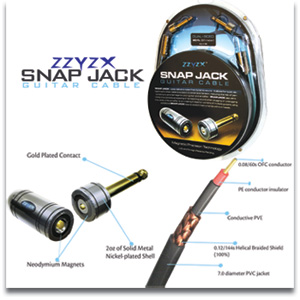
A good buddy of mine, Phil, of Phil ‘N The Blanks, e-mailed me the other day, raving about ZZYZX Snap Jack instrument cables. Even though I’m a gear freak, I had to admit that I never heard of ’em, so I did some research.

According to company ZZYZX company blurb:

Snap Jack Tips are made out of neodymium magnets with 24 carat gold plated contact. Snap Jack magnets allow for quick separation when the cable is subject to excessive tension, thereby reducing the risk of personal injury and damage to your equipment, while eliminating any obnoxious popping or screeching sounds when it snaps. It also avoids the popping screeching sound during plugging or unplugging of the cable while the amplifier is on.

Very intriguing. In fact, that’s downright cool. We’ve all experienced jacks popping out with the accompanying snap, crackle and pop of our amp, and the ensuing hum… Sound familiar? With a Snap Jack cable, if the tip releases, you don’t get any of that pop. This could be used for some quick axe changes as well.

I’m intrigued enough where I’m going to buy a couple, along with some extra tips. The cables themselves aren’t that expensive – under $40 – so it’s definitely worth a look. Here’s a link to Musicians Friend.

Rock on!

Read Full Post »

Just wrote this one today. While a love song, I wanted to be careful about the lyrics because it’s easy to get cheesy. πŸ™‚ But at the same time, I didn’t want to get really cerebral like Sting because I can’t do it as well – sounds way too formal and contrived, whereas Sting can almost always pull that stuff off.

For equipment I used:

Fender Stratocaster for main rhythm riff (set to middle/bridge position)
PRS SE Soapbar II for the solo (used the bridge pickup and ran it through my vibe pedal).

Mic’d my Fender Hot Rod Deluxe. I just love that amp!

Read Full Post »

Whether or not you write songs, there are times you might be noodling on your or just plain thinking, and suddenly, out of nowhere, a riff, or a way to play a certain phrase pops in your mind. If you’re lucky, you’re nearby some recording equipment. But more likely than not, like me, you’re driving in your car, or doing something that is not guitar related.

This has happened to me so many times when I’m driving to or from work. When I can, I’ve pulled off the road, and work out and write down the riff. But oftentimes, when I finally get back to my notes and start playing the riff, it just doesn’t have the same vibe as when I originally wrote it down, and I have to spend quite a bit of time recapturing that feeling. If I only had a way to record the riff as a reference, then I’d be able to capture the chord progression or phrase, plus at least some or most the tonal subtleties.

It turns out, there are some pretty good ways to do this. I’ll cover a few here:

  1. Did you know that most cell phones, especially later models have the ability to record both audio and video? My LG Shine records both audio and video, and I’ve used it twice now to record a riff I came up with while driving down the road. The second time this happened, I pulled into a rest area, pulled out my guitar, got my phone out and started recording. Some passers-by thought I was on a video scavenger hunt… yeah, I admit, it was rather weird, but I didn’t want to lose the riff. It didn’t help that I was also trying to hum the melody, so I sounded like a retard making noise. But then again, like I said, I had to capture that riff… It actually turned into this song. For those of you who read the original article about the song, I talked about what triggered the song, but I didn’t mention how I actually captured it… πŸ™‚ In any case, I’ll admit that it’s not the most optimal alternative, but it certainly works in a pinch.
  2. Lots of digital point-and-shoot cameras also have both audio and video recording capabilities. I usually have my camera with me, so that is an alternative as well.
  3. Finally, the most optimal solution would be to have a digital stereo field recorder. There are lots of ’em on the market nowadays, and they aren’t very expensive, ranging from a couple of hundred to a few hundred for very nice units. The three that really stick out for me are:Tascam DR-1 Portable Digital Recorder ($299)
    Edirol R-09HR Hi-res Digitial Recorder ($399)

    There are lots more, but then we start getting into the $600+ range. Conceivably, you could also use just a mono recorder, and you can get those cheap – under $100!

Of course, if you’re by your Mac (if you have one), it’s a non-issue. Just open GarageBand, and record… but that’s another story…

Allan Holdsworth picture courtesy of InnerViews.org

Read Full Post »

It just occurred to me that I haven’t gotten any new gear lately. Okay, I just got a new PRS SE Soapbar II guitar a couple of weeks ago. But the thing that struck me was that I wasn’t really even in the market for a guitar when I got it – I wasn’t even thinking about getting a new guitar! The opportunity just kind of presented itself, and I acquired it.

My approach to guitar gear lately has been much like the graphic to the left. Think of the signs being different pieces of gear that point the way to different paths in a journey for tone. I’m at a huge fork in the road right now, and don’t quite know which path to take.

But maybe that’s not such a bad thing. Come to think of it, I’m pretty happy with my tone right now. Unless something mind-blowing comes along, I’m probably not going to be looking to get any new pedals for my rig. I would still like to get a new amp; especially one that has a tube rectifier in it because I love the voltage sag you get from a tube rectifier and the reverb-like tone it can give you. But I can live with what I’ve got for probably years to come.

All that said, I think I’m in a good place with respect to gear, and you know what? I’m actually okay with coming to this fork in the road. It’s a bit liberating because unlike the picture, I’m not really scratching my head trying to figure out which way I want to go tonally. I’ve got my sound, so all things being equal, any path is good – at least for now.

But ever one that has dreams of attaining gear, here are some things completely beyond my current budget that I’m dreaming of getting one day (not necessarily in order of acquisition):

  • Either a Victoria Double Deluxe or a Victoria Victorilux
  • King Amplification Uptown 33 (Kenny Neal plays one and it SCREAMS!)
  • Vox Virage
  • Gibson Les Paul Double Cutaway (this actually is not too far out of reach, but it would be tough now).
  • Vox AC30 (I dig that tone!)

Read Full Post »

Yesterday, I received the following comment on my rating system page:

Hey , I just purchased a SAINT GUITAR COMPANY “bechmark” model From MESA/BoogieΒ  Hollywood. It isΒ  by far the nicest custom instument I’ve ever Played . Y’all shouldΒ  check them out. The only reveiws I’ve seen for these is on harmony central.Any who . .Β  check em out .

At first, I thought it was spam, but wanted to be fair and do some research first before I marked the comment as spam. So I called the Mesa Boogie store in Hollywood to see if they carried the guitars, and they confirmed that they did, but only sold them on consignment. The sales guy did say the guitars both played and sounded awesome, so that was encouraging and piqued my interest even more. Then I read the reviews on Harmony Central. Every review just raved about how playable and sweet sound the guitars play, which made me a little leary because it’s entirely possible that they could’ve been planted. I did find the company’s web site, but it’s so new that a lot of stuff doesn’t work on it. I also left a message for what appears to be the founder of the Saint Guitar Company – hopefully he’ll call me back.

It has been a long time since I’ve heard of any truly new guitar brand; I mean, this brand came out of the blue for me! It’ll be interesting, to say the least, to get the low-down on these guitars.

BTW, if you have any other information on the Saint Guitar Company, please let me know!!! πŸ™‚

Read Full Post »

Lots of people ask me if there’s a process I go through when I want some gear, if I have any tips for buying gear, so I thought I’d share some ideas. Before I dive into details, let me advise that you should first evaluate your need. I came up with a great way to do that – as long as you’re completely honest with yourself. Check out my GAS Management Page.

So let’s say you’re definitely going to get some gear. You’ve done the GAS test, and it says, “buy, Buy, BUY!!!” You still need to come to terms with acquiring it. If you have the resources, it’s a simple matter of ordering, but if you’re like many of us with limited financial means, you need to find some creative ways to get the gear. So here’s some do’s and don’ts….

  • DO: Try bartering first. I’ve bartered my talents as a web developer for lots of things. It’s a win-win for both you and the seller, and most of the time, all it takes is time.
  • DO: Wait a week or two to see if your wanting settles down. In many cases, you’ll find that you don’t really need the gear, though it would be nice to have.
  • DO: Put gear on layaway. It’s a financial commitment to buy within a certain period of time, but you don’t get charged interest.
  • DO: Negotiate the price. Everything is negotiable in some respect. If you can’t get the price lowered, see if the seller will throw something in with the gear. You’ll find that even major retailers will do this. I’ve gotten lots of sets of strings this way, to the point where I haven’t purchased any strings for a few years. πŸ™‚
  • DON’T buy on credit or financing, unless you plan to pay off the entire purchase within a couple of months. I’ve racked up thousands in the past doing this, and it’s not a pretty sight getting rid of that debt.
  • DON’T be impulsive. Make an acquisition plan, and stick with it.
  • DON’T bail and settle for something cheaper. You’ll be sorry you did. But let me qualify that.Β  If that something cheaperΒ  fits your need better than theΒ  more expensive item, by all means get it. I did this with my Strat, literally saving $2000!

Oh well… that’s it for now… If I come up with more DO’s and DON’TS, I’ll post more…

Rock on!!!

Read Full Post »

« Newer Posts - Older Posts »