Feeds:
Posts
Comments

Archive for the ‘guitar gear’ Category

Photo courtesy of Courtesy of Sollophonic Guitars, UKMy blog buddy IG wrote this article on a DVD for guitar maintenance the other day, and as oftentimes happens, his article sparked an idea – what if I set up my guitars myself? So, guitar tools in hand, I set off to do it. In short, now I know why I’ve sent my guitars to a tech… 🙂 Well… now that I’ve done it a couple of times, I think I’ll be doing it myself from now on.

While IG’s article did play a huge role in motivating me to set up my guitars, I had a pressing need to set the action and intonation of a my brand-new PRS SE Soapbar II. When I got it, it played like a dream, but the action was set a little high for my liking.  I knew I’d have to have it set up, but I didn’t have the time to bring it down to my tech, and I was going to gig with it this coming weekend! So with a deep breath (actually several to calm myself down), I set up a clean, padded workspace, and went to work.

Thirty minutes later, I was done! It really didn’t take all that much time to dial in after all. A few twists of a screwdriver and allen wrench, and I had my SE ready to go. That said, I was lucky because there wasn’t any bow in the neck that I had to adjust – this time. But I’m really jazzed that I finally did some instrument maintenance myself – other than changing strings. I immediately went to work on my Strat and ES-335 guitars, and they’re in top form again!

So for all of you who have even the slightest inkling of working on your own guitar(s), let me share some things I learned from this experience:

  • First of all, it’s totally worth it to learn this skill. Not only is it personally rewarding, you’ll save yourself tons of money. Think of action, neck bow and intonation adjustments like doing simple maintenance on your car. That said, if I need fretwork done, I’ll still bring my guitars to a tech. I don’t trust my feeble skills with major work.
  • Lots of small adjustments are way better than a few big adjustments. You’ll make minute tweaks anyway to get your adjustments spot on, so have the patience to make your adjustments in small increments.
  • After each tweak, re-tune all your strings. This will ensure you’re measuring against playing tensions. I didn’t do this at first, and would have to tweak and re-tweak a few times.
  • I mentioned patience above. I’ll mention it again. For someone like me, if patience was a virtue, I’d be a slut. It really took all of my will power to just relax and go with the process.
  • Floating bridge adjustments are much harder to dial in than fixed bridge adjustments – you really have to make very minor, incremental tweaks with a floating bridge (my SE and 335 both have floating bridges). Fixed bridge axes have individual saddles, so they’re a bit easier to dial in

ROCK ON!!!

Read Full Post »

In my previous post today, I wrote about the value of using and evaluating gear in the place you’d normally use it before buying because you never really know how something will perform until you use it outside of a controlled environment. I got the chance to do that this past weekend, and in a word, this guitar is impressive. It’s incredibly playable, and even though the action is a bit higher than I like it, the neck is fast due to the slightly shorter scale length.

With a shorter scale length than my Strat, I was expecting even less sustain, but the solid mahogany body and neck combined with the beautifully polished rosewood fretboard provide for a warm, resonance with lots of sustain. It was pure joy bending a note, applying a bit of vibrato, and hearing the note just float in the air (sorry, couldn’t help but wax rhetorically).

Tonally, the P-90’s being single coils sit very close to the Strat, but without the chimey sound normally associated with a Strat. The tone is just a tad thicker and a little darker, but nowhere near as dark as humbuckers. I’ve been really diggin’ on the clean tone from neck pickup. It’s surprisingly deep without being boomy – almost like a plugged-in acoustic. It’s really great for playing clean leads. Switching to the middle position introduces the bridge pickup, and this setting is great for crunchy rhythm parts. Finally, I can finally say that I’ve found a guitar that has a single-coil bridge pickup that is usable to me. I’ve found bridge pickups on single coils to be just too trebley. The bridge pickup on the SE is indeed bright, but not so bright that it’s displeasing to me.

As far as saturated tone is concerned, my initial thought was that it would be thick – similar to humbuckers. But amazingly enough, it’s hard to get this puppy to break up a lot without boosting the drive on either my amp or my stomp boxes. This is NOT a bad sound at all. You get a bit of breakup, but loads of sustain. Very much like a Santana sound, and that’s never bad in my opinion.

I also love the simple two-knob volume and tone layout. The volume knob is positioned perfectly and doing volume swells is a breeze! Just extend your pinky. The guitar is very responsive to the volume knob as well, and you can clean up your tone just by rolling off the volume. The guitar is also very responsive to the tone knob, and unlike my other guitars, I found that I was actually using the tone knob in middle of songs to add or subtract edge and bite to my sound. Normally, it’s a set it and forget it affair.

Finally, one of the coolest things I found while playing this guitar is how responsive it is to how you attack the strings. Even with the gain cranked, playing lighter really cleans up the signal. But dig in, and you get a pleasant growl. I love this guitar!!!

In closing, I used to have this negative vibe about P-90’s. They always seemed way to bright for my liking. But the PRS SE Soapbar II has cured me of that negativity. It’s a truly playable and versatile guitar that definitely would fit in with any axe-slinger’s arsenal. Even though they’re not made any longer, you can find great deals on E-Bay. Imagine a tone machine like this for under $400! Simply awesome!

Read Full Post »

In my humble (or not so humble 🙂 ) opinion, there’s no better way to evaluate gear than to gig with it. It’s one thing to play with a piece of gear in a controlled environment; it’s an entirely different matter when you use it to perform your music. Gigs can be a chaotic affair, and when you gig with something, its quirks and strengths show themselves.

For instance, let’s say you want to evaluate a new amp. It’s easy to twiddle with the knobs in the shop or in someone’s garage to evaluate the sound it produces. But when you gig with it, there are a lot of factors that come into play such as transport weight, the ability to cut through a mix, tonal quality when played in a crowd – lots of things that aren’t apparent when you’re in a controlled environment.

So if you’re evaluating a new piece of gear, ask the person or shop selling it if they lend it to you, or if you can rent the gear so you can try it out before you buy it. That way you can bring it to where you’ll be using it the most – studio, rehearsal, etc. – to see how it performs. Personally, I wish I had done that with my Line 6 Flextone III amp. Once I got it, it was great for studio work, but transporting it was painful (the damn thing weighed a ton), and it sounded horrible when I gigged with it. Had I evaluated it before I made a decision to buy it, I probably wouldn’t have bought it. Oh well, as a friend of mine once said, “You just got levied a learning tax.”

Photo courtesy of Wikipedia

Read Full Post »

PRS Soapbar SE II

Summary: Made in Korea? Who the hell cares! Workmanship is incredible, the paint job is impeccable, and with the two P-90’s, this dog’s got bite! But roll off the volume, and it becomes a sweet, cuddly puppy.

Pros: Real simple controls: Two knobs and a 3-position pickup toggle. Very versatile tones from nice, almost chimey cleans to bright, crunchy breakup.

Cons: Not a whole lot of sustain, but that’s to be expected

Price: $250-$500 Street depending on condition

What better way to chill at the end of a busy work week than to come home, strap on a guitar and let your fingers do the walking. Even better to have a great guitar to play with, as I certainly just did with the PRS SE Soapbar II! My good buddy, Phil, from a local cover band, Phil ‘N The Blanks lent me his SE Soapbar II today to try and perhaps buy. He told me I wouldn’t be disappointed. Aw shucks! Looks like I’m soon gonna be adding to my collection! Ne’er to worry, the sound this guitar produces will more than make up for the money I’ll be shelling out. Let’s get into the details, shall we?

Fit and Finish

First of all, this is one gorgeous guitar! The one I played has a translucent teal finish that beautifully fades into a glossy black lacquer trim; and as a dedicated San Jose Sharks fan, what better than to have a guitar that’s the color of my favorite hockey team!!! The neck is also finished in glossy black lacquer. Very nice. Phil has taken great care of this guitar. There were no scratches on it whatsoever!

As far as the build quality is concerned, I couldn’t see any obvious joints or imperfections on the body. This is one well-made guitar!

The body is solid mahogany with a flame maple top, whose grain is visible through the translucent finish. It’s stunningly gorgeous. The neck is a solid mahogany set neck with a rosewood fretboard. That alone attracts me to the guitar, as I just love a rosewood fretboard and the warmth it adds to your tone.

Playability

When I read other reviews of the SE, I was a little dubious, as most people talked about the wide, C-shaped neck. I have relatively short fingers, so neck diameter is a real important to me. All I can say is that the neck on this guitar is just how I like it. It’s wider than my Strat’s neck, but despite that, it’s just a dream in my hands. The semi-flush heel also allows someone like me with short fingers to comfortably reach notes above the 18th fret with ease.

Phil had the action set on this SE a bit higher than how I usually like it, but despite that minor nit that can be easily remedied, the neck is fast, and the frets are perfectly finished – not too deep and not too shallow, so you can bend and easily articulate nice vibrato without going out of key.

One thing I really like about this guitar was the simple controls: Two knobs and a 3-way toggle. The volume knob is perfectly positioned for rolling up or down volume with your pinky – very convenient. From a playability standpoint, PRS truly made this guitar with a gigging guitarist in mind. Everything it about how you play this guitar speaks of convenience and playability with minimal fuss.

The SE also sports a bit shorter scale length than the Strat – 25″ vs 25 1/2″ – it doesn’t seem like much, but the shorter scale length does help in getting around the neck.

How It Sounds

To test how the SE sounds, I plugged it into my trusty 5 Watt Champ, which I’ve found is a great way to test out guitars as all it has is a volume knob. Tone and sustain all have to come from the guitar when plugged into this amp, and from that perspective, the SE simply shines. It’s truly the first guitar I’ve played in a long time that is SUPER-responsive to volume rolls. With any pickup you can go from clean to dirty simply by rolling the volume knob. The neck pickup produces a nice, hollow clean tone, reminiscent of using the bridge and center pickups on a Strat; but unlike the Strat there’s no ringing. The tone is deep and smooth. Rolling up the volume produces just a tiny bit of grit, that you can increase significantly by attacking the strings more. In fact, in all three settings the guitar responds incredibly well to pick attack. You gotta love it.

My favorite pickup setting was with both pickups engaged. In this position, the tonal quality became a lot more complex, with a noticeable midrange boost (something I prefer), and just as with the neck pickup,
the responsiveness to pick attack was still present – probably even more so in this position.

With the bridge pickup selected, you get that classic P-90 tight, bright honk. I’ve traditionally not been a bridge pickup kind of guy as the highs on most guitars are just too over the top for me. But with the SE, I was pleasantly surprised that this wasn’t the case. Yes, the treble boost was there, but it was quite pleasing to me!

Summing It Up

I saw a video on YouTube with PRS himself with Mike Ault demonstrating the SE, and PRS said the mission of the SE was to be the best value guitar on the market. Frankly, I don’t know how true this is in reality, but I’m willing to bet that that’s not a very far-fetched statement. For the money, you get what amounts to a tone chameleon! You want blues? You got it? Wanna do some classic rock? No prob. High gain? Got it covered. I will warn that this guitar may not appeal to thrash metal guys, but hey! You never know.

So the verdict? I’m going to have to explain to my wife why I need another guitar… 🙂

ROCK ON!!!

Read Full Post »
After a minor scare last week with my heart and circulation and worrying about how long I’ll be able to play guitar, I went to the doctor and was relieved to find out that I didn’t have a heart attack – just a strong arrhythmia. It was enough to scare me, and I’m now back to taking my heart meds and am feeling like a million bucks!

As far as the hand numbness goes, thanks go to Isaac Priestly for recommending fish oil pills for good joint health! Not only are fish oil pills great for joint health, they’re also great for promoting good heart health with the Omega 3 Fatty Acids! I’ve been taking them for over a week now, and I’m starting to lose the numbness. It’s still there, but nowhere near the amount it was. Turns out that I’m developing a bit of carpel tunnel syndrome from playing so much, so the doctor is prescribing a set of splints that I’ll wear at night to immobilize my hands while I sleep.

It’s all good now!

In other news, I’m considering buying a PRS Soapbar SE II from a friend of mine. Anyone have any input on it? I haven’t had a chance to play it yet, but will hopefully get a chance soon. I guess that’s really the deciding factor.

Read Full Post »

This past weekend, I discovered a new hobby: GeoCaching. From geocaching.com:

=======================

What is Geocaching?

Geocaching is an entertaining adventure game for gps users. Participating in a cache hunt is a good way to take advantage of the wonderful features and capability of a gps unit. The basic idea is to have individuals and organizations set up caches all over the world and share the locations of these caches on the internet. GPS users can then use the location coordinates to find the caches. Once found, a cache may provide the visitor with a wide variety of rewards. All the visitor is asked to do is if they get something they should try to leave something for the cache.

=======================

I had a total blast searching for caches over the weekend with my son, and considering my recent health problems, it’s a great way for me get outdoors and get some exercise to boot. I’m so inspired by this that I’m going to create a GuitarGear.org GeoCache, and fill it with custom printed GuitarGear.org picks. It’ll be a great way to share the love!

Stay tuned for GuitarGear.org’s GPS coordinates!!!

Read Full Post »

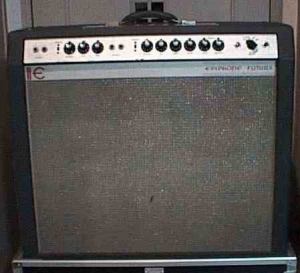
The big drawback of being a gear freak is that it can be an expensive hobby. But at the same time, it’s a hell of a lot of fun discovering new gear, or discovering little-known vintage gear. I was in a local use gear store the other day, and happened upon this amp. What a classic! It’s all-tube, with 4 – 8″ speakers. As far as tone goes, think Beach Boys and Jan and Dean, and perhaps a little quieter Dick Dale. In other words, this produces pure, clean surf guitar tone.

I tried it out with a number of guitars, and could never get it to break up. Talk about headroom! I do have to say that with a drive pedal, it didn’t sound too good. Actually, it sounded awful with a drive pedal.

Here’s the cool thing about this amp: If you run across one, and you like its sound, you can get it for around $500. For a clean tone vintage amp, that’s a pretty awesome price!

As far as features are concerned, it has two completely independent channels. The first channel only has EQ, while the second channel adds Presence, Reverb and Vibrato. Unfortunately, the vibrato on the amp I tried didn’t work, but the reverb was nice and thick, and reminiscent of old surf music. It sounded best with a semi- or hollow-body axe with the reverb kicked in about halfway.

There aren’t too many of these floating around, but you can find ’em.

Read Full Post »

I’ve tweaked about everything I want to on my guitars and amp, but haven’t gotten around to trying out a new speaker. I have a Fender Hot Rod Deluxe that I love, and while the sound is awesome, I was wondering what kind of speaker would work well with it, since I haven’t tweaked that part of the amp yet.

I’m thinking definitely along the lines of a vintage sound, and am leaning towards an AlNiCo driver. But I wanted to open it up to discussion to see what other people prefer. Any ideas?

Read Full Post »

BOSS CS-3 Compression/Sustainer
Summary: If you’re looking to really squeeze your signal, this box’ll do it.

Pros: 4 knobs provide great flexibility to shape your compression. For the money, it’s a pretty good deal.

Cons: Has probably some of the most severe compression I’ve ever experienced, which results in a loss of tone. Sounds okay with solid state amps, but horrible with tube amps.

Price: $89 Street

Back when I was looking for a compressor to fatten up the tone of my Strat to compensate for the really bright Tex-Mex pickups, I evaluated a bunch of compressor pedals, from the high-end (Maxon, Demeter) to the low-end, one of which was the BOSS CS-3 and MXR DynaComp.

I recently went through my review notebook and saw that I didn’t do a review of the CS-3, so here goes…

To start with, if you don’t want to read the entire article, if you’re a hard-rock/metal player, I think you’ll like this pedal. It’s real squishy, and combined with an amp that produces a tone of low-freq, it will definitely get you that super-compressed distortion. On the other hand, if you’re a jazz/blues or classic rock player, you will not like this pedal as it can really muddy your clean tone.

That said above, the CS-3 is not a bad pedal. It’s well-made, and compared with other BOSS I’ve owned in the past, it is probably just as reliable. But the CS-3 follows in pretty much the same formula as other BOSS pedals: You get decent tone for a relatively cheap price. They’re made for a mass market audience. Not that that is intrinsically bad, but if you’re a real tone freak, it won’t be up to par tonally with what you’ve come to expect. But high expectations aside, as I said, the CS-3 is not a bad pedal, and with the right amount of tweaking you can get a decent tone from this box.

One thing I really liked about this pedal is its configurability. It has four knobs for Level, Tone, Attack, and Sustain. The Tone knob really comes in handy as you increase the sustain, as I found that increased levels muddied the high-freq tones. The Tone knob helps to compensate for that to a point. But dial in too much highs and your tone becomes really “tinny” irrespective of the guitar you use. Having an Attack knob is a pretty cool feature as well, as you can adjust how fast the compression kicks in. Not bad for a $89 pedal.

The unit I tested was a little noisy when engaged, not matter how much I tweaked the knobs. It wasn’t so apparent when tested with a Roland Cube 60, but with a tube amp (tested on a Fender Twin and 65 Super Reverb Reissue), the soft hiss was a bit annoying. But with either type of amp, as I mentioned above, this thing really squeezes your signal to the point that there’s a noticeable difference in tone between the unit being engaged and not engaged. In comparison, my Maxon CP-9 Pro+ when engaged retains my tone even at higher levels of compression, but just “feels” fatter. Very transparent.

All in all, the BOSS CS-3 is a decent pedal. For someone on a budget who wants to add some compression to their signal, as I said above, this will do the job. But if you’re looking for transparency, this isn’t the pedal for you.

Read Full Post »

As some might know, I’ve spent the last year working on my first album, “You Stir My Soul,” which is a collection of contemporary religious songs I wrote for the Catholic Mass. About three weeks ago, I finished the album and submitted it to a digital distribution company to place on iTunes. They indicated that it would take about 8-10 weeks before it was available, but last night, I noticed that it had already become available!

This is a huge milestone in my life! I don’t have any illusions that it will elevate me to superstardom. But I’ve accomplished what has been a lifelong dream for me.

Admittedly, a couple of the songs really aren’t production quality, but I learned a lot about the music production process since then. The ones that have a much clearer sound to them are the songs I recorded later in the process. Oh well, first album, lesson learned.

Check out “You Stir My Soul” on iTunes!

Read Full Post »

« Newer Posts - Older Posts »