Feeds:
Posts
Comments

Archive for the ‘guitar’ Category

New Song: Que Cosa

I wrote this song in my head yesterday while I was driving home from work. Amazing how stuff just gets into your head. I named it “Que Cosa” because of my wife asking me, “What’s wrong?” while I was working out the arrangement. She said I had this concerned expression on my face. Anyway, give it a listen and let me know what you think!

http://www.icompositions.com/music/song.php?sid=80200

BTW, the drums and bass were all loops in GarageBand, and I used “Rusty,” my beloved ES-335 for the guitars.

Read Full Post »

Top Dawg: Frank Marino

Read Full Post »

pedal_tote.jpgOkay, yet another product review on a fairly mundane piece of gear, but hey, sometimes you have to be practical!

A few years ago, I was pretty spoiled when it came toting guitar gear around. I was using a Line 6 Flextone III as my amp, and as a modeling amp with all sorts of effects built in, the only thing I needed to hook up to my amp was my floorboard and guitar. That all changed when I moved to a tube amp for performance. All the things that I used to do to tweak my sound were no longer built into the amp! I had to get effect pedals to get the types of sounds I wanted.

At first, I only had a couple of pedals, so just putting them into my guitar’s gig bag wasn’t a problem. Then I got a couple of more pedals, so I started carrying my pedals and cables in an unused large camera bag. Still, it wasn’t a problem. Once I got to seven pedals, it became a problem. At every gig, I’d have to hook up the pedals to each other, not to mention having to hook up my 1 Spot power cable. What once was a five minute affair was now taking up to 20 minutes to get everything set up and dailed in. So I broke down and bought a pedal board.

There are lots of boards on the market. You can get them custom made, or go with fully powered units. For me, my needs were simple. I wanted a board that could carry up to 8 pedals, and I didn’t want a powered board. The reason was that most powered boards only provide 9V power for all the connections, and I have a couple of pedals that can take18V. Also, powered boards run pretty expensive (for an 8 to 10 pedal board, expect to pay close to $200). There are other powered boards that take 6 pedals, but that wasn’t a real option for me. Enter the Gator Pedal Tote.

The Pedal Tote is a non-powered, inclined pedal board made of 8-ply plywood. It’s covered in black tolex, and topped with small loop carpet. It comes with two 1-inch strips of velcro (about 2 1/2 feet all in all) to stick to the bottom of your pedals. I love the sturdiness of this board. The only beef I have with it is that Gator doesn’t come enough velcro for eight pedals. I had to go down to an arts and crafts store to buy more sticky-back velcro in order to attach all my pedals to the board. Not a big deal, just a minor inconvenience.

So how do I like it? I love it! It’s built like a tank, and has made my life a lot easier. Set up and strike are simple, five-minute affairs now.

Read Full Post »

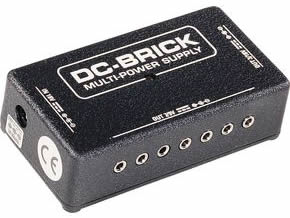
Dunlop DCB10 Brick A power supply? I know, kind of mundane, but if you’re still using 9V batteries, you might want to rethink your power supply needs. Here’s a common situation: You’re in the middle of a set, and your beautifully clean tone starts getting kind of fuzzy. It’s not too bad at first, but worsens as the gig progresses. You look down at your effect pedals, and one pedal’s light seems to be a bit dimmer than it normally is. You realize the battery is going dead. So after the song, you go back to your gig bag to get another 9V. You’re shocked to find that you don’t have a spare!

That situation happened to me this past weekend. I recently added a couple of pedals to my chain, but because my 1-Spot only had 5 connectors, I had to use batteries in my new pedals. The batteries were only a couple of weeks old, so I thought I was safe. Was I ever wrong. I had to rewire my signal chain to bypass those pedals. It wasn’t so bad, but it was a pain in the ass because I was in the middle of a set. After this experience, I decided to look into getting a more robust power supply that could power all my pedals.

So why the DCB10? Simply because as far as power supplies are concerned, I think it’s the best one I’ve ever had! It has 7 9V connections, and 3 18V connections – plenty to power up most boards. What really excites me about this pedal are the 18V connections. I have a Fulltone OCD that can take 9V or 18V power. At 18V, the headroom on the pedal just soars! But I digress… In addition to all the connections, the unit doesn’t introduce any hum. My 1 Spot could get a little noisy, and was a bit of frustration point for me. But the brick makes my chain as quiet as can be. A lot of this has to do with the fact that in addition to being a power supply, the Brick is also a power regulator/conditioner, so you get a consistent current going to your pedals at all times. This also means that you have built-in surge protection, which could be fatal to your pedals.

The Brick is also built like a tank, with a heavy-duty metal casing, so it is definitely a road-worthy power supply. Finally, the Brick can be used with any power source, from 110 to 240 (you’ll have to get an adapter for 240), which means you could gig anywhere in the world and not have to worry about swapping out your pedal board’s power supply.

Price: $190 retail / $99 – $109 street

A note about pricing: If you look for this on EBay, make sure you figure the shipping costs into the total price you pay. A lot of EBay vendors list the Brick for $99, but charge $19.95 for shipping. I bought mine from a local shop for $109 flat. Caveat Emptor!

Read Full Post »

Ig wrote a great article last week, and challenged his readers to write letters to themselves that they’d read some time in the future; a lot like Marty did for Doc in “Back to the Future.” So I’m going to take a crack at this.

Hey!

Looks like you’ve come a long way. I know you were thinking about giving up playing, but knowing you, you just couldn’t keep away from your passion. Hopefully, you’ve kept driving towards incorporating different kinds of styles into your playing. I know you started a bit late with improvisation on the guitar, but I’m hopeful that you are now a master of it; or short of that, can work your way around the fretboard instinctively, switching modes to suit the musical phrasing.

Speaking of musical phrasing, you must have written a few hundred songs by now. I wonder what style of music you’re writing? It’s a good bet that rock and roll is still your staple, but I hope you haven’t given up your dream of finishing your concerto. I can only imaging what it would be like to combine a full orchestra with a rock band, and a huge choir. While I know that you originally thought that you’d hire a big name to play lead guitar, at the rate you’re going, I hope you decided to play that role yourself.

You’re probably not a shredder – that’s not something that you ever aspired to being. Though I know that learning various techniques to incorporate into your playing have always been one of the earmarks of your learning experience on the guitar. Never forget though, you always need to sound like yourself, be it on guitar, or vocally.

I know it has been a rough road to get to where you are. But what’s life without struggle? How can you learn without making mistakes? But just keep doing what you’re doing. Keep pushing the envelope with your skills. Be happy with all you’ve accomplished, but don’t settle with where you are. Complacency leads to boredom, both inside and out; and you are far from being boring.

Cheers!

Read Full Post »

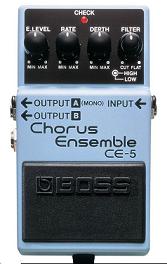
BOSS CE-5 Chorus EnsembleWhen it comes to chorus sounds, Roland/BOSS is pretty much the standard for the last twenty or so years. The CE-2 has especially been very sought-after used pedal 1) for its simplicity and; 2) for it’s analog design. I owned a CE-2 back in the 80’s, and have since kicked myself since I traded it for other hardware – that I don’t use at all anymore! Since then, BOSS has gone through a couple of renditions with the Chorus Ensemble line, and now offers the CE-5 Chorus Ensemble. A pedal that even though digital, sounds pretty darn good.

The CE-2 was a simple affair: Just two knobs for rate and depth, and a single output. With the CE-3, Boss introduced a “stereo-like” affair with two outputs, and three knobs, introducing a “Stereo Mode” knob to control how the outputs generated their sound. The CE-5 does away with the Stereo Mode knob and replaces it with an Effect Level knob, and a dual knob used for Hi- and Lo-cut filters.

In my opinion, the Hi/Lo Cut knob is what makes this pedal special. With it you can really shape your chorus sound from bright and smooth to dripping wet. All in all, you can’t go wrong with this pedal; and for less than $80, it’s a deal.

Starting with this review, I’m going to start giving summary ratings at the bottom of each review, similar to what you’d see in one of the trade rags.

BOSS CE-5 Chorus

  • Price: $129 (<$80 street)
  • Pros: Very versatile. Can produce a wide range of sounds
  • Cons: Can take awhile to dial in the sound you want
  • Summary: Great sounding chorus at a great price

Read Full Post »

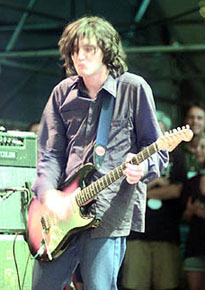
John Frusciante of the Red Hot Chili Peppers…when you learn a new lick or technique?

After a week-long hiatus from playing, I picked up my Strat and started playing some warm-up licks. Ooo did it feel good!

After about half and hour, I put the guitar down, and went to YouTube.com to see if I could find any videos of John Frusciante. I’ve always admired his no-nonsense approach to the guitar, and wanted to learn some of the technique he uses to play those very cool licks on the Red Hot Chili Peppers songs.

Sure enough, I found some great instructional videos that John has produced. In particular, I found this great video where John explains some Hendrix technique that he learned:

After years of doing this halfway, now that I’ve seen how it’s done, I’m totally jazzed to practice it! For a pretty much pure rhythm guitarist like myself, learning how to add stuff to the things I’m playing is just incredible!

Read Full Post »

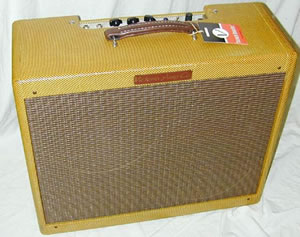
Victoria Amplification Double DeluxeTalk about getting a “clean” tone, and invariably, some Fender amp will be mentioned, especially the models from the 50’s like the Twin. By far, “Fender clean” is the clean tone that has been emulated for decades by amp manufacturers the world over. Unfortunately, if you want that clean tone from the 50’s, you’ll have to get a used Fender amp from a vintage shop – and they’re not cheap. Enter Victoria Amplification. As Mark Baier (owner of Victoria Amps) says on the company site’s “About Us” page:

In 1993, I set out to faithfully recreate the crown jewels among the many classic amplifiers developed by Leo Fender. The tweed amps of the late ’50s defined the sound of rock and blues on vinyl and on stage, but they had also become increasingly scarce, and well beyond the reach of most working musicians.”

And recreate the sounds of those amps he has! So much so, that one might be inclined to say that his amps are even more “Fender than Fender,” as each amp is meticulously hand-wired point-to-point. Most Fender amps today rely significantly on solid state technology, especially for amps in the 40+ Watt range; for instance, using solid-state rectifiers to convert AC-DC current. Granted, solid state rectifiers are considered to be more “reliable” and don’t suffer from voltage sag like a tube rectifier. However, that voltage sag can actually be a real plus when using a tube rectifier as the sag can act like a compressor/sustainer as the voltage builds in the rectifier when you strike a note on your guitar. Thus, amps with tube rectifiers tend to sound “warmer” than their solid-state brethren.

I recently had the chance to plug into a “Double Deluxe,” and I have to say that I am now in love! In testing, I played the Double Deluxe with a Fender Custom Shop ’57 Re-issue Strat (I didn’t have enough time on my lunch break to plug other guitars into it). The first thing I noticed was the touch sensitivity of the amp, even at low volumes. Cranking the volume knob on the guitar produced a singing clean tone, with just the hint of breakup. With my own Fender Hot Rod Deluxe, to achieve this at lower volumes means I have to use a drive pedal. But this little amp, responds well to input gain; I think the tube rectifier has a lot to do with this, though it doesn’t matter. It just sounds great!

The Double Deluxe also responds well to attack. Light finger picking produces beautiful ringing tones, while a heavier, driven attack produces a pleasing, even-toned crunch that is like candy for the ears. Unlike a lot of newer Fender models, the Double Deluxe responded very well to tone settings (there’s just a single knob), which was very impressive, as I could dial in the tone for fatter, thinner, or balanced tone presentation. No matter how you set the tone or attack the guitar, the Double Deluxe retains note definition, and doesn’t muddy up at all.

The 2 – 12″ Jensen P12Q vintage speaker re-issues also have a lot to do with how great this amp sounds. These are generally very warm speakers that don’t squeak with lots of high-frequency harmonics when pushed. Rather, what you get is a very complex sound that you can tweak with the tone knob; and here’s an interesting thing: This amp has no reverb, but you could swear that there’s reverb built in! That’s a testament to the beautiful complexity of sound that this amp generates.

Operating the Double Deluxe is pure simplicity. Plug into one of the inputs (normal or bright – the amp has four inputs so you can jumper between the two “channels;” hence the “Double” in “Double Deluxe”), set the volume according to the input you’re using, then dial in the tone with the single knob. How much easier could it get? You might be thinking that you need individual control over lows, mids, and highs, but this amp just doesn’t need it. Just set the tone knob to what’s pleasing to you and play.

Here are some specs (taken off the web site):

  • Completely hand-wired point-to-point
  • 5E3-type circuit. Class A cathode bias push-pull operation. (40 Watts by default)
  • Tube complement:1-5AR4, 4-6V6GT, 1-12AX7, 1-12AY7
  • 2-Jensen P12Q speakers
  • Cabinet Dimensions (HxWxD, Inches) 20.5 x 24.5 x 11
  • List Price: $2695.00 / ~$1900-2000 (street)

Note that you can swap the 5AR4 rectifier with 5Y3 rectifier to reduce the amp’s output to 30Watts. Very cool.

When I first saw the list price of this amp on the Victoria Amplification web site, I gulped. I thought these amps were accessible. But I looked around, and you can get one for less than 2 grand, so I was calmed immediately. And for the price, what you get is a lot of amp that you can use for all sorts of applications.

Over the past couple of years, I’ve played lots of different amps from big manufacturers to small boutique shops. And among the tweed amps I’ve tested, Victoria Amps Double Deluxe is at the top of my list. If you’ve got a distributor near you, I suggest taking a trip there as soon as you can. You won’t be disappointed!

Read Full Post »

If you’re an avid musician – and I don’t necessarily mean “pro” or anything like that – a good piece of your free time is spent playing your instrument. Like, every day. But sometimes you just need to take a break and do something else to get your perspective back.

A couple of weeks ago, I had to go out of town on a family emergency. Usually, when I go out of town, I have my trusty acoustic guitar with me to fill up my free time. But because I had to leave and hop on a plane at pretty much a moment’s notice, I didn’t have time take my guitar. Up to that point, I had been busy in my home studio, writing and recording songs for a few weeks, and I found that I was hitting a state of emotional and mental block. It was taking me longer and longer to motivate myself to set up my gear and play as the days wore on.  Then this emergency came up (it wasn’t anyone sick or hurt, but it did require my presence), and that was probably one of the best things that happened to me with respect to playing guitar.

On the return leg of my trip, as I was sitting in my seat on the airplane, I really looked forward to playing. But by the time, I got home, I realized that I just wanted to sit at home with my wife and kids and just enjoy being with my family. And I did that for the rest of the week!

The net effect was that by the time I picked up my guitar, I had a renewed verve and appreciation for playing. I got just a tad bit rusty, but 10-15 minutes of warm-up exercises got me right back into the groove.

So if you’re feeling blocked with your music, take a break and do something else entirely. You’ll be surprise at your renewed strength!

Read Full Post »

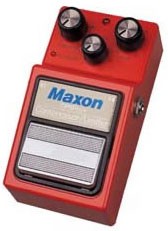
Maxon CP-9 Pro+ CompressorThe last review I wrote was on the Demeter Opto Compulator, a great compressor that I had the chance to A/B a couple of weeks ago. In the review, I said that that was the comp I was going to buy, but that was until I did a side-by-side comparison with the Maxon CP-9 Pro+ today. Now it looks like the winner of my search for a good, transparent compressor is the Maxon CP-9 Pro+. But I’ll have to admit, I’m very torn between the two.

When I heard Buford play through the Demeter, I loved its transparency. The compression is so subtle, you hardly notice that it’s there. But my side-by-side comparison with the CP-9 really got me hooked on it instead of the Demeter – for now (I’ll explain in a bit). Let’s look at the features, shall we?

Like the Demeter, the Maxon CP-9 Pro Plus is fairly straight-forward to use. It has three knobs to the Demeter’s two, adding a threshold knob to the ratio and makeup gain knobs, and this is what got me hooked on this pedal. I really liked having that threshold knob to control when the compressor kicked in – that made this pedal much more versatile in my eyes. I set it to about 10-11 o’clock, set about 2.5 to 1 ratio, then set the gain to match the uncompressed signal volume as closely as possible. What this pedal did for the Strat’s sound that I was playing was very sweet. The tone stayed the same, it was just fatter. And for low-volume applications, this is EXACTLY the effect I was looking for. It’s not as subtle as the Demeter, but it’s still transparent as all get out.

Since the shop I tried the CP-9 at also had a Demeter as well, I decided to try out the Compulator for myself, since I didn’t get to play Buford’s guitar that night at the casino. So here’s my feedback. The Demeter is incredibly subtle in its compression. It squeezes your signal just right, but in the quiet environment where I was testing, I noticed a distinct, but very pleasing high-end shimmer that was produced by the Compulator that I couldn’t hear in the crowded environment in which I first heard the Compulator. Talk about ear candy! Unfortunately, what I’ve been looking for is a compressor that doesn’t add any artifacts. It just squeezes. So I was faced with a bit of a dilemma: Go with the Maxon’s versatility, or go with the Demeter’s subtlety and beautiful high-end shimmer. I’ve decided to go with versatility for now.

Mind you, these two compressors are very different beasts. The Demeter employs an optical circuit for compression, while the CP-9 uses a Voltage Controlled Amplifier (VCA) and a RMS sensor. Click here for a great article covering that various electronic approaches to compression. The reason I mention this is because the different approaches yield different sonic results. Optical comps tend to be the most subtle of the compressors, while the VCA type compressors offer the most versatility and highest attack response. That said, it’s possible to use different types of compressors to achieve specific types of tone. Oy Vay!

I’m not sure if I’ll ever get the Demeter, though it will always remain in the back of my mind. And even though I was totally blown away by that high-end shimmer, my practical side made me err on the side of versatility.

Read Full Post »

« Newer Posts - Older Posts »