Feeds:
Posts
Comments

Archive for the ‘guitar’ Category

A few questions…

First, some background…

I was walking around Downtown Disney (in Anaheim, CA) a couple of months ago, enjoying the various street acts that Disney hires to play. One of the acts was a solo guy who played guitar and sang on top of recorded tracks laid down that were inserted into his mix. I have a bunch of songs that I have in ProTools that I’d love to output and play and sing on top of when I gig.

So my question is: What kind of equipment will allow me to do this? Is an Akai MCP[500, 1000, 2500] the answer? Or is there a more straight-forward solution that doesn’t require sequencing?

Thanks for the input!

GoofyDawg

Read Full Post »

I was in a rush the other day to make it to the pre-service rehearsal at my church. I was farting around and didn’t keep track of time, and realized that though I could make it to rehearsal, I wouldn’t have that much time to set up my usual rig for Mass. I normally bring a couple of guitars, my amp (a modified Fender Hot Rod) and run through 5 effect pedals (Tube Screamer, Boss Chorus, Boss Delay, DigiVerb, and a BBE SonicStomp – and no, I don’t have them mounted on a board – yet). The guitars are A/B’d through a Morley ABY box.

As I said, I didn’t have much time, so I just loaded up my amp, Pearl (my beloved Strat), and my Tube Screamer into my little SUV,  and sped off to church. With so little equipment, I was able to bring it all into the church in one trip, and set up in 5 minutes. Being the leader of the band, it was imperative that I get set up quickly so I could run rehearsal.

Once I got set up, we started rehearsal. As we got further into it, one thing struck me: I wasn’t missing the tone from my other pedals! It helped that none of the songs in the set didn’t require any texturing (some of my songs were written to take advantage of a deep chorus). But just the raw tone coming from the amp (along with some spring reverb), sometimes combined with the edginess of the Tube Screamer, was incredibly pleasing to my ears, and it has made me really re-think the necessity of having a bunch of pedals. Not that I would do away with them altogether, but I’ve now decided to take a much more minimalistic approach to my tone. Actually, it’s sort of a relief, because it means I won’t be buying more gear in the immediate future – though as I’ve written in the past, I do have serious GAS.

But the GAS notwithstanding, there’s a lot to be said about just producing raw tone. Try it out, you may be very pleasantly surprised.

Read Full Post »

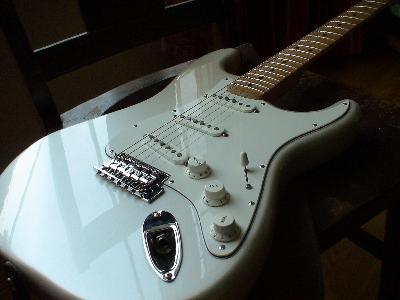
pearl_chip.jpg A couple of weeks ago, I was re-stringing Pearl, my trusty Strat when I noticed that something was dreadfully wrong: My high E string was laying flat on the fretboard! I thought I had simply missed placing the string in the groove of the nut, but to my dismay, the nut had chipped at the groove! Who knows where the piece went! It actually didn’t matter whether I found the piece or not – having experienced this before with another guitar, there was no way I could simply super-glue the piece back on. I had to have a new nut fabricated. So I frantically looked for an authorized Fender repair shop near my home in Cupertino, CA, and I found Keith Holland Guitars in Los Gatos, CA. In addition to selling custom guitars and amps, this shop does guitar repairs through its Guitar Hospital (cool name).

I called the shop and spoke to a friendly guy named Jim, and explained what happened. He told me to bring Pearl into the shop, and it would take about a week until the guitar was ready; not that it would take them that long, but they were totally back-logged on repair work as their repair business has boomed – a great problem to have, I suppose. In any case, when I brought Pearl in, Jim did a quick inspection and suggested that I let him do a full setup on the guitar: smooth the frets, straighten the neck, clean out the pots, and adjust the action to what I wanted. I knew there was a slight bow in the neck, so I quickly agreed to the work. I wanted to go from 9’s to 10’s with my strings to get a better ring and sustain, so I knew I’d have to get the action adjusted anyway.

When I got Pearl back, I just couldn’t believe how much more playable she was! Jim lowered the action about a 64th of an inch, replaced the wood shim that I placed behind my tremolo bar and cranked down the bar, and now moving about the fretboard is just simply amazing. BTW, I’ve never been able to get the hang of using a tremolo bar, so I just removed it. Anyway, even with the heavier gauge strings, Pearl plays like silk now! She was great before, but now she’s otherworldly territory! Here are a couple of pics of Pearl:

pearl1.jpg pearl3.jpg

I tell ya, I’m having a bit of a love affair with this guitar. I still play Rusty, my ES-335, but Pearl is definitely my go-to guitar right now. Amazingly enough, I’ve never been a Strat guy. I used to be into fat-toned dual humbucker guitars. But I think as a musician you gravitate towards the sound that meets your particular tonal tastes. As I do a lot of composition, Pearl provides the tone that’s in line with the style I’m writing right now.

Read Full Post »

In search of boutique tone? There’s no better place than Tone Merchants in Orange, CA. I found this excellent shop online while surfing the web for a boutique tube amp, and recently had the fortune to visit the shop while I was on vacation.

Why is it so special? First off, Noel Evangelista, who runs the place is just a great guy. Very warm and good-natured – and definitely not someone who tries to be a salesman. In fact, when I was first searching for a tube amp, it was Noel who recommended that I buy a Fender Hot Rod Deluxe to get introduced to tube amps. Paraphrasing our conversation a few months ago, “If you’re new to tube amps, then you can’t go wrong with a Fender Hot Rod Deluxe. It’s a great starter amp – plus you get that distinctive Fender clean sound.” Based upon that conversation, that’s exactly what I did, and after a few mods, I’m absolutely lovin’ it!

Secondly, the shop is set up for hanging out. The main amp room is spacious with a couple of comfy couches in the center, so you can relax while you twiddle with the amps. The unsaid sales pitch is simply this: Let the equipment speak for itself. For serious tone freaks, that’s a powerful pitch. Words can’t convey what an amp or guitar does. You have to hear it.

Furthermore, unlike most music shops, Tone Merchants has a very select, very limited inventory of amps and guitars. You won’t find name brands like Fender, Gibson, Marshall, Vox, Bad Cat, Buddha, or any boutique amps that you might read about in Guitar Player mag. The stuff here is all boutique. I played two amps from Cornford and Faustine. Loved both, but really dug the Faustine which has a built-in reactive speaker load attenuator. That’s a very useful addition as well as being a fantastic-sounding amp. For guitars, I played a Heritage 535 classic made by some of the original Gibson guys, which was an even better-sounding ES-335. Real clean, deep tones. But the guitar that I absolutely fell in love with was a Suhr Classic. From a distance, it looks like a Strat with a dual-coil humbucker in the bridge position. But what sets it apart is the absolutely gorgeous, silky-smooth tones it produces. The one I played had an alder body with a maple neck like my own Strat, but the fret board was rosewood, which really smoothed out the tone (I love rosewood fretboards). Ahh… I want this guitar!!!

Anyway, I digress. Tone Merchants also gives clinics and small concerts in their sound stage at the back of the shop. It’s a great place for showcasing local guitarists. If you’re in the area, check out their concert and clinic schedule.

All in all, this is a must-see shop if you’re looking for boutique equipment. Also, if you want to play a Faustine amp, this is the ONLY place to go as they have an exclusive deal with Faustine amps.

Read Full Post »

A friend of mine recommended that I try out a T5. He was raving about how cool it looked, and how you could switch from acoustic sound to a full-blown electric. I was a little dubious, considering that that’s really just modeling, and frankly, it was nothing new to me). Parker Guitars did this with “The Fly” well over a decade ago. But to be fair, I went down to my local GC to check one out and see what all the hype was about. So, under the guise of “Honey, I need to run some errands. I’ll be back in a couple of hours,” I ventured to my local GC, and played it for over an hour. The following is the result of that session with the Taylor T5:

Oops! Before I start on the actual review, I played the T5 through three amps: A Fender Acoustasonic Junior, a Fender Hot Rod Deluxe, and a Roland Cube 30.

Fit and Finish:

All Taylor guitars look great, and the T5 is a real beauty. I played a T5 with a beautiful royal blue finish – very sexy. The T5 also lives up to the Taylor standard of construction – all their guitars are very well-built. As far as acoutrements are concerned, personally, I’m not a real fan of low-profile knobs (when I’m in the middle of a song and want to make an adjustment, I want to be able to feel the knob – ooh, that didn’t sound good), but the knobs on the T5 fit in with its design nicely.

Feel and Playability:

The T5 has a nice narrow neck – very similar to my Strat and Ovation Acoustic/Electric – which I love, so moving around on this neck was amazingly easy and very comfortable. Acoustic players who are accustomed to wider necks will need a little time to get a feel for the neck, but should adjust pretty quickly. I had an easier go of it myself from playing my Ovation. When I first got that guitar, I had a bit of a break-in curve, but now it’s the type of neck I prefer.

Sound:

I know that I may piss some people off when I say this, but as far as sound was concerned, I was a bit disappointed. Based upon my conversation with my friend who raved about it, and lots of glowing reviews I read on Harmony Central and Musicians’ Friend, I was expecting a lot more with respect to tone – especially since the T5 starts at $1999, and goes up from there. I used the same evaluation process on the three amps I played the T5 on: On both amp and guitar, I started out by setting all the tone knobs to the mid settings. Guitar volume was set to midline, and since I was in a shop, I had to set the Fenders pretty low (they use logarithmic volume pots), while the Cube 30’s gain could be cranked while leaving the volume at a comfortable level. From there, I played the guitar in three different ways: 1) Fingerpicking; 2) strumming (using a straight sweep strum, and a percussive, attacking strum); 3) Then just playing various lead patterns in clean and high-gain modes.

Played clean with fingerpicking and lead playing, the T5 was very nice on all the amps; great clarity and sustain, though I really had to pump up the bass and turn down the treble on the amps to achieve a rich sound – especially on the Hot Rod Deluxe which, even with brightness off, plays pretty bright. Strumming in clean mode was pretty ugly on the Fenders – the guitar sounded like an acoustic plugged into an amp – very flat sounding, and no amount of EQ tweaking or reverb helped. Plus, when using a percussive strum pattern (think Michael Hedges), I would get an annoying popping sound. Probably has to do with the very touch-sensitive pickups, added to the touch sensitivity of the Fender amps. On the Cube 30 though, since I could apply some chorus, the tone cleaned up quite nicely, and helped dissipate the high end. If I was to use the T5 clean with a straight tube amp or acoustic amp, I’d run it into a compressor, a chorus, and then run the entire signal thorough a sonic maximizer – and possibly add an EQ pedal to texture the sound better.

In high-gain mode on the Hot Rod, the T5 actually sounded very nice. Even though I had to play at a lower volume, I could crank the drive and get a real nice distortion out of the T5. I think this is where the body vibration from the hollow body comes into play. It actually sounded a lot like my ES-335 in that mode; very pleasing to the ear, with a big, rich sound. With the Roland Cube 30 in the modeling channel, the T5 performed great with the gain at about midway, using the all the non-acoustic amp models. In the acoustic model on modeling channel, the T5 actually sounded VERY good, but then again, that’s a modeled sound.

Overall:

The Taylor T5 is a pretty nice guitar. Would I pay two grand and up for it? I don’t think so. I look at this guitar as being similar to a Line 6 Variax 700, which has a lot more features and guitar models built into it, and costs more than half the price less (I know, the T5 is NOT a modeling guitar)! Then again, I wouldn’t buy a Swiss Army Knife type of guitar period, mainly because even though it may sound real close to what it’s modeling, it’ll never get the exact voicing that the original gives you. For instance, if I want a thin, single coil sound, I’ll use my Strat. If I want a richer, boomier presentation, I’ll use my ES-335 (I’m also in the market for a Les Paul Double Cutaway, which I just adore). For acoustic/electric work, I’ll use my Ovation shallowbody.

Read Full Post »

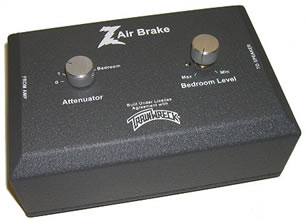
The Dr. Z Air BrakeAfter many years of using solid state amps, I finally started looking at tube amps; specifically, boutique tube amps. I’ve looked at and played several from folks like Dr. Z, Mesa, King Amplification and a bunch of others. But boutique amps are VERY EXPENSIVE. And upon the recommendation of a very knowledgeable acquaintaintance (mentioned previously), I purchased a Fender Hot Rod Deluxe to tide me over until I could afford the $2500-$3500 for a boutique amp.

But no matter what boutique tube amp I decide to buy, one thing that struck me about about tube amps is that they’re LOUD!!! Yeah, I know, a lot of that comes from the types of volume pots installed on many amps, but irrespective of that little issue, tube amps just rock the house with their tonal clarity and their ability to punch through a mix. Unfortunately, they can get so loud that they squash the rest of your band (let alone shatter the eardrums of your audience), and that’s the bad part because most tube amps, especially Mesas and Marshalls just don’t sound right until they’re cranked and really pushing their power tubes. But in small to medium-sized venues, you’ll have people running for the door!

So I went looking for a solution where I could push my power tubes but not break windows (or in a specific personal instance, not have the next-door-neighbor calling me at 1 am to “turn my f&*king amp down”). In any case, the answer lay in a box called a power attenuator. There are several types, and I won’t bore you with technical details, but the gist of a power attenuator is just that: it attenuates the signal coming from your amp. You simply place it between your amp and your speakers and it outputs a lower signal – thus lower volume. What this means is that you can crank your amp to the level that you’d like and achieve an overdriven tone, but do it at a significantly reduced volume level.

The hot ticket right now seems to be the THD Hot Plate. But there are others out there as well. Personally, I like the Dr. Z Air Brake because it has a very simple set up (just two knobs), and is much more versatile right out of the box than the Hot Plate. This is because it automatically adjusts to the proper impedance of your amp; whereas you have to get a specific Hot Plate model that matches your amp’s impedance level. Choose the wrong one and you could be in a world of hurt! So I’ll be going with the Air Brake.

However, since I have a home studio, I will also be purchasing the Weber Mass 100 because it has a EQ’d DI direct output that I can run directly into my MBox 2. That’s very useful for studio work, but way too complicated for stage work. Besides, even though I only play with 4 effect pedals (BBE Sonic Stomp [you gotta get this – or better yet, get a rackmount sonic maximizer], Ibanez TS-808 Tube Screamer, Boss DD-3 delay, and Boss CE-5 chorus), I have more than enough knobs to twiddle with, and the Air Brake is simple enough to use on stage – two knobs. I tend to be a set it and forget it kind of guy and only like to channel switch to my gain stage or switch the TS-808, so the less I have to play around with, the better.

Anyway, if you’re a guitar player who’s in search of maintaining your tone but saving your eardrums – as well as those in your audience – then a power attenuator is the thing for you.

Read Full Post »


How you sound is important, and what sounds good to you is an entirely subjective thing. A lot of guitar players want to sound like other guitarists – that’s not a bad thing. Hell, I’d love to sound like Eric Johnson or Joe Satriani or Stevie Ray Vaughn myself! But whether or not you want to sound like some other guitar player, or create a sound that’s unique to you, you need to take into account what shapes your overall tone.

Unfortunately, many guitarists, especially inexperienced guitarists don’t understand tone shaping all that well. They think that just because they get a certain stomp box, they’ll sound just like their favorite guitarist. But getting the right tone involves a lot of different factors, but they boil down to three different areas. And how you balance those areas will affect how you sound. NOTE: This deals more along the lines of equipment as opposed to the guitarist, who of course is the main factor in getting tone; in other words, how you play affects how you sound, so technique is really a huge factor.

The Tone Triangle
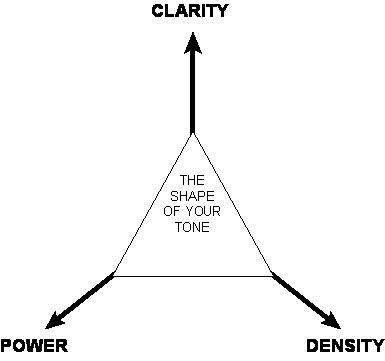
The tone triangle

The diagram above is what I call the “Tone Triangle.” It simply is a graphical representation of the three factors that influence your overall tone: Power, Clarity, and Density. Power is a function of your volume, whether set from your guitar, volume pedal, or amp; or by using a booster or overdrive pedal. Clarity is the cleanliness of your tone. I tend to think of clarity or cleanness in terms of the amount of distortion or lack thereof that is present in your tone. Density is the “fatness” or “thinness” of your tone. For instance, a Strat has a fairly thin tone as it doesn’t produce much in bass area. An ES-335 or Les Paul however, have dual humbuckers, so they produce a much wider range of tone; thus the “fatter” tone.

So what’s the point to all this? What you do to tweak your sound will affect the shape of your tone triangle. Note that there’s no bad shape to the triangle. Its shape just changes based upon the tweaks you make. And understanding how that shape is affected will get you a long way towards knowing what kinds of pedals to buy or adjustments you have to make. So armed with that idea, let’s look at the three corners of the tonetriangle.

Things That Affect Power

Power is a pretty easy thing. Pump up the volume, add an overdrive or boost, and the net result is a generally louder sound. But keep in mind that power has an inverse relationship with clarity. The more power you add, the lower your clarity, as your signal will tend to distort at higher power levels.

Specifics: Volume adjustment (guitar, amp, volume pedal); overdrive and boost pedals.

Things That Affect Clarity

As discussed above, gain has a negative effect on clarity; not that this is a bad thing. I myself can appreciate a creamy smooth distorted signal. But distort too much, and what you get is a mess. In fact, with an overly distorted signal, even though you might pump up the volume, your sound will just get lost in the mix. So with clarity, you have to really balance how much distortion is appropriate for what you’re playing and who you’re playing with.

Let’s take a bit of time to discuss distortion. Generally, there are two types of distortion. The first distortion is the result of high input gain, while the other type is the result of signal manipulation. Both are completely valid, but each produces completely different types of sounds. Distortion from gain or overdrive tends to be on the bright and gritty side, while distortion from dedicated distortion pedals tends to be thick and smooth. The combination of both kinds creates a very big sound indeed – sometimes too big for some applications, so be careful how you’re applying distortion. With respect to distortion pedals, my advice is to play a bunch of different kinds. The same goes for overdrive pedals. Again, it’s all about personal preference, but it’s also about the type of music you play. It doesn’t make a lot of sense to play with a lot of overdrive and distortion if you’re playing jazz or pop; on the flip side, playing a really clean tone with death metal is absolutely nuts!

Clarity is also affected by how you EQ your rig. Put too much bottom-end in your sound, and you’ll sound muffled. Dial in a lot of treble, and you’ll sound thin or at higher volume levels, you’ll sound piercing. So you have to be careful about how you balance your EQ.

Specifics: Again, volume or gain; distortion and overdrive pedals. EQ. Modulators such as reverb, chorus, flange, and phasers also affect your clarity.

Things That Affect Density

As mentioned above, density is about the fatness of your tone. This can be affected in a lot of ways, not the least of which is the type of guitar you play and the pickups they employ. In general, single coil pickups produce a thinner tone, while humbuckers have a deeper and richer, thus denser or “fatter” tone. The type of amp you play out of can either thicken or thin out your tone. For instance, Fender amps are clean and bright, while something like a Vox AC30 produces a thicker overall tone.

As far as effect pedals are concerned, the most common pedal used for adjusting signal density is the compressor. I’m tired, and this entry is getting long so for a good discussion of how a compressor works, read this great article. An overdrive pedal can also serve to thicken your tone if used at lower drive levels, but it’s tricky, and you have to do a lot of tweaking depending upon the guitar you use.

Specifics: Type of pickups you employ;compressor, overdrive pedals.

Wrapping It Up

Notice that I didn’t mention specific brands or pedals in this discussion. This is because tone shaping is such a personal thing that to give advice on specific items to purchase would be a disservice. What I wanted to do was give you an idea of the kinds of things that can affect your tone triangle. So go out and shape your tone!

Read Full Post »

Fender Hot Rod DeluxeA few days ago, I got a Fender Hot Rod Deluxe, and as I mentioned, I was just blown away by the sound. As I’ve mentioned before, there’s nothing like the tube sound, and according to articles I read and people that I’ve spoken to about this amp, it’s a great entry-level tube amp that you can a lot of mileage out of. Since I’ve gotten it, I’ve been playing it at least a couple of hours a day – it’s that good!

After a few days of playing it though, I started feeling that there was just something not completely right about the sound. Mind you, compared to my modeling amps, the sound from this amp could be compared to swimming in hazy waters, then coming into a crystal clear patch of water. But still, the clean channel felt just a little “flat,” and in the drive stage – even with my TS-808 adding heavy overdrive – the distortion was choppy.

Before I bought the Hot Rod, I had read a bunch of articles and talked to a few very knowledgeable amp technicians about how the stock tubes that come with the amp are biased pretty low – in other words they run at a lower output level so they last longer, but this has an effect on the sound. So, armed with that input, I took my amp to King Amplification in San Jose, and none other than Val King (the owner and designer of King Amps) took a look at the tubes. My intent all along was to swap out the stock Groove Tube 6L6GC’s and run up the biasing just a bit higher based upon my reading, but Val did a thorough check of all the tubes and various voltages in the circuits, and I actually ended up not only swapping out the power tubes, I replaced the pre-amp tubes as well because they were just slightly distorting at low volumes. According to Val, that was probably causing the “flatness” in tone I was experiencing. So he replaced both pre-amp tubes and also replaced the phase inverter tube. Now, the sound that the amp produces is crystal clean, and has a lot of ringing overtones! I’m very happy.

I’m scheduling to have another mod made to the amp, and that is to tighten up the distortion even more in the boost channel. The new tubes helped a lot toward this, but I want a subtler, creamier distortion – it’s still a tad choppy for my tastes – so I’m going to have it adjusted. I’m also going to have the volume pot changed from a logarithmic-style volume pot to a linear one – it’ll make it much better for controlling the amp’s volume.

Read Full Post »

In my last entry, I recommended that anyone who was in the market for a tube amp should read the excellent article by Randall Smith (president of Mesa Engineering) on the different tube configurations before making their decision. So, armed with that information, I started surfing the web on different kinds of tube amps. No telling, my head started spinning. When you start getting serious about getting a tube amp, the challenge in finding one is not just about understanding tube configurations and what they all do, it’s also sifting through the literally hundreds of boutique tube amps out on the market. After a couple of hours, I was admittedly pretty forlorn.

But a chance conversation led me call to Tone Mechants in Orange, CA. I’ve got to tell you, this was the most useful conversation regarding tube amps I’ve ever had! Instead of trying to sell me one of theirs, the guy recommended that I go down to my local music equipment store and get an entry-level tube amp; specifically, a Fender Hot Rod Deluxe. This is a two-channel tube amp with three 12AX7’s for pre’s and 2 6L6GC power tubes, and a good starting point for anyone who’s new to tube amps. The guy’s reasoning was that there’s a lot of snake oil out on the market today with boutique tube amps, and you should take as much time as possible to find the right one for your needs. While you’re searching, you can get a starter tube amp that will get you familiar with the sound and technology of tube amplification, and you won’t break the bank in the process.

So… I went out and bought one last night at Guitar Showcase for only $589.00. 🙂 I also bought a seemingly universally recommended stomp box: An Ibanez TS-808 tube screamer overdrive, along with replacing my BOSS CE-5 Chorus and DD-3 Digital Delay boxes. This morning, I’ve VERY tired because I just couldn’t stop playing last night once I got it all set up! I’ll talk more on the details of the amp a little later, but the moral of this story is:

Watch what you research… You wallet may get a lot lighter! Ciao!

Read Full Post »

…then you’ve got to read this article about tube amplification written by the president of Mesa Engineering, Randall Smith. Beware, you should have a good hour or so on hand to go through it (I read it in two sittings, myself). In any case, it’s just about the best article I’ve ever read on how tube amps work, and what it means when someone says, “Class A” or “Class AB” configuration. And if you’re someone like me who is currently in the market for a good tube amp, this article completely demystifies all that stuff a salesman will bandy about to get you excited about an amp.

As they say, information is power. With this article, you should be able to make a really good, informed decision on what kind of tube amp will suit your needs best. For me, after reading through this article (I actually re-read several sections just to make sure I understood what he was talking about), I’m going to be looking for a two-channel setup that’ll give me Class A and Class AB operation, so I have maximum versatility. But I’ll let you read the article – I understand the concept, but I don’t think I could explain it any more clearly than what Randall did.

Read Full Post »

« Newer Posts