Feeds:
Posts
Comments

Archive for the ‘guitarists’ Category

Just read an interesting article in the new issue of Guitar Player, where guitar great Wayne Krantz described a different kind of lead practice technique that eschews the use of scales and modes, and instead focuses on how the lead sounds irrespective of chords or fingerings. Wayne describes this practice technique as playing in a “zone.” A zone is only 4 frets wide, and you have stay within that zone, and pick only the notes that fall within that zone while you’re practicing – and importantly, you have to be disciplined to not venture out of the zone.

The idea behind this technique is that it forces you to let go of the patterns and scales you’ve learned and/or memorized, and makes you explore the tonal possibilities from within a zone.

In the article he uses something like a Abmb5b7 chord structure to start out with then, sets his zone from the 5th to the 8th fret, essentially in an “A” position. But because the base chord is a half step down, you really have to think about what you can pick within that zone. 

I tried it out, and it’s a lot harder than it appears. Without thinking about it, I went to my tried and true pentatonic minor scale, and it TOTALLY SUCKED against this chord! HA! So I just started playing around with the notes and was able to come up with some interesting – to say the least – leads. Here’s an example. The chord progression is Abmb5b7 / Gbm / Cbm7 / Gbm / Abmb5b7 / F#m / Cbm7 / Dbm7 / Gbm7. The lead’s pretty rough, but the cool thing is that it’s all spontaneous.

The fallout of this practice technique is that it really helps you be spontaneous with your leads. Once you figure out what works and what doesn’t in a “zone,” you can really start exploring. For instance, in the example I gave above, I just let GarageBand record in loop mode several times while I essentially just messed around. The result is a bit rough, but this exercise taught me a completely different way of exploring the fretboard.

Another cool thing is that you can move your zones around. I used the 5-8 zone, but I’m going to experiment and try something like the 13-17 zone to see where that takes me. Very cool indeed!


Read Full Post »

Getting a good guitar sound on a recording can be a real challenge when recording at home. It’s not that it’s difficult mechanically, it’s difficult because of the environment. Working around the limitations of the environment is really the challenge. For instance:

  • Most of us don’t have a dedicated sound-proof room; thus, we get a lot of sound leakage that translates to neighbors (and family) screaming to turn down the volume.
  • Furthermore, most home recording areas aren’t optimized for a “flat” acoustic response. You can do some dampening to reduce room reverb, but you can’t eliminate it entirely.
  • Finally, most of us don’t have expensive recording gear.

But despite all that, it’s still possible to record great, high-quality guitar tracks. I’ve done a lot of recording at home in the past year and thought I might share some of the things I’ve learned in capturing good guitar sounds. Mind you, I’m no audio expert. Everything I’ve learned comes from pure trial and error.

  1. First of all, invest in a decent tube pre-amp. PreSonus makes a great one called the TUBEPre. You can read my review on it here. Even if you use a dynamic mic that will draw power from your line, a pre-amp will boost your mic signal, and at low-volume levels, this is absolutely essential. Also, a pre-amp will add a lot of warmth to your mic signal. In my mind, it’s an essential piece of gear.
  2. Ribbon mics are great for adding depth to your sound, or for recording two amps at once. Unlike unidirectional or cardioid mics that have a reception field that’s in one direction, ribbon mics record in a figure eight pattern in two directions. What this means is that it’ll pick up the ambient sound behind the mic as well. I typically place my ribbon mic about a foot away from my amp cab, then place a 3/4″ thick piece of plywood about a foot behind the mic. This helps reflect the sound back to the rear of the mic. And as long as you keep the volume low on your amp, you won’t get feedback.I also have used my ribbon mic to record two amps at once. For instance, in this song, in the overdriven guitar part, I ran a dry signal out to one amp, then used the other signal to run through my board into the other amp. The net result was it sound like I was employing a lot more output than I actually was. In fact, you could speak (with just a tiny bit of effort 🙂 ) over the combined volume of the amps.
  3. Use two mics to record an acoustic guitar. I read somewhere that using an “X” pattern aimed at the sound hole is really effective. Personally, I use my ribbon mic pointed at about a 30″ angle at the center of my guitar’s body, then use a dynamic mic pointed straight at it. The ribbon mic is about 6-8″ away from my strings, and the dynamic is placed about 10″ inches. The result is a very deep, very natural sound that captures the natural tones from your acoustic guitar.
  4. Because we’re talking low-volume here, there are pedals that you should have that will help quite a bit in getting a good sound:
    a. First, get a decent compressor pedal. I’ve got the Maxon CP-9 Pro+, and just love it. This will help fatten your signal, and give the impression that you have a bit more amp than you actually have.
    b. Invest in a couple of decent overdrive pedals. Personally, I use three: a DigiTech Bad Monkey, an Ibanez TS-808 and a Fulltone OCD. I will either use these individually, or “stack” them in a signal to produce varying levels of overdrive. I know, many purists want to get that power tube saturation sound, but at low volume levels, that’s not practical. Besides combined with a compressor, you can get pretty close.
  5. As far as reverb is concerned, I tend to use very light spring reverb, then layer reverb on top of that in my recording program. It makes it much easier to control on the recording. Some folks use dedicated pedals, which is fine, but I prefer to capture as much of the raw signal as possible, then layer reverb or other effects on top of that raw, dry signal. However, this doesn’t necessarily apply to time-based effects like chorus, flange, vibe, delay or phase. I’ve never been satisfied with the sound quality of software based time-based effects.
  6. There’s nothing like the sound of a tube amp. Unfortunately, with larger tube amps, they just don’t sound good unless they’re cranked. But there are a number of low wattage “practice” amps that actually produce incredibly good sound if you close-mic them. The one I use in particular is the Fender Champion 600. Epiphone also makes the Valve Junior, which has gotten some great reviews. Another low-wattage amp that I’ve been considering is the Blackheart Little Giant BH5-112, which is a switchable 3W/5W amp with a 12″ Eminence speaker. Very cool. Blackheart also makes a 7W/15W version called the “Handsome Devil,” that is also worth a look.

As I mentioned above, I’m not a professional sound guy, and I certainly wouldn’t call myself a recording engineer. But I recorded my first album over the past year entirely at home, under less than ideal recording conditions. It’s entirely possible to do. You just have to find ways to work out, work around and work with the limitations of your environment.

Got any other tips? I’d love to hear ’em!

Read Full Post »

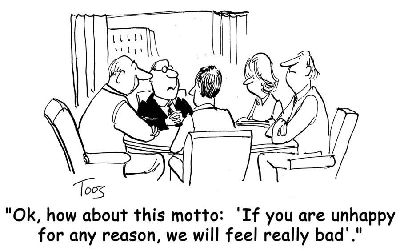
Customer Service Cartoon

If you’re like me, you dread calling up any company’s customer service center. Nowadays you never know if the person on the other end of the line is even in the same country as you. But when customer service is good; that is, the rep listens attentively to your problem, and can offer a solution, or short of that, does his or her best to solve your problem, you come away feeling good. Perhaps more importantly, the “feel-good” image you get about the company will most likely make you a repeat customer.

About a week ago, I called up the Jim Dunlop company in search of some parts. I stupidly misplaced the extra wires that came with my Dunlop DC-Brick, and needed to get replacements (and some extras just in case). I got routed to a tech support guy who helped me get the right part numbers, and he transferred me to a sales rep who promptly took my order – all in the space of about 3 minutes. Very quick, very efficient. I was impressed.

A couple of days ago, the wires arrived. I excitedly opened the box, and my heart sank as I realized that they were the wrong wires! I didn’t get mad mainly because I thought that I might have not provided a good enough description for the tech to get the right part. But I resolved to call the company and make a new order for the right wires.

I called them up yesterday, and mentioned to the tech that I probably ordered the wrong wires, and said, “What I need are the wires with the 1/8″ male on one end, and the center-negative female on the other. The part number for the ones I ordered were […].” The tech replied, “Hmmm…. that’s actually part number for those wires, but you got 1/8″ males on both ends. Our mistake. In that case, I’m going to take your information down right now and we’ll ship you 4 of the correct parts free of charge.”

Wow! I was so impressed with that level of customer service that I offered to pay the shipping, but he insisted that since it was Dunlop’s mistake, they needed to rectify the situation. Now that’s great customer service, and even though I hadn’t been a Dunlop customer prior to this, they’ve moved to the top of my list for companies that I know will provide great customer service should I have a problem.

Customer care is important, folks. Since I’ve become a real gear addict, it is one of the things that I consider before purchasing anything. Especially if I’m going to buy something that’s expensive, I call up a company’s customer service to ask questions and see how they respond. If I don’t feel comfortable with their customer care, I don’t feel as comfortable with buying the gear. Take, for instance, this review about the PRS DGT. A reader, Jimi Ray Clapton, had been waiting 9 months for his new DGT, and it still hadn’t come. He even spoke to PRS himself at a show with no results. Every time he called, there were further delays with very little action or follow-up. Consider that if you spend a few thousand dollars on a piece of gear, you want some attentive customer service! I would at least…

I know it’s a bit of a pain, but do yourself a favor and include customer service as part of your buying decision. You’ll want to know that the company you’re dealing with is going to be responsive to your needs.

Read Full Post »

About a month ago, a friend of mine asked me to update his web site with some minor text changes, and to help him drive more traffic to it. As I’ve been doing web development professionally for the last ten years, it was natural for him to ask me, and since he’s like an older brother to me, how could I refuse to do it? I finished the task in an evening, and didn’t think once about getting paid for the job. But his wife insisted that they pay me because my work helped produce income from their site.

But in lieu of them writing me a check for my services, I suggested that they order some gear for me and have it shipped to my house. So, I pointed them to the Voodoo Lab Micro Vibe pedal that I’ve been wanting, and it should arrive within the week!

So if you don’t have the clams to buy gear, see if you can trade services with people to get some gear that you’d like!

Is it realistic? Sure it is. I bartered building a web site for my architect for a lower architectural fee when we were rebuilding our house. I also built a web site for our contractor in exchange for his labor in laying our hardwood floors. Bartering works.

Read Full Post »

My son Owen As a guitar player and singer/songwriter, nothing brings me more joy than to see my kids enjoying my music. But what really makes it all worth the effort is a conversation I just had with my son Owen a few minutes ago. I was in my home studio, mixing a song, and my son (he’ll be 3 at the end of July) walked in, had me pick him up, and said (in his slightly slurred two-year-old voice), “Daddy, I wanna play guitar?”

I replied, “Really? You want to play guitar?”

“Yeah, Daddy, just like you.”

Okay, I admit, I got real teary-eyed when he said that, and just held him and hugged and kissed him for his sweetness, and I thought to myself that even though I experience lots of joy recording and performing, and make a decent amount of money doing it, none of that comes close to bringing me the joy I just experienced with those simple words.

I knew he liked my music, because he sings my songs to himself all the time. More often than not, he’s sitting down in my studio while I record songs – he loves the process – and loves to be around music! But to hear him say something like that was really overwhelming for me; not only as a parent, but as a musician.

Just thought I’d share that. Any of you axe-slingers have similar experiences? I’d love to hear ’em!

Read Full Post »

healsun-rays.jpgI was conversing with a friend of mine who just received his conditional black belt in Tae Kwon Do this past weekend – very great accomplishment. During the course of our conversation, he said the one missing ingredient in his study of martial arts is developing his “chi.” He believes in chi, but is having a hard time grasping what it is all about. Chi is a Chinese word that describes the natural energy of the universe. For sci-fi folks, it’s the equivalent of the Force in Star Wars. Without going into detail, the development of chi is at the heart of martial arts, though it is downplayed in the US because we live in such an empirical society where everything needs to be explained. In any case, my friend wanted to know more about developing his chi. We’ve had previous conversations about this subject, and I’ve related how I developed my chi over the years, so I showed him some techniques. But that’s really not what this blog entry is about…

During our conversation, I said something that compelled me to think about my guitar playing [actually, I’m surprised I even said it]. It was simply this: “Sometimes, in order to even start a journey, you have to give yourself permission.” For quite a while now, I’ve experienced a bit of a block in regards to improvising, admitting that I can’t do it, or saying that I’m purely a rhythm guitarist. Even the solos in the songs that I’ve recorded are the result of countless takes, where I’ve memorized the lead. That’s not so bad, Brian May talked about doing this on some Queen records back in the day. But for me, I realize now that it was fear that was blocking me; my fear of people thinking I sounded bad.

But something changed in me this past weekend. I wrote a new song for Church and I only had an hour or so to lay down tracks so my band had an idea of how I wanted it to sound when we performed it. So I open GarageBand, picked out a click track, laid down the keyboard and bass parts, then laid down the two rhythm guitar parts, then finally added the vocal parts. Realizing that I wanted a bit of solo at the beginning of the song, I quickly recorded a solo in the first 16 bars of the song. I did a quick mix and master, output the song, and wrote it to a CD.

On the way to Church, I listened to what I recorded, then realized I did every single part in one take each – even the solo. I know it’s not a very sophisticated solo, but it was the first time I just put something down without thinking about it. That really inspired me for the service where we were going to do a couple of songs that would require some instrumental interlude.  To make a long story short, when it was my time to solo, I just – did it. I told myself, “Don’t think about what you’re going to do, you know the fretboard well enough now. Just feel the music.” After Mass, someone came up to me and said they really enjoyed the music, and the way I expressed myself on the guitar. How’s that for affirmation? Admittedly, I was somewhat nervous because all my solos had been fairly calculated in the past – I had a pretty good idea of what I was going to do, and how I was going to do it. This time, I was on a bit of shaky ground because the only thing I started out with was the key of the song.

The point to all this is that in giving myself permission to solo, I was able to just do it. Did I make mistakes? Sure I did, but nothing glaring. For the very first time in my life, I was able to just let loose and express a message using my guitar. After Mass, I realized that I could probably have done this for a long time, but my fear of soloing kept me from doing it.

So give yourself permission to pursue your dreams and goals.  Like me, you will be pleasantly surprised by what you can accomplish.

Read Full Post »

People get inspired by lots of things: Pictures they see, songs they hear, conversations they’ve been in; lots of things. Over the course of my life, like others, I’ve gotten inspired by lots of different things, but certain wise words I’ve heard from various people have probably inspired me the most. Not surprisingly, these have mostly been things people have said to me in the context of me being a musician. I’d like to share them with you here.

“There’s always room in this world for people who are good.”

The Dean of my college said this to me during a meeting where he was deciding whether to let me back into my major, which was Biology. I was asked to take a break for a year to “evaluate” my college career. It wasn’t that my grades were bad, but I was taking under the minimum number of courses and making very little progress that year. I was just focused on ballet and playing my guitar, and didn’t really feel up to pursuing a career in a lab or going to medical school. My Dean felt that my calling was in the performing arts (I didn’t know that he was a fan at the time). As he explained to me, people who are good at what they do get noticed, so if my concern was supporting myself, as long as I put my talent out there, I wouldn’t have to worry about getting gigs.

It took me a long time time – almost 20 years – to actually heed that advice, but I took the plunge and started playing at small gigs a few years ago. I started with just a few, but now I do about 30-40 gigs a year all over my local area. I don’t get paid much, maybe a few hundred a gig, but I totally love it!

“Focus on the goal, and let the universe take care of the details…”

These are very wise words from my friend and mentor, Dan Retuta. Dan is a medicine man as well as being a 5th level black belt in Aikido. Right before I decided to start pursuing music more, I was in a discussion with Dan about the logistics of doing music as well as supporting my family. When Dan said these words, I paused because they really struck a chord in me. The point of these words is that when you focus your energy on achieving a particular goal, you will place yourself in the right situations to achieve that goal. Not only that, you will then become aware of the opportunities that have always been around you to help you achieve your goal. Very cool words…

“We’ve all entered this world with certain talents… …our particular challenge in life is step out of the way to let our talents come through.”

I actually said these words to a bunch of teenagers at a retreat, but I’ve heard them said in a variety of ways by a variety of people. The point of this particular saying is that there are so many people who have never discovered their talents, whatever they may be, because they get caught up in the ways of the world, with the chaos of life, with misconceptions and preconceptions of how their world should be. We all fall prey to this. But if we just quiet our minds, and stop trying to analyze all the minutiae, we’ll discover those talents.

From another perspective, there are those, like myself, who have had to overcome their fears in order to fully discover their talents. Again, all it takes is to step out of the way and let your talents through.

“Wanna make God laugh, tell Him about your plans…”

I forgot where I got this one from, but I look at it as a corollary to my friend Dan’s saying, and also a corollary to my own. Don’t get caught up in planning your life to the letter. Prepare for the future, yes, but always be flexible because you never know what circumstances may arise that will shatter your plans. In other words, live the “NOW.” Be aware of your past, and look ahead to your possible futures, but live NOW! There are things you have to deal with NOW! What’s past is past, and the future is never certain. The only things you truly know are what you know NOW.

So how does all this relate to playing guitar? For me personally, these sayings have served as guides to keep me centered while I pursue my musical career. My goal is to have music (and ministry) be my main source of income within the next few years. I’m taking steps towards that now, but most importantly, I’m keeping my eyes open to opportunities. And let me say that I’m not going to be shattered if it remains that I support my music through another job. I love what I do as a successful engineer. I’m building cool stuff that has an impact on people’s lives, and that’s really cool to me.

In any case, rock on!

Read Full Post »

I was looking for some videos of a local band here in Northern California, called Big Rain on YouTube, and they did a cover of Bill Withers’ “Ain’t No Sunshine When She’s Gone” in a reggae style. Not bad at all. But as I’ve been looking to expand my current repertoire, I’ve been looking for different songs to cover. “Ain’t No Sunshine…” is very intriguing to me, so I looked for other covers of the song on YouTube, and ran across this dude, NAUDO, from Brazil. His instrumental version of “Ain’t No Sunshine…” on the classical guitar is beautiful, and not only that, effortlessly done. Check out the video. This guy’s awesome!

Read Full Post »

dear01_stompbox.jpgI walked into my garage this morning, which also doubles as my home studio and I looked around and saw several items that I’m not using at all right now. This includes a couple of solid state amps, a few pedals, and a sweet, digital recording workstation that I inherited from my brother that I never use because GarageBand is so much easier. My wife is great about all this, but she recently told me I have to do some spring cleaning. “Look at the big amp,” she said, “You haven’t gigged with that in a couple of years, and I haven’t seen you record with it either. Maybe you ought to get rid of some stuff… Besides, you need to make room for the shelving I want to put in here this spring”

Yikes! Looks like I have to take an inventory of what I can part with, but there is a rub to this. My friend Phil of Phil ‘n the Blanks said to me last week, “Don’t try to hide it, you’ve got GAS. I read your site all the time, and I’m amazed at all the s&*t you buy. Besides, if you get rid of some stuff, you’ll just replace it with other stuff…” OMG!!! How true. I found a place nearby that trades good-condition used gear for store credit. Damn! And on top of that, they’re a G & L guitar dealer! Maybe if I sell enough stuff…

The point? Sure, we gearheads go through periods of spring cleaning, but it’s more like gear rotation, as we rotate in new stuff for the stuff we no longer use.

Why not share your “spring cleaning” story?

Read Full Post »

Just read a great article in Guitar Jam Daily entitled: Industry Insider: The Cobain Backlash and it got me thinking about what really makes a guitarist great. I know, this is such a subjective thing that if you ask ten different people, you’ll get ten different answers. But I’d like to posit an idea about what makes a guitarist great. The idea hit me because of its simplicity, and it’s simply this: Musicality. I know, rather nebulous but – at least in my opinion – it’s the one word that truly captures the many facets of a guitarist’s greatness. It’s also a term that isn’t limited by style or genre.

Ana VidovicI began thinking about musicality being the key to measuring guitar prowess several months ago after reading an interview in Guitar Player with Ana Vidovic, THE babe of classical guitar. In that piece she talked about really focusing on her musicality, and got me thinking about my own musicality, which then lead me to thinking about musicality being the true measure of a guitarist’s greatness.

So what’s musicality? To put it simply, musicality is the relationship between instrumental technique and musical expression. Achieving a close relationship between the two requires a certain level of virtuosity in the instrument you’re playing and also a thorough understanding of the music being played: Where volume or rhythmic or expression characteristics can be applied within the body of a song. A truly musical musician will add subtle (and sometimes not so subtle) nuances to the things they’re playing; and while quantifying musicality can be a difficult thing, it’s very easy to discern between a musician with a high degree of musicality and someone who isn’t quite as musical.

Unfortunately, many of the guitar magazines out there seem to focus on shredders, so it has warped a lot of people’s views on who would or could be a great guitarist. In their view, the faster you play the better. But speed doesn’t mean at thing as far as musicality is concerned. But as long as we’re talking about speed, let’s look at a couple of pure, lightspeed-quick shredders: Yngvie Malmstein and Herman Li of Dragonforce. Herman Li is incredibly fast and he has tons of tricks up his sleeve. But listen to a few Dragonforce songs, and you realize that he’s using the same licks in practically every song. Where’s the musicality in that. On the other hand, Yngvie has so much more control not only over his speed and dynamics but also the tonal characteristics of the various phrases within his leads. So where Herman is a super great guitar technician, Yngvie is a true maestro.

But let’s not just look at shredders. Remember, musicality is not genre specific. What’s important is the relationship a guitarist builds between his or her guitar with the songs they play. From that perspective, let me list just a few of my favorite great guitarists:

  • James Taylor
  • Albert King
  • Elliot Smith
  • Joaquin Lievano
  • Neal Schon

This by no means is a complete list. I listed guitarists from different genres. None of them were the fastest, and in Elliot Smith’s case, not necessarily a real technician per se, but each brought a very definite musicality to the table in all the songs they play(ed).

So next time you want to compare what guitarist is better, you might think about comparing them on a different level other than speed and technique and ask, “Just how musical is this player?”

Read Full Post »

« Newer Posts - Older Posts »