Feeds:
Posts
Comments

Archive for the ‘Guitars’ Category

BeatBuddyThe pedal you see to the left is called the BeatBuddy, and it ain’t even out yet! But the damn thing’s so cool that I couldn’t keep my mouth shut about it. This is a drum machine with over 200 beat patterns built in. But at the press of the switch and/or an optional footswitch, you can add fills, change to a chorus beat, and even do an ending fill!

I have to admit that when I first saw the email from the maker, David Packouz, I treated it like many of the gear announcements I get on a regular basis. I put it aside until I could have some time to take a good look at the materials they sent thinking, “Ho-hum, more gear…” 99% of the time, it’s nothing special. But when I took the time to view their promotional video (sorry, it was a draft, and they asked me not to repost it), by the end of the video, I knew that this was something I needed to have.

They will be launching a campaign to help finance production on IndieGoGo on December 16 at 11:00 am EST. That’s when you’ll get the full rundown of what this thing can do.

For me, after watching the promotional video, I was thinking that as a solo artist, this is exactly what I’ve been missing. I could get plenty of mileage out of something like this! One thing I was thinking was that I’d have to practice with this enough so I could use it with my looper as well. That way I could play this along with my looper and play leads over a loop AND a beat! That would be freakin’ awesome! But I’m probably getting ahead of myself. First these guys have to get funded… I’m game. I’ll probably contribute!

Anyway, I’ll be posting more as I know. Stay tuned!

Read Full Post »

SONY DSC
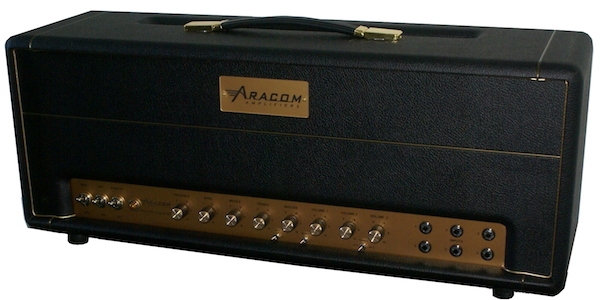
Aracom PLX100

Summary: Based upon the PLX amp “platform” that Jeff Aragaki has created for creating customer-specific amps, this 100-watt beast is actually 3 classic Marshall amps in 1: Plexi 100 SuperLead (JMP), Plexi PA, and JCM800 (high gain).

Features

  • Three channels (Plexi SuperLead, Plexi PA, JCM800)
  • “Bite” Switch (mild mid boost)
  • Master Volume Control with Bypass Switch
  • Presence, Treble, Middle, B ass Tone Controls
  • Solid State/Tube Rectifier Simulation Switch
  • Channel Disable Switch
  • Bias Test Points with user accessible bias pot
  • Handwired turret board construction
  • “M” style large box head cabinet

Price: ~$2900

Tone Bone Score: 5.0 ~ Talk about high-gain versatility. This is no gimmick. Each different channel has voicing that you’d expect out of that particular model. The SuperLead is classic, bright Plexi, while the JCM800 has a darker, much more aggressive tone, and the SuperPA is all about clean headroom. While the amp in an of itself is special; the PLX platform is what make all this possible. If I’ve said it once, I’ll say it to the grave: Jeff Aragaki is genius!

About three years ago, Jeff Aragaki and I were talking about a new amp design. I told him that I would love to have a high-gain amp either in a 50 or 100 Watt version, but gave me the flexibility to voice it in various ways to fit the particular sound I wanted. We affectionately called this a “FlexPlex” because for me in particular, I wanted that Plexi sound, but wanted to be able to tweak it. Jeff actually built it, and I saw the prototype for it a couple of weeks ago.

But in the process of building the FlexPlex, you might say he “stumbled” upon a completely new way to build his amps; and that was basing his builds upon a platform. This wasn’t trivial, and no, I’m not just bandying about some buzzword. The platform that Jeff discovered has allowed him to create all sorts of different amps; starting with a common construct. I’m not sure about all the details, but the proof is in the pudding. Here Jeff’s words that describe this particular amp:

“The ARACOM PLX100 amplifier is a platform that allows us to build customer specific amplifiers with the features and specifications they desire.   For this custom build, our customer wanted a 100 watt amplifier with the vintage Marshall Super PA look.   The Super PA head cabinet has a “wide mouth” front panel opening, allowing access to four separate P.A. channels.    The model designation for this custom ARACOM amplifier is” Super H.T”.,  H.T. representing the initials of our customer.  However, instead of having 4 identical channels like a standard Super PA amplifier, the Super H.T. has 3 different channels, allowing for a highly versatile amplifier. 

“The JMP channel offers clean and overdriven tones as expected with a Plexi SuperLead amplifier.  It has two separate Bright switches that allow the channel to go from a Plexi Normal (Dark) channel tone to Plexi Bright channel tone, or something in between.   The Super PA channel provides slightly less gain than the JMP channel, with a fuller bass response.   The JCM channel is the high gain channel, designated for overdriven/distorted tones.   The JCM’s Bright switch allows for the standard JCM800 bright tone or a slightly darker tone.   The Master Volume control with a true bypass switch, allows for cranked up tone at lower volume levels.   The rear panel Bias Test points, allows for quick and easy tube biasing.”

Fit and Finish

It sure looks like a Marshall… 🙂 But in all seriousness, it’s an Aracom Amp, and that means quality. Jeff doesn’t skimp on components, and he takes a lot of pride in making sure everything that leaves his shop looks absolutely professional, and the PLX100 is no exception. The tolex is perfect, and all the knobs are snug and turn smoothly. And since this amp was going overseas, you can bet that Jeff made sure that everything was sturdy to eliminate or severely reduce the risk of breakage.

Ease of Use

I normally don’t have this section in my reviews, but I thought it necessary in this case. While I absolutely love the amp, with all the switches and the push-pull knobs, I have to admit that I’d have to take a lot of time getting familiar with it. I don’t call that really a negative mark on the amp. For goodness’ sake! How else do you pack in all those features? But despite that, the knob and switch layout is pretty clear. It would take me awhile to find the sweet spot in each channel for all the guitars I’d play through it. But that’s the beauty of discovery and experimentation, wouldn’t you say?

How It Sounds

This amp sounds amazing! Jeff explained each channel as I would have, so I’ll just reiterate and say that his descriptions of each channel reflect my own experience with it. When I was in his shop testing the amp, we must’ve played around with it for at least an hour as he twiddled knobs and flipped switches to demonstrate the amazing number of voices that could come from this amp. The permutations of settings make this amp able to tackle practically any style of music. Oh! We did all the testing through a huge 4 X 12 at gig volumes, so it was LOUD! 🙂 I played a Les Paul, a Gene Baker prototype (it was a hybrid that is VERY cool), and a Strat through the amp, and each guitar sounded killer through it. My favorite channel by far was the SuperLead channel, which had lots of gain on tap, but wasn’t at all over the top. Next was the JCM channel – especially its dark mode which produced thumping overdrive. I wasn’t too wild about the SuperPA with a Les Paul, but with single coils, that channel was absolutely SWEET! It would be a perfect channel to use with overdrive pedals because of its clean headroom.

Overall Impression

What strikes me the most about the PLX100 is that you literally have three amps in one. If you had all three, you’d probably be close to $10,000. That this amp is only $2900 is pretty amazing to me. But that’s Jeff. He doesn’t make a huge profit on the gear he builds – that’s a personal choice. He just wants to build great amps. This is like my friend Perry Riggs of Slash L Guitars. He makes absolutely awesome guitars but sells them at a price-point that’s rather incredible. Both of these gentlemen are true artisans of their trade, and I’m glad there are folks like this.

With respect to the PLX100, I sure wish I played in venues where I really open up an amp like this and really do it justice. For my particular uses, this is way too much amp. But if I ever get the chance to regularly play large venues, you can bet that I’ll be calling Jeff Aragaki to build me an amp on the PLX100 platform. Or… maybe he has a 50 Watt version. 🙂

For more information, visit the Aracom PLX100 product page!

Read Full Post »

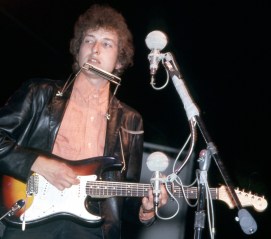
I just read this article on Rolling Stone this morning. Christie’s just auctioned off Bob Dylan’s iconic Strat for $965,000, breaking the previous record held by “Blackie,” Eric Clapton’s iconic Strat. But hey! It came with the original leather strap and hardshell case, plus drafts of various songs. According to the article, the buyer is as of yet unknown.

For me, I wasn’t much of a Dylan fan, and as a Les Paul guy, I’m not really all that keen on a Strat, though I sure wouldn’t mind having a vintage instrument to play.

Read Full Post »

Challenging Myself…

…to use less gear.

Yup, gear slut that I have been, I’ve been focused on using a lot less gear when I gig. Tonight at Mass it was just my acoustic plugged into one of the church’s Genz-Benz amps – though I hate the modulation effects on that amp so I run a chorus, delay and reverb in the effects loop. And even when I bring my electric, in the recent past, I’ve only brought my amp, cab and guitar – well, plus my attenuator. But no effects.

A primary reason for this choice was because I felt that I was relying a bit too much on effects; especially reverb and delay to get some sustain. I felt that I wasn’t using my fingers enough to eek out as much tone as possible from what I was playing.

This had two results: 1) I slowed my leads way down and concentrated on making my guitar sing with bends and vibrato, working individual notes as much as possible; 2) playing with no effects meant that I couldn’t hide my mistakes, so in addition to slowing down, I focused on being precise – not boring, mind you, but hitting notes and chords much more precisely.

Oh I struggled for awhile with the barebones approach, but once I became comfortable with playing that way, just like anything else in life, the repetition just made me better. In fact, in my latest songs, the modulation effects you hear on my guitars were applied in the mix post-fader. I didn’t want to rely on effects applied at the front of my signal; again, challenging myself to only rely on my fingers to get my sound.

So why have all this gear, and why not get rid of all those pedals?

I don’t think I’d ever get rid of them – maybe some that I’m not using. Pedals are great to help sweeten my sound. I like a slap-back delay at times, and as the great Doug Doppler once said, “I always use a little reverb to add a little grease to my tone.” But having challenged myself to not rely on them, I’ve actually turned down the levels of my modulation effects so more of “me” comes through in what I play.

I’m no virtuoso by any stretch of the imagination, but for what I do know, I want to sound good, and that starts in my fingers.

Read Full Post »

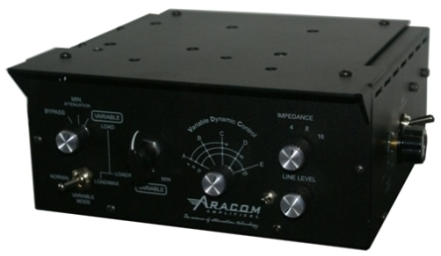
DualRoxWhen I get excited about new gear, it’s kind of hard to stop playing with it. No exception here with the Aracom DRX Attenuator. In my “First Impressions” article I posted earlier today, I mentioned the top three features of the attenuator that had me completely sold:

  1. The first was the “boost” or dual-mode feature that provides an output boost, great for changing volumes at the click of a foot switch.
  2. The second was the Variable Dynamic Control (VDC) that adjusts the reactance between the attenuator and speaker, essentially acting as a high-cut filter.
  3. The third was the weight of the attenuator, which is less than half the weight of a PRX unit.

As soon as I finished writing the article, I went out to my man-cave and started messing around with the unit that Jeff let me borrow. Man, I was giddy. This thing works great! In any case, I got ambitious and decided to do some quick demo clips demonstrating the first two features: Boost and VDC.

One thing that I forgot to discuss in my first impressions article was weight reduction. The reason why this unit weighs so much less than the PRX is due to the lack of a huge transformer. But that loss of weight comes at the price of a little flexibility. The transformer in the PRX allowed you to use different amp and cab impedance combinations. The DRX has variable impedance from 4 to 16 ohm, but your amp and cab impedance settings have to match. For me, that’s not a big deal because though I have cabs that are either 8 or 16 ohm, all my amps have output jacks for those impedance settings. But the features that this unit bring to the table make that particular issue almost irrelevant.

For both clips, I had the attenuator plugged into an Aracom VRX18 Plexi clone. Master is pegged and Volume is at 3pm, which is pretty dirty for this amp. I’m playing my Slash L Guitars “Katie May”

Boost Mode

In this clip I’m playing a single-chord riff, and switching in and out of boost mode without changing the way I’m playing. My “normal” mode attenuation is down about -20dB, while boost mode is probably around -14-17dB. It’s an analog sweep, so it’s tough to get the exact numbers. The idea behind this was to demonstrate the increase/decrease in volume but not gain, which would have changed my tone due to compression.

Variable Dynamic Control

As I mentioned above, VDC adjusts the reactance between the attenuator and speaker, essentially acting like a high-cut filter (though there are no filter caps). In this clip, I’m going between full-reactance (no cut), to the maximum setting, which is four clicks left on the five-position rotary switch. You won’t notice a stark difference between the two, but when I play at the maximum setting, the real high frequencies get cut off, due to the slightly lower dynamics.

Like I said, it’s a fairly small, but noticeable difference. For that particular amp, just moving it over one position tamed my tone just fine. But I wanted demonstrate by going to the extremes. I believe this will be particularly useful at gigs to get just the right amount of bite without feeling as if my tone is slicing.

So there you have it. For more information, visit the Aracom DRX product page!

Read Full Post »

When being fat is good…

Okay, not for a human, but for a pick, at least for me, it’s what I prefer. I use a Wegen Picks Fatone (fat-tone) pick, and at 5mm thick, it’s one fat pick. I’ve sung the praises of fat picks I’ve used in the past, but this one is special in that I use it for both acoustic and electric guitar; something I couldn’t do with other picks.

In any case, last night I got a renewed appreciation for a fat pick because I actually left my Fatone at home. And not having enough time to set up for my gig and fetch it, I had to use the spare emergency pick I keep hidden in the piano at the restaurant. This is a medium Dunlop Tortex. Not a bad pick, as I used that very same pick for years until I discovered fat picks.

Tonally, it didn’t sound bad, but I had gotten so used to playing with a fat pick that I couldn’t get comfortable with the Tortex. The main issue was holding on to the pick. With fat picks, contrary to what you initially might think, you actually hold the pick much lighter, and let the pick tip do the work. Also, fat picks just glide over the strings effortlessly. In contrast, I felt like the Tortex was getting “stuck” on the strings when I played.

I eventually got used to it, but it was a huge adjustment for me. I was really missing my Fatone. I won’t be forgetting again!

Read Full Post »

DualRoxI’ll say this first: The Aracom DRX power attenuator is everything a power attenuator should be!

Biased? Perhaps. After all I’ve made no secret about owning and preferring Aracom equipment, and Jeff Aragaki is a good friend of mine. But irrespective of my ownership of Aracom products and my relationship with Jeff, if you’ve followed this blog with any regularity at all, I don’t say things like that lightly. There’s too much competition in the marketplace to crown a “best” or make a claim like I just did without experience. Luckily, experience is on my side, and having kept tabs on the various attenuators that have hit the market over the years – especially the last few years – I can confidently say that no other attenuator on the market does what the DRX can do.

I was going to save this for the end, but yes, it’s bye-bye PRX150, once Jeff finishes construction of a DRX for me. But I will say this: For basic attenuation requirements, the PRX line of attenuators are fantastic. My PRX150 has been a stand-by on stage and in the studio for years, and has served me quite well. The totally transparent passive attenuation technology combined with the Aracom input/output impedance matching that Jeff invented has no match on the market. And if what you’re looking for is straight-up attenuation, you can’t ever go wrong with a PRX attenuator.

Every year, I write an article on game-changers for me. The PRX150-Pro has always made the list because I just can’t do without attenuation and get the high-gain sounds I need at a reasonable volume. But the DRX will unfortunately AND fortunately supplant it on the list.

So, with the preamble out of the way, let’s get down to brass tacks…

In evolutionary science, there’s a term called “disruptive selection” (aka diversifying selection) wherein extreme traits are selected over intermediate traits within a given population. A good example of this is the evolution of the peppered moth in England (yeah, I was a biology major at university and genetics and evolution were part of the curricula). In this study, the light-colored peppered moth population was severely decreased due to predation; in large part because of the environmental changes brought on by soot covering the foliage, thus making the moths stand out. On the other hand, dark-colored moths increased in population because they could conceal themselves much better against the darker foliage. Darwin also observed this on the Galapagos islands with the finch population (this is a cardinal case, as it is known, and it is mentioned in the article to which I provided a link).

So what does disruptive selection have to do with the DRX? Well, first we have to start with the PRX. Jeff’s attenuation circuit technology, while functioning in basically the same manner as other attenuators; that is, attenuating output power was actually a disruptive event in attenuator technology when it first arrived on the scene. Every other manufacturer at the time was basically using a variation on the same attenuation technology which, while effective, were tone sucks. So to get their transparency, they had to add EQ circuits to compensate for the high-end frequency loss inherent to the traditional attenuator design. Jeff, on the other hand, figured out circuitry that retained transparency and dynamics without the need for an EQ circuit. It truly was a game-changer, and sparked some heated debate on the forums. But with time, things settled down, people picked their attenuators, and the discussion moved on. Enter the DRX (I really wanted to say “Dragon”).

I had worked with a prototype of this a couple of years ago. It was on a pine board. 🙂 And even at the time I told Jeff that this was going to change everything in the attenuator market once he came out with the real deal, and now that I’ve had a chance to finally play with it, I wasn’t wrong. This attenuator changes everything for me!

I finally got to try out the DRX at Jeff’s workshop over the weekend. I was taking my PRX150 in for a bit of servicing because after hundreds of hours of use, I started noticing some weirdness in it that I wanted to have him check out. Also, Jeff wanted me to test a VERY special, new 100-watt amp that he was shipping to Australia before he packed it up. This amp will be his flagship 100-watt Marshall-style amp. I say “Marshall-style” because it has circuitry in it that will give it voicing for three different Marshal amps: Plexi 100, Plexi PA, and JCM800 – all in one amp! It’s absolutely killer, and I will be writing a review of it in the coming weeks.

After I played with the amp for quite awhile, Jeff hooked up the DRX to show that to me as well, then spent several minutes explaining its operation to me. As I listened to him, I started chomping at the bit to test it because it had everything that I had wanted in the PRX150! I also knew that based upon my experience and knowledge of other attenuators on the market, the DRX would be an ass-kicker.

I won’t bore you with technical details, as this is an “impressions” article, so you can read about the features here. But I will highlight the three most major features that get me so excited about this attenuator:

Dual-level attenuation. For clarity, Jeff has this labeled “boost” on the attenuator. But it’s not a boost in the traditional sense in that it doesn’t add input gain to your signal, which would result in a bit more compression from the power tubes. This is actually an attenuation reducer. In that sense, it is a boost as output power increases and you get more volume. But unlike input boost, no compression takes place, thus your tone stays the same. This is an absolutely HUGE feature for me, especially when I’m playing in overdrive and need to get into a lead break. If I’m already slamming my amp with input gain and my tubes are pretty well saturated, adding more input gain to do my leads doesn’t change my volume much. But with a “boost” mode on the attenuator, I can reduce the attenuation to increase the output power at the back-end of my amp and will get the volume boost that I need. Then switching back to “normal” mode, I can easily go back to rhythm volume.

This is the very first feature I tested on the DRX, and that feature alone sold me on it, and I asked Jeff if he’d build me one. This is something that I’ve wanted on my PRX150. The secret behind this feature is the foot switch; actually foot switches available for the DRX. I won’t go into detail about them here – because I only know about what mine does – so you can read about what each different type does here. I have a “Type B” foot switch which allows me to not only switch back and forth between normal and boost modes on the attenuator, but also allows me to switch channels on my two-channel amps. I could actually use this on my DV Mark Little 40. While it’s not a two-channel amp, the foot switch provides 6dB of gain boost. So I could have the amp set up in normal mode at just the edge of breakup, then when I engage the “boost” on the attenuator, I’ll simultaneously add the 6dB boost on the amp to take it over the edge.  OMG! Looks like I’ll have to test this. 🙂

You might be thinking “so what” about the foot switches. Well these are what set the DRX apart from the competition. Actually, you could do without a foot switch and in that case you’d have to switch between normal and boost by hand; still much more than what the competition offers. But combined with one of the Aracom foot switches, it suddenly opens up a bunch of possibilities, and further distances the DRX from the pack.

Variable Dynamic Control. As if Jeff’s attenuator technology and dual-level modes weren’t enough, Jeff added another feature to the attenuator that to me, simply decimates the competition. VDC is a subtle feature (actually less subtle if you switch back and forth between extremes) that adjusts the reactance between the DRX and the speaker. The result is a smoothing out of the high-frequencies as you change the reactance. This is NOT an EQ, but it does act like a very subtle high-cut filter. For instance, when my Plexi-style amps are cranked, they produce a ton of bright tone (and no, I’m not talking about those undesirable high-end transients that some in the past have imagined hearing – I think it’s their tinnitus. 🙂 ). With the VDC, I can roll off a bit of that so my tone isn’t quite as piercing. In my test of the DRX, we had the 100-watter cranked in the Plexi channel with minimal attenuation (oh yes… it was LOUD). With Jeff moving from extreme to extreme, the sound went from piercing (no roll-off), to much smoother. The sweet spot for me was a couple of clicks down on that amp.

Why is this an important feature? One of the complaints that people had about the PRX line when it first came out was that when they cranked their amps, they’d hear these high-end transients or their sound was piercing. I don’t think they ever totally cranked their amps up before. A cranked tube amp takes a little getting used to because it transforms at higher-gain, with many amps seemingly producing more highs when cranked (or they’re just not as apparent when slightly overdriven). For some like me, I love those high-frequencies. But for others, they’re undesirable. So now, those complainers have nothing to complain about. If they don’t like all the highs their amp is producing, they now have a way to dial them down; without adjusting the EQ on their amp! How f-in’ cool is THAT?!!!

It only weighs 7 lbs!!! As much as I love my PRX, it weighs 18 lbs, and is about the height of an amp head. The DRX, on the other hand weighs less than half that, and has a lower vertical form factor than the PRX, making it much more easily transportable. For as much I gig, the less weight I have to lug, the better.

I could go on and on and on, and it looks like I’ve done a good job of that already. 🙂 But the DRX represents yet another turning point for me. I will be releasing gig reports and a studio test (with clips) in the near future. Jeff graciously lent me his first production model while my DRX is being built. Stay tuned!

For more information, check out the DRX product page!

Read Full Post »

Influences

There’s an old saying, “No man is an island,” well, no one person is an island, no matter how much they might try to isolate themselves from people or the trappings of society. No matter what, our lives are touched and shaped by the interactions we have with other people and the environments in which we live. Even those who’ve chosen to live solitary lives have done so as a result of their experiences – albeit negative.
And in music, this adage holds especially true. Every musician is influenced by the people and things around them, past and present. For those who claim they have no outside influences, they’re lying to themselves, plain and simple.

What compelled me to write this article was I spent an afternoon  back in July (I actually wrote this article that day) sitting on the front porch of my sister’s house in Lone Tree, CO with my Aunt Kathy, who’s an incredible professional artist and an owner of the Allegri Wine Shop in Gresham, OR with her husband, my Uncle Bill (that’s one of her incredible watercolors to the left). In any case, we were mutually inspiring each other. She was painting these incredible “sketches,” while I played and sang.

Occasionally we’d stop and chat, and at one point I said, “You know, we really are a family of artists.” She enthusiastically agreed. Art was something that has always been a part of our family lifestyle for as long as I can remember. Everyone sang, and most played some sort of musical instrument. My dad was trained as a concert pianist, most of my aunts and uncles played something.

So it was not surprise that music came naturally to me. As I said to my Auntie in one of our conversations, “People ask me a lot how much training I’ve had. My answer to them is I’ve had very little training in my lifetime, but I grew up in a very musical and artistic family, so music has always been part of my life, and part of the makeup of who I am.

Sure, I have musical influences galore. But the root of my musicianship comes from sitting in a busy room at a family get-together, breaking out the instruments, and playing tunes. I had an uncle who was an incredible slack-key guitarist, but he could play jazz like a MoFo! I got a lot of my melodic phrasing from watching and playing with him. Another uncle taught me how to read guitar chord charts when I was eight years old. Once I learned how to do that, I took out all my dad’s pop music books (this was 1970), and proceeded to learn Beatles, Burt Bacharach, Lovin’ Spoonful tunes, and whole mess of others.

It was family that stirred and continues to stir the musical fire that burns inside me. When I sing a love song, I think about singing to my lovely wife. When I’m singing fun tunes, I think about playing with my kids. When I’m singing sad songs, I think about long-lost loved ones.

I know it’s not the same for everyone, but we all have our influences. I believe if we recognize the people and things that influence us as musicians, it allows us to tap into the emotions associated with those influences and make us much more expressive in what we play.

Read Full Post »

Matches Made In Heaven

Katie May and the Aracom VRX18

Katie May and the Aracom VRX18

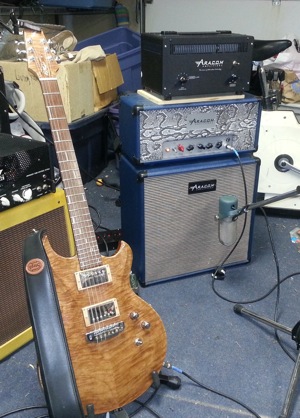
I was talking to Jeff Aragaki yesterday evening about his absolutely magical Aracom VRX18 Plexi clone and how Katie May sounded so perfect with that amp. I used that combination in my latest song, “The Lothario” and was completely amazed at how well they fit together.

I told Jeff that I hadn’t played the VRX18 in awhile, and hadn’t gigged with it for a long time since my DV Mark Little 40 does the job for playing out. But for studio work, the VRX18 and her more aggressive sister, the VRX22 (I had Jeff voice her a bit more aggressive), have been studio stand-bys for me for a long time. In any case, I was looking for a particular sound with that song, and thought that the VRX18, with her creamy-smooth overdrive and gorgeous sag would do the trick perfectly. I wasn’t wrong.

Katie May took to her like white on rice. Here I was thinking that Katie May was best played clean, and had shared that with Perry Riggs, Katie May’s builder. But what issued from the amp stopped me dead in my tracks. It was clear that I just hadn’t matched her up with an amp that would allow her to fully express herself. The Lollar Imperials with their lower output drive the VRX18 perfectly, producing a buttery/creamy-smooth overdrive tone. I was up till the wee hours of the morning yesterday just playing around after I had already finished mixing down the song. And come to think of it, Katie May has never disappointed me when played with my DV Mark Little 40, but she sounds absolutely incredible with a vintage Marshall-style amp.

Tonight, I was looking for a song I had recorded a couple of years ago to see if I could add an overdriven guitar to it, as a professional reviewer had given me feedback that it would be nice to make it have a bit of an edge. But in my search, I came across something I put together for practice (I’m not too good at playing without some sort of backing track to give me a reference) a few weeks ago, and immediately started tooling around with it. After about a half-hour of messing around, I decided to lay down a track to demonstrate just how good Katie May sounds with the VRX18. Give it a listen:

As you can see in the picture above, Katie May was plugged directly into the VRX18. No effects were used. In the recording though, I added some reverb and a little delay to add some ambiance to the guitar; just as with “The Lothario,” I didn’t EQ the guitar at all. Also note that I did the guitar part in a single take, and went from clean to dirty by simply turning up the volume knob on the guitar. Katie May went from this hollow body clean tone to a rock machine with a simple twist of a knob.  Of course, that’s also a testament to how responsive the VRX18 is. On the amp, I had the Master pegged, and the volume at about 2pm. That gives me plenty of overdrive with the guitar’s volume all the way up, but will also clean up real nice by turning the volume down.

I just gave the track another listen-to and thought back to when I was up on something like the 20th fret to hit that high-high note. One thing that I love about playing Katie May is that the butt of the neck doesn’t get in my way. I don’t have very long fingers, so playing way up on the fretboard has always been an issue playing other guitars. But not with Katie May. I can get to those notes now – and she has 24 frets – all playable! But note one VERY important thing: On other guitars where I’ve been able to reach the really high frets, though most have been playable, they haven’t had the sustain that Katie May has. I believe this has to do with the neck-through construction. Since there’s no break in the neck, the sound waves are allowed to reverberate continuously throughout the neck and create much more sustain than bolt-on, or even set necks. Even my Les Paul, which is a sustain machine doesn’t sustain nearly as much way up high as Katie May does.

In any case, this marriage gives me the same kind of feeling I get when I play my Les Paul R8 through my Aracoms and DV Mark Little 40. “Amber” loves to scream through those amps, though I have to admit, I love her best with the Little 40. They pair so well together that I forget about twiddling knobs to dial in the right tone. I set it my amp in the sweet spot and play. Those kinds of things are to me at least, matches made in heaven.

Read Full Post »

I have several friends and acquaintances who, after their breakups or divorces, went on a bit of a tear on electronic dating sites and seemed to go through women – quickly. I used to tease them that they were fast becoming lotharios. But they always had a reason for not committing. So I wrote this song from their point of view. It’s called “The Lothario.”

Here’s the final mixed version. For the guitars, I added just a little high-end boost to make them stand out a bit more, but I kept their levels pretty much the same.

In any case, here’s the gear I used:

Guitar: Slash L Guitars “Katie May”
Damnation! That guitar played just slightly dirty through my little 18-Watt Plexi clone sounded absolutely incredible! Didn’t have to EQ it at all. Katie May was set to the middle position (both pickups), but in single coil mode so I could get a bit of that Strat Position 4 jangly sound with the dirt.

I was originally going to add a clean guitar track on the left side of the mix, but started noodling with my amp much more overdriven, and decided that I wanted to give the song a bit more of an edge than what it had. So I added it in plus some really simple, but thematic lead breaks over the main riff.

Amp: Aracom VRX18
This is a VERY special amp to me, and while I don’t gig with it much, this amp with its tube rectifier has a very distinctive tone and dynamics. Standard VRX’s (18 and 22) come with a solid state rectifier – that’s not bad. My 22-watter has one. It just has more attack, and I wanted the feel of bit more sag as I was playing a bit behind the beat.

But being a Plexi-style amp, cranked up, this amp has a big sound, and on the “lead” track, I had to make sure I was doing a lot of palm muting to tame the overdrive a bit. But it turned out awesome!

Bass: Ibanez G-10
Cheapo, but it totally serves my purposes.

Here are the lyrics:

The Lothario

I was just a regular guy
…at least I thought I was
going day to day through life
All I wanted was to pass the time
…just doing my thing
You live your life and I’ll live mine
Then I saw her and she turned me all around
Don’t know which way is up or down!

Wasn’t looking for a good time
it must’ve come from outer space
all I know is that she launches
my heart into the sky
But I know I shouldn’t get too high
too much risk of falling
so I’ll enjoy the warmth I’m feeling inside
Enjoy her till it’s time to say goodbye

Please don’t judge me too unkind
…I know how it must look
But they shouldn’t be surprised
I never mean to make them cry
…the truth just hurts
But I have to draw the line
I don’t need no one to
spend their life with me
But I don’t mind the company

I wish she wanted just a good time
and be satisfied with that
but I know that what she wants is more
than what I had in mind
So we can have ourselves some good wine
and compelling conversation
and we’ll enjoy this warmth we’re feeling inside
Enjoy it till it’s time to say goodbye.

Spent so many years in losing myself
Not about to apologize
Though I haven’t put my heart on a shelf
I’ve just had to take the time to realize…

I just want to have a good time
don’t want no one depending on me
as if I have to fill up their lives.
So if you want to have a good time
Kick off your shoes and just go with it
enjoy this warmth we’re feeling inside
Enjoy it till it’s time to say goodbye.

Read Full Post »

« Newer Posts - Older Posts »