Feeds:
Posts
Comments

Archive for the ‘Guitars’ Category

Let me qualify before I go on: I actually don’t care if a guitar is handmade or if the wood is carved by a machine. All I care about is that the guitar plays and sounds good. I’m not going to advocate one over the other.

The other day, I was on an online forum where there was this HUGE debate about handmade guitars vs. CNC. The handmade proponents all talked about “soul” and “mojo,” while the CNC proponents talked about consistency and speed.

The reason I call this a “dumb” debate is that many people think that a CNC is just a set-it-and-forget-it appliance. You press a button and out pops a finished guitar. It’s a tool. And make no bones about it, despite parts being cut by a computer-controlled machine with a CNC, the finish and assembly of pretty much all high-end guitars are done by hand.

Personally, as I mentioned at the top of this entry, I don’t care. If a guitar sounds good and plays good, then it is good – at least to me.

I know, I’ll probably piss some people off – especially the ones who swear by getting nothing but handmade guitars. Hey man, if that’s what does it for you, then go for it! For me at least, I’m much more utilitarian with my approach to gear. I’ve got to be able to gig with it and record with it. A guitar’s soul is how I connect with it.

It can be a cheapo guitar like my original Yamaha FG-335 or my $200 Squier Classic Vibe Tele. If I can make music with it, my thought is simply this: Lemme play it.

Read Full Post »

Summary: Let’s get this out of the way first: The T5z is an electric guitar that has acoustic capabilities. But its acoustic sound is killer! Unlike in the past where I felt that Taylor couldn’t decide whether the T5 was an electric-acoustic or acoustic-electric, now, I feel the dichotomy between the two is much more clear now.

Pros: You get the best of both worlds with the T5z: A great acoustic sound and lots of tone-shaping capabilities in both electric and acoustic modes. It’s also super-light and incredibly playable with the Les Paul-like scale length. The separate bass and treble knobs give the guitar lots of tonal range.

Cons: Now this really isn’t necessarily bad thing, but it takes a while to dial in the right sound and especially EQ balance. The very thing that’s a pro with the separate bass and treble knobs also can get you in a bit of trouble during a performance if you haven’t done your homework; and yes, that’s from personal experience.

Features:

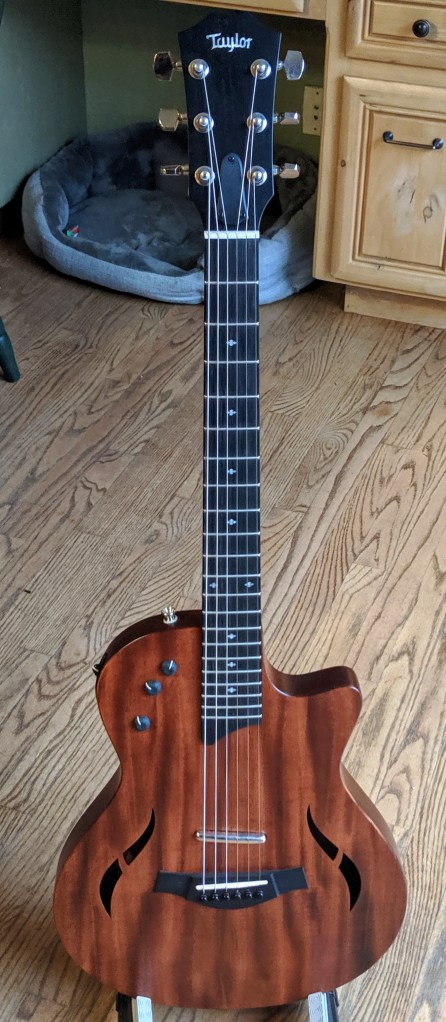
  • Body – Hollow body, mahogany with a mahogany burst stain and satin finish
  • Back – Mahogany, two-piece, no wedge
  • Neck/Heel – Sapele
  • Fretboard – Ebony, black binding, small diamond inlays
  • Fretboard Radius – 12″
  • Frets – 21
  • Scale length – 24 7/8″
  • Nut – Tusq
  • Saddle – Micarta
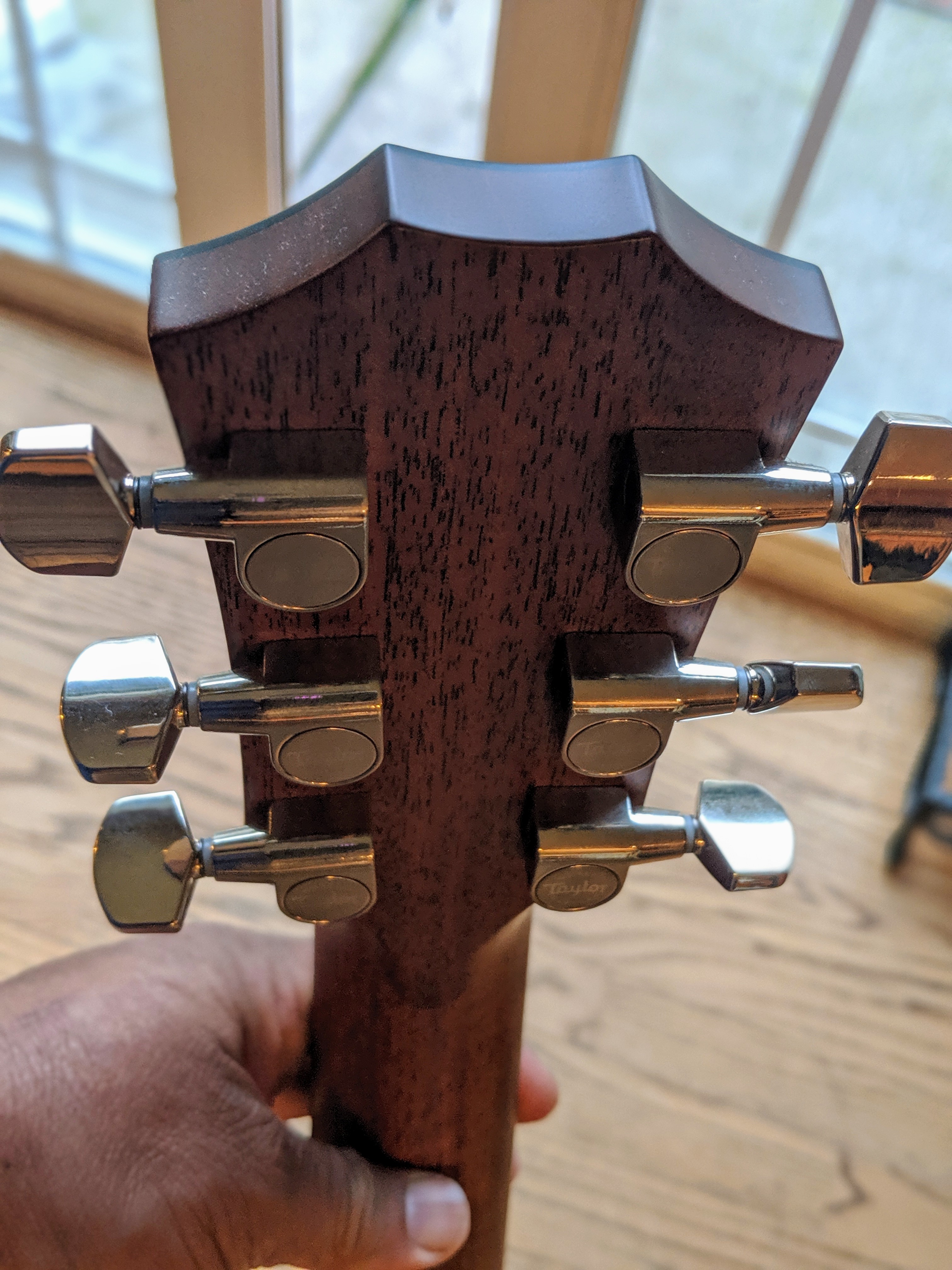
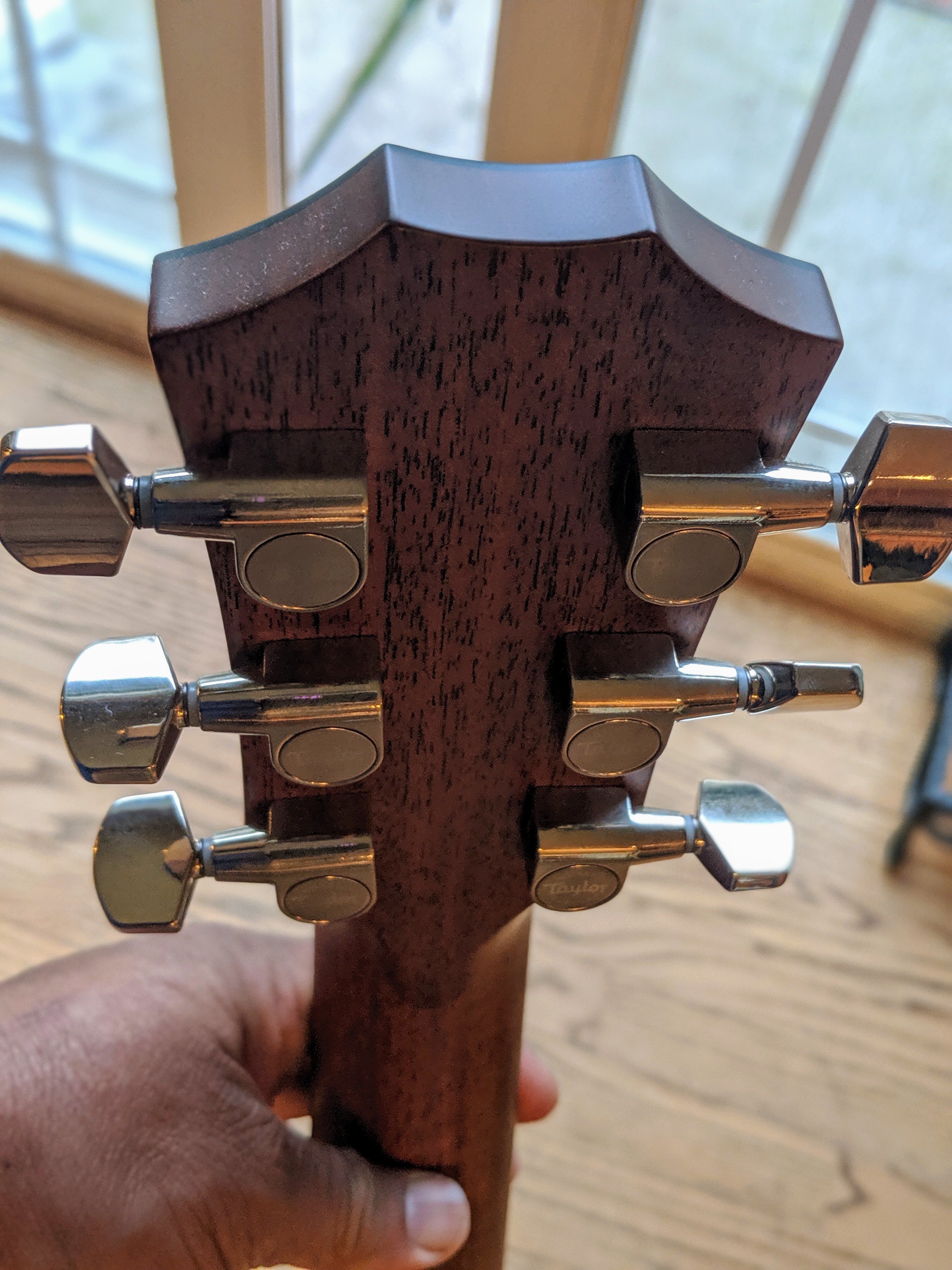
  • Tuners – Taylor Nickel
  • Controls – 5-way switch system, Volume, independent Bass and Treble
  • Pickups – 3 pickups: Concealed neck humbucker, Stacked bridge humbucker, Body sensor behind the saddle.

Street Price: $1899 ~ But you can get a deal. I got mine for $1600 at Guitar Center. Granted it was their floor model, but they had just pulled it out and set it up a couple of days before. Chances are, no one played it. 🙂

Tone Bone Score:

Hands-down, by its very nature, this is the most versatile guitar in my arsenal. I’ve been playing it daily since I got it and have performed with it three times. I couldn’t be happier with the T5z.

Can Two Wrongs Make a Right?

It’s a funny thing where two things that individually aren’t very appealing can be combined to create something beautiful. That’s the T5z for me. I was really meh about the T5 when it first came out, and I have never liked Elixir strings. But here I am now with a T5z, strung with Elixir Nanoweb 11s and they feel perfect together!

In demo videos I’ve seen, pretty much every demonstrator I saw mentioned the guitar being strung with Elixirs. That had me raising my eyebrows a bit. It’s not that I didn’t like the feel of Elixirs. I just never liked their sound on any guitar I strung them on. But with the T5z, they’re perfect, and it seems as if Taylor tuned the guitar to work with these strings.

Since I’ve purchased the guitar, I’ve been playing it almost daily and the more I play it, the more I’m loving it for what it brings to the table. Especially for leading praise and worship, where I play a wide range of styles, being able to seamlessly switch between acoustic and electric is pretty freakin’ cool.

Combine that with my BOSS Katana Artist, and it’s simply the flick of a switch on the guitar and a press of a button on my foot controller to go between acoustic and electric and vice-versa. This is the promise of the T5 since its inception that kind of fell flat with me twelve years ago. But today, that promise has been fulfilled.

Fit and Finish

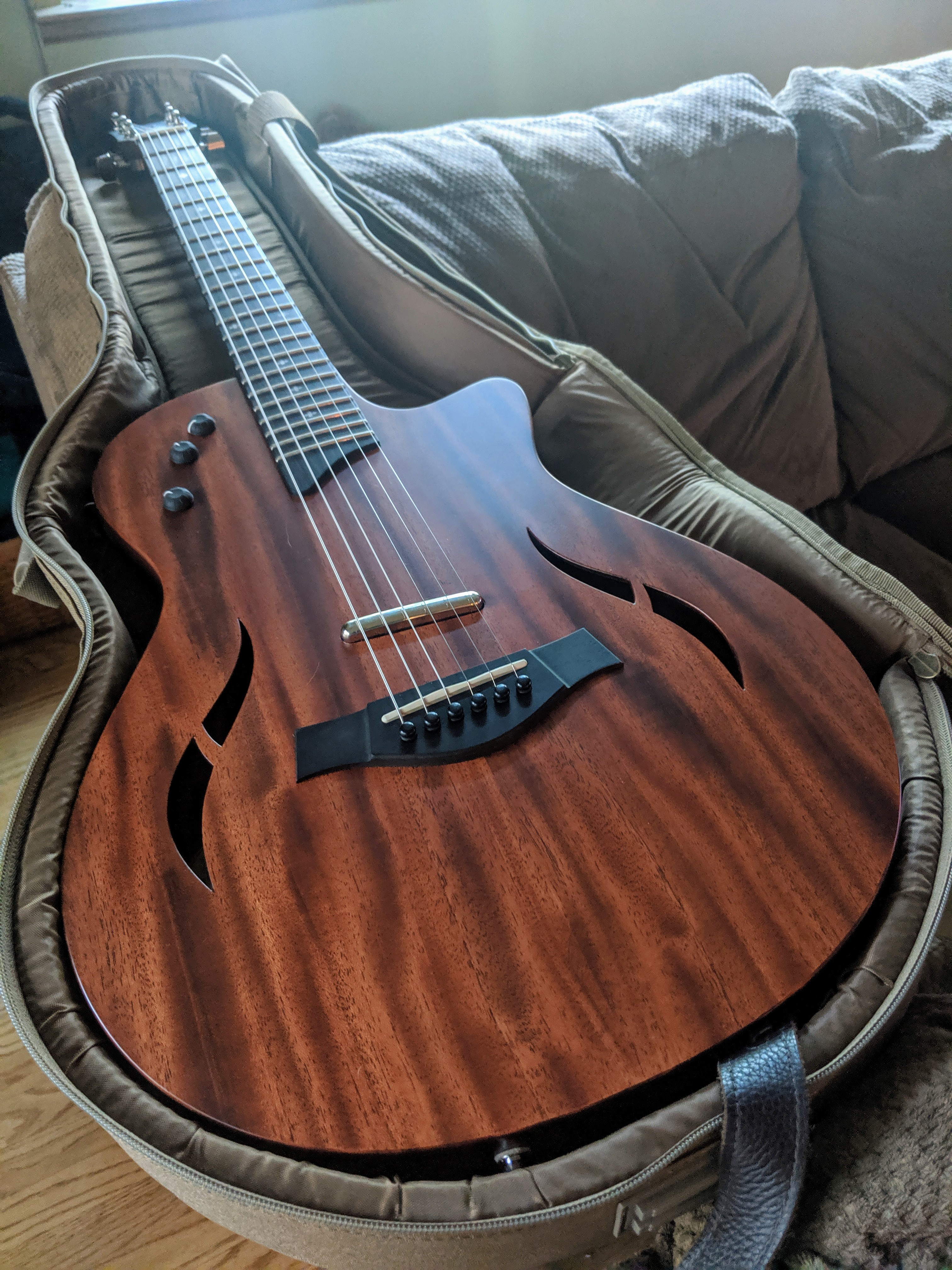
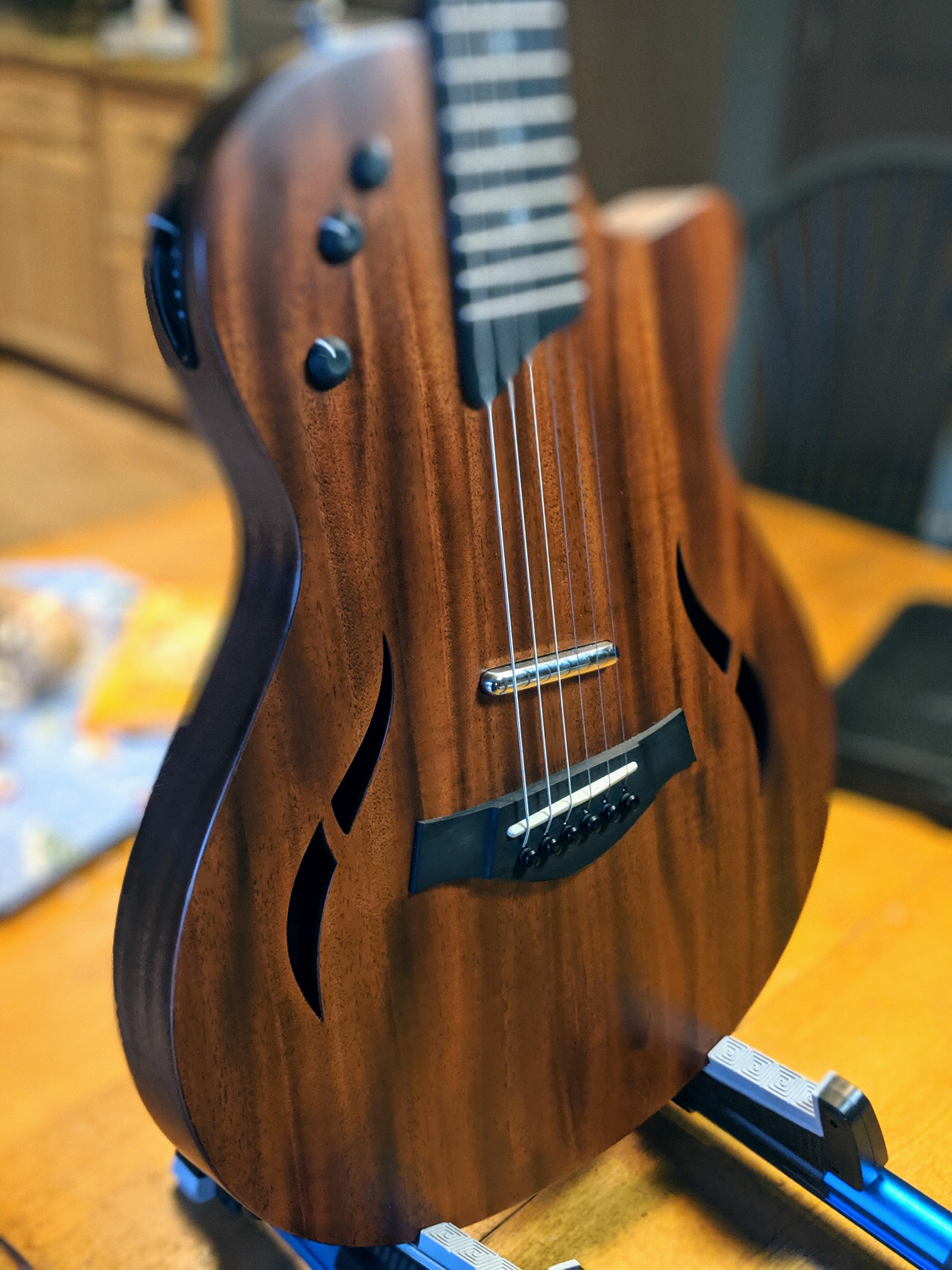
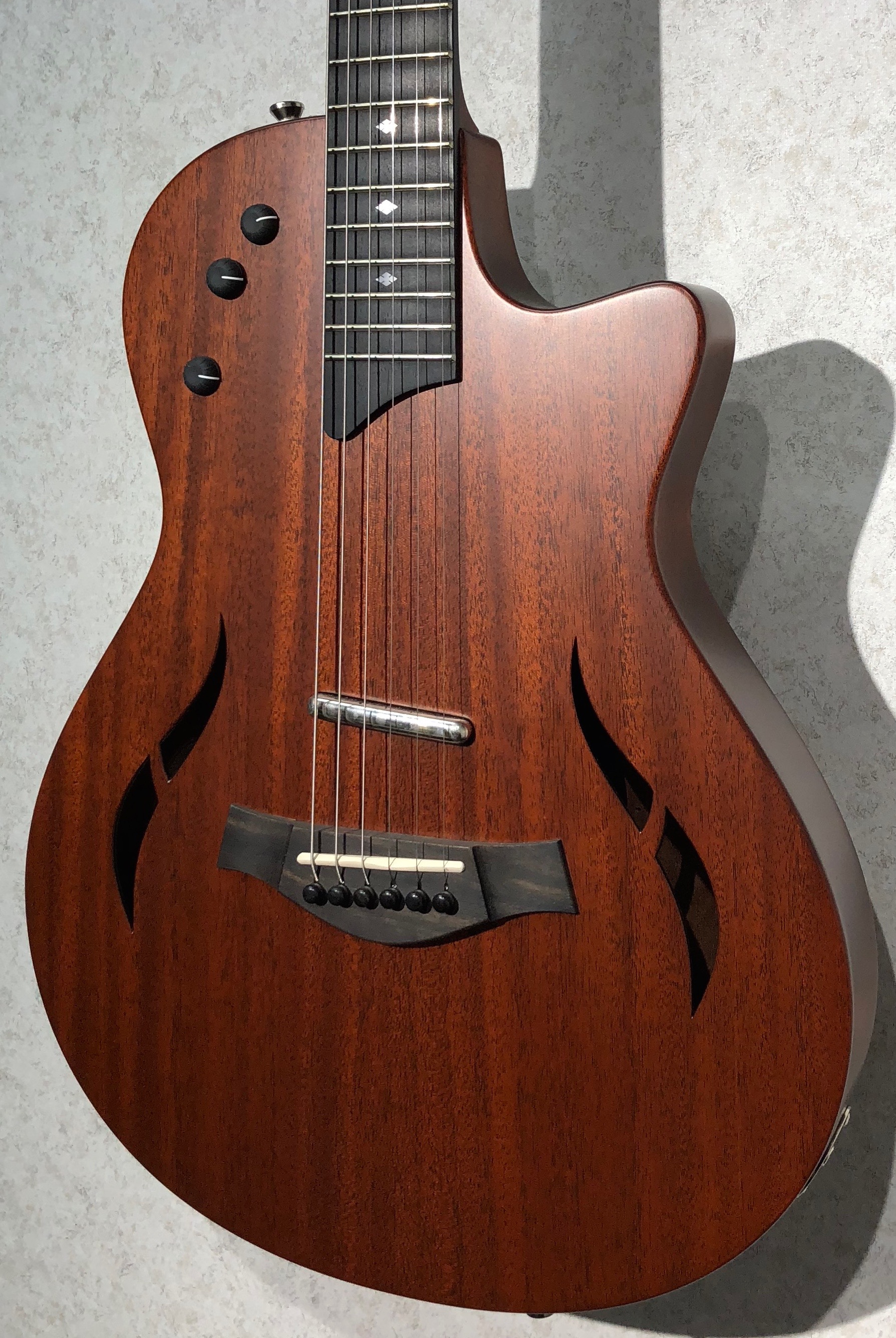
True to Taylor’s reputation for building high-quality instruments, the T5z is no exception. There’s nary an uneven joint nor uneven finish on the guitar. My particular guitar has this wonderful variegation in the grain, that even with the flat, satin finish gives it a 3-D quality.

There are three knobs: Volume, Bass and Treble. For the volume, there’s a detent notch which sets the volume at line level, making it very easy to set the gain going into an amp or PA.

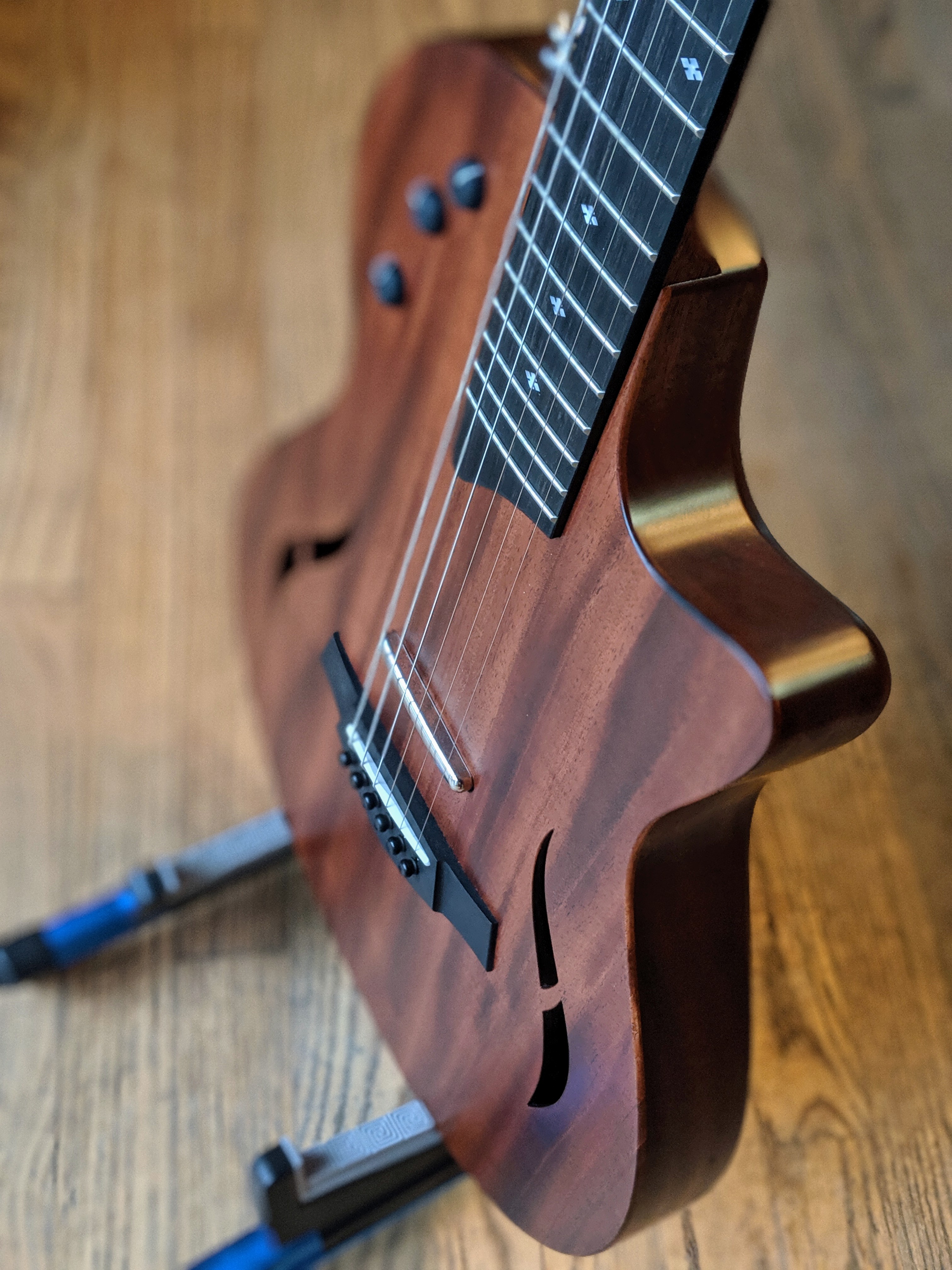
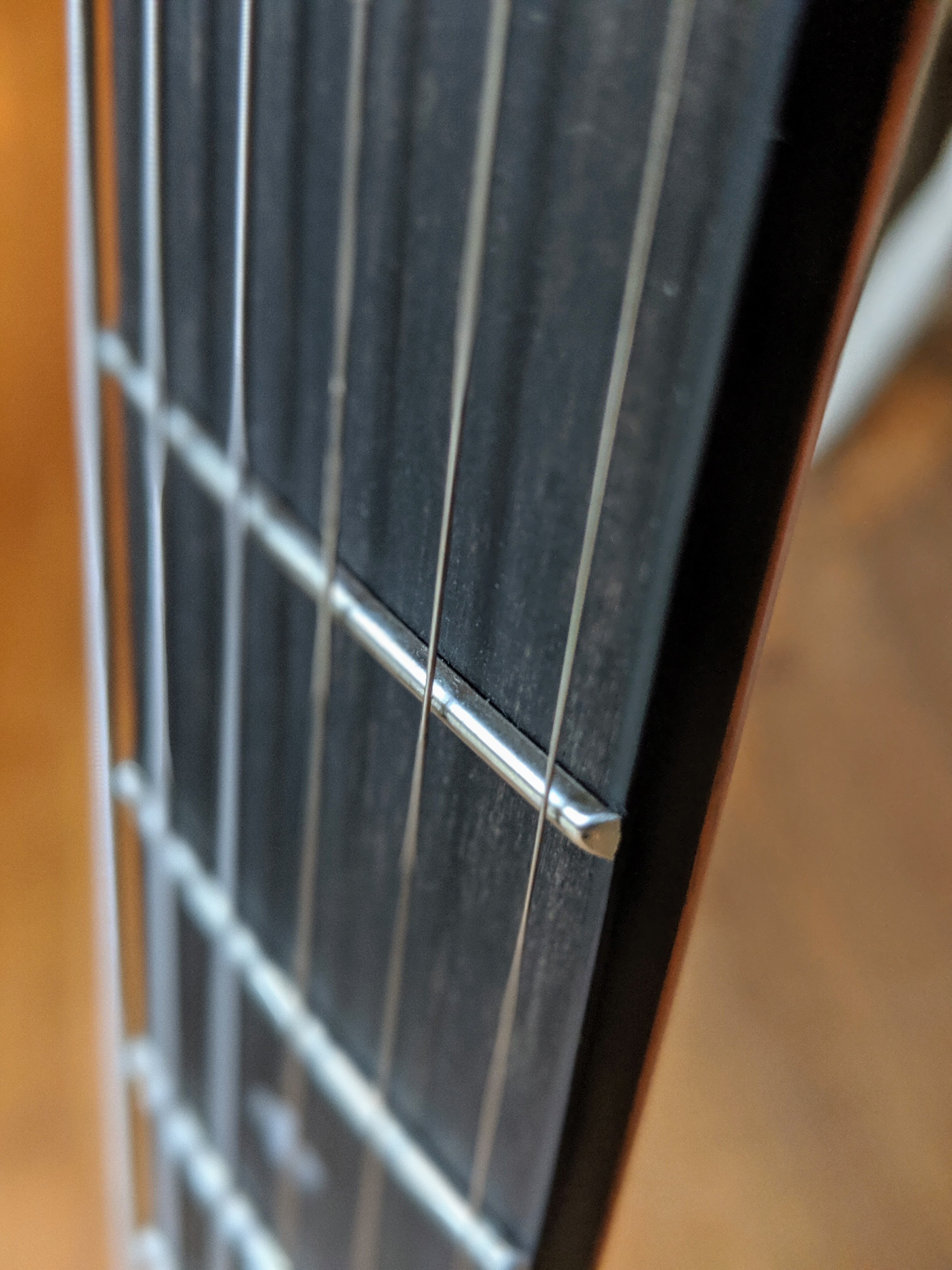
The ebony fretboard is smooth as silk and feels oiled despite being completely dry. The jumbo fret wire really makes the guitar so much more electric in feel and combined with the shallow-C neck profile, yeah, this is an electric guitar.

The ONLY thing I wish the guitar had was a clear pickguard to add a bit of protection to the top. Though my strumming technique is pretty good, I use very thick, beveled picks, plus I keep the fingernails of my right hand long for fingerstyle playing.

I damaged the top of my Simon & Patrick with just my fingernails, but that was exacerbated by my thick pick occasionally striking the soundboard. The T5z top is mahogany so it’s much harder than spruce, but I can see rub and smudge marks on the guitar (not gouges, mind you) and for something this pretty, I want to protect it as best I can.

You can find a clear plastic guard on EBay here. It’s static cling, so you don’t have to worry about adhesives. Nice. I ordered a set today. EDIT 1/2/2020: I just found out from the seller that the static cling pickguard will not work with the satin finish. He was very gracious and refunded my money.

Playability

Yowza! This guitar is incredibly approachable whether I’m playing acoustic or electric. The smooth fretboard allows my fingers to just glide up and down the neck. Because it’s an electric guitar, the action is low, but not so low that it causes string buzz.

The jumbo fret wire took me a little while to get used to as I only have to use a light touch to fret a note or play barre chords. I actually had to make the most adjustments playing barre chords, ensuring that my index finger was flat. If I roll my finger too much to the side, my knuckle would bend the string. This actually forced me to lighten up my grip, which was a good thing.

From a soloing perspective, the jumbo frets make playing similar to playing scalloped frets; not quite, but they’re big, so a light touch is necessary. But digging in with jumbo frets provides for so much expression.

The most incredible thing with the T5z’s playability is that without a neck heel, reaching the upper bout of the neck is SO easy. My mate and I were doing some jamming before Mass the other day and I worked my way up the neck. I started chuckling at how easy it was to get to those high notes and not have to stretch!

A note on the string gauge. The guitar comes standard with Elixir Nanoweb 11s. The thicker gauge gives a slightly acoustic feel to the strings. But the Les Paul-like scale length makes bending super easy. It really feels like playing an electric guitar with thicker gauge strings. Also, the thicker gauge prevents too much bending while just fretting notes. Going any lighter on the gauge, at least to me, would make the guitar very difficult to play.

How It Sounds

I have yet to record demo clips for the guitar. With my kids home for the holidays, that was relatively impossible. I’ll post some in the next few weeks. Despite that, I’ll do my best to describe the T5z tone.

Tone Controls: Complicating Things

This is NOT a bad thing. But the independent bass and treble knobs kind of complicate things because not only do you get a wide range of tones just from the various switch positions but the EQ controls give you lots more range within a single position. Because of this, it takes a bit of time to dial in the guitar. Though I like pretty much every sound I’ve discovered thus far, I don’t know if I’ve found my personal sweet spot for each position. That said, let’s continue, shall we?

There are 5 switch positions. When describing the sound, it’s best to do it per pickup position as each engages the pickups in different ways, thus providing different tonal possibilities.

Position 1: Neck HB and Body Sensor

This is the only position that engages the body sensor and is considered the “Acoustic” mode. The body sensor is what gives the T5z that natural sound while the guitar’s plugged in. I really don’t know how it works, but it sounds way better than a standard, under-saddle transducer. When I saw Eric Rachmany playing his T5z, I was amazed at how gorgeous his acoustic tone was.

And having played the guitar myself, up close and personal, I know I’m playing an electric guitar, but the acoustic tone is incredibly rich. With more bass, I can get a dreadnought tone; backing it off and turning up the treble will give me more of a concert body tone. Mind you, it’s important to keep in mind that this a plugged-in acoustic sound, not an exact reproduction of an acoustic guitar.

Position 2: Neck HB

I have to admit that I haven’t really played with this position that much. Without the body sensor, which provides treble much like the way the Seymour Duncan Mag Mic’s microphone works, the neck pickup is warm and a little dark. Even cranking up the treble in this position, the tone is still very warm. It would be perfect as a rhythm, playing-in-the-pocket setting.

Position 3: Bridge HB

This is definitely the rock position, and I love it. It’s bright and a little filthy when played with overdrive. I have been using this setting almost exclusively for solos. But clean, I love the Tele-like tones I can get out of this position.

At Christmas Eve Mass last week, we closed out with a country/bluegrass-style arrangement of Joy to the World. I set my amp to clean with a little slapback delay, boosted the Treble on the guitar, and I got this great, twangy tone that was perfect for the song!

Position 4: Neck and Bridge HBs in Parallel

So far, this has been my favorite setting. Taylor implies that this is more of a Jazz setting. I can see that, but I love how versatile this particular setting is. Pump up the bass and back off the treble and you get a tone that’s reminiscent of an ES-335. Do the opposite and you get that jangly tone of a Gretsch Country Gentleman.

Throw some overdrive in this setting, and for me, this is the perfect position for classic rock. For doing solos, I crank the gain on the guitar past the detente (line level), and the overdrive is smooth and creamy.

Position 5: Neck and Bridge HBs in Series

Running the ‘buckers in series creates a FAT tone, as the gains of each pickup stack. I actually prefer using this position clean. It’s almost like Position 1 but simply lacks that natural, woody tone that the body sensor provides.

Last Sunday at Mass, I used it as my soloing position and pumped up the treble. It was quite pleasing.

Like I mentioned above, I’m still discovering the different tones that the T5z can produce and I really haven’t found my sweet spot for each switch position. But that’s part of the fun in playing this guitar!

Overall Impression

As with anything I give 5 Tone Bones, it’s obvious I love this guitar. And playing it through my BOSS Katana Artist is like the perfect marriage. I now have flexibility in both guitar and amp to get any sound I need!

Read Full Post »
When I purchased my Gibson J-45 Avant Garde Walnut Burst earlier this year, a huge factor in my buying decision was that it was constructed of sustainable material. The body is made of walnut, the top is Sitka spruce from a sustainable source, the neck is maple and the fret board and bridge are made of Richlite.

While sustainability and socially responsible manufacturing has been in the back of my mind for years, it wasn’t until I did my research on the J-45 that it really hit home with me.

Gibson has gotten in a lot of trouble over this in years past and I’m glad that they’re finally “getting it.” Their situation is kind of like Apple who was sourcing components from Chinese manufacturers whose factory conditions and production waste were abysmal and treated their workers extremely poorly.

Apple got busted – more from bad PR than anything else – and now takes an active role in ensuring their manufacturing partners treat their workers well and that their manufacturing is more environmentally safe, however dubious the rules are in China, considering the pollution in that country.

What crossed my mind is that I’m at that stage in life where I have the means to buy pretty much any guitar I want and pretty much any time I want. But just because I have the means to do so, doesn’t mean that I can be indiscriminate about how and where the materials that go into the guitars I buy come from.

Don’t get me wrong. It’s not that I’m being a tree-hugger. But I strongly believe that I as a consumer have a responsibility to the planet and its people, and where I can and as much as I can be aware, apply my purchasing power to companies that not just believe in but actively practice socially and environmentally responsible manufacturing. I will not support a gear company who doesn’t have policies in place that respect our planet and its people.

I applied that thinking to my recent purchase of my Taylor T5z. But I didn’t have to dig too deep with respect to Taylor’s sustainability practices and social responsibility because I’ve been well-aware of Bob Taylor’s practices with respect to these issues. Though I’ve never been a big fan of the Taylor sound, I nonetheless have had a deep respect for how Taylor sources its wood, ensuring that it comes from sustainable sources and is ethically and legally sourced.

More impressive with Taylor guitars is their “Ebony Project.” Taylor purchased an ebony sawmill in Cameroon in an effort to ensure that their ebony is sourced sustainably and that it is processed ethically and legally, following both Camerooninan and US laws.

Taylor has created a video series around their Ebony Project. The introductory message is below:

Check out the rest of the Ebony Project series here.

Other guitar manufacturers have also gotten into the act, and that’s a good thing.

But as far as consumers are concerned, yes, buying a guitar is like voting. Your personal vote may not count for much. But thousands of votes together have an impact. The same goes with buying gear. My refusal to buy a guitar from a company that doesn’t have environmentally and socially responsible practices in place may not have much of an impact. But maybe by sharing this can raise people’s awareness, and at least create a little bit of a ripple in the vast waters of consumerism.

Read Full Post »

Last Friday, I saw Eric Rachmany and Kyle Hearn of Rebelution playing this guitar and after doing some research on it over the next few days, and then playing one at my local Guitar Center yesterday, I just had to have it (F-in’ GAS).

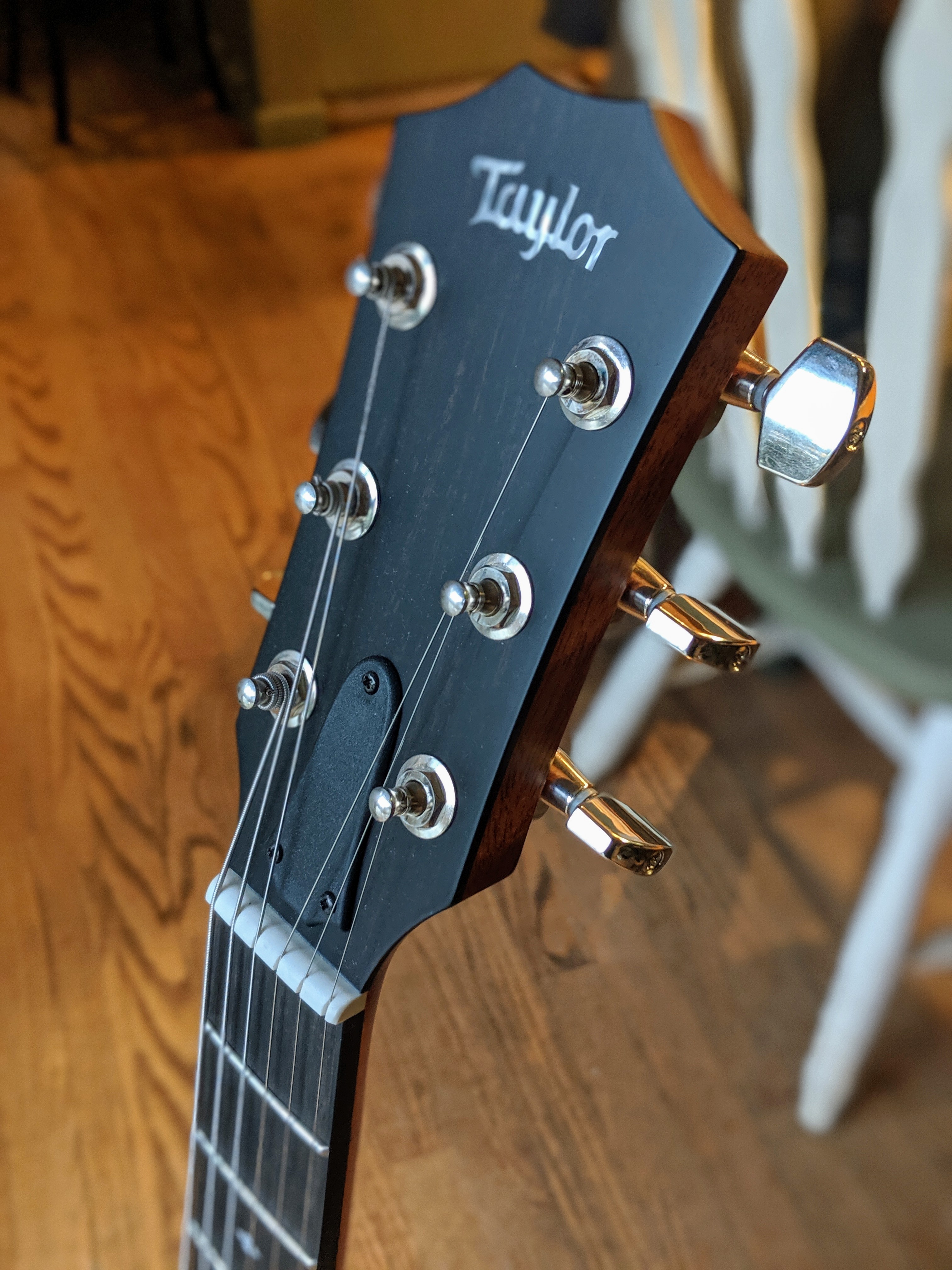
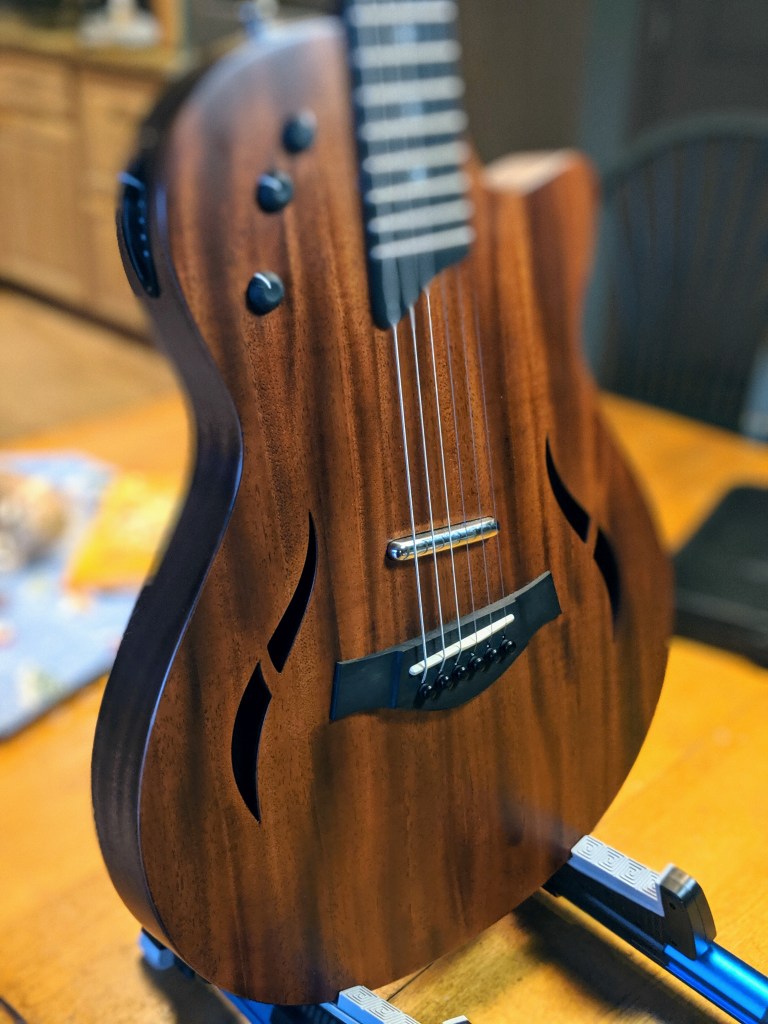
I took some pictures of it this morning. I’ll talk about it after.

Impressions

Looks

First off, the look of this guitar is spectacular. The grain on the mahogany top – even in a natural finish – is so three-dimensional. I’m glad that Taylor didn’t put a gloss clear coat on the guitar. The satin finish lets the grain of the wood speak for itself. It’s a sexy guitar. In fact, at the concert the other night, I was thinking about how awesome the guitars looked and my wife must’ve been reading my mind and commented on how gorgeous the guitar were.

What amazes me about the grain of my guitar are the pronounced striations of dark and lighter wood. Most of the pictures I saw of the guitar and the guitars that Eric and Kyle were playing didn’t have these. I totally lucked out with this! It almost looks like walnut!

Fit and Finish

True to Taylor’s workmanship and quality, there is absolutely nothing out of place; no crooked joints, no blemishes in the finish. The machine heads are perfect and silky smooth to tune.

The jumbo frets – yes, jumbo frets – are clean and smooth. Some people in the past have remarked on the relatively sharp edge of the fret board, but I have to problem with it. I like that pronounced edge.

The body is perfect on this guitar. It’s a little wider than a Les Paul, but it feels like holding an electric. In fact, Taylor calls it an electric guitar (more on that later – it’s important). The body size combined with the weight which couldn’t be more than 5 lbs. make for a very comfortable guitar to play.

Playability

The scale length on the T5z is 24 7/8″. We’re getting into Les Paul territory here and all be damned if this guitar doesn’t play like an electric. It comes strung standard with Elixir Nanoweb 11’s (electric), which are perfect for this guitar. The thicker string gauge provides pop for the acoustic mode, but the Les Paul-like scale length makes bending super easy.

The neck radius, which is 12″ is down three inches from the original T5’s 15″, with a nut width of 1 11/16″. The neck profile is a shallow C; more shallow than a Les Paul, but it makes playing up and down the fret board a dream!

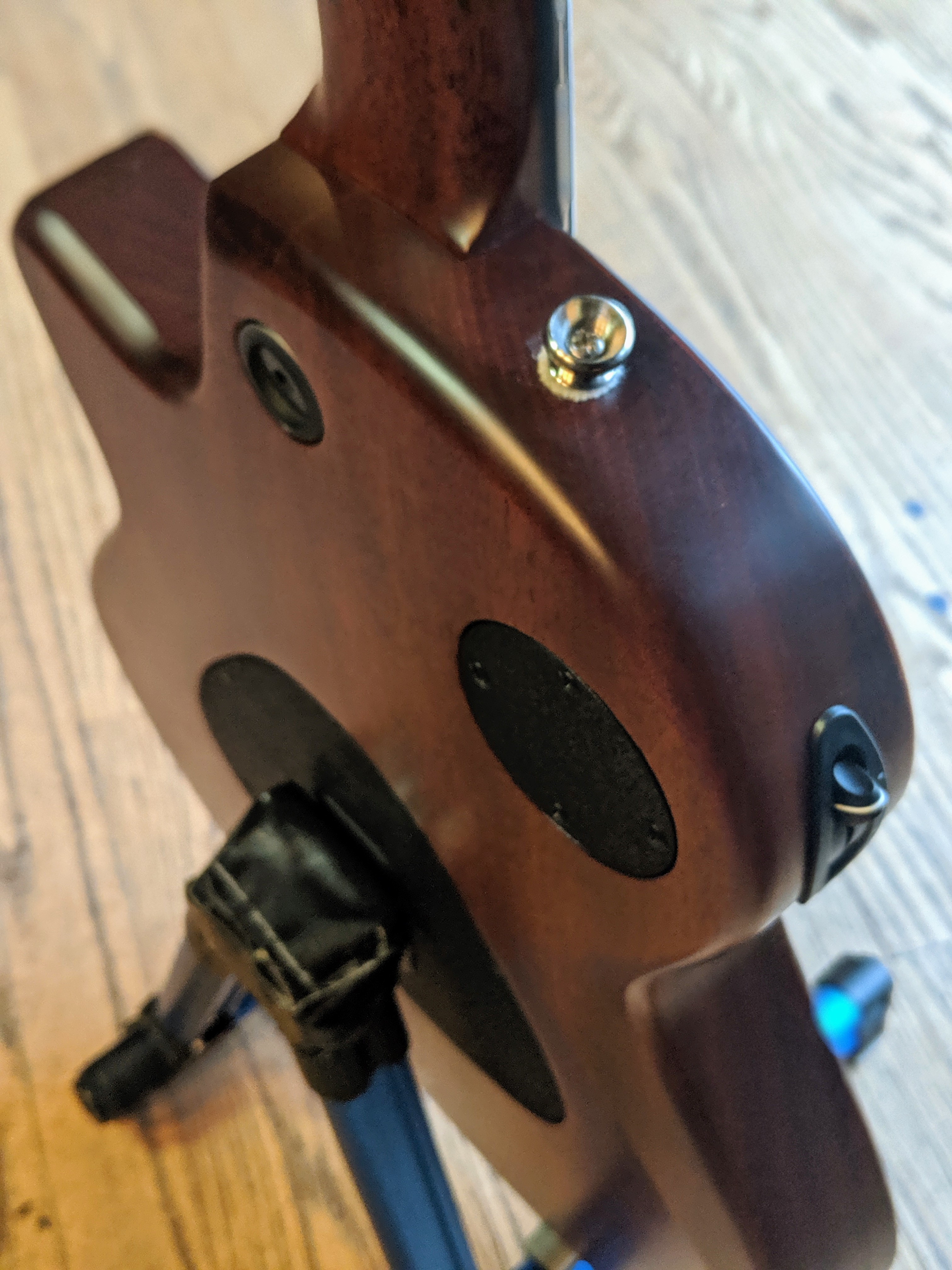
And reaching notes in the upper bout? FUGGETABOUTIT! The neck is attached to the body via what Taylor calls a “T Lock.” You ever assemble IKEA furniture before? You put pieces together and turn what looks like a large screw head to pull the pieces tight. It appears to be a similar principle with the T Lock mechanism. It pulls the neck in tight to the body. What this means is that there’s no heel on the neck, allowing access to the notes in the upper bout super easy. You don’t even have to change your wrist angle to reach the notes! F-in’ A!

Sound

Looks and build quality aside, it’s the sound of the T5z that pushed me over the top to buy it which, interestingly enough, kept me from buying the original T5 when I evaluated it almost 13 years ago. Back then, though I got what Taylor was going after, I felt as if it was an acoustic guitar trying to be an electric and not able to do the job of either very well. It gave me the impression at the time that Taylor couldn’t quite decide on what they wanted the guitar to be.

But with the T5z, it’s unabashedly an electric guitar that has an acoustic setting, and more importantly, it does both acoustic and electric duties incredibly well.

The guitar is meant to be plugged in. Demonstrators say that it has a nice unplugged sound. It doesn’t. It sounds like a mildly deeper acoustic sound of an electric guitar. It’s serviceable for quiet playing, but contrary to what a demonstrator said about it having a good acoustic sound for songwriting, I personally would have to plug it in if I’m writing music. But for practicing or learning songs, it works good enough.

But the plugged in sound? Wow! The acoustic tone is wonderful and a lot of that has to do – at least in my opinion – with the body sensor right behind the bridge. It provides for a very natural-sounding tone. It’s not quite acoustic, but it’s pretty damn close, and for use in a live performance, it works great. When I saw Eric Rachmany, the performance tone was crystal clear with the qualities I’d expect from a plugged-in acoustic guitar.

I will be playing it at Christmas Eve Mass today, so I tested it direct into my JBL Eon One PA. It sounds spectacular through my PA, so I’m now looking forward to playing some solo gigs with it.

As soon as I brought the guitar home yesterday, I immediately played it through my BOSS Katana Artist, going through every single setting. In the acoustic channel, it was awesome, and I only had to do some minor tweaks to dial it in for use today.

On the electric side of things, I just have to smile. I was able to Tele-like tones out of it using the neck pickup and turning up the highs. Then was able to get fatter and more driving tones with the other pickup settings.

To be honest, and I’m actually very glad about this, the T5z has its own tone. It’s not trying to be a Strat or a Les Paul or an ES335. But what it offers is the ability to shape the guitar’s tone to fit whatever genre I’m playing. That’s really the promise of this guitar and at least from my very short time playing it thus far, Taylor has fulfilled that promise, where I feel it fell short in the original version.

Granted, I still need a few more hours with the guitar. Every time I pick it up and plug it in, I find some new tone from tweaking the gain and EQ knobs which, I have to say, function incredibly well. I love that there are independent bass and treble knobs which is significantly better than having a single tone knob which, as you know, when you roll off the tone can get really muddy as the highs become muted.

Overall Initial Impression

I’m going to refrain from raving about the T5z, though I’m very tempted to do so. My gut tells me that this is truly a great guitar, and there’s no denying its versatility. But I want to save the raves for my formal review once I’ve had a few more hours on the guitar.

I am SO looking forward to playing it at Christmas Eve Mass today!

Read Full Post »

I know, I know… When I get excited about some gear, I’m like a pit bull that won’t let go. But this T5z has gotten me real excited! So excited that I test-drove it today at Guitar Center, and walked out of the store with one!

I went into the shop specifically to test-drive the guitar. I wasn’t intending to buy it, but after two hours of playing, I pulled the trigger. I wasn’t going to leave the store without one in hand. It really is that good.

The standout feature of the T5z from the beginning is its versatility. The premise of the guitar when it was first released was that it could handle both acoustic and electric duties.

Unfortunately, though I loved the prospect of a dual-solution guitar, I had a real problem with it in that I felt the acoustic setting was not acoustic enough, and the electric side wasn’t electric enough. The acoustic setting was kind of lifeless in the amps I played it through, and the electric settings, while serviceable, were a bit uninspiring, and I about said as much in my original review 12 years ago.

But 12 years later, my opinion has completely changed. The acoustic sound is very acoustic and the electric sound is electric. It’ll never replace the sound of my Les Paul or my J45 – those sounds are distinct – but it’s not meant to do that. This guitar is meant to get you into the genre that you’re playing. Even though I just got it, I can see that it is now the most versatile performance guitar I have.

And for me as a worship leader, it checks off all the boxes for what I need. My band plays a mixture of contemporary Christian and more old-school Catholic folk stuff, and having a guitar that can cover the range is important to me. The T5z fits that bill perfectly!

And that brings me to the T5z being the perfect complement for my BOSS Katana Artist.

Since I’ve gotten my Artist, when I’ve had to play a set where I need both acoustic and electric, I’ve brought two guitars. I have my Artist banks set up to accommodate both electric and acoustic. When I need to play an acoustic song, I unplug my Les Paul, switch banks, then plug in my acoustic. But with the T5z, I just need to switch banks and adjust the volume knob on the guitar.

But the even cooler thing is that I now can do that mid-song. This is going to open up all sorts of possibilities for me.

For solo gigs, I can’t wait to use the T5z through a looper. I can do the foundation track on the acoustic setting, then do solos on an electric setting. Granted, I’ll have to adjust my rig a bit and I think I’ll be getting something like a Strymon Iridium to handle those electric duties. I tell you, I can’t wait to dive into what this guitar can do!

Update 12/25/2019

As one of my regular gigs is playing at church, I used the T5z with my Katana Artist yesterday for Christmas Eve services. I had spent about an hour prior to going to the church setting up my acoustic and electric banks. I was going to have a full band, so I needed to get my sound dialed in.

To make a long story short, the T5z worked spectacularly with the Katana Artist as I was both hoping and expecting. I did the traditional Christmas hymns in Acoustic mode, but for the more contemporary stuff we did, I was able to switch between Acoustic and Electric with a little dirt then back again mid-song!

The ease of which I was able to do this – it was so natural. Just a simple button press on the GA-FC to switch banks, then move the pickup selector to an electric position. It confirms my belief that the T5z is the perfect guitar for the Katana.

Read Full Post »

Et tu, Brute? Or latin for WTF?!!!

Yeah, when the T5 first came out, I was NOT a fan. I didn’t think it was a bad guitar, but I just didn’t get it, and honestly, I wasn’t that impressed with the electronics. Though I knew it wasn’t a modeling guitar, it just kind of felt like a modeling guitar to me.

Even after I played it at a shop through several amps – and really, I did try to like it – I just couldn’t bond with it. That was over 10 years ago.

And over the years, I don’t think I ever saw a major artist using it. The people who loved the T5 loved it, and though they might have been regular players like myself, I’d never once seen a big name using one. Fast-forward to today, and I just saw one of my favorite guitarists, Eric Rachmany, playing a T5z Classic – in a concert! I was literally no more than 20 feet away from him and there was no mistaking that what he and his partner were playing were T5’s.

After the concert, I did a little research on the T5, and it looks as if Eric was playing a T5z Classic Mahogany. The T5z has a smaller body than the traditional T5, and has a scale length that is similar to a Les Paul. I was blown away by the sound. I need get one of these – or at least test drive one.

Back when I first test drove the T5, I felt the electronics were a little off. But all things evolve and I’m sure Taylor has put some work into it. Maybe they improved the body sensor. Maybe they updated the internal circuitry. But whatever they did, they definitely got it right.

So here I am. I’ve never really been that much of a Taylor fan; and especially NOT a T5 fan, and I want one of these. I really love the plain, natural look of the Classic Mahogany, and it’s at a great price of $1899. But the Custom K koa top looks great with the binding. That’s also twice as much, so I don’t know what that will get me. But the Classic has a nice, warm sound that has a bit of a high-end jangle. It’s very nice.

Yeah… it’s definitely time to check this one out…

Here’s an Anderton’s video that kind of took it over the top for me:

Read Full Post »

Taylor T5: Changing My Mind?

Eric Rachmany (left) and Kyle Hearn of Rebelution

Last night, I attended a GREAT show featuring Eric Rachmany and Kyle Hearn of Rebelution. This is an annual tour that Eric puts on where all the proceeds go to charity. But it’s special when he comes to San Francisco because that’s his home town, so there seems to be an extra intimacy and vulnerability that he displays that’s different from his normal Rebelution shows.

Both Eric and Kyle have used Taylor acoustic guitars exclusively, though for as long as I’ve followed Rebelution, Eric has played an OM-size regular acoustic. One thing that has set Rebelution apart – at least for me – has been their acoustic sound. Eric, then later Kyle, both have had incredibly natural tone with their amplified sound with none of that piezo quackiness that I have found with a lot of Taylors. And having seen Rebelution a bunch of times, I came to realize that Eric really does care about his acoustic sound. So it was a HUGE surprise last night to see the roadies place T5s on the stage.

But I have to say that once Eric and Kyle started to play, I was blown away by the sound! It was SO natural and huge! I then realized that electronics have come a LONG WAY in twelve years. Taylor certainly improved the electronics of the T5, plus, with all the great processors on the market now, dialing in a great sound is pretty easy.

When the T5 first came out twelve years ago, I didn’t have much of a warm and fuzzy about it. Moreover, I never saw any major artist playing one, so while I didn’t brush it off, I didn’t really consider it a serious contender to add to my stable.

But after last night, I’ve resolved that I have to test out a newer model. After looking at the pictures I took last night, it looks like Eric and Kyle were both playing a T5z Classic. That’s the basic mahogany version with no binding. It’s a gorgeous guitar – even my wife commented on how nice the guitars looked on stage.

But the sound! OH! The sound! It was big, thick, natural, and full of that sweet mojo that’s distinctly Taylor. I’ll know more once I can get my hands on one to test it, but suffice it to say that I’ve now changed my tune about the T5. It’s certainly a guitar that I could see myself playing.

Read Full Post »

I have to admit that before yesterday, I had absolutely no idea that this guitar even existed. I only discovered it by watching a video of Juliana Vieira doing a demo of the BOSS RC-10R rhythm/looper.

When I looked at the guitar, I thought it was a Gretsch or a 335 but then I saw the distinctive Fender headstock and thought What? When did Fender do a hollowbody?

It turns out that back in 1966, in response to the popularity of the Epiphone Casino, Fender enlisted Roger Rossmeisl, a German luthier who designed guitars for Rickenbacker to design them a hollowbody guitar that could compete with the likes of Ephiphone and Gretsch. The guitar went through a few iterations in its original production run from 1966-1972. Then Fender discontinued production.(1)

But in 2013, Fender reissued the Coronado II, which was the dual-humbucker version of the Coronado that featured a Tune-O-Matic bridge and what Fender called Fidelitron humbuckers. Those pickups made me think the guitar was a Gretsch at first because they look like the TV Jones pickups. But then I looked at the body an thought that it bore a real resemblance to an ES-335. The block inlays on the neck further reinforced that, but the headstock gave its away.

When I saw that it was a Fender, I literally laughed out loud. As I mentioned in the title, I love schizo guitars. I personally have a Godin Artisan ST-V which, from a distance, looks like a Strat with a long upper horn. But on close inspection it’s nothing like a Strat. But it’s so cool to play! Another one that comes to mind is the Gibson Firebird which looks like a backwards Fender Jaguar but at the same time looks like an Explorer “Lite.”

Though Wikipedia says that the guitar is still in production, I couldn’t find any new guitars in the major online shops, and there is absolutely no information to be found on the Fender website. All the guitars that I found on sale are on the used market. And there aren’t that many.

With the re-issue, when Fender released the Coronado II, it’s as if it was again responding to the popularity of another manufacturer’s release, namely the Gretsch 5xxx Electromatic line. I bought one back in late 2011. I got it for $549. The Coronado went for $100 more – of course Fender’s charging more. 🙂

The ones I’ve found are in pretty good shape at around $600. I might just have to pull the trigger on one of these in the near future.

Here’s Juliana Vieira’s demo of the BOSS RC-10R.

_________________________________________________________

1 Fender Coronado. Wikipedia

Read Full Post »

Up until recently, you had two options in the digital modeling world: A full-blown modeling amp (BOSS Katana, Fender ToneMaster, etc.) or, a dedicated, self-contained amp sim and cab unit like the Helix, AxeFX, or Kemper. If you’ve read this blog as of late, I’ve personally gone the full-blown digital amp direction. I couldn’t be happier with how it works for me for live performances. And it works great in the studio as well.

But in my last recording session, I thought to myself that it would be great to have a compact, standalone unit that I could just plug into my interface and record; a middle ground between full-blown amp and a self-contained unit. One could argue that that could easily be accomplished by a Helix or AxeFx. No argument there. But what has kept me from going that route is the complexity of those units. I abhor deep tweaking. For me, I just want to twiddle a few knobs and be done with it. I want to get to making music.

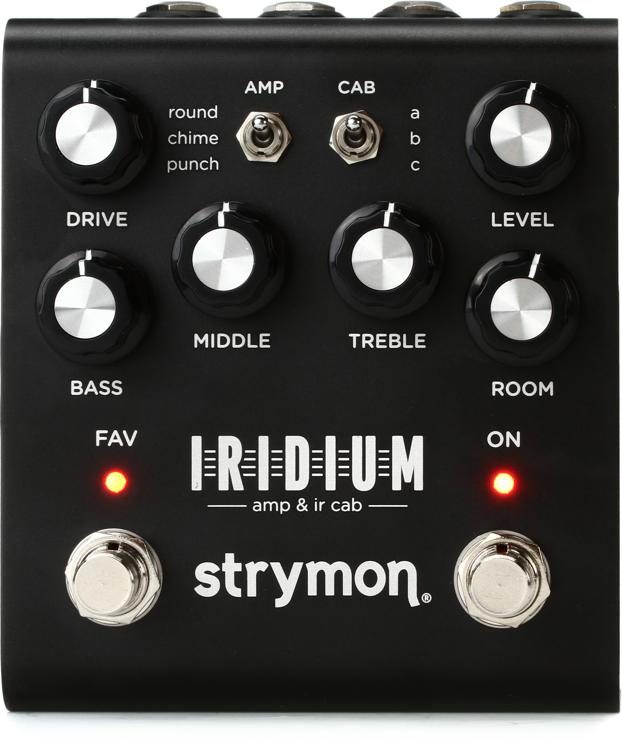
And maybe the Iridium is the answer to that. With only six knobs and two three-way switches, giving me access to three different amp models, it could very well be that middle ground.

Granted it has much more in common with the Helix-like units being a self-contained unit itself. And though you can load your own IRs into it, you can’t do much more than that, whereas with the Helix and the like, you can affect everything in your virtual signal chain. For some, that’s a panacea for all their guitar sound needs. But for others like me who just want something basic, the Iridium seems to be a much better fit.

As for live use, at least as far as I’m concerned, I don’t know if it’s something I’d use live on a regular basis, though there’s one particular venue where I have an FOH tech that can send my guitar sound back to me where it would be useful. Where I know that I’d get the most use out of this is for recording.

I shared this video on my post about Keven Eknes and it demonstrates just how good the Iridium can sound plugged directly into an interface:

Granted, that dude is an absolutely killer player. But according to him, he just went direct into his interface. Reverb and delay were added in software.

As with all Strymon products, they don’t come cheap. At $399, it’s definitely a serious investment, which unfortunately is a limiting factor for me. Whether or not I decide to make the investment is going to depend heavily on being able to demo the unit to see if it works for me. Luckily, I know a few people who are considering getting this so hopefully I’ll be able to try it out.

Read Full Post »

For the past several years, I’ve had some sort of vocal/harmony processor in my solo acoustic rig. Some were all-in-one units that combined vocal processing along with guitar effects (DigiTech Vocalist Live, TC Helicon VoiceLive Play Acoustic and GTX). Others were focused mainly on vocals with limited guitar processing such as my trusty TC Helicon Harmony G XT. All in all, a vocal processor/harmonizer has become an invaluable component in my solo acoustic rig.

But like any gear that gets used often, it eventually wears out. I’m actually surprised my Harmony G XT lasted over 6 years because these units while they certainly look and feel as if they’ll last a long time, they just don’t stand the rigors of regular gigging, with some units like the VoiceLive Play units not lasting more than a year. Granted, I gig far less now than I used to, so chances are that the unit I eventually will get should last a bit longer. Let’s hope.

So I’ve boiled my search down to two units: The BOSS VE-8 Acoustic Singer and the TC Helicon VoiceLive 3. Both offer similar features, and from what I can tell, the sound quality of both units is pretty similar, though I do give an edge to the TC Helicon. But admittedly that could be bias since I’ve been using TC Helicon units for so long.

I’m kind of agonizing over which unit to get. All things being equal, I’d probably get the VE-8 because it’s less than half the price of the VoiceLive 3. BUT the big mark against it is complexity of the unit. You can set all sorts of stuff on the pedal, but to get to them and set them, you have to do a lot of knob and button twiddling.

Plus, there’s so much packed into the unit, it seems you have to have the manual handy; unless, of course, all you do is tweak it constantly and memorize everything. Um…. NOT! Clearly this is a unit where it’s best to preset everything you need for a gig then make adjustments in between gigs or on long breaks. That’s not necessarily a bad thing, but I’ve usually found that kind of stuff fairly tedious. On the other hand, at $299, damn! That’s VERY approachable.

In contrast, in typical TC Helicon style, the VoiceLive 3 is set up to make setting parameters incredibly easy. From what I can tell, you can set everything from the foot switches entirely, making it so much easier to use than the VE-8. That has always been a hallmark of TC. It’s clear they put a lot into their user interfaces to ensure unparalleled ease of use.

On top of that, based on past experience, the TC Helicon harmony algorithm is incredibly natural-sounding and very fast, with no detectable lag. It’s actually pretty amazing. I’ve purchased and demoed five different TC Helicon units over the years, and have always loved how good the harmonies sound.

But the high-quality voices and ease of use of TC Helicon units are much more expensive than the competition. In fact, the VoiceLive 3 Extreme, which seems to be the one that all the distributors carry instead of the regular unit is over twice the price of the VE-8. Furthermore, the VoiceLive 3 has been plagued with reliability issues since its release.

But to be fair, from what I’ve been able to find out through research is that these problems are easily addressable and don’t require spending money on repair, though you will have to get electrical contact spray and a star Allen bit. I have both, so no expense for me. The problem stems from dust build-up and metal shavings from the switches themselves and from the internal Micro SD card either coming loose or collecting dust in the mount. Yes, it’s a bit of a pain, but the fact that the known issues are addressable makes the reliability issues less of a deterrent.

So I’ve got my work cut out for me in figuring out which one to get. I’m leaning heavily towards the VoiceLive 3 because frankly, ease of use is very important to me. But the big factor is simply this: Am I willing to pay over twice as much for that? It certainly does give me pause.

Read Full Post »

« Newer Posts - Older Posts »