Feeds:
Posts
Comments

Archive for the ‘Music’ Category

Where’s IG?

IG must be busy, because he hasn’t posted something since 8/15… Who’s IG? Why none other than Ignacio Gonzales: Guitarist, guitar writer, philosopher and teacher, and generally great guy.

IG, I NEED MY IGBLOG FIX!!! πŸ™‚

Funny how you get the in habit of visiting certain sites. IGBLOG has been a regular, daily stop of mine for quite some time, and I have to admit that I miss it when he doesn’t post new material. But, I totally understand how life can get in the way of our passions at times. That doesn’t mean I have to like it, though… πŸ™‚

Read Full Post »

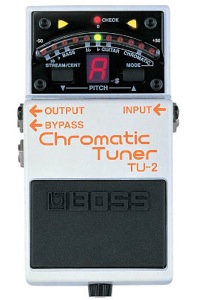
BOSS TU-2 Chromatic Tuner

BOSS TU-2 Chromatic Tuner

BOSS TU-2 Chromatic Tuner
Summary: Basic, no-frills chromatic tuner in a convenient stomp box that can also double as a power source.

Pros: Super-convenient stomp box makes on-stage tuning a breeze. Tuning mode automatically cuts off signal to the rest of your board for relatively “silent” tuning.

Cons: Only has 11 total LED’s, so fine adjustments aren’t possible.

Price: New $99 Street

Features (fr. BOSS site):

  • BOSS world-renowned TU-Series tuner accuracy in a convenient stompbox design
  • Mute/Bypass select for silent tuning with a single stomp
  • 11-point LED indicators and new “stream” meter display tuning discrepancy via speed and direction of LEDs (speed of LED movement gets slower as pitch becomes more accurate)
  • 7-segment LED displays string and note names, easily visible on dark stages
  • Seven easy tuning modes include Chromatic, Guitar Regular, Guitar Flat, Guitar Double Flat, Bass Regular, Bass Flat, Bass Double Flat
  • Tuning mode setting and display style choice stored in memory
  • Adjustable reference pitch from 438 to 445Hz
  • 8-octave tuning range–the widest in its class
  • Footswitchable Tuner Off mode preserves battery life by disabling LEDs

Let’s face it: Tuning is a fact of life when you play any musical instrument. And if you’re like most gigging musicians, you don’t have a guitar tech at your gigs to tune your guitars in between songs. For that, you need a tuner. For years, I used a cheap, hand-held analog tuner with a sweep meter for tuning. It was very accurate and did the job well, but as I started to gig more and more, having to turn the volume down on my amp to tune soon became irritating.

So I decided to get a stomp box tuner, and went down to Guitar Center and bought the TU-2. Now I will be the first to admit that I didn’t do much research before buying the TU-2. I’d recently read an interview with Joe Satriani and he had a TU-2. I figured if something’s good enough for Satch then it’s definitely good enough for me. It was a safe bet then, and it’s a safe bet now. The TU-2 is solid performer that’s fairly accurate, though no LED-based tuner could even possibly suss the accuracy of a strobe or analog tuner. But for what it does, I’m pretty satisfied with it.

Another nice feature about the TU-2 is that it can also act as a power source for up to either other pedals. I power up my board with a Dunlop DC Brick, but once I used up the 6 available 9V ports, I couldn’t add more
pedals without having to get another brick. For one or two pedals, that’s just not a good justification when you’re spending 100-bucks. The TU-2 comes with both a DC-in and a DC-out port. You can use a standard 9V cable to hook up another pedal, but it probably makes more sense to spendΒ  the $12.99 and buy the BOSS PCS-20A power cord, which will route power up to eight pedals. Caveat: The cable runs between connectors are short. BOSS assumes you’ll be using nothing but BOSS pedals, but with tone freaks, that’s rarely the case. But it is a cheap, convenient solution nonetheless.

So what’s my verdict? I wouldn’t have it if I didn’t think it was useful. It’s not in any way, shape, or form something to do cartwheels over, but it’s a solid pedal that gets the job done. At Harmony Central, when you write a review, they ask you what you’d do if it the gear you’re reviewing gets broken or lost. Were I to review this pedal there and answer that question, I’d probably take a serious look at the Korg stomp box tuner that sports more LED’s and is a bit more accurate than the TU-2. The only thing that would probably keep me from switching is the ability of the TU-2 to provide power to other pedals.

Rock on!!!

Read Full Post »

http://www.icompositions.com/music/song.php?sid=94586

Had another song idea, but thought I’d share the main riff as a Jam Track. It’s a slow ballad in A. I actually had a lot of fun with this, working between an A major scale and a F#m pentatonic then adding some diatonic runs as well. With this tempo (mm=84), you can play your solo fast or slow. It’s about 5 1/2 minutes long. Have fun!

Equipment: PRS SE Soapbar II, plugged into Fender Champ 600 amp. I used a Nady RSM-200 ribbon mic set about 8 inches away from the center of the speaker. It’s amazing how big the sound is! πŸ™‚

Read Full Post »

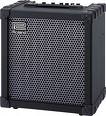
Roland Cube 60 Amplifier

Roland Cube 60 Amplifier

Roland Cube 60 Amplifier
Summary: Built like a tank, great-sounding and versatile, the Roland Cube 60 is at home on the road and in the studio.

Pros: Built-in Roland COSM modeling technology to mimic 9 British, Vintage and Modern amps, plus an added Acoustic mode. The Cube 60 also sports Recording Out, Line Out and Speaker Outs, plus a Tuner Out that can feed a Tuner independent from Volume control. Very loud for a small amp!

Cons: Reverb sounds hollow and a muddy at higher settings, with a definite loss of clarity.

Price: New $300-$359 Street ($250-$275 used)

When I bought my Cube 60 a three years ago, I wasn’t even looking for an amp. At the time, I was using a Line 6 Flextone III that served my purposes beautifully. But when you’re a gear freak and you just happen to have a bit of coin to spend well, some things just can’t be passed up.

Such was the case when I was perusing my favorite local gear store. I sauntered into the cramped guitar area, and saw this tiny black cube amp sitting against the wall. Intrigued, I picked it up by its handle and marveled at not only its diminutive size, but also its light weight (it weighs only 25 lbs.). Then Jordan, the guitar guy walked up and said, “I just got me one of these. It sounds awesome, and you can use it anywhere.” Normally, when I hear stuff like this coming from a salesperson’s mouth, I just nod, smile and say, “Cool.” But I’ve known Jordan for awhile, and I’ve learned to trust him. After all, he’s a gigging guitarist who knows his gear. When I hear him even slightly rave about something, I know it has got to be something cool (not that I can always afford the stuff he says is cool, but that’s another story).

So instead of my usual reaction, I silently pulled a Strat down from one of the hangers while Jordan went to fetch a cord. Big mistake! πŸ™‚ It took me no longer than 10 minutes to know that I had to have this amp. Plus it was on sale for the Christmas season, so I got it for $50 less than normal retail!

I won’t go into the technical details of this amp because you can google for them. Let me just say this: This amp kicks ass! While I use my Fender Hot Rod for my electrics on stage, I use this with my acoustic, and it’s a dream. There’s something about the Acoustic channel on this amp that makes my Ovation sound like a Martin dreadnought! It’s that sweet

But in the studio, I use this amp a lot for recording backing rhythm parts. Even though it’s a modeling amp, which I normally don’t really get too wild about, this amp produces really nice tones in all of its amp modeling settings. And with its recording out jack, which shuts off the speaker, I can safely record deep into the wee hours of the morn without worrying about waking the neighbors. Surprisingly enough, it sounds great going direct into my DAW. In fact, I recorded this song using nothing but my Roland Cube 60. Of course, there’s nothing like the sound that a cranked tube amp produces, but late in the night, when you’ve got the inspiration, having the convenience of an amp that sounds great going direct is very nice!

Finally, did I say this amp is LOUD? You’d never expect the kind of volume that this amp is able to produce. At home, I rarely take the amp above 9am on both the Gain and Volume knobs. Any louder, and I’d start getting calls from the neighbors and complaints from my wife! πŸ™‚ One of my close friends uses this amp for gigging, and he loves its versatility. Mind you, this is a guy who has tons of gear. His amps include a Marshall JCM half stack, and a gorgeous ’71 Fender Twin. But he likes to gig with the Cube because it’s so versatile AND it’s incredibly light! Weight matters when you’re hauling gear.

This amp is definitely worth a look.

Rock on!

Read Full Post »

As you can see, I added a linked graphic to my right-hand pane that goes to an article I wrote about the SAINT Guitar Company. This is a mini-site that I’m creating to help get the word out about SAINT Guitars (and no, I’m not being compensated for this).

In any case, I know there are a couple of you who have either a Messenger or Benchmark, and I was wondering if you had any sound bites of either of these guitars you’d like to send me, so I can put them up on the mini-site. I’ll also forward them to Adam, so he can put them on his own site.

Any takers?

Read Full Post »

http://www.icompositions.com/music/song.php?sid=93388

This is the first kind of risque song that I’ve ever written. The back story is that I went dancing last weekend and ended up dancing with this super-sexy 22 year old girl that danced like she was pole dancing. It was amazing to behold. Funny thing was that I sort of beside myself – I’m old enough to be her father – and observing what a 22 year self would do and think. This song is about that observation. πŸ™‚

Guitars: Gibson ES-333, PRS SE Soapbar I
Amp: Fender Hot Rod Deluxe

For mics, I used a Nady RSM-2 ribbon mic on the guitars, and a Senheiser 835 stage mic for the vocal (love that mic).

Read Full Post »

Recently, my career as a web development engineer has taken a huge turn for the better. But it has also affected my ability to set aside some time to play guitar. Because of my weird schedule this past week (luckily it’s an anomaly), I haven’t picked up a guitar since Tuesday, and I’ve got serious emotional withdrawals going on!

My home office doubles as my studio, and I’ve gone in there to follow up on personal e-mails each night, and look longingly at my axes sitting pretty in their stands. But duty calls, plus the bed, since I’ve actually been too tired to play – can you imagine that?!!!

Oh well… such is life, and while I know from past experience that things go in cycles, it doesn’t mean I like it just the same…

Read Full Post »

Whether or not you write songs, there are times you might be noodling on your or just plain thinking, and suddenly, out of nowhere, a riff, or a way to play a certain phrase pops in your mind. If you’re lucky, you’re nearby some recording equipment. But more likely than not, like me, you’re driving in your car, or doing something that is not guitar related.

This has happened to me so many times when I’m driving to or from work. When I can, I’ve pulled off the road, and work out and write down the riff. But oftentimes, when I finally get back to my notes and start playing the riff, it just doesn’t have the same vibe as when I originally wrote it down, and I have to spend quite a bit of time recapturing that feeling. If I only had a way to record the riff as a reference, then I’d be able to capture the chord progression or phrase, plus at least some or most the tonal subtleties.

It turns out, there are some pretty good ways to do this. I’ll cover a few here:

  1. Did you know that most cell phones, especially later models have the ability to record both audio and video? My LG Shine records both audio and video, and I’ve used it twice now to record a riff I came up with while driving down the road. The second time this happened, I pulled into a rest area, pulled out my guitar, got my phone out and started recording. Some passers-by thought I was on a video scavenger hunt… yeah, I admit, it was rather weird, but I didn’t want to lose the riff. It didn’t help that I was also trying to hum the melody, so I sounded like a retard making noise. But then again, like I said, I had to capture that riff… It actually turned into this song. For those of you who read the original article about the song, I talked about what triggered the song, but I didn’t mention how I actually captured it… πŸ™‚ In any case, I’ll admit that it’s not the most optimal alternative, but it certainly works in a pinch.
  2. Lots of digital point-and-shoot cameras also have both audio and video recording capabilities. I usually have my camera with me, so that is an alternative as well.
  3. Finally, the most optimal solution would be to have a digital stereo field recorder. There are lots of ’em on the market nowadays, and they aren’t very expensive, ranging from a couple of hundred to a few hundred for very nice units. The three that really stick out for me are:Tascam DR-1 Portable Digital Recorder ($299)
    Edirol R-09HR Hi-res Digitial Recorder ($399)

    There are lots more, but then we start getting into the $600+ range. Conceivably, you could also use just a mono recorder, and you can get those cheap – under $100!

Of course, if you’re by your Mac (if you have one), it’s a non-issue. Just open GarageBand, and record… but that’s another story…

Allan Holdsworth picture courtesy of InnerViews.org

Read Full Post »

I just read a great article on Guitar Jam Daily by Carl Verheyen (this dude has a really smooth style!) about the art of layering guitar parts in a song. Essentially, the article covers using a variety of guitars, and approaches when recording a song. For instance, using clean to slightly distorted guitars for rhythm and then distorted guitars for leads. As Carl says,

…I believe the state of the art in guitar playing has more to do with layering and orchestrating and less to do with shredding and the blatant displaying one’s chops.

You may not have a huge collection of guitars at your fingertips, but you can orchestrate the tones and colors of the ones you do have. Getting these elements “on tape” and into a musical tapestry can be a very creative process…

That passage really spoke to me because as a working stiff with limited time and resources, I have to rely on the gear I have, and use them in combination to create the songs I record. From my own perspective and technical abilities on the guitar, I don’t really consider myself a good improv guy, so I try to make up for that by layering different guitars or rhythmic approaches to the guitars I use in my songs. If you listen to the individual guitars, the parts aren’t all that complex or sophisticated, but the result of “stitching” those parts together creates a really interesting tapestry of sound – at least to me. πŸ™‚

From the songwriting standpoint, it’s the components of the song that make the song, not the individual pieces. I highly suggest reading that article. The cool thing is that if you’re in a band, you can also take that approach. Not everyone has to be playing distorted. Myself, I like to be presented with musical complexity and sophistication. To me, the sound is so much richer

Read Full Post »

Song Link

It’s funny how the inspiration for a song comes. I started out writing out the idea of a song that evolved into a jam track that evolved into a completed song structure that finally evolved into a finished piece, replete with vocals and a guitar solo. For this piece, “You’re Stuck With Me” I was really struggling to find words for the song, when I remembered a conversation – more like a heated argument – I had with my wife a few weeks ago. She was PMS’ing, and she can be downright evil when she’s in this state.

For years, I’d just taken the abuse or yelled right back at her, but this time, I decided that I was going to stand up to her rants and foul tongue, and use a different tact. While she was getting all huffy for something I said, I stopped what I was doing, walked right up to her, put my arms around her, told her to look at me, and said, “Whether you like it or not, you’re stuck with me… I’m not going to let you push me away.”

This song is about standing up to your life partner, but doing it in such a way that assures them that despite all that they may do to put you down and push you away during their time of discomfort, you’ll always be there.

Music Notes

This is kind of new territory for me musically. I’d done some blues in the past, but I wanted to do something different than a regular I-IV-V progression. In other words, I wanted to be a bit unpredictable, but by the same token, retain some familiarity with the sound. This song has elements of blues and country and rock, that I wanted sort of meld together. I think it works… πŸ™‚

Read Full Post »

« Newer Posts - Older Posts »