Feeds:
Posts
Comments

Archive for the ‘Music’ Category

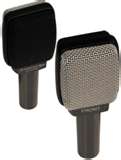
Sennheiser e609 Silver Instrument Microphone

Summary: Need a great mic to close-mic your amp? Look no further! The e609 delivers on all fronts, able to withstand high SPL’s, and still accurately reproduce your tone.

Pros: Flat-face design makes placing the mic a breeze, but more importantly, placed correctly (as you should with any mic), it’ll capture your tone beautifully!

Cons: None

Features (from the web site):

  • Hum compensating coil reduces electrical interference (I can attest to this – it’s super quiet)
  • Neodynum ferrous magnet with boron keeps mic stable regardless of climate
  • Metal construction—rugged and reliable
  • Super-cardioid pick-up pattern provides isolation from other on-stage signals

Price: ~$95 streetTone Bone Score: 5.0 ~ Going back to my “using the right tool for the job,” I don’t know why I didn’t pick up one of these earlier. I have some good mics, but now that I’ve got the e609 that was made explicitly for micking instruments, I kicking myself a bit. Lesson learned yet again!

I told myself that all I would get was a speaker cable for my cab when I walked into my local Guitar Center today. Unfortunately for me, the cables were located in the Pro Audio area where GC has a big case of very nice mics. And, gear slut that I am, I couldn’t resist a look. Granted, most of those mics were completely out of the ballpark for me, costing several hundreds of dollars. But it did get me thinking that I really should be using a dedicated instrument mic for my home studio when recording my clips and songs.

Fortunately, they didn’t have any instrument mics in the case, but silly me, I just had to ask the guy behind the counter if he had an e609 (I had researched this and other instrument mics several months ago). “Oh yeah,” said another sales clerk, “We got those. They rock, and they’re cheap.” Damn! Words that a gear slut should never hear in one sentence: ROCK and CHEAP! That will instantly elicit a fidgety, twitchy response as the pragmatic half of the psyche wrestles with the GAS half. And usually the GAS half wins, as it did today.

So now I am the very proud owner of a Sennheiser e609. And I do have to say that it does rock, and it costs far less than what one would normally expect to pay for a great mic. At less than $100, how can you argue with that?

How It Sounds

I recorded a little blues solo over a standard GarageBand backing track to demonstrate. Give it a listen:

For the solo, I used “Blondie” my Squier Classic Vibe Tele, the insane-sounding Aracom VRX18 amp (it’s customized with an EZ81 rectifier), and my custom Aracom 1 X 12 cab with a Jensen P12N speaker. The e609 was placed about halfway between the dome and the speaker edge about an inch away from the grille cloth.

I added a touch of reverb to the dry clip in GarageBand, but that’s it. No EQ (I don’t like to EQ my guitar parts anyway). What you hear on the clip is what I heard in my studio. Freakin’ amazing! Like I mentioned above, after recording this clip, I should’ve gotten one of these a long time ago. It’s a great mic!

Mixed Reviews

I re-read some reviews today, and interestingly enough, they come back mixed. Harmony Central user reviews rate it at about 7.5 on average. People other love it or hate it. But in reply to the negative experiences, I have to call into question mic placement. If it’s one thing I’ve learned from years of home studio recording, placing your mic correctly is critical to getting a good tone. Maybe they weren’t experimenting enough with mic placement. Who knows?

With the e609, I first went with the recommended placement in the user manual (yes, I am one of those anal people who do indeed RTFM), then moved it maybe half an inch more towards the speaker edge to reduce the highs just a tad. That made all the difference in the world because my amp is pretty bright micked up close, and I didn’t want that to dominate the recording, especially since the mic was only an inch away from the grille cloth.

Overall Impressions

The Tone Bones score says it all. I’m hooked! Frankly, it didn’t take me long at all to dial this puppy in. It’s a truly great mic!

Read Full Post »

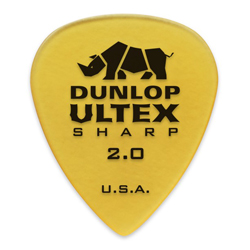
Dunlop Ultex Sharp 2.0 mm

Summary: It’s sharp alright; nice and pointy, and it feels great in your hand!

Pros: Like any sharp pick, this pick is accurate. It’s super lightweight, and made of a material takes a lot of pressure to even slightly bend. The pointy end makes pick harmonics a breeze!

Cons: It’s a small nit, but I wish the butt-end were just a bit wider.

Features (from the web site):

Based off of a coveted vintage tortoiseshell pick in our collection, the Ultex Sharp delivers a pick with a rigid body tapering into a thinner and sculpted tip for intense control and speed. The seamless contoured edge surrounds the pick for more playing surfaces and tones. Engineered of Ultex—the Ultex Sharp is virtually indestructible and delivers a crisp tone and quick release attack. Available in .73, .90, 1.0, 1.14, 1.40, and 2.0mm gauges.Price: 50 cents street

Tone Bone Score: 4.75 – Real nice-sounding and nice-playing pick. If you want to step up to a thicker, more rigid pick, but don’t want to shell out for high-end picks, this is a winner!

Okay, I’ll admit it: I’m a bit of pick snob. Ever since I started playing with V-Picks and Red Bear picks, I’ve mildly eschewed mainstream picks in favor of the insanely awesome picks those two companies produce. But I have to tell you that I was taken by complete surprise by the Dunlop Ultex Sharp pick! I wasn’t really looking to explore new picks, but a buddy of mine was looking for some Ultex picks at a local store, and offered to buy me a couple. Hell! They were only 50 cents apiece! I carried them around for a couple of days before I actually got to try them; not because I was dubious of them, I just couldn’t find time until this evening to sit down with an axe. Life happens, you know?

Anyway, I slung “Blondie” my trusty Squier Classic Vibe Tele, dug an Ultex out of my pocket, and started to play. Admittedly, I had a bit of trouble playing with the pick at first. Even though it’s slightly thicker than the thinnest pick I play – a Red Bear Tuff-Tone – it’s decidedly narrower in shape; something to which I’m no longer accustomed. But being the hard-headed type, and because I wanted to give the pick a fair shake, as it were, I kept at it, playing scales and riffs to get used to it.

I have to say that I’m really impressed by this pick! First of all, the material feels great in your hand, and like any real good pick, you forget about it. I love the rigidity of the material as well. Contrary to what you might think, a rigid pick actually makes you relax your hand. I know, it’s counterinuitive, but any player that plays a rigid pick will attest to this.

I spent quite a bit of time playing with this pick, and it’s a fast pick, though what I really missed was how my high-end picks really glide over the strings, like they’re lubricated. The Ultex material is pretty smooth, but there is a difference. Mind you, I’m not saying it’s bad in the slightest; it just has a different feel on the strings.

Most importantly though, the Ultex Sharp produces a nice, bright tone. That’s what I really dig about this pick! Part of it is due to it being rigid, but the other part is because of the pointy end. It really makes the strings snap in a very nice way!

Will the Ultex supplant my V-Picks and Red Bear picks? Probably not, but I will be using it for sure. It’s not even a small wonder why these picks are so popular among guitarists. They’re great playing and sounding picks at an insanely cheap price. I’m sold! Buy a few, and you’ll see for yourself!

Read Full Post »

I’ve been working on a new instrumental for over a month now, called “Strutter.” I think I’ve probably made 50+ recordings of the song, and even though I dig the melody I’ve come up with, I’ve always thought it needed something… more… Couldn’t put my finger on it, but none of my recordings of the song were working for me completely. After I finished recording this final cut which I’ll share below, I believe a lot of my “frustration” had to do with me wanting to only use a single guitar and amp for the recording since I play this song live with only a single guitar.

But it’s different in the studio. I have a lot of options open to me, so I decided to break down and instead of recording the song in its entirety with a single take with a single guitar and amp, I recorded the two different parts of the song with two guitars and two amps. The result knocked my socks off! So the lesson learned is in the studio, you can be truly creative, and for me, I’ll use the tools I need in favor of what I’d like to have. Anyway, here’s the song:

Gear:

Rhythm: Fender MIM Strat / Aracom VRX22 (6V6) Clean Channel
Lead 1 : Squier Classic Vibe Telecaster 50’s (bridge) / Aracom VRX18 (EL84) Channel 2 (Master cranked / Volume 3pm)
Lead 2 : Saint Guitars Messenger (bridge) / Aracom VRX22 Channel 2 (Master 4pm / Volume 3pm)

All guitars were recorded at bedroom level using the Aracom PRX150-Pro attenuator, with no effects. Estimated output of any of the amps was less than 1 watt! That unit is absolutely amazing!!!

Small room reverb was added during production to give a more spatious effect to the lead tracks, and absolutely no EQ was applied to the guitars.

Description:

This song was originally inspired by an image of a supa-mac-daddy-pimp dude struttin’ his stuff down the avenue. 🙂 At least that was the kind of vibe I wanted to capture: 70’s-style guitar-plugged-straight into the amp. It’s a raw kind of tone.

From a structure/feel point of view, what I was after with this song was a contrast in textures. The Rhythm track uses the VRX22 clean channel for that snappy clean attack. For the Lead 1, I wanted use the creamy smoothness of the VRX18 combined with a single coil, and take advantage of the awesome decay of the tube rectifier. For Lead 2, there’s nothing like the pure balls-out sound of the VRX22 drive channel played with a bridge humbucker. The distortion though is ultra smooth, but very complex.

I should be the Aracom Amps poster boy!

I just realized that this song could be an Aracom Amps VRX amp line demo! I make no secret that these are my amps of choice (I have three of them). Jeff Aragaki’s amp designs are absolutely killer – that’s why I buy his equipment.

Read Full Post »

There’s an unspoken battle raging on The Gear Page forum about which is the best “popular” attenuator on the market. Yeah, everyone claims theirs is the most transparent, and frankly, that’s true for very low levels of attenuation. But for really cranking down on the volume, my money, of course, is on the Aracom PRX150-Pro. To me, not only is it the most transparent attenuator based upon head-to-head comparisons of some of the popular attenuators done by me and others, and also being the safest with its input AND output impedance matching, it is also the most cost-effective attenuator out there. Don’t believe it? Well, the numbers don’t lie. When you consider the versatility of input/output impedance selections vs. cost of the unit that the PRX150-Pro offers, it’s simply no contest.

Let’s have a look at the numbers shall we?

Cost Per Impedance Selection Combination
Attenuator Price # Impedance Combos. Cost/Imp. Combo
THD HotPlate $329.00 1 $329.00
Alex’s Attenuator $350.00 1 $350.00
Faustine Phantom $799.00 3 $266.33
Aracom PRX150-Pro $650.00 16 $40.56

Clearly, based upon the number of impedance matching selections, the PRX150-Pro is the clear winner in terms of value. Even if the Aracom unit only had three impedance matching selections, it still will have 9 different available input/output impedance selection combinations, and each combination would only cost $72.11; still far below the competition!

Furthermore, let’s say the PRX150-Pro didn’t have output impedance matching, reducing its impedance matching combinations to 4. It still outperforms the competition in terms of value at $162.25 per selection!

Let’s compare the PRX150-Pro with the Alex’s attenuator for example. People love the Alex’s attenuator, and I understand it works great. But you have to get 4 of those units to match the impedance matching capabilities of the PRX150-Pro. In absolute cost terms, yes, the PRX150-Pro costs more. But with respect to value, well, you can’t hide from the numbers. The same thing applies to the THD HotPlate (though I have other reasons not to like this product). As for the Faustine Phantom, it has more versatility than the Alex’s by far, but it’s also very expensive, and it is unclear whether or not you’ll get one in a timely fashion. Some people have been waiting for theirs for several months.

Sometimes you have to spend more to get much more, and in the case of the Aracom PRX150-Pro, you’re getting A LOT more!

Disclaimer: I will say this again that I am not an employee of Aracom – I’m a faithful customer because of the superior product Jeff produces.

Read Full Post »

I walked into my garage/studio this morning and looked over to my gear – there’s a lot (though probably not as much as I’ve seen from other gear sluts’ pictures). Peering over my collection, the thought struck me: What if I could only have one of each type of gear… What would I choose? What would be the basis for my decision?

After ruminating on this subject over breakfast and coffee, I decided that I’d choose the gear that gives me the most versatility with respect to tone and usability given the various types of music I play. So based upon that here are my choices:

  • Squier Classic Vibe Tele 50’s
  • Aracom VRX22 with 1 X 12 Cab
  • BOSS TU-2 Tuner
  • Aracom PRX150-Pro Attenuator

Those four things will get me through any gig or recording session. Not to say that they’re my favorite pieces of gear, but that combination will give me the most versatility with respect to versatility and usability.

What? No Goldie? Man, I love that guitar, don’t get me wrong. But that guitar is so heavy, I don’t gig with it unless I’m at a place where I have to sit down. The Tele, on the other hand, is super-light, and with its pine body, it’s very resonant, so I can get thick, almost humbucker-type sounds to nice trebly tones. Goldie offers that up and more, but she loses on usability in a variety of venues due to her weight.

The Aracom VRX22 happens to be my favorite amp in any case, but it’s my favorite because of its versatility. Once I had Jeff do the footswitch mod so I could switch between channels, and remove the clean channel from the master volume, there’s nary a tone – except for super heavy, high gain – that I can’t produce with that amp.

With respect to my TU-2 tuner, yeah, I know, there are much better ones out there, but it’s what I’ve got. But despite that, I’d rather be in tune than to have a cool effect, so that pedal would stay.

Finally, the Aracom PRX150-Pro attenuator will always be a part of any rig I put together because it allows me to set limits to my max volume in any venue. Since I play mostly small to medium venues, this box is essential for dialing in just the right amount of volume for the house. And even if I have to play at super low volumes where the Fletcher-Munson effect comes into play, I can rest assured that when my amp is miked, I’ll get my true tone.

I was actually surprised by my own choice of guitar primarily because Goldie is such a tone machine. But for as much as I move around when performing, lugging a heavy guitar is definitely not my cup of tea; especially if it makes me throw out my back, which I did a couple of weeks back. But it also says loads about that Squier Tele. I’ve got some great guitars, but that little $329 wonder creates such awesome tones and it plays so great, that it’s a clear winner. I might’ve gotten lucky with my particular guitar because I’ve read some user reviews that their tone is inconsistent. I’ll play a few more to see how that holds up.

Read Full Post »

When I first talked to a guy at a shop about this guitar (it’s someone whose word I’ve learned to trust over the years) about the Squier Classic Vibe Tele, one of the first things he said was, “For the guys who know tone, this is one of the best kept secrets in the industry.” That, from a guy who pedals high-end Fender custom shop axes. His only nit about the guitar was the same as mine: The frets seemed a little small. But other than that, the guitar was a player in his opinion; and so it was with my own estimation of this wonderful little guitar.
Squier is supposed to be the budget line for Fender, and traditionally have been tagged as beginner guitars. But the way this guitar looks, feels, plays and sounds, there’s nothing beginner or budget about it. The build quality is excellent. There are no split or jagged joints or uneven painting. This guitar looks and feels solid. And it’s light, weighing no more than 7 pounds with its pine body and maple neck.

I was excited about this guitar when I first played it, as evidenced by the high marks it got on my original review. I couldn’t believe that a guitar with a street price of $349 could actually be this good. But the one thing that struck me about it was not just its looks, but its tone. This ain’t your typical, thin Tele twang machine. This guitar has balls. The pine body resonates – a lot – and that adds a fatness to the tone that is completely unexpected! Even in the bridge pickup that really brings out the twang, the Classic Vibe Tele sounds like a bridge humbucker with just a touch of twang!

Since I was able to bring one into my studio, I decided to record a couple of clips to demonstrate how fat this guitar sounds…

The first clip features the Tele clean in the neck pickup for both rhythm and lead, though I dirtied up the lead part just a tad.

This next clip demonstrates how the guitar sounds through a fully cranked up amp (Aracom VRX22 with 6V6’s). The three parts feature the neck, middle, and bridge positions of the same chord progression, respectively:

Finally, here’s my new song Strutter again with the Tele played in the bridge position through my Aracom VRX22:

As you can tell from the clips, “thin” is just not part of this guitar’s modus operandi. It’s actually unsettling at first because when I’ve played Tele’s in the past, they were pretty bright and thin. But this guitar just sings and resonates all day long! Must be the pine body. But who cares! It’s a player, and for the money, you just can’t go wrong.

Read Full Post »

Click on the picture for a larger view. Aracom Amps PLX BB 18

Summary: Reminiscent of John Mayall and the Bluesbreakers, the PLX18 BB is a tribute to the classic Marshall Plexi’s of yesteryear.

Pros: Looking for classic EL84 classic rock/blues tone? Look no further. This amp has tons of mojo that’s just waiting to be tapped, with two independent channels and a subtle, tube-driven tremolo that’s to die for!

Cons: Tiny nit, but the stock speaker – Eminence Red Coat Red Fang – is voiced way to brightly for this amp. For cleans, it’s great, but creates a bit of fizz when you’ve got it cranked.

Features:

General (from the Aracom site)

– On/Off Switch
– Standby Switch
– Indicator Lamp
– Custom Heavy Duty
Aluminum Chassis
– Impedance Switch:
4, 8, 16 ohm
– (2) Speaker Jacks
– Custom Handcrafted
Turret Board
– Handwired
– Gold Plexi Front and
Back Panels

Tremolo Channel

– Single Knob Tone Control
– Single Volume Control
– Tremolo Intensity Control
– Tremolo Speed Control
– High/Low Input Jacks
– Tremolo/Reverb Remote
– On/Off Footswitch Jack
– Reverb: Available with
optional Tube Driven
Reverb in the Combo 1×12
and 2×12 configurations.

Normal Channel

– Single Knob Tone Control
– Single Volume Control
– High/Low Input Jacks

Price: ~$1750 Direct

Tone Bone Score: 4.75 – If it weren’t for the speaker, this would get 5 Tone Bones, but I remedied that very easily by running it through either a Jensen P12N or a Red Coat “The Governor.” I dig that Governor speaker! It really brings out the best in that amp by taming the highs and adding a nice and smooth bottom end.

When you live less than half an hour from a boutique amp maker, you get to try out lots of GREAT gear. It’s so convenient to drop by Jeff’s shop or have Jeff over. He’s someone I love spending time with because we both share a passion for vintage and vintage style gear (Jeff is a passionate Les Paul collector), and we spend lots of time just talking about different kinds of gear, and especially his approach to amp building. As of late, Jeff Aragaki and Aracom Amps have gained a lot of attention in the guitar world for his incredible PRX150-Pro attenuator. And while I love what that attenuator does (it really has made my home recording late at night so much more convenient), it was his amps I fell in love with, and to date, I have three of them, having added the PLX BB 18 to my growing collection of low-wattage amps.

In Jeff’s words, the PLX BB 18 “ …is our tribute to the Marshall 18 watt Tremolo amp that was originally introduced in 1967. The term “Bluesbreaker” originated from the Marshall JTM 45 Tremolo Combo amp that Eric Clapton made famous when he was with John Mayall and the Bluesbreakers. While the JTM 45 Tremolo is the original “Bluesbreaker”, many people also refer to the early 50 watt and 18 watt Marshall amps with Tremolo as Bluesbreaker amps.

This amp is the elder statesman in the Aracom lineup, and while lots of attention has been paid to his latest VRX line, it was the PLX that gave Jeff his start. Unfortunately, because there are lots of classic Marshall Plexi 18 remakes on the market, the PLX BB 18 is probably his least known amp. That’s too bad because the tweaks Jeff made to the classic Marshall circuit has produced a very distinctive amp that has a mojo that’s almost visceral in its appeal.

Based upon a pair of EL84 power tubes, and an EZ81 rectifier, the PLX produces a very three-dimensional tone that’s at once in your face, but also fills the space you’re playing; and mind you, this is at fairly low levels – maybe loud conversation levels – due to squelching the output volume with the PRX150-Pro. Strike a chord or bend a note, and you can feel the tone! It’s that way with my VRX amps as well. There’s something that Jeff has discovered in building his amps that make them ooze a certain mojo.

Like all Aracom amps, the PLX18 BB is packed full of character. It’s amazing how it responds to volume knob changes and pick attack. But one thing that really strikes me about this amp is how smooth the distortion is when I crank the amp. When pushed hard, it has tons of gain and oodles of dynamics, but they’re very well-mannered. Notes are well-defined, and especially played with humbuckers, bloom nicely when you attack a string. F-in A!

How It Sounds

I got the amp this past Saturday, and I’ve been playing with it since. I spent Saturday evening and most of Sunday just getting used to it, and experimenting with different speakers. As I said, the stock speaker is a little bright (admittedly, I’m experimenting with it), but it’s also brand new, so that probably accounts for the abundance of highs. With time, that speaker will mellow out. But as I wanted to use the amp right away, I ran it through my custom 1 X 12 cab with a Jensen P12N and also my Fender Hot Rod’s cab that has the Governor in it. Amazingly enough, this amp LOVES the Governor. The P12N sounds awesome (and I’m a huge fan of Alinico speakers), but the Governor seems to bring out the best qualities of this amp. Anyway, here are some clips I recorded:

  • This clip features the stock Red Fang. I’m playing my Prestige Heritage Elite (an LP copy) for the lead with the Treble pickup engaged. This is a clip from a song I’m working on called “Strutter.” I normally don’t EQ my guitar parts, but I did bleed off some of the real high-frequencies to cut down on the natural fizz.
  • This next song is called “Plexi Lullaby” because it reminded me of a lullaby. The base rhythm track was recorded on the tremolo channel with my Heritage, then I created a second rhythm track with my Strat. The Lead is also played with my Strat. You’ll notice that you really have to listen for the trem. The tube-driven trem is killer. It’s very subtle and oh so smooth! Almost forgot! The base rhythm track was played through the stock speaker, while the Strat parts were recorded through a P12N, and no EQ was applied to any of the parts.
  • Finally, here’s a simple track I recorded just with my Strat for both parts, running the PLX18 BB through the Governor. This in the drive or “normal” channel of the amp with it cranked up to about 3pm, which is almost full out. To achieve the cleans, I just used a light touch, and played it finger style. I picked the Lead so I could get some occasional grind sneaking in:

I really love the tone on the last clip. The cleans it produces just make me close my eyes and play; which is pretty much what I did when recording the lead part. Just hearing how the chords just rang was so inspiring! The amp the entire time was just on the edge of breakup – it’s so expressive! I just added a touch of room reverb in the mix, but the guitars were all recorded completely raw. I didn’t do any adjustments.

Overall Impressions

I know, I say this quite a bit about Aracom amps, but I LOVE THIS AMP! As you can hear from the clips, it has an abundance of character. Jeff has recommended a few times that I try some NOS tubes with it, as all the pre-amp and power tubes are all JJ’s. But I’ve resisted because it just sounds great with the stock tubes. As I told him, “I know, I’ve got some NOS tubes on hand, but there’s no reason to put them in there. It sounds great with the JJ’s.” I may eventually do that, but for now, I won’t replace the tubes until they start getting dull.

The PLX18 BB yet another one hit out of the ballpark by the humble genius, Jeff Aragaki!

Read Full Post »

I just finished cooking my lunch of Potatoes O’Brien which consists of diced potato, onions and red and green peppers. You fry up the mixture in hot pan with a bit of oil, seasoning to taste until the potatoes turn golden brown. When they’re done, I like to sprinkle a bit of shredded cheese, and I also like to add some chopped bacon for a nice contrast. Very tasty indeed!

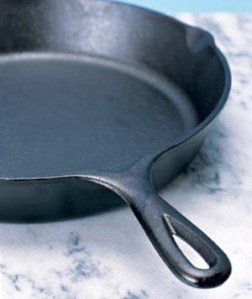
If you’ve ever cooked with potatoes in a regular frying pan (not the non-stick kind), it can be a painful process because potatoes have a proclivity to stick. But I have a great cast iron skillet that has been seasoned from years of frequent use, and sticking is not part of its modus operandi. It has taken years of care and cooking, and keeping the pan lubricated to where the oils and the fats from the food have worked into the pores of the metal. It is now a masterpiece of cooking utility, and I’d be heartbroken if it got ruined.

The same thing can be said of a guitar. When you first get it, it’s all shiny and new – though I suppose that doesn’t count for relicked guitars, as they’re supposed to already be broken in… But even if they’re vintage-ized, out of the box, they’re still new, the new gear “feels” new, and thus needs time to season through use. Woods take time to settle. Oils have to work into the neck and fretboard, etc., etc..

Especially with a fretboard, it takes time to work the oils from your fingers into the pores of the wood and fret metal. Ever wonder why new fretboards feel “sticky?” They need lubrication. I read in an interview with Neal Schon of Journey fame that he actually rubs a piece of salami on a fretboard to help break it in! Now THAT’S about seasoning! Ha!

Moreover, I just don’t feel a guitar will actually sound right until it has really broken in through regular use and exposure to all sorts of environments. When I first got my MIM Strat, “Pearl,” I loved her tone, but after playing her for over five years now, her tone to me is so much more mellow than when I first got her, and the frets and neck are nicely broken in from regular use. She’s just a dream to play.

One of my kids once asked me why I get so attached to my guitars that I give them names. I told them that I give my guitars names because I’ve spent so much time seasoning them, like I do with my “special” pan. They all know that my cast iron skillet is “Daddy’s special pan” so when I gave them the reason, they immediately understood.

It doesn’t end with just a guitar, though I focused on that. Amps – and especially speakers – take a long time to truly season. But that’s another discussion altogether. 🙂

Read Full Post »

bwb
As I’ve mentioned in the past, I purchased Chuck D’Aloia’s “Blues with Brains” series. After a month, I still haven’t moved past Volume 1, but that’s only because I’m going slowly and methodically with the process. Besides, the one thing that I found is that Chuck throws A LOT of stuff at you in a very short period of time, and I’m one of those types of learners that has to let information soak in before I can move on.

There aren’t any step-by-step lessons in this series. It’s very free-form, which I find is totally cool. But as I mentioned above, there are several places where Chuck throws in lots of material in a short span of time, so I’ve found myself going back and forth and listening and practicing for a couple of days before moving on. This is a real change of approach for me because I’ve operated by this little saying for quite awhile: “If patience were a virtue, I’d be a slut.” 🙂 But this time ’round, I made a conscious decision to not move on until I could execute on what the teacher was talking about proficiently.

What about the fruits of my labor? Well… I know I’ve used this clip before, but it’s a good example of applying what I’ve learned:

Excuse the obvious mistakes, the song’s not really in a finished state (can’t decide what guitar/amp combo I want to use). But here’s what I’ve learned so far that I’ve applied to this song:

  • I now pay lots of attention to the current chord being played and playing notes that “fit.” I used to be a real pattern player – especially the minor pentatonic – but I’m learning to break free of those patterns.
  • I’ve lately put a lot of emphasis on learning various triad shapes up and down the neck. This not only helps with getting the proper fingering at a particular place, but it also helps in coloring.
  • I’m also learning to let my solos breathe. One thing that I haven’t heard Chuck mention yet – though he’ll probably share it – is taking some time to let my idea sink in, then playing to build on it. Yeah, that song is somewhat composed, but it came about through playing over the rhythm track underneath. The themes you hear are ideas that I came up with while just playing around!

Regarding that last point, that is probably the salient point that I’m getting out of the lessons thus far, and that is taking an idea, then developing it and building upon it. It’s incredibly freeing!


Read Full Post »

stagetrix-pedalfastener

Click for full size view

I wrote about StageTrix Pedal Risers awhile ago, and how they elevate the back row of your board to make your pedals more accessible. I’ve been using them since, and they really are a godsend! I did mention that they already came with the fastener already installed, so all you have to do is place the riser.

I really like the fastener they’re using. For one, the material is thinner than most kinds you buy at a store, which means it shapes well to contours. Another thing – and more importantly, in fact – is that the glue StageTrix uses on the fastener can withstand up to 200 degrees Fahrenheit. That’s the best thing. We’ve all had the experience of getting velcro glue on our fingers. It’s a gooey mess! Well, that’s solved with the Pedal Fasteners.

For $9.95, you get a pack of three (click on the picture to get a full size view). You can install a fastener with the middle, or you can remove the middle part, and only use the fastener on the edge of  your pedal. Very cool stuff!

For more information, check out the StageTrix Products site!

Read Full Post »

« Newer Posts - Older Posts »