Feeds:
Posts
Comments

Archive for the ‘musicians’ Category

Lots of people ask me if there’s a process I go through when I want some gear, if I have any tips for buying gear, so I thought I’d share some ideas. Before I dive into details, let me advise that you should first evaluate your need. I came up with a great way to do that – as long as you’re completely honest with yourself. Check out my GAS Management Page.

So let’s say you’re definitely going to get some gear. You’ve done the GAS test, and it says, “buy, Buy, BUY!!!” You still need to come to terms with acquiring it. If you have the resources, it’s a simple matter of ordering, but if you’re like many of us with limited financial means, you need to find some creative ways to get the gear. So here’s some do’s and don’ts….

  • DO: Try bartering first. I’ve bartered my talents as a web developer for lots of things. It’s a win-win for both you and the seller, and most of the time, all it takes is time.
  • DO: Wait a week or two to see if your wanting settles down. In many cases, you’ll find that you don’t really need the gear, though it would be nice to have.
  • DO: Put gear on layaway. It’s a financial commitment to buy within a certain period of time, but you don’t get charged interest.
  • DO: Negotiate the price. Everything is negotiable in some respect. If you can’t get the price lowered, see if the seller will throw something in with the gear. You’ll find that even major retailers will do this. I’ve gotten lots of sets of strings this way, to the point where I haven’t purchased any strings for a few years. 🙂
  • DON’T buy on credit or financing, unless you plan to pay off the entire purchase within a couple of months. I’ve racked up thousands in the past doing this, and it’s not a pretty sight getting rid of that debt.
  • DON’T be impulsive. Make an acquisition plan, and stick with it.
  • DON’T bail and settle for something cheaper. You’ll be sorry you did. But let me qualify that.  If that something cheaper  fits your need better than the  more expensive item, by all means get it. I did this with my Strat, literally saving $2000!

Oh well… that’s it for now… If I come up with more DO’s and DON’TS, I’ll post more…

Rock on!!!

Read Full Post »

My blog buddy IG, wrote this article today about the power of short practice sessions. I totally agree that short, daily practice sessions are a great way to keep your chops up. My only problem is that while I normally set a time limit of about 30 minutes to practice each day, my practice session oftentimes turns into a couple to a few hours. For instance, I was practicing arpeggios one day recently, and happened to do an arpeggio “run” in Am that sounded like it would fit with an acoustic riff that I had come up with a long time ago. I was having problems coming with suitable lyrics and a song structure, so I had just laid down the riff to save it for posterity and let it sit.

So I opened up the song in GarageBand, played the arpeggio run along with the acoustic riff, and voila! I had the basis for a new song. That turned into a two-hour recording session, but the result was a really cool instrumental.

The point to all the anecdote is that you can use your practice time to open up possibilities for new song ideas. The original riff for “RESOLUTION” was the result of practicing a rhythmic strumming technique and chord/picking pattern that I wanted to get a lot cleaner than I had played it in the past. It turned into a song.

So you never know what might come out of your practice…

Read Full Post »

In my previous post today, I wrote about the value of using and evaluating gear in the place you’d normally use it before buying because you never really know how something will perform until you use it outside of a controlled environment. I got the chance to do that this past weekend, and in a word, this guitar is impressive. It’s incredibly playable, and even though the action is a bit higher than I like it, the neck is fast due to the slightly shorter scale length.

With a shorter scale length than my Strat, I was expecting even less sustain, but the solid mahogany body and neck combined with the beautifully polished rosewood fretboard provide for a warm, resonance with lots of sustain. It was pure joy bending a note, applying a bit of vibrato, and hearing the note just float in the air (sorry, couldn’t help but wax rhetorically).

Tonally, the P-90’s being single coils sit very close to the Strat, but without the chimey sound normally associated with a Strat. The tone is just a tad thicker and a little darker, but nowhere near as dark as humbuckers. I’ve been really diggin’ on the clean tone from neck pickup. It’s surprisingly deep without being boomy – almost like a plugged-in acoustic. It’s really great for playing clean leads. Switching to the middle position introduces the bridge pickup, and this setting is great for crunchy rhythm parts. Finally, I can finally say that I’ve found a guitar that has a single-coil bridge pickup that is usable to me. I’ve found bridge pickups on single coils to be just too trebley. The bridge pickup on the SE is indeed bright, but not so bright that it’s displeasing to me.

As far as saturated tone is concerned, my initial thought was that it would be thick – similar to humbuckers. But amazingly enough, it’s hard to get this puppy to break up a lot without boosting the drive on either my amp or my stomp boxes. This is NOT a bad sound at all. You get a bit of breakup, but loads of sustain. Very much like a Santana sound, and that’s never bad in my opinion.

I also love the simple two-knob volume and tone layout. The volume knob is positioned perfectly and doing volume swells is a breeze! Just extend your pinky. The guitar is very responsive to the volume knob as well, and you can clean up your tone just by rolling off the volume. The guitar is also very responsive to the tone knob, and unlike my other guitars, I found that I was actually using the tone knob in middle of songs to add or subtract edge and bite to my sound. Normally, it’s a set it and forget it affair.

Finally, one of the coolest things I found while playing this guitar is how responsive it is to how you attack the strings. Even with the gain cranked, playing lighter really cleans up the signal. But dig in, and you get a pleasant growl. I love this guitar!!!

In closing, I used to have this negative vibe about P-90’s. They always seemed way to bright for my liking. But the PRS SE Soapbar II has cured me of that negativity. It’s a truly playable and versatile guitar that definitely would fit in with any axe-slinger’s arsenal. Even though they’re not made any longer, you can find great deals on E-Bay. Imagine a tone machine like this for under $400! Simply awesome!

Read Full Post »

In my humble (or not so humble 🙂 ) opinion, there’s no better way to evaluate gear than to gig with it. It’s one thing to play with a piece of gear in a controlled environment; it’s an entirely different matter when you use it to perform your music. Gigs can be a chaotic affair, and when you gig with something, its quirks and strengths show themselves.

For instance, let’s say you want to evaluate a new amp. It’s easy to twiddle with the knobs in the shop or in someone’s garage to evaluate the sound it produces. But when you gig with it, there are a lot of factors that come into play such as transport weight, the ability to cut through a mix, tonal quality when played in a crowd – lots of things that aren’t apparent when you’re in a controlled environment.

So if you’re evaluating a new piece of gear, ask the person or shop selling it if they lend it to you, or if you can rent the gear so you can try it out before you buy it. That way you can bring it to where you’ll be using it the most – studio, rehearsal, etc. – to see how it performs. Personally, I wish I had done that with my Line 6 Flextone III amp. Once I got it, it was great for studio work, but transporting it was painful (the damn thing weighed a ton), and it sounded horrible when I gigged with it. Had I evaluated it before I made a decision to buy it, I probably wouldn’t have bought it. Oh well, as a friend of mine once said, “You just got levied a learning tax.”

Photo courtesy of Wikipedia

Read Full Post »

After a minor scare last week with my heart and circulation and worrying about how long I’ll be able to play guitar, I went to the doctor and was relieved to find out that I didn’t have a heart attack – just a strong arrhythmia. It was enough to scare me, and I’m now back to taking my heart meds and am feeling like a million bucks!

As far as the hand numbness goes, thanks go to Isaac Priestly for recommending fish oil pills for good joint health! Not only are fish oil pills great for joint health, they’re also great for promoting good heart health with the Omega 3 Fatty Acids! I’ve been taking them for over a week now, and I’m starting to lose the numbness. It’s still there, but nowhere near the amount it was. Turns out that I’m developing a bit of carpel tunnel syndrome from playing so much, so the doctor is prescribing a set of splints that I’ll wear at night to immobilize my hands while I sleep.

It’s all good now!

In other news, I’m considering buying a PRS Soapbar SE II from a friend of mine. Anyone have any input on it? I haven’t had a chance to play it yet, but will hopefully get a chance soon. I guess that’s really the deciding factor.

Read Full Post »

In the past couple of weeks, I’ve acquired this weird tingly sensation in my hands – like they fall asleep – when I have my arms bent. On top of that, the joints in my fingers hurt. It’s uncomfortable and a little scary; and worst of all, it won’t go away. So I’ve made an appointment to go see a doctor. Heart and pulmonary disease runs in my family, so I’m probably a prime candidate for hardened arteries and heart problems. But this condition has made me start thinking: What would it mean to not be able to play guitar?

Understand that the guitar has been pretty much the center of my life since I was a kid. Playing guitar is my escape from the stresses of the world, and pains of relationships. It is my outlet to release the creative energy bottled up inside of me.

I live to play guitar and play guitar live. To not be able to play, well, that would be the worst tragedy of my life, second only to the loss of a member of my family. I frankly don’t know how I’d be able to cope with life without guitar. Is it unhealthy to have such a dependence on it? I don’t know. But it has always been a calming presence in my life – my own personal therapy. If it’s gone, I suppose I could find something else, but 30 years of playing every day is kind of a hard act to follow.

Before I see the doctor, I’ve already resolved to make some major changes in my life. First, I’m no longer eating red meat. I love it, but my steady diet of pork and beef over the years and not enough fruit and vegetables has probably caught up to me. I can eat fish a couple of times a week, and chicken, maybe once every couple of weeks.

I’m also going to start exercising regularly. Before I started really working on my album, I was walking at least a couple of miles a day, and trying to do something active. But when I hit the studio last year, I did nothing. Now I’m paying for it.

I’m not asking for sympathy. I got myself into this mess, and I’m resolved to get out of it. Wish me luck!

Read Full Post »

A while back, one of my kids asked me, “Dad, what makes a rock star a rock star?” Being a dad who is also a performer, I didn’t want to give him the trite response and tell him to look up rock star on Google or make comparisons between rock guitarists. I wanted to provide a certain level of intellectualism to my answer, so I told him to hold on a bit, and I’d let him know what I came up with…

So after a lot of thought, I came up with what I think could be a reasonable explanation of what makes a guitarist a rock star. I call it the “Three E’s.” Here goes:

Excellence, Exuberance, and Entertaining

Excellence – A rock star guitarist excels at playing and musicality. Don’t confuse this with speed. Speed can be acquired. You need excellence in musicality as well as technique. Case in point? Neil Young. Okay, not necessarily that good technique-wise, but more than makes up for it with his musicality.

Exuberance – …and passion. You have to be exuberant and passionate about playing your guitar – and it has to be genuine. Audiences can read right through false passion or a boring disposition, or just plain fakery. Look at someone like Steve Vai when he plays. That’s a dude that just exudes passion and exuberance for his instrument. Others that come to mind are Santana, Frampton, Satch, Stevie Ray, etc…

Entertaining – Finally, a rock star guitarist is far from boring. It’s not that they have to jump around on stage. But by their very nature, they engage their audiences, and draw them into what they’re playing. Look at BB King. Damn! What an entertainer! The same would go for Michael Shenker. People might say that he just stands there, but there’s something about him that just completely draws you in when he’s playing.

So to me, a true rock star guitarist possesses a combination of the three E’s in various balances, but they always possess all three characteristics.

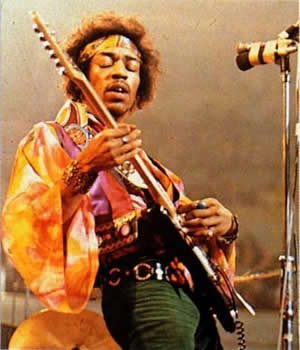
Note that I used a picture of Jimi. He was one of the rare guitarists that had enormous quantities of all three rock star guitarist characteristics. There are few that I’ve seen in my lifetime that were huge on all three. Another would be Prince.

Care to share more?

Read Full Post »

Getting a good guitar sound on a recording can be a real challenge when recording at home. It’s not that it’s difficult mechanically, it’s difficult because of the environment. Working around the limitations of the environment is really the challenge. For instance:

  • Most of us don’t have a dedicated sound-proof room; thus, we get a lot of sound leakage that translates to neighbors (and family) screaming to turn down the volume.
  • Furthermore, most home recording areas aren’t optimized for a “flat” acoustic response. You can do some dampening to reduce room reverb, but you can’t eliminate it entirely.
  • Finally, most of us don’t have expensive recording gear.

But despite all that, it’s still possible to record great, high-quality guitar tracks. I’ve done a lot of recording at home in the past year and thought I might share some of the things I’ve learned in capturing good guitar sounds. Mind you, I’m no audio expert. Everything I’ve learned comes from pure trial and error.

  1. First of all, invest in a decent tube pre-amp. PreSonus makes a great one called the TUBEPre. You can read my review on it here. Even if you use a dynamic mic that will draw power from your line, a pre-amp will boost your mic signal, and at low-volume levels, this is absolutely essential. Also, a pre-amp will add a lot of warmth to your mic signal. In my mind, it’s an essential piece of gear.
  2. Ribbon mics are great for adding depth to your sound, or for recording two amps at once. Unlike unidirectional or cardioid mics that have a reception field that’s in one direction, ribbon mics record in a figure eight pattern in two directions. What this means is that it’ll pick up the ambient sound behind the mic as well. I typically place my ribbon mic about a foot away from my amp cab, then place a 3/4″ thick piece of plywood about a foot behind the mic. This helps reflect the sound back to the rear of the mic. And as long as you keep the volume low on your amp, you won’t get feedback.I also have used my ribbon mic to record two amps at once. For instance, in this song, in the overdriven guitar part, I ran a dry signal out to one amp, then used the other signal to run through my board into the other amp. The net result was it sound like I was employing a lot more output than I actually was. In fact, you could speak (with just a tiny bit of effort 🙂 ) over the combined volume of the amps.
  3. Use two mics to record an acoustic guitar. I read somewhere that using an “X” pattern aimed at the sound hole is really effective. Personally, I use my ribbon mic pointed at about a 30″ angle at the center of my guitar’s body, then use a dynamic mic pointed straight at it. The ribbon mic is about 6-8″ away from my strings, and the dynamic is placed about 10″ inches. The result is a very deep, very natural sound that captures the natural tones from your acoustic guitar.
  4. Because we’re talking low-volume here, there are pedals that you should have that will help quite a bit in getting a good sound:
    a. First, get a decent compressor pedal. I’ve got the Maxon CP-9 Pro+, and just love it. This will help fatten your signal, and give the impression that you have a bit more amp than you actually have.
    b. Invest in a couple of decent overdrive pedals. Personally, I use three: a DigiTech Bad Monkey, an Ibanez TS-808 and a Fulltone OCD. I will either use these individually, or “stack” them in a signal to produce varying levels of overdrive. I know, many purists want to get that power tube saturation sound, but at low volume levels, that’s not practical. Besides combined with a compressor, you can get pretty close.
  5. As far as reverb is concerned, I tend to use very light spring reverb, then layer reverb on top of that in my recording program. It makes it much easier to control on the recording. Some folks use dedicated pedals, which is fine, but I prefer to capture as much of the raw signal as possible, then layer reverb or other effects on top of that raw, dry signal. However, this doesn’t necessarily apply to time-based effects like chorus, flange, vibe, delay or phase. I’ve never been satisfied with the sound quality of software based time-based effects.
  6. There’s nothing like the sound of a tube amp. Unfortunately, with larger tube amps, they just don’t sound good unless they’re cranked. But there are a number of low wattage “practice” amps that actually produce incredibly good sound if you close-mic them. The one I use in particular is the Fender Champion 600. Epiphone also makes the Valve Junior, which has gotten some great reviews. Another low-wattage amp that I’ve been considering is the Blackheart Little Giant BH5-112, which is a switchable 3W/5W amp with a 12″ Eminence speaker. Very cool. Blackheart also makes a 7W/15W version called the “Handsome Devil,” that is also worth a look.

As I mentioned above, I’m not a professional sound guy, and I certainly wouldn’t call myself a recording engineer. But I recorded my first album over the past year entirely at home, under less than ideal recording conditions. It’s entirely possible to do. You just have to find ways to work out, work around and work with the limitations of your environment.

Got any other tips? I’d love to hear ’em!

Read Full Post »

My son Owen As a guitar player and singer/songwriter, nothing brings me more joy than to see my kids enjoying my music. But what really makes it all worth the effort is a conversation I just had with my son Owen a few minutes ago. I was in my home studio, mixing a song, and my son (he’ll be 3 at the end of July) walked in, had me pick him up, and said (in his slightly slurred two-year-old voice), “Daddy, I wanna play guitar?”

I replied, “Really? You want to play guitar?”

“Yeah, Daddy, just like you.”

Okay, I admit, I got real teary-eyed when he said that, and just held him and hugged and kissed him for his sweetness, and I thought to myself that even though I experience lots of joy recording and performing, and make a decent amount of money doing it, none of that comes close to bringing me the joy I just experienced with those simple words.

I knew he liked my music, because he sings my songs to himself all the time. More often than not, he’s sitting down in my studio while I record songs – he loves the process – and loves to be around music! But to hear him say something like that was really overwhelming for me; not only as a parent, but as a musician.

Just thought I’d share that. Any of you axe-slingers have similar experiences? I’d love to hear ’em!

Read Full Post »

People get inspired by lots of things: Pictures they see, songs they hear, conversations they’ve been in; lots of things. Over the course of my life, like others, I’ve gotten inspired by lots of different things, but certain wise words I’ve heard from various people have probably inspired me the most. Not surprisingly, these have mostly been things people have said to me in the context of me being a musician. I’d like to share them with you here.

“There’s always room in this world for people who are good.”

The Dean of my college said this to me during a meeting where he was deciding whether to let me back into my major, which was Biology. I was asked to take a break for a year to “evaluate” my college career. It wasn’t that my grades were bad, but I was taking under the minimum number of courses and making very little progress that year. I was just focused on ballet and playing my guitar, and didn’t really feel up to pursuing a career in a lab or going to medical school. My Dean felt that my calling was in the performing arts (I didn’t know that he was a fan at the time). As he explained to me, people who are good at what they do get noticed, so if my concern was supporting myself, as long as I put my talent out there, I wouldn’t have to worry about getting gigs.

It took me a long time time – almost 20 years – to actually heed that advice, but I took the plunge and started playing at small gigs a few years ago. I started with just a few, but now I do about 30-40 gigs a year all over my local area. I don’t get paid much, maybe a few hundred a gig, but I totally love it!

“Focus on the goal, and let the universe take care of the details…”

These are very wise words from my friend and mentor, Dan Retuta. Dan is a medicine man as well as being a 5th level black belt in Aikido. Right before I decided to start pursuing music more, I was in a discussion with Dan about the logistics of doing music as well as supporting my family. When Dan said these words, I paused because they really struck a chord in me. The point of these words is that when you focus your energy on achieving a particular goal, you will place yourself in the right situations to achieve that goal. Not only that, you will then become aware of the opportunities that have always been around you to help you achieve your goal. Very cool words…

“We’ve all entered this world with certain talents… …our particular challenge in life is step out of the way to let our talents come through.”

I actually said these words to a bunch of teenagers at a retreat, but I’ve heard them said in a variety of ways by a variety of people. The point of this particular saying is that there are so many people who have never discovered their talents, whatever they may be, because they get caught up in the ways of the world, with the chaos of life, with misconceptions and preconceptions of how their world should be. We all fall prey to this. But if we just quiet our minds, and stop trying to analyze all the minutiae, we’ll discover those talents.

From another perspective, there are those, like myself, who have had to overcome their fears in order to fully discover their talents. Again, all it takes is to step out of the way and let your talents through.

“Wanna make God laugh, tell Him about your plans…”

I forgot where I got this one from, but I look at it as a corollary to my friend Dan’s saying, and also a corollary to my own. Don’t get caught up in planning your life to the letter. Prepare for the future, yes, but always be flexible because you never know what circumstances may arise that will shatter your plans. In other words, live the “NOW.” Be aware of your past, and look ahead to your possible futures, but live NOW! There are things you have to deal with NOW! What’s past is past, and the future is never certain. The only things you truly know are what you know NOW.

So how does all this relate to playing guitar? For me personally, these sayings have served as guides to keep me centered while I pursue my musical career. My goal is to have music (and ministry) be my main source of income within the next few years. I’m taking steps towards that now, but most importantly, I’m keeping my eyes open to opportunities. And let me say that I’m not going to be shattered if it remains that I support my music through another job. I love what I do as a successful engineer. I’m building cool stuff that has an impact on people’s lives, and that’s really cool to me.

In any case, rock on!

Read Full Post »

« Newer Posts - Older Posts »