…was the question my wife recently asked me, to which she added, “You already have a bunch of guitars, and amps are sometimes stacked like a wall in the garage, and you’ve got pedals on the floor that aren’t even on the board that you gig with. It’s not that I want to you to get rid of anything, I’m just trying to understand your obsession with gear.”
I replied, “I’ve been trying to understand that myself, and for years. Just when I think I’ve found the perfect tone, I come across some piece of gear that really turns me on, and well, I just have to get it.”
That brief conversation led me to into a bit of introspection, and I asked myself, “Is there a perfect tone out there?” And the answer I came up with is: Yes and No.
“Yes” from the perspective that for certain periods of time, I totally dig my tone. But “No” from the perspective that that satisfaction is fleeting. It’s not that I get tired of my tone, it’s just that I periodically want to enhance it; add a different kind of distortion color, try out a British-style amp. Fundamentally, it still sounds like me, but just different. Sometimes the changes I make are good, and they become permanent, other times, I tire of them. And there are times where I go practically bare-bones, and strip back to the basics.
So I guess it’s not really about searching for the perfect tone, but exploring the different types of tones that may tickle my fancy from time to time. Sometimes it involves buying gear. But the kicker is that I won’t get rid of anything because I never know when I might return to a different tone from days gone by. Besides, who doesn’t like a bit of change from time to time?
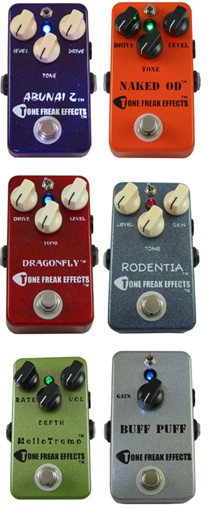
I love serendipitous moments, when I stumble upon something new when I’m doing something else entirely. Such was the case of me stumbling upon Tone Freak pedals. I was seeing if the domain name “tonefreak.com” was taken, and at the top of the search results was Tone Freak Effects. You know me and overdrive and distortion pedals. I LOVE ‘EM! And Tone Freak Effects specializes in two kinds of overdrive, two kinds of distortion pedals, plus a buffer/booster and a really nice trem pedal.
The OD and distortion pedal clips I listened to demonstrate a very diverse set of pedals that have a classic character, but also sound fairly unique as well. For instance the Abunai 2 clips sounded a lot like a classic Tube Screamer – nice and open – but with a bit more low-end while maintaining that openness. In fact, all the pedal clips I listened to portrayed familiar OD and distortion sounds, but were also wonderfully different in very good ways. This could likely be because almost all the pedals are the result of collaborations with various guitarists.
No matter, these pedals sound awesome!
I’m particularly interested in the Buff Puff, a signal buffer, plus a clean boost. The buffer is on all the time, and helps restore the signal loss that can occur in a long effects chain. When you switch the pedal on, you get some clean boost. Not sure how many dB, but that is something that I find totally cool. In addition to my love for OD pedals, I’ve really started getting into clean boost – not just to up my volume, but to also slam the front-end of an amp. It’s wonderful!
Introduced at Winter NAMM, the Lava Cable CPS (Configurable Pedal Board System) is what Lava Cable claims is the first fully configurable pedalboard system ever. They may be right, and are certainly on to something. The CPS consists of individual, notched pedal “blocks” that fit flush together. You then screw the pieces together in whatever fashion you wish. Imagine growing or shrinking your board at will! For pedal junkies like me, this system could be a bit dangerous. The limited size of my current board makes getting more pedals prohibitive, and that’s a good thing. A system like this would allow me to expand it ad infinitum!
In all seriousness though, being able to flexibly lay out your board is a totally cool concept to me. You’re not reliant on the shape of the board nor, if you’re into doing it yourself, must you cut out your own templates. For more info, go to: http://www.lavacable.com/lavacps.html
Ran across these demos on YouTube, and thought I’d share them here. This first one is from VOX at the NAMM show, and sound quality stinks, but the dude’s explanation of the differences between the two different voices (British or American):
This next clip comes from someone apparently in Japan, where the pedal was recently released. The sound quality is much better, and he inserted little conversation bubbles to show his settings. Picture quality isn’t that great but the quality of the sound makes up for it. Plus, it’s kind of amazing that this dude has such clever and articulate feet that he can make all the adjustments with his toes! HA! He’s not bad at guitar either! Check it out!
Especially after viewing the second clip (despite Mr. Clever Toes), this is definitely my next pedal – at least until after I try it out for myself. 🙂
Summary: With seven (7) licensed Lexicon reverb models, this is one bad-ass reverb pedal, and a great value proposition given the relatively inexpensive price of $149.99 for a true bypass pedal. With the Hardwire series, Digitech has really hit a home run!
Pros: Just about the best-sounding spring and plate reverbs I’ve ever heard in a digital reverb. Capable of subtle reverb, to thick, rich and wet surf.
Cons: None. I dig this pedal!
Price: $149.99 street
Features (from Digitech):
Reverb Types
Room – Fast decaying reverb; great for a touch of ambience
Plate – Renowned studio reverb heard on classic recordings
Reverse – Reverb in reverse; gradually crescendos to full volume
Modulated – Lush, modulating, reverb ideal for chords
Gated – Unique reverb with abrupt decay; good for percussive playing
Hall – Large, encompassing reverb with warm decay
Spring – Classic “surf” reverb; great for Rockabilly too!
Tails On/Off Switch – When on, reverb tails are not cut off in bypass
True Bypass circuitry preserves your tone in bypass
Constant high-voltage operation for tonal quality and noise reduction
HardWire Pedals include the following stage accessories
Stomplock™ knob guards lock your tone in place and prevent tampering or accidental knob adjustments onstage
Green gaffer tape helps you locate the pedal in adverse stage lighting
Custom-cut Velcro® pads attach and lock your pedals to your pedalboard
Tone Bone Rating: 5.0 – I did a review of this awhile back, but I finally bought one, and I am oh so pleased with how it sounds!
Yeah, yeah, say what you will about Digitech being known for “consumer” grade pedals, and I’m as much of a boutique pedal snob as the next guy, but there’s no denying the quality workmanship that has gone into the Digitech Hardwire series of pedals. And yes, I know, I reviewed this pedal before, but that review was based upon a test at my local Guitar Center, while competing against the flailing of a wanker sitting next to me, trying to look cool and and trying to play metal licks and failing horribly. Okay, enough of the ranting… Y’all know how I feel about wankers… (search GG for “wankers”).
And say what you will about a digital effect box, but the fact the RV-7 has seven licensed Lexicon reverb voices inside give this pedal LOTS of credibility in my book. As I mentioned in my previous review, I’ve used a Lexicon rackmount for vocals at my Church, and have absolutely loved the reverb effects it contains. Though digital, Lexicon has figured it out, so it’s no surprise that they’re pretty much the standard for digital reverb.
In any case, despite the conditions I had to play within during my initial test, the RV-7 blew me away. Honestly, at the time, I didn’t think Digitech was capable of making a truly great-sounding pedal. Make no mistake, I’ve had Digitech pedals in the past, and they’re all quite functional, but I would never give them a “best in class” rating. They tend to offer great value for the money you pay – which isn’t much for their standard stuff; at least until I discovered the Hardwire series – especially the RV-7!
Since I reviewed the RV-7, I’ve tried several, and even came close to buying an EH Holy Grail. It too is a great sounding reverb, but there was something about its room reverb model which just didn’t do it for me. It’s a great pedal though, but I still liked the RV-7 better.
Recently, I had the chance to go to the local music shop near my work (B Street Music in San Mateo, CA) to perform an A/B test between the Holy Grail and the RV-7. Head-to-head the pedals were pretty close in performance, but the RV-7 beat the Holy Grail with the types of reverb voices it offered, plus the room reverb model on the RV-7 was superb! While the Holy Grail just edged out the RV-7 with the spring reverb, I found I could dial in a great sounding spring reverb with the RV-7 just the same, so that, combined with the awesome room reverb was what sold me. But let’s get into some specifics…
Fit and Finish
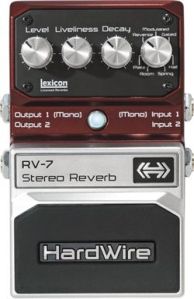
All the Hardwire pedals are solidly built with a cool, flat metallic finish. These pedals are very well-built, and surprisingly heavy – definitely gig-worthy. The RV-7 has a purplish, flat metallic finish on the body with a flat silver switch plate that has a nice rubber pad with the Hardwire logo. The pedal featurs a cool, light-blue LED indicator light. The RV-7 has four control knobs: Level, Liveliness, Delay, and a Voice selector knob. The first three knobs are not smooth sweep knobs. They have – for lack of a better term – micro-notches that really add to the whole industrial vibe that the Hardwire pedals have going on. When you look at the pedal, what’s not to like? 🙂 Of course, how it sounds is where it’s at, isn’t it?
Controls
Level – Controls the Wet/Dry amount. Fully clockwise is 100% wet.
Liveliness – This is actually hi-cut filter to add or reduce the amount of high-end freqs that come through
Delay – Controls how long the reverb effect decays after striking a note or chord
Voice Selector – pretty self-explanatory
How It Sounds
In a word, AWESOME! I used it in my weekly acoustic gig this evening, and was thanking the heavens for such a great pedal. My guitar maintained its clarity, no matter how much I upped the level knob. It must have a slight pre-delay built in; whatever, the fact that I could clearly hear the notes and chords I was playing and not having them washed out by the effect was truly an inspiring experience. Add to the fact that it is true bypass, so when it’s off, it’s really off, is yet another reason to love this pedal; no hum, no buzz.
To be fair, I have no idea what to do with the reverse reverb other than to add some interesting effect with single notes in a song. But other than that, I’m really digging this pedal!
Sound Samples
Here are some sound samples I quickly created… Please excuse the recording quality. I just recorded in an open room with no filtering. BTW, I used a Strat with a prototype Aracom RoxBox 18 Watt Amp with a Jensen 1 X10 speaker. In almost every case, all the dials were at 12 o’clock, except for the Hall and Spring, where I set Level and Decay to about 2pm. I prefer a more subtle reverb effect, but as you’ll hear, the RV-7 is crystal clear, and produces a very nice reverb effect.
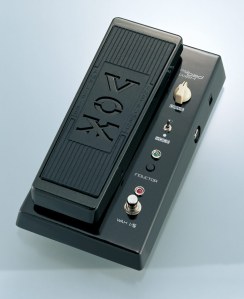
Ever since I tried out the VOX Satchurator a few months ago, I’ve been waiting for the this wah pedal to arrive. If it is anything close to the quality of sound that the Satchurator produces, I know that this is going to be a great pedal. The pedal features two modes: Mode 1 is classic VOX wah; while Mode 2 features the ability to variably adjust the gain and voicing profiles of the wah to dial in a variety of tonal possibilities.
One thing I take note of when evaluating pedals is if I can reproduce the manufacturer’s or endorser’s claims about a particular feature. For instance, when Satch touted the “More” switch on the Satchurator, during my tests, I was expecting more volume when my amp was clean, and more balls when my tubes were saturated. The pedal definitely lived up to that claim.
With the Big Bad Wah, VOX states, “Designed to Joe Satriani’s custom specs is the design of the pedal pot itself, delivering a smooth, musical tone throughout the entire sweep of the pedal.” This is huge, because I’ve found in my evaluations of different kinds of wah pedals that when you back off the pedal, your output becomes a bit muddy, so you end up never fully backing off because the wah will just suck your tone. Or seemingly to protect against this, manufacturers will narrow the sweep range, so the wah becomes much less dramatic. I found this to be the case with Morley Steve Vai Bad Horsie, which was very musical throughout its sweep range, but overall, didn’t have that dramatic of a sweep as compared to others I tried. So I ended up just getting a Dunlop Cry Baby, and despite its shortcomings, I’ve come to love it.
But I’ve always loved Satch’s wah tone, not because I want to necessarily sound like him, but because it’s just a killer tone, and highly expressive. And as with the Satchurator, Joe was involved in every aspect of the design process, so the Big Bad Wah promises to be of the exacting standards for which Professor Satchifunkilus is known. Once the Big Bad Wah is available in stores, which should be soon, considering the announcement of its release was made at NAMM, you can be assured I’ll be running down to the local shop to try one out!
Some online retailers like Sweetwater, are doing pre-orders for $219. That’s not a bad price to pay, especially for a signature pedal. And I dig the fact that Joe really wanted all his signature pedals to be affordable and within the reach of a wide range of people. In any case, all this combined makes for me taking a serious look at the Big Bad Wah
Back in the early 1990’s, Jeorge Tripp started Way Huge and created a line of pedals starting with the “Fuzz Box” that for all intents and purposes started the whole boutique pedal movement. Later in the decade, he decided to go on to other stuff (I believe he went to Line 6). I didn’t play much electric guitar back then, but I do remember a couple of guys I knew who used to rave about Way Huge pedals. I had never heard of them, and as a primarily acoustic guitar player, didn’t really pay too much attention because distortion was not part of my tonal palette. That all changed when I started focusing on electric guitar a few years ago. I’d visit forums and lurk discussions about how people were paying hundreds (never saw any go for thousands, but apparently some did) for these rare pedals. I was amazed. These pedals must’ve been something special if they were in such high demand.
Then a few weeks ago, I had heard that Jeorge Tripp struck a deal with the Jim Dunlop company to resurrect Way Huge. I did a google search to see if I could find any info, and came up pretty empty-handed. Even the Way Huge site had no information – until I did another search about ten minutes ago, and saw that a search on “way huge” produced the result “Jim Dunlop – Way Huge” as a search result. Naturally, I had to click the link, despite the seemingly sexual undertones the link title might have implied.
To my everlasting surprise, the Way Huge site was completely transformed from the comic book-like line drawing theme into a real site, replete with Flash graphics! But to be clear, the fact that it’s Flash did not get me excited. It was the fact that it was a real site. You have to check it out!
Featured on the site are the three pedals Way Huge is offering right now: The Swollen Pickle Mk II, The Fat Sandwich, and the Pork Loin. The Swollen Pickle is a pure Fuzz machine, while the Fat Sandwich and Pork Loin are soft-clipping overdrive pedals. Each has a very unique voice. The sound samples really display the capabilities of each pedal, so I encourage you to check ’em out.
Personally, I’ve never been much of a fuzz guy, but I do love soft clipping pedals. So naturally, I gravitated toward the Fat Sandwich and Pork Loin pedals. Very nice sounds indeed!
What do you do when you have two kick-ass overdrive/distortion pedals and don’t know which one to choose because both pedals bring so much to the table? The obvious answer is to use both. But my problem in choosing is exacerbated by limited pedal real estate, so I have to make a choice.
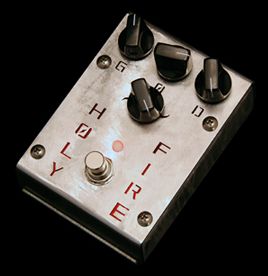
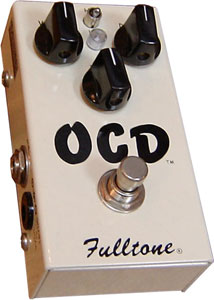
Actually, the choice wasn’t too hard to make once I started playing with the Creation Audio Labs Holy Fire. While I love the OCD, the Holy Fire wins hands-down for its versatility and total transparency. While the OCD is somewhat transparent, it can get kind of muddy and a little choppy at high drive settings, whereas the Holy Fire’s distortion section reacts a lot like a power tube at high gain settings producing a compressed effect that just rocks the house!
I still love the sound that the OCD produces. It really brings out harmonics and overtones, and set in a “sweet spot” produces a nice sparkly distortion that really sounds great. But as of late I’ve been gravitating towards retaining the natural sound of my guitar and amp, so the added artifacts that the OCD adds aren’t really what I want right now.
On the other hand, the overdrive on the Holy Fire is totally unique, and nothing like I’ve ever witnessed in all my tests of overdrive pedals (and believe me, I’ve tested a lot). The overdrive has what Creation Audio Labs calls a “wave shaping” circuit that evenly distorts the entire bandwidth of the incoming signal as opposed to creating a mid-range hump, or scooping the EQ. It really is completely even. You don’t lose any lows or highs, which is common in overdrive pedals. And the circuit reacts to both volume and pick attack, providing more wave shaping as you hit the front-end of the pedal harder. Simply put, you retain all the natural tone of your guitar! It’s insane! And it’s so special, Creation Audio Labs is trying to patent it!
I gigged with the Holy Fire for the first time this evening at my weekly Church gig. Make no mistake, this may be a church service, but we regularly hit above 100db in our sets, so there is plenty of room to let our amps breath, and take advantage of the higher gain settings on our equipment. Tonight, I made sure to pick music that would allow me to use the Holy Fire throughout my set. Talk about being inspired! I used it with my Strat and a Reason SM25 amp. What a combo! I set the gain to just above unity with the clean channel (about 10am), the overdrive at about 2pm, and distortion at about 3pm (so the distortion section would compress – it does this at around 2pm). The breakup was so smooth and delicious, I wanted to keep it on all the time! Unfortunately, I couldn’t do that with some songs, but where I had the entire band playing all out, the Holy Fire just made my heart sing!
The Holy Fire also plays well with other pedals. My mainstay overdrive pedal is my trusty green machine, an Ibanez TS-808 Tube Screamer. That’s one pedal that will NEVER leave my board! But here’s the cool thing: Running the Tube Screamer in front of the Holy First was like nothing I’ve heard before. I did this with my OCD as well, essentially getting a combined tonal effect that the TS and OCD produce. But the Holy Fire maintained the tone the Tube Screamer produces! On the other hand, it smoothed out and thickened the distortion. The result was the expected mid-range hump from the Tube Screamer, but with super-creamy distortion, plus the TS tone, that was like candy to my ears. No extra coloration that I came to expect by running my TS into the OCD. It was like playing a fatter Tube Screamer!
Believe me, despite playing in a worship service, the way I was feeling with both those pedals running together made it seem I like I was flying with the angels! I’m not exaggerating! There is absolutely nothing compared to the feeling you get when you’re playing with wonderful tone. It inspires and emboldens you, and you take your playing to places you didn’t think possible.
That was the feeling I got when I first started playing with the OCD, and frankly, I didn’t think it could get much better. But the Holy Fire has changed everything.
On top of that, I was using another Creation Audio Labs pedal, the Mk.4.23 clean boost, yet another amazing product from those electronics wizards. I used the booster to give me just a slight gain boost for when I was doing solos, or was in the refrain section of a song when I needed just a bit more volume. It too is a totally transparent boost, adding ZERO artifacts to your signal, so all the time I spent dialing in my settings wouldn’t be lost when the Mk.4.23 was engaged.
I swear, I must sound like a twitterpated, googly-eyed schoolgirl! 🙂 But it’s been a long time that I’ve felt truly inspired, like everything was totally right with my world of tone. I’ve finally (at least for now), found total balance in my tone. The circle is complete…
I dig interesting pedals. in my search for a decent reverb, I came across the Plush Verberator that is a tube-driven effects loop and a 24-bit reverb in one pedal. I’m not too sure about the effects loop bit, but the reverb sounds really awesome. Here’s the product description from the Plush site:
The Verbrator® is a new multipurpose pedal which combines an all-tube effects loop with a studio grade reverb featuring a 32-Khz clock speed for full 16-K audio bandwidth. The Verbrator® is our most innovative pedal offering to date. It’s an effects loop, it’s a reverb, it’s both!
Unlike other “tube pedals,” the Verbrator® power supply features a unique regulated switching technology that takes the incoming 9 volts and converts it up to the optimal high voltage a tube really needs to operate best. In addition, a 6-volt DC regulator provides consistent clean DC power for the tube filament assuring lowest noise and consistent performance despite any changes to incoming line voltage.
The Verbrator® can be used as a pedal on a pedal board as a reverb pedal. It features a level control and decay control allowing you to have a short medium or long decay reverb algorithm. It can also be used as a tube buffer to convert an incoming high impedance signal to a low impedance for long cable runs or driving a pedal board. The recovery (gain) stage can be used to boost the level of a guitar or pedal board with a true tube audio stage. It provides a warm sweet utility gain stage with a multitude of uses.
The effects loop portion of the pedal features a unity gain cathode follower to work with any amp that has passive preamp output – power amp input patch jacks, and not a true active effects loop like Ceriatone, Dumble, Bludotone, Brown Note, some Marshall models and others. It has a send level control and high headroom. The return portion of the loop features a high impedance input (250-K) and a low output impedance with its own level control as well. The loop can be run in series or parallel modes, and features a level adjust switch for rack or pedal style effects.
9-volt DC adaptor provided, the Verbrator® features a unique “window” showing the tube. Like all Fuchs pedals, the Verbrator® features solid cast aluminum powder coated enclosure with heat cured silk screening, dual sided heavy circuit boards, premium switches and controls, and premium electronic parts throughout.
Like I said, I’m not too sure about the effects loop part of it, but the reverb really sounds good. Check out the video below:
Summary: Overdrive and Distortion and tons of gain in one box that will NOT alter your tone. Has built-in wave shaping that responds to attack and input gain that simulates overdriving the front end of an amp.
Pros: Possible to achieve all sorts of clipping from swampy grind to searing distortion rife with harmonics, overtones and feedback, and it can do all this at ANY volume – freakin’ amazing!
Cons: Operationally, none. But its circuitry is so special that it requires a special 48V DC adapter – it will not run from a standard 9V or 18V power supply like Dunlop DC Brick. But for what it brings to the table, that’s a small price to pay.
Price: $195 direct
Knobs:
– “G” Gain
– “O” Overdrive – Soft clipping circuit – has built-in wave-shaping to react to input gain much like the front-end of a tube amp. Higher levels evoke increased wave-shaping ensuring even distortion throughout the EQ spectrum.
– “D” Distortion – Square wave form distortion
– Hi-cut (variable sweep hi-cut, fully open gives you all the tone, dialed back scales back the hi-freqs)
Tone Bone Rating: 5 This stuff is magic.
The guys at Creation Audio Labs must be wizards – or at least half wizard – because they’ve created what I consider to be the only overdrive/distortion pedal that does what it’s supposed to do, and doesn’t alter the tone of your amp! Mind you, there are times when you want that. For instance, to me, the classic overdriven mid-range hump of a Tube Screamer is an incomparable sound, and something I will always have on my board because I like the way it changes my tone. But in a lot of other circumstances, all I want is grind or all out distortion, and I don’t want my tone changed. That’s where the Holy Fire overdrive/distortion comes into play.
This is truly a magical pedal. Not only does it look awesome with that brushed metal exterior, and glowing red “Holy Fire” letters, it kicks the freakin’ pants off pretty much anything that’s out there that claims tone transparency in my opinion. And I don’t say this lightly. Remember, if you’re a regular reader of this column, I’ve got a real penchant for overdrive and distortion boxes – especially overdrive boxes. So when I say a pedal totally kicks ass, I mean it! You might not see too many reviews on them here, only because I only take the time to write about gear I love and would put in my chain. This is a pedal that will be taking up space on my board! And at $195 direct from Creation Audio Labs, this is a must-have box!
What’s so special about it? Actually, the question should be: What’s not to like? You get the best of both worlds here: Completely transparent overdrive or beautifully compressed distortion. Playing just with the overdrive and the distortion completely rolled off, you can get that classic, mildly crunchy, gritty grind to rip-roaring rattle that’ll make you think your amp’s bottles will shake off. Conversely with the overdrive turned all the way down and sweeping the Distortion knob, you can go from sweet and mild distortion, to heavily compressed gut-wrenching distortion replete with harmonics and overtones that’ll make you feel you’re getting scalped! But the best settings combine certain amounts of both. When you find your sweet spot, it’s epiphany time!
Imagine all this in one little stomp box! And the kicker is that your amp will still sound like your amp! Mind you, I didn’t read any reviews of this pedal before I got one for review. I didn’t want to taint my assessment of the pedal. The VERY first thing I noticed as I twiddled with the knobs is that my test amps never lost their voicing (I used three amps: An Aracom RoxBox combo, a Reason SM25, and my trusty Fender Hot Rod Deluxe). In all cases, the amp I was playing still sounded like my amp except it had grind and/or distortion. And no matter what output volume I had, the pedal operated the SAME WAY!!! So imagine the versatility this pedal brings to the table! I’m going to do a test later on with my Fender Champ 600, and see what wonders the Holy Fire will conjure when I lay down some tracks. It should be interesting as well as rewarding. So whether you’re on stage or in the studio. If you need breakup in your sound, this pedal will do it.
But wait there’s more!
On top of all I discussed, the pedal is sensitive to input gain, and has what’s called “wave shaping” that responds to higher input gain and acts like you’re overdriving the front-end of a tube amp. When you hit the pedal hard with either a booster or diming your guitar’s volume, or just picking hard, the pedal’s LED changes to a yellow color indicating that you’re overdriving the pedal. The magic behind this is that wave shaping evenly distorts the input signal across the EQ spectrum, so all your input tone is completely retained. The damn thing works too! It ain’t no marketing gimmick! So just as you’d expect when you do the same things with an amp, the Holy Fire will do it as well. Like I said, it’s magic.
I should make mention to a very cool effect that happens when you turn the distortion knob past 2 o’clock. The circuit actually starts compressing the signal, so you lose a little volume, but you get a very fat signal. In my opinion, that’s where the magic occurs with the distortion. After playing around with lots of combinations, I ended up just diming the distortion knob altogether, then just layering in varying amounts of overdrive and gain. Truly candy for the ears here, folks. With that, I’m going to post a couple of YouTube vids here so you can see and hear for yourself.
 I love serendipitous moments, when I stumble upon something new when I’m doing something else entirely. Such was the case of me stumbling upon Tone Freak pedals. I was seeing if the domain name “tonefreak.com” was taken, and at the top of the search results was Tone Freak Effects. You know me and overdrive and distortion pedals. I LOVE ‘EM! And Tone Freak Effects specializes in two kinds of overdrive, two kinds of distortion pedals, plus a buffer/booster and a really nice trem pedal.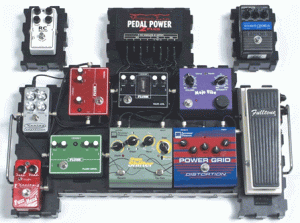

 Guitar Gear