Feeds:
Posts
Comments

Archive for the ‘Tone’ Category

A few months ago, I was in a rush to get to a gig. I didn’t keep good track of time running errands beforehand, and had to make a mad dash home to pick up my gear. Once home, I frantically loaded up my mini-SUV with my gear, took a quick “make-sure-everything’s-there” look, hopped into the driver’s seat, and sped off.

Now, as many gigging musicians know, rushing to a gig is a recipe for disaster: You’re stressed when you get to the venue; that stress in turn makes you rush even more once you get there; and when you’re rushing, you tend to forget things. That gets you even more pissed, and the net result is that nothing goes very smoothly.

Such was the case on that fateful day of rushing to my gig. In the corybantic state I was in while loading my car, I had overlooked loading something that is central to my setup: My gear bag where I carry all my pedals, cords, extra picks and my tuner. While unloading my vehicle, I didn’t even notice that it was missing. I felt rushed, yes, but I also felt confident that I had all my stuff, and could just set up, go through sound check, and be ready to perform. It was when I went to set up my gear that I suddenly realized my gear bag was not present. Talk about being pissed! I had to leave the building to regain my composure.

Once I calmed down, I went back inside, gave a small chuckle of futility, and asked my band members to help me out. Luckily we always have extras of stuff, so I borrowed a couple of cables, plugged in my amp and guitars, then went outside to lock up my car. As I was closing the tailgate, I looked inside the cargo area of my mini-SUV, and lo and behold, sat two of my pedals: my trusty Boss Chorus, and my TS-808 Tube Screamer. I had taken them out to jam with a friend the night before, and laziness kept me from putting the pedals plus my power snake back into my gear bag! All was not lost. I was still missing three pedals, but hey! Two are better than nothing.

With glee, I returned to my setup and inserted the pedals into my signal chain, and we got ready for sound check. I was a little dubious about how things would sound without my full array of pedals, especially my BBE Sonic Stomp that really helps contour the lows in my amp, but once my amp warmed up, I couldn’t believe the clarity of sound that was coming through my amp! I was in absolute heaven! Granted, I had to tweak the EQ a bit, but I was beside myself with how good my amp sounded. So what started out as a potential gig-breaker, turned into a blessing in disguise.

Now, I only play with the chorus and tube screamer in my signal chain, though I may add a tube reverb in the near future to get different reverb effects in addition to the stock spring reverb in my amp. But I’m in no rush (excuse the pun). In any case, I’ve learned a couple of valuable lessons:

  1. Always give yourself a lot of time to prepare for a gig.
  2. More is not necessarily better with respect to effects. This is a point I need to discuss a bit…

With respect to item 2, I bought all my effects when my amp was new. While I loved the way it sounded out of the box, I felt that it had some rough edges, so I smoothed them out by adding pedals to my signal chain to compensate. But after playing with this amp for over a year now, I think the reason it sounds so good without the pedals is because the speaker cone is broken in from frequent use. So a third lesson can be gleaned from all this: Spend the time to break in your amp. Depending upon how much you play, this could take weeks, or it could take months.

A final lesson I’ve learned is this: So much of your tone comes from your fingers – how you articulate the strings on the fretboard. Trust your fingers!

For me, I probably could’ve removed half of my pedals months ago, but didn’t know any better. Now I do. At this point, my tone has really evolved to a place where I’m absolutely happy, and that just drives me to get even better as a guitarist.
Read Full Post »

In a previous post, I mentioned that I may not get a boutique amp after making mods to my Fender Hot Rod Deluxe. But after playing several boutique amps over the past few months, I’ve changed my mind. There are a couple of reasons for this:

  1. First, a boutique amp has a distinct tone. You might think that the distinctiveness is limiting. But it’s not. To me, boutique amps represent the ideal tone right out of the box. For instance, I played a VersaTone 57 from Faustine Amps the other day. It had the tone I’ve been after: Smooth bass, thick mids (but not overpowering), and beautiful, harmonically-laden highs that seemed to float in the air. When driven, the resulting distortion was absolutely smooth as silk, with no high-end break-up. To achieve this tone with my Hot Rod, I’ve had to swap tubes, re-bias the power amp tubes, and throw a few effects at it. And I still get a high-end break-up, which means I have to bring the amp back into the shop to have a couple of resisitors changed. In essence, with bench time and equipment, I will have spent just a couple of hundred bucks short of what I would’ve paid for a VT-57.

    Mind you though, because boutique amps are very distinctive, you have to play a lot of them before you make a decision. I’ve tried out at least 20 different amps, and I’ve finally narrowed my search to two amps, and this search has taken a few months.

  2. Secondly, almost all boutique amps are completely hand-wired. Mass-produced amps such as my Hot Rod use a PCB board to route all the electronics – it’s efficient and cheap. The advantage of hand-wiring is that if you happen to blow a resistor or a capacitor, you can simply swap it out for a new one. On the other hand, you have to replace the entire PCB board if you blow a resistor since it resides on the board itself. Not fun. From what I understand, the typical life for a Hot Rod is about seven years under regular use. There are hand-wired amps from 40 years ago that still function great. For instance, I know a guy who still plays his ’65 Fender Twin Reverb. Back then amps were completely hand-wired, and he’s just made simple repairs over the years. So the point is that boutique amps are designed and built to last for decades, not just a handful of years.

So what about my Hot Rod Deluxe? Frankly, I still love it, and because I’m so satisfied with how it sounds, I’ll continue to play it until it dies. That may be 10 years from now, it may be a couple of years from now. When that happens, I’ll go with a boutique amp. But not before.

Read Full Post »

A friend of mine recommended that I try out a T5. He was raving about how cool it looked, and how you could switch from acoustic sound to a full-blown electric. I was a little dubious, considering that that’s really just modeling, and frankly, it was nothing new to me). Parker Guitars did this with “The Fly” well over a decade ago. But to be fair, I went down to my local GC to check one out and see what all the hype was about. So, under the guise of “Honey, I need to run some errands. I’ll be back in a couple of hours,” I ventured to my local GC, and played it for over an hour. The following is the result of that session with the Taylor T5:

Oops! Before I start on the actual review, I played the T5 through three amps: A Fender Acoustasonic Junior, a Fender Hot Rod Deluxe, and a Roland Cube 30.

Fit and Finish:

All Taylor guitars look great, and the T5 is a real beauty. I played a T5 with a beautiful royal blue finish – very sexy. The T5 also lives up to the Taylor standard of construction – all their guitars are very well-built. As far as acoutrements are concerned, personally, I’m not a real fan of low-profile knobs (when I’m in the middle of a song and want to make an adjustment, I want to be able to feel the knob – ooh, that didn’t sound good), but the knobs on the T5 fit in with its design nicely.

Feel and Playability:

The T5 has a nice narrow neck – very similar to my Strat and Ovation Acoustic/Electric – which I love, so moving around on this neck was amazingly easy and very comfortable. Acoustic players who are accustomed to wider necks will need a little time to get a feel for the neck, but should adjust pretty quickly. I had an easier go of it myself from playing my Ovation. When I first got that guitar, I had a bit of a break-in curve, but now it’s the type of neck I prefer.

Sound:

I know that I may piss some people off when I say this, but as far as sound was concerned, I was a bit disappointed. Based upon my conversation with my friend who raved about it, and lots of glowing reviews I read on Harmony Central and Musicians’ Friend, I was expecting a lot more with respect to tone – especially since the T5 starts at $1999, and goes up from there. I used the same evaluation process on the three amps I played the T5 on: On both amp and guitar, I started out by setting all the tone knobs to the mid settings. Guitar volume was set to midline, and since I was in a shop, I had to set the Fenders pretty low (they use logarithmic volume pots), while the Cube 30’s gain could be cranked while leaving the volume at a comfortable level. From there, I played the guitar in three different ways: 1) Fingerpicking; 2) strumming (using a straight sweep strum, and a percussive, attacking strum); 3) Then just playing various lead patterns in clean and high-gain modes.

Played clean with fingerpicking and lead playing, the T5 was very nice on all the amps; great clarity and sustain, though I really had to pump up the bass and turn down the treble on the amps to achieve a rich sound – especially on the Hot Rod Deluxe which, even with brightness off, plays pretty bright. Strumming in clean mode was pretty ugly on the Fenders – the guitar sounded like an acoustic plugged into an amp – very flat sounding, and no amount of EQ tweaking or reverb helped. Plus, when using a percussive strum pattern (think Michael Hedges), I would get an annoying popping sound. Probably has to do with the very touch-sensitive pickups, added to the touch sensitivity of the Fender amps. On the Cube 30 though, since I could apply some chorus, the tone cleaned up quite nicely, and helped dissipate the high end. If I was to use the T5 clean with a straight tube amp or acoustic amp, I’d run it into a compressor, a chorus, and then run the entire signal thorough a sonic maximizer – and possibly add an EQ pedal to texture the sound better.

In high-gain mode on the Hot Rod, the T5 actually sounded very nice. Even though I had to play at a lower volume, I could crank the drive and get a real nice distortion out of the T5. I think this is where the body vibration from the hollow body comes into play. It actually sounded a lot like my ES-335 in that mode; very pleasing to the ear, with a big, rich sound. With the Roland Cube 30 in the modeling channel, the T5 performed great with the gain at about midway, using the all the non-acoustic amp models. In the acoustic model on modeling channel, the T5 actually sounded VERY good, but then again, that’s a modeled sound.

Overall:

The Taylor T5 is a pretty nice guitar. Would I pay two grand and up for it? I don’t think so. I look at this guitar as being similar to a Line 6 Variax 700, which has a lot more features and guitar models built into it, and costs more than half the price less (I know, the T5 is NOT a modeling guitar)! Then again, I wouldn’t buy a Swiss Army Knife type of guitar period, mainly because even though it may sound real close to what it’s modeling, it’ll never get the exact voicing that the original gives you. For instance, if I want a thin, single coil sound, I’ll use my Strat. If I want a richer, boomier presentation, I’ll use my ES-335 (I’m also in the market for a Les Paul Double Cutaway, which I just adore). For acoustic/electric work, I’ll use my Ovation shallowbody.

Read Full Post »


How you sound is important, and what sounds good to you is an entirely subjective thing. A lot of guitar players want to sound like other guitarists – that’s not a bad thing. Hell, I’d love to sound like Eric Johnson or Joe Satriani or Stevie Ray Vaughn myself! But whether or not you want to sound like some other guitar player, or create a sound that’s unique to you, you need to take into account what shapes your overall tone.

Unfortunately, many guitarists, especially inexperienced guitarists don’t understand tone shaping all that well. They think that just because they get a certain stomp box, they’ll sound just like their favorite guitarist. But getting the right tone involves a lot of different factors, but they boil down to three different areas. And how you balance those areas will affect how you sound. NOTE: This deals more along the lines of equipment as opposed to the guitarist, who of course is the main factor in getting tone; in other words, how you play affects how you sound, so technique is really a huge factor.

The Tone Triangle

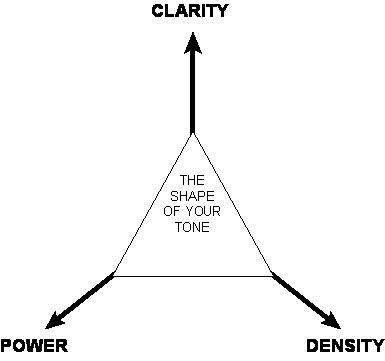
The tone triangle

The diagram above is what I call the “Tone Triangle.” It simply is a graphical representation of the three factors that influence your overall tone: Power, Clarity, and Density. Power is a function of your volume, whether set from your guitar, volume pedal, or amp; or by using a booster or overdrive pedal. Clarity is the cleanliness of your tone. I tend to think of clarity or cleanness in terms of the amount of distortion or lack thereof that is present in your tone. Density is the “fatness” or “thinness” of your tone. For instance, a Strat has a fairly thin tone as it doesn’t produce much in bass area. An ES-335 or Les Paul however, have dual humbuckers, so they produce a much wider range of tone; thus the “fatter” tone.

So what’s the point to all this? What you do to tweak your sound will affect the shape of your tone triangle. Note that there’s no bad shape to the triangle. Its shape just changes based upon the tweaks you make. And understanding how that shape is affected will get you a long way towards knowing what kinds of pedals to buy or adjustments you have to make. So armed with that idea, let’s look at the three corners of the tonetriangle.

Things That Affect Power

Power is a pretty easy thing. Pump up the volume, add an overdrive or boost, and the net result is a generally louder sound. But keep in mind that power has an inverse relationship with clarity. The more power you add, the lower your clarity, as your signal will tend to distort at higher power levels.

Specifics: Volume adjustment (guitar, amp, volume pedal); overdrive and boost pedals.

Things That Affect Clarity

As discussed above, gain has a negative effect on clarity; not that this is a bad thing. I myself can appreciate a creamy smooth distorted signal. But distort too much, and what you get is a mess. In fact, with an overly distorted signal, even though you might pump up the volume, your sound will just get lost in the mix. So with clarity, you have to really balance how much distortion is appropriate for what you’re playing and who you’re playing with.

Let’s take a bit of time to discuss distortion. Generally, there are two types of distortion. The first distortion is the result of high input gain, while the other type is the result of signal manipulation. Both are completely valid, but each produces completely different types of sounds. Distortion from gain or overdrive tends to be on the bright and gritty side, while distortion from dedicated distortion pedals tends to be thick and smooth. The combination of both kinds creates a very big sound indeed – sometimes too big for some applications, so be careful how you’re applying distortion. With respect to distortion pedals, my advice is to play a bunch of different kinds. The same goes for overdrive pedals. Again, it’s all about personal preference, but it’s also about the type of music you play. It doesn’t make a lot of sense to play with a lot of overdrive and distortion if you’re playing jazz or pop; on the flip side, playing a really clean tone with death metal is absolutely nuts!

Clarity is also affected by how you EQ your rig. Put too much bottom-end in your sound, and you’ll sound muffled. Dial in a lot of treble, and you’ll sound thin or at higher volume levels, you’ll sound piercing. So you have to be careful about how you balance your EQ.

Specifics: Again, volume or gain; distortion and overdrive pedals. EQ. Modulators such as reverb, chorus, flange, and phasers also affect your clarity.

Things That Affect Density

As mentioned above, density is about the fatness of your tone. This can be affected in a lot of ways, not the least of which is the type of guitar you play and the pickups they employ. In general, single coil pickups produce a thinner tone, while humbuckers have a deeper and richer, thus denser or “fatter” tone. The type of amp you play out of can either thicken or thin out your tone. For instance, Fender amps are clean and bright, while something like a Vox AC30 produces a thicker overall tone.

As far as effect pedals are concerned, the most common pedal used for adjusting signal density is the compressor. I’m tired, and this entry is getting long so for a good discussion of how a compressor works, read this great article. An overdrive pedal can also serve to thicken your tone if used at lower drive levels, but it’s tricky, and you have to do a lot of tweaking depending upon the guitar you use.

Specifics: Type of pickups you employ;compressor, overdrive pedals.

Wrapping It Up

Notice that I didn’t mention specific brands or pedals in this discussion. This is because tone shaping is such a personal thing that to give advice on specific items to purchase would be a disservice. What I wanted to do was give you an idea of the kinds of things that can affect your tone triangle. So go out and shape your tone!

Read Full Post »

Fender Hot Rod DeluxeA few days ago, I got a Fender Hot Rod Deluxe, and as I mentioned, I was just blown away by the sound. As I’ve mentioned before, there’s nothing like the tube sound, and according to articles I read and people that I’ve spoken to about this amp, it’s a great entry-level tube amp that you can a lot of mileage out of. Since I’ve gotten it, I’ve been playing it at least a couple of hours a day – it’s that good!

After a few days of playing it though, I started feeling that there was just something not completely right about the sound. Mind you, compared to my modeling amps, the sound from this amp could be compared to swimming in hazy waters, then coming into a crystal clear patch of water. But still, the clean channel felt just a little “flat,” and in the drive stage – even with my TS-808 adding heavy overdrive – the distortion was choppy.

Before I bought the Hot Rod, I had read a bunch of articles and talked to a few very knowledgeable amp technicians about how the stock tubes that come with the amp are biased pretty low – in other words they run at a lower output level so they last longer, but this has an effect on the sound. So, armed with that input, I took my amp to King Amplification in San Jose, and none other than Val King (the owner and designer of King Amps) took a look at the tubes. My intent all along was to swap out the stock Groove Tube 6L6GC’s and run up the biasing just a bit higher based upon my reading, but Val did a thorough check of all the tubes and various voltages in the circuits, and I actually ended up not only swapping out the power tubes, I replaced the pre-amp tubes as well because they were just slightly distorting at low volumes. According to Val, that was probably causing the “flatness” in tone I was experiencing. So he replaced both pre-amp tubes and also replaced the phase inverter tube. Now, the sound that the amp produces is crystal clean, and has a lot of ringing overtones! I’m very happy.

I’m scheduling to have another mod made to the amp, and that is to tighten up the distortion even more in the boost channel. The new tubes helped a lot toward this, but I want a subtler, creamier distortion – it’s still a tad choppy for my tastes – so I’m going to have it adjusted. I’m also going to have the volume pot changed from a logarithmic-style volume pot to a linear one – it’ll make it much better for controlling the amp’s volume.

Read Full Post »

« Newer Posts