Feeds:
Posts
Comments

I’ve literally spent hundreds of dollars on picks over the years; well most of that was spent in the last few years as I transitioned from standard Dunlop nylon picks to high-end, thick, rigid picks. Until recently, I used different picks for different guitars and even styles. For instance, for electric guitar, I used a V-Picks Snake (pointed) or a V-Picks B-flat for general rock, and I’d use a Red Bear B-Style Gypsy Jazz pick for when I knew I’d be doing a lot of leads or fills in a song. For acoustic, I also used the Red Bear, but mostly used a Wegen GP 250. But when I lost the GP 250, I wanted to get a new Wegen, so I found the “Fatone.”

When I first held it, I knew I was holding something special. It just felt “right.” Then trying it out on a couple of different guitars (at Gryphon Stringed Instruments in Palo Alto, CA), I immediately fell in love with the pick. It was so comfortable in my hand, and the bevel was absolutely perfect! Even within the first couple of minutes, I figured out that slight angle changes my attack angle could produce different tones. With the pick attack angle more perpendicular to the strings, I could get a warmer tone. Flattening out the angle put the bevel more into play, and would produce more highs. I was really blown away! So of course, I bought the pick.

Now, almost a month into owning it, I’ve used it in over 10 gigs, for both acoustic and electric, and I can confidently say that this is it! I’ve found my all-in-one pick.

Soon after I got the pick, I contact Michel Wegen via email (he’s in Holland). On his site, he has a particular emphasis of using his picks on acoustic guitar. I asked him about that considering I’ve been using his picks for both acoustic and electric, and why he doesn’t mention anything about using his picks with electric guitar. Here’s his response verbatim:

Hi Brendan, It’s like the microwave and the small dog story. I’m sure you have heard of this. So, to be on the safe side, I only recommend my picks for acoustics. I have some customers having great fun making big electric guitar noise, using distortion and all, and they complaint to get free picks.

Kind of a bizarre response, but I get the picture. 🙂 I suppose from the response that several electric guitar players have used the picks and were breaking strings because they’re wailing on the strings so hard. But they love the sound, so they try to needle Michel into giving them free picks as compensation for their string loss.

But that brings up an important point about playing with thick picks. You have to un-train yourself from attacking hard. With traditional thin, flexible picks, to get more volume, you attacked harder. The same principle applies with thick picks, but because of their mass, you needn’t attack nearly as hard as with a traditional pick. Where with a traditional pick, your picking hand does most of the work to produce volume, with a thick pick, that work is transferred to the pick. You also hold a thick pick must lighter than a traditional pick. The net result is that your hand is very relaxed, and allows you to be much more fluid with your playing.

Django Reinhardt used super thick picks back in the day. If you see videos of him playing (there are only a few), look at his right hand, and see how fluidly his hand moves across the strings. Of course, a lot of that can be attributed to his incredible technique, but I can assure you his pick was never an impediment.
I know, I’m always like… I normally don’t reprint press releases, but this is an exception… 🙂 Yeah well, here’s another exception. The new Chris Shiflett Tele Deluxe Signature Model. I got the press release in my email this morning. As I was deleting the ads – of which this was one – I stopped when I looked at this Tele Deluxe because it looked like a Les Paul configuration, with the independent volume and tone knobs and the 3-way switch on the upper bout of the body. So I gave the link on the email a click. Didn’t even bother looking at the details on the page; I just went to watch the video. Here it is…

The ‘buckers on this are apparently a bit hotter than your standard Fender ‘buckers. That’s VERY cool. For me, I love the sound of a Tele, but a Tele capable of some drive? Getoutatown! Then top this off with a $899 MSRP, which means that the guitar will probably sell around $600 street.. F-me!!! When it’s finally released, I’m going to take a good look at this guitar.

Start talking about Les Paul’s – or even Gibson in general – and you’re sure to spark off a heated debate. Most of the negative comments are about how over-priced Les Pauls are in proportion to their quality; lately, there has been lots of talk about how stupid Gibson has acted with sourcing exotic tone woods, and how the consumer pays the price, etc., etc., etc… I’ve heard ’em all, and I get people’s anger or frustration, but I still love the Les Paul in all its various versions; well, at least with the exception of the BFG Dusk Tiger and the absolutely FUGLY Gecko Burst. 🙂

From a player’s perspective, I’ve never bonded more with a guitar than I have with a Les Paul; especially the historic re-issues (pre-’60’s). Not sure why because Les Pauls used to scare the crap out of me. It was purely psychological, but I used to equate a Les Paul with some of my favorite players, and I used to get this, “I’m not worthy” kind of feeling. But luckily my good buddy Jeff Aragaki, who is a Les Paul collector helped in encourage me to get a Les Paul. And when I finally got my ’58 Historic Reissue, that completely changed the game for me.

A fallout of getting into Les Pauls was also getting into the history of the guitar. Plus, with Jeff always talking about collectors pieces, then introducing me to the book, “The Beauty of the Burst, ” I was solidly hooked on Les Pauls. To me, there is nothing more beautiful than the burst finish of a Les Paul; especially the vintage models. Speaking of vintage models, there’s a huge collectors market for vintage Les Pauls, with the 1959 models garnering prices in the neighborhood of $500,000. That’s out of the reach of most people, and us mere mortals can only hope to see one in our lifetimes, let alone hold one.

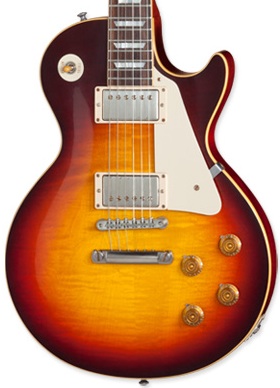
But Gibson, knowing how popular the vintage models have been over the years, has recently released a reproduction of a coveted 1959 owned by collector, called Collectors Choice #6, Mike Subowski (shown in the picture above). However, unlike the Historic Reissues, this reproduction was constructed to the exact measurements and tolerances of the original Les Paul. Even the pickups were meticulously wound to closely match the original pickups. If the Historic Reissues capture the “spirit” of the vintage models, the Collectors Choice tries to reproduce the vintage guitar rather than being built in the style. This is exciting to me because it’s about the closest I’d get to actually playing a true vintage model.

Another plus to this guitar is that it’s nice and shiny, as the original guitar was very clean. That’s VERY appealing to me because I just don’t “get” the relic thing. Give me a nice, shiny guitar, and let me relic it myself through years of use. The burst finish on this guitar is also spectacular. Though they call it a “Tobacco Burst,” the brown is a little more red than your typical tobacco brown. I love the reddish hue to that brown. It reminds me of a cross-section of a nectarine. 🙂

With respect to the Collectors Choice series, these guitars are limited run guitars produced by the Gibson Custom Shop. They’re close to exact reproductions of the original guitars, and each original guitar is measured to minute specifications using digital analysis, so there’s very little guesswork in taking measurements. These are special guitars with a limited run of 300 per model. So far they’ve only done 1959 and 1960 models. I’m hoping they get a hold of a ’58. THAT’s a guitar that I would definitely buy.

Took a break for a few days to take my son to college and a couple of days ago, I received a press release from Peterson Tuners that I tucked away for later review. Now that I’m back and settled in, I had some time this morning to catch up on emails. Normally, I take press releases with a grain of salt, but this one in particular caught my attention; not because it was from Peterson, but because instead of touting a tuner, they were touting a pedal. And not just a wah pedal, but a wah that combines both a low-pass AND a band-pass filter, which you can adjust independently to get all sorts of sounds. Very intriguing to me.

As opposed to getting into a lot of detail here, here are some links that Peterson provided:

Product page: http://www.petersontuners.com/index.cfm?category=195
Sonuus Site: http://www.sonuus.com/products_wahoo.html
Video and sound demos: http://www.sonuus.com/products_wahoo_demo.html

Now this seems like something I could use, and from what I can tell from the sound clips, it produces some very nice tones. I especially like the fact that it doesn’t use a potentiometer that will wear out over time. So that’s a huge bonus. But I’d really like to try it out first. At $349, it’s definitely an investment; mind you, I’m not saying it’s not worth it, but at that price, I’d really have to be sure. I know… bit of a change for me when I see something that’s really exciting to me, which this is, but I’m being a lot more careful now as I’ve kind of reached a saturation point with gear, and have actually been shedding pieces the last few months. But the first chance I get, I will be checking this out!

5 Tone Bones - Gear has stellar performance, value, and quality. This is definitely top of the class, best of breed, and it's a no-brainer to add this to your gear lineup!

Wegen "The Fatone"

Click to enlarge

Wegen’s Picks – The Fatone (Fat Tone)

Summary: This is now my new favorite pick! I had misplaced my Wegen GP 250 and wanted to get another GP 250. The store that I bought the last one at was out of GP 250’s so I dug in the Wegen pick box and found this beauty! The grip is awesome!

Pros: Beefy (5mm) pick that is amazingly accurate despite its thickness. Despite its thickness, this is tonally versatile pick!

Cons: Though it doesn’t take anything away from the rating, my only nit about my pick is that it’s black. Black gets lost easily on a dark stage. But Wegen makes them in white, so I’ll probably order a few of the white ones.

Price: $15.00 ea

Specs:

  • 5 millimeters thick
  • Hand-made
  • Perfect bevel that makes your strings really ring!
  • Don’t know the material, but it’s a VERY hard plastic that does not scratch. You will never need to buff or resharpen Wegen picks!

Tone Bone Rating: 5.0 ~ Though I still love my V-Picks Snake (pointed), this pick is now my primary. It’s the perfect pick!

I’ve been searching for the perfect fat pick for a long time; or perhaps I should say that I’ve been looking for a pick that I could use for both acoustic and electric, but I never could. So I used a V-Picks Snake for electric and a Wegen GP 250 and a Red Bear Gypsy Jazz for acoustic. But all that changed when I got the Wegen “The Fatone.”

Admittedly, I discovered this pick not because I was looking to add to my collection of picks, but because I lost my GP 250, which had served me well for the last couple of years. I simply wanted to replace it. Unfortunately – or fortunately – the shop that I bought my GP 250 at was all out of them. So I looked through the case to see if I could find an alternate. That alternate was the Fatone. I knew from the first moment I held it that I was onto something with that pick. Then when I strummed it on a guitar in the shop, I was completely sold! Playing it at my solo acoustic gig an hour after that sealed the deal for me. I’ll be hard-pressed to use another pick.

This is a FAT pick at 5mm. But the inset, thumb-side grip, combined with the beveled tip make this pick feel so much thinner. It’s truly a joy to play.

What is it about fat picks for me? Well, having used them for a few years now, the most significant effect they’ve had on my playing besides tone is how they make my right hand relax. The way that works is that in order to make the pick glide over the strings effectively you have to hold the pick a lot looser in your fingers. That looser grip affects the whole hand. Granted, it took a little while to get used to, but once I was comfortable with a fat pick, going back to my old nylon picks seemed absolutely foreign to me. But relaxation made my playing much more fluid, and I was actually able to play a lot faster because my hand was so relaxed. In any case, I’m hooked on fat picks, and I’ll never go back to conventional picks.

Now I know that I normally do a “How It Sounds” section, but I’m actually on the road right now, writing while my son is driving the car (I’m taking him to college). But also, I don’t know how useful that section would be in this case. All I can say is that the fat pick produces a big sound, but in the case of the Fatone, because of the nice pointy bevel, it produces a nice, bright ring in addition to the deeper tone. It’s a bit hard to describe. It “feels” so much more full than other picks. For instance, though I love the sound my V-Picks Snake makes, it’s definitely a lot more mid-rangy than the Fatone.

One thing that is significant about the Wegen pick material is that it has a texture that feels softer than tortoise, but it’s actually a VERY hard material. The cool thing is that it’s a lot more damp on the strings than either acrylic or tortoise (or natural material). But it doesn’t produce a damper sound. It’s a feel thing. 🙂 In any case, I’m hooked on this pick. Also, tonally, this is a VERY versatile pick. By simply changing the angle and depth of attack, I can get thick, warm tones to nice bright tones. That’s extremely cool!

Overall Impression

As I mentioned above, I now have a new favorite pick. Not sure what else I can say about it. I won’t be getting rid of this one any time soon!

Oooo…. nice…. I’ve always loved 12-string guitars. There’s nothing like the strum sound of a great 12-string, be it acoustic or electric. But a Les Paul 12-string. OMG! I need to play one! Here are some quick features:

  • Solid mahogany body (weight relieved)
  • Grade-A Maple neck with 60’s profile
  • Grade-A Rosewood fretboard (wonder why they didn’t use Richlite on this)
  • Classic 57’s for pickups (I dig these pups)
  • Mini Grover tuners
  • Comes in Heritage Cherry Burst, Goldtop, or Ebony
  • PLEK’d neck.

From what I can tell, street prices for these are around $2199. That’s actually not a bad price at all. In all honesty, though I’d love to play one, I’m not sure if I’d ever get one. But that all depends on what ideas I could come up with once I play it. That’s really the deciding factor for gear for me. Does it inspire me to play? That said, I don’t think this guitar is gimmicky at all. But I do believe any 12-string is a sort of niche guitar.

Yamaha APX900 Thinline Acoustic/Electric GuitarIt’s no secret that my stage acoustic of choice is my beloved Yamaha APX900. I’ve been playing that guitar for the last couple of years, and its sound never lets me down. The A.R.T. pre-amp system, which consists of four transducer mics on the top along with a piezo saddle pickup, create a rich and deep tone that contains nothing of that tinny, mid-rangy tone you normally get with other pre-amps. But you’d never know it if you just played it unplugged because its natural tone is rather weak.

I’ve played this guitar side-by-side with guitars that cost 5 times as much, and the APX900 just blows them away! Such was the case last week at my weekly restaurant gig. For that gig, I also brought along an Ovation Collector’s 2006-FKOA guitar that I’ve been borrowing for my latest recording sessions. That guitar, which I recently reviewed and gave high marks, has an incredible natural tone; so much deeper and richer than its brethren that I’ve played. And plugged into a board for studio use… Wow! What a great tone! But I have to say that it just didn’t work very well with my live rig. Through my Fishman SA220 SoloAmp, the bottom end was just not there, whereas my APX900 performed absolutely beautifully.

Now this is a classic case of a rig mismatch. If I were to use the Ovation at a gig, I’d probably run it through my SWR California Blonde, which will give me the low end that I need. But that sucker weighs 75 lbs, so it’s not likely that I’d be lugging that around but to special gigs.

On the other hand, there hasn’t been an amp that my Yamaha APX900 has worked with flawlessly. Again, this is a testament to Yamaha electronics. They’re just superior to everything else out there in my opinion.

Enter the S.R.T.

Beginning with the 1000-series guitars, Yamaha started installing the S.R.T. – Studio Response Technology – pre-amp system. This is a mic modeler as well, and at first blush might seem as if it would behave like the Ovation’s system. But unlike the Ovation system, S.R.T. doesn’t have a mix function. It’s always on. You set it to the mic-type and “distance” and EQ that works for your rig, then go. One feature of the S.R.T system that really turns me on is the Body Resonance knob that lets you dial in resonance from the body.

What’s very exciting about this is that S.R.T. was originally only available on the high-end, handmade guitars. I am so glad that Yamaha has brought it to the APX series. I called Gelb Music yesterday, and they have an APX1000 in stock. I will be going there this weekend to try it out. If it’s as good as I think it will be, I may be walking out the store with it.

Circling back to the stage, it is so important to have good electronics. Even a cheapo guitar like my APX900 can sound fantastic when the electronics are right. For me, searching for a great stage acoustic was literally a months-long exercise in frustration. I just never got comfortable with any guitar’s plugged in sound until I plugged in the APX900. The funny thing is that it took me all of ten minutes to know that it was the right guitar. 🙂 I’ll be sticking with Yamaha for all my stage work.

Cords and cables are those kinds of things that we take for granted; that is, until we’re missing them… Last night, I went to the recording studio to do a session and much to my surprise – and utter shock – I realize that I had left my bag of cords at my church on Sunday!

Talk about putting a black cloud over my mood. I figured that our tech guys would find my bag and lock it up in our equipment closet – which they did – but it still didn’t help my mood as there was the uncertainty that I had left it in a place that they wouldn’t find it, and it would be left out for anyone to take. 

Mind you, it wasn’t just my speaker and instrument cables in that bag. My power cords for my amp and pedal board were in there, and since I also use that bag as my cord bag for my solo acoustic gigs, I had all my XLR cables in there as well. 

Needless to say, the studio had extra cords, and I just recorded my guitar raw with no effects. It turned out to be a good thing because what I laid down was exactly what I was after, but I have to say that it wasn’t my most inspired performance. I was pissed off!

I recovered my cords this morning, so it’s all good, but it did serve to make me realize just how precious a commodity my cords are. I, for one, will not ever take them for granted again… 🙂

Having worked with lots of people throughout my lifetime, I’ve invariably run into folks – and even I’ve done it at times – who get in a funk and say things like, “I wish I could do _________” or “I wish this would be like ________.” Without saying it directly and being as diplomatic as possible, I usually reply to them to stop wishing someone would do something sometime to make things happen. The time is now and you’re that someone.

But it’s even more than just realizing that you’re the one who has to make things happen for yourself, you have to be willing. Several years ago, I attended a few self-help seminars and something that a seminar leader said always stuck with me – and I’ve mentioned it here a couple of times – was “There’s a fine line between dreams and reality, and that line is called ‘willingness.'” That had a profound effect on how I approached life afterwards, but in the years since, I’ve realized that realizing your dreams takes even more than just willingness. It takes discipline; lots of discipline.

Not meaning to be religious, but there’s a very famous quote from the Bible from the Gospel of Matthew: “So you had not the strength to stay awake with me for one hour? Stay awake, and pray not to be put to the test. The spirit is willing enough, but human nature is weak.” The shorter, more commonly known version is: The spirit is willing but the flesh is weak. In any case, Jesus said that to the disciples who were supposed to keep vigil with him while he prayed but instead fell asleep. He was reprimanding them for not having the discipline to stay awake – even for just an hour – while he prayed. Put simply, with discipline, you make the hard choices. Clearly the disciples didn’t have enough of it at the time…

Or take for example the Navy SEALs and their training program known as Basic Underwater Demolition SEALs, or BUDS for short. Hundreds have tried out, and over 80% ring the bell to quit. The SEALs’ motto, “The Only Easy Day Was Yesterday” is a testament to the fact that it never gets easier, it only gets harder. People who quit weren’t losers. Some were top athletes, used to sustained physical and mental stress, but even they broke in the end. The training program is really that hard! The only way to get through that program is to have the mental fortitude to maintain discipline in the face of growing difficulty.

Even though I’ve never gone through something quite as physically and mentally extreme and rigorous as the Navy SEAL BUDS program, I’ve also learned over the years that discipline is what needs to take over when you don’t have the motivation to do something. It truly is the difference between success and failure. This concept applies to everything in life, be it your job, learning to play an instrument, or even a making a relationship work (and no, I don’t mean the chips, dips, chains and whips variety of discipline, either).

Circling back to the title of this article, what I’m suggesting here is that in order to achieve anything in life you have to:

  • Realize that you are the only person who can achieve your goals.
  • Be willing to achieve your goals.
  • Have the discipline to do whatever it takes to achieve them.

And please don’t confuse this with “the ends justifies the means” mentality that seems to be so prevalent in American culture these days. Can you say, “Financial collapse of 2008?” There are no shortcuts to success, even though the short-term might indicate otherwise.

So what does all this have to do with guitar? Simply put, apply the three points above to any learning situation with your guitar. Want to play like SRV? Santana? EVH? You’re the one that has to make it happen, you have to be willing to make it happen, and you have to have the discipline to make it happen.

It’s also not just about lessons. I know a guy who has been taking lessons every week for over 10 years, and he’s still a bad musician. He knows lots of licks and tricks, but put him in a band, and he flails away simply because he doesn’t have the discipline to practice and therefore truly understand his instrument. It simply boggles the mind and frustrates the hell out of me that he doesn’t see this – or perhaps more to the truth, I’m frustrated that his lack of discipline affects the band.

So the next time you say, “I wish I could do ______________,” think about what was discussed here because the answer to is quite simple: You can – and will – but it’s all on you. No one can do it for you.

ROCK ON!

Ovation 2006 Collector’s 2006-FKOA

Summary: One of Ovation’s popular collector’s series, the 2006-FKOA sports a solid Koa top over a deep contour body. Unlike other Ovations that can have bright, “tinny” tone, this guitar has a much deeper voice, but has that signature Ovation projection.

Pros: VIP (Virtual Image Processing) pre-amp with 5 different microphone images is the bomb! The Koa top is absolutely beautiful and adds so much warmth to the natural tone of the guitar.

Cons: Using an image is an absolute must for plugging in. The raw preamp sounds pretty bad.

Price: $1000 – $1500 (if you can find one for sale)

Features:

  • Deep contour body
  • Solid figured koa top
  • LX scalloped bracing
  • 25 3/4″ scale length
  • Deluxe grade ebony fretboard
  • Ebony bridge
  • Inlaid flame maple epaulet
  • Tortoise shell-like bracing on the body

Tone Bone Rating: 4.75 ~ What a fantastic guitar! I’m borrowing this guitar from a friend for my recording sessions. It has an absolutely killer tone! I don’t like the raw pre-amp tone (as you’ll see below), but the various microphone images completely compensate for that.

Well, it’s back to the studio again, but this time instead of my “man cave” home studio, I’m in a real studio. I borrowed this guitar from a buddy of mine who’s also playing in the sessions. He’s playing his Collings Dreadnought which has a completely different sound, so I figured that this would be a good contrast and I asked him bring to the Ovation along to the sessions. He’s letting me borrow it until we’re done with the project, so I’m going to have lots of time with this guitar.

We’re mostly recording the natural tone of the guitar with a couple different mics, but we’re also plugging in for an even richer sound. Thank heaven this guitar has the VIP pre-amp system because I’d be trashing the plugged in track. The sound that it produces is the classic twangy, honky, lifeless sound that you’d expect out of a cheap pickup system. My Yamaha APX900’s plugged in tone beats this guitar hands-down! Well, that is a testament to how good Yamaha pickup technology is… But I have to say that with the VIP system, Ovation did real good.

Fit and Finish

Talk about an easy guitar to play! Well, I’ve played a couple of Ovations over the years, and I’ve always loved the necks on Ovations. They’re immediately comfortable to me, and I felt right at home playing this guitar. My previous guitar before my Yamaha APX900, was an Ovation thin-body, and the neck on that was very similar to this one, though if memory serves, the 2006-FKOA’s neck is just a tad beefier, but I like that because it’s like my Les Paul R8, so I have a tactile cue to work with.

This is also a gorgeous guitar. I love the figured Koa top, and the flame maple epaulet adds a nice touch to the overall appearance of the guitar. The deep contour body is actually quite comfortable. I was a bit concerned that it might be a bit wide (especially with my extra girth around the middle), but it works even with a big boy like me. I also gigged with it today, and it was absolutely comfortable.

As expected, the build quality is superb. I haven’t played or evaluated an Ovation guitar that wasn’t rock-solid in build quality. There are no uneven seems, no extra lacquer bumps. It’s clean and tight, and that’s always a good thing. 🙂

How It Sounds

The VIP-5 sports 5 different mic images. As Ovation explains it:

…the VIP-5 preamp replicates the sound of high-end microphones used in professional recording studios. Using spectrographic analysis, the VIP-5 compares a guitar’s saddle pickup output to stored audio “images” of a guitar recorded with a studio condenser microphone. The pickup signal is then processed using approximately 1,000 filters and shaped to match the recorded sound image…

The question you might have is “But does it work?” I can emphatically say yes; and it works quite well. Compared to the raw pre-amp with no filtering (which you get by turning down the Image mix all the way), it’s like night and day, and the tone sounds like a guitar being mic’d. Ovation doesn’t specify which high-end studio condenser mics they modeled, but it doesn’t matter. You pick the one you like and go with it.

I’ve got some sample clips to share with you. All of the clips are with the guitar plugged directly into my pre-amp going into my DAW. I’ve got all filtering and compression and EQ turned off in Logic, so what you’ll be hearing is the direct sound. I recorded the individual images with the image mix cranked all the way up.

Reference Tone (raw, image mix turned all the way off)

Image Setting 1

Image Setting 2

Image Setting 3

Image Setting 4

Image Setting 5

The images completely transform the plugged in tone. The reference track was quacky and honky. Blech! But with the images, it’s a completely different animal. I love it! I used Image Settings 3 and 4 in my sessions this weekend. They seemed to fit well with the songs I was recording. And I think that that is the point of the images, and that is to choose an image that works with your rig. I’m going to gig with this in my solo acoustic gig. Who knows what will work with my SA-220 SoloAmp? I’ll just have to find out…

I also recorded a couple of clips with the guitar miked as well to give you an idea of the natural sound the guitar makes:

Comparison Clip to Clips Above

The mic was placed about a foot away from the guitar to allow its tones to develop.

Fingerstyle Clip

This is definitely where this guitar absolutely shines. The natural brightness of the Ovation is offset by the deep contour body which produces a gorgeous scooped tone that really comes out when playing fingerstyle.

Overall Impression

I’m thoroughly impressed with this guitar. Thought I was done with Ovations, but this is one that I have to have eventually. They’re pretty rare, but from what I can tell, people have been selling them for pretty affordable prices; far less than the original $3k+ street price.