Feeds:
Posts
Comments

…without a pedal board. But last year, I started to going to gigs without my pedal board, and relying entirely on whatever amp I was playing to provide my tone. With just my guitar, amp, and an attenuator of course, I can usually cover all the tonal landscape I need to cover with just that. With a great amp, like my 18 Watt Plexi-style amp (Aracom PLX18-BB Trem), I just crank it up, set the attenuator to the stage volume I need, and just go to town.

It’s actually been quite liberating. Of course, the challenge of playing without effects is that if I make a mistake, I don’t have anything to hide behind. But that has just pushed me to practice more and make less mistakes – or find other ways to cover them up; usually the latter… 🙂

Now I have to admit that playing without effects wasn’t a calculated thing – well, it kind of is now… But I was kind of forced to do it once when I was running late to rehearsal, and forgot to load my board into my car. Instead of driving all the way home, I decided to just rely on my fingers. From then on, especially with my church gig, if I arrange a set that doesn’t need effects (which is actually a lot more often than not), I just load my amp, guitar and attenuator into the car. It certainly makes things interesting, but I’ve found that I’ve become a much better performer since playing without effects.

Gretsch Electromatic G5122 GuitarSummary: Big hollow body Gretsch tone in an affordable guitar. This is one impressive-sounding axe!

Pros: Unlike higher-end Gretsch models, this guitar is pretty basic and straight-forward. But that’s okay because it has tone for days! And for the price, it just can’t be beat.

Cons: None.

Features:

  • Laminated maple hollowbody 16″ W x 2.2″D
  • Laminated maple top
  • Laminated maple neck (24.56″ scale)
  • Rosewood fingerboard
  • 22 medium jumbo frets
  • 1-11/16″ (43mm) nut width
  • Vintage style machine heads
  • 2 Gretsch chrome-covered Dual-Coil humbuckers
  • #1 tone pot control setup
  • G-Arrow Knobs
  • Adjusto-Matic bridge on rosewood base
  • Bigsby® B60 vibrato tailpiece
  • Gretsch knurled strap knobs
  • Chrome-plated hardware
  • Urethane finish

Price: $675-$699 Street

Tone Bone Score: 5.0 ~I’m all about value, but when you get value along with fantastic tone, I’m all over it! This is a SWEET guitar that also feels as good as it sounds!

I’ve never been one for pure hollow body guitars, but the Gretsch Electromatic that I just played during my lunchtime has completely changed my mind about hollow body guitars. I literally was blown away by the sweet sound that the guitar produces, and also by its incredible playability. For me at least, this is one guitar that I’m going to have to take a real serious look at.

Fit and Finish

There’s a reason why this guitar is so affordable: It’s made in Korea. But that shouldn’t stop you from considering a non-USA made guitar. Both PRS and G&L use Korean manufacturers for their affordable lines and for good reason: The quality of the workmanship is excellent. The Electromatic line from Gretsch is no exception. The finish is incredible, with the poly coat evenly applied over the body with no bubbles or gaps. I played the walnut stain model, which is a reddish-brown, and the thin, translucent stain brings out the gorgeous grain of the wood, producing and almost wine-red effect. Very sexy.

The Bigsby trem bar finishes the look to give the Electromatic that classic, vintage Gretsch look. Truth be told, I’ve never been into Bigsby trems, but it just works for this guitar. I wouldn’t have it any other way!

For a Gretsch, the Electromatic Double Cut is quite simple. Not sporting the filter knobs and switches that you normally see in the higher end models, the Electromatic has a pickup selector, a single tone knob (next to the bridge pickup), independent volume knobs for each pickup, then a master volume knob. That’s it. If you’re looking for simplicity, then this is a great guitar to have!

How It Sounds

Most reviews of the guitar’s sound are very good, though there are some who don’t like it. I think it really depends on the amp you play it through. I played it through a Mesa Royal Atlantic at a local shop, and it sounded absolutely gorgeous! In fact, the tone was incredibly acoustic. The G5122DC is generally known for its “twang.” But dialed in correctly, I could see using this guitar in my acoustic sets. Really. The neck pickup was definitely my favorite, with the middle pickup, which allowed me to blend the two, coming in a close second. The bridge pickup’s tone is definitely twangy. Overall, tonally, this guitar is very versatile. I could see using it in a variety circumstances, not just limit it to blues and rockabilly. I love it! I’m going to get it! 🙂

Update May 13, 2011 – Since I’ve been seriously evaluating this guitar (and am picking it up today, as a matter of fact), I played it through a few amps and also directly through a PA board, and my Fishman SoloAmp. It’s going to do the job and then some for my solo gigs!

Playablity

Gretsch’s have always been known for their playability, and the G5122DC is no exception. Didn’t matter where I was on the neck, I could get great tones out of this guitar, and it always felt incredible. The action was perfect on the guitar I played, and frankly, I just don’t have a single complaint about the guitar; not a one. I love the thinner profile of the neck, and the gentle “C” feels like a 60’s Les Paul neck. Not sure what kind of rosewood they used, but it’s very smooth to the touch, and digging in feels amazing!

Overall Impression

Here I was all GASsed out after getting my Les Pauls, but this Electromatic G5122DC is a clean machine. Add a little ‘verb and some slapback delay, and you’ve got a great rockabilly tone. Take out the delay and add just a touch of ‘verb and back off the volume knobs, and you’ve got an incredible acoustic tone. How incredibly versatile!

…or “Don’t let the bastards grind you down.” Many have probably heard this saying, though it’s not real Latin. But who cares? It’s a cool saying, and something I always remember when I visit gear forums. The great thing about the Internet is that it has made the world a lot smaller, but the darker side of it is that it has allowed people to exercise a certain anonymity, and some folks use this anonymity as a license to be an asshole. It’s really too bad because the Internet after all was meant as a way for people to collaborate. But that doesn’t mean it’s all bad; and in fact, you can gain lots of useful information on the various forums – I belong to several – that can help you in your buying decisions. But just remember: Don’t let the bastards grind you down.

In light of this discussion, the Internet and web forums are great resources for learning about gear. But here are some rules of thumb to consider when doing a search for some new gear:

  1. Never ask an open-ended question: “What is the best __________?” That’s just going to invite lots of useless discussion, and oftentimes lots of argument. Instead, phrase it like: “I want to achieve __________ kind of sound. In your experience, what would help me get there?” With your question framed like that, you’ll still get a lot of answers, but they’ll be much more focused.
  2. Just because someone “sounds” or gives seemingly intelligent responses, doesn’t mean they’re knowledgeable about a particular subject. On the Internet, you have to remember that until you’ve proven someone’s bonafides, everything they say is an opinion.
  3. Verify, verify, verify. This simply means what I say over and over again: You have to play something to truly know if it “fits.” Going purely off the word of someone – even someone whom you trust – could be an expensive learning experience. Believe me, I’m quite familiar with this. 🙂
  4. Take what you hear or read from manufacturers with a grain of salt, and don’t get pulled in by their bombast. There’s one manufacturer in particular that I won’t call out by name that is notorious for this, claiming things about his product and charging a super-high price, and he uses a $10 part that does most of the heavy lifting. Instead, get opinions from other users and see if they’ve made comparisons between competing products. That’s more valuable than the hyperbole of a manufacturer.

There are probably more I can think of, but these should suffice for now…

As you know, I’ve had a guitar custom built for me by Saint Guitars. It’s a thing of beauty. Well, another custom guitar builder contacted me about doing a review on one of his guitars, and I have to say that that is an absolute thing of beauty! Made by “part time” luthier Perry Riggs out of Houston, TX, I have to say that just based upon the looks of the guitar in the pictures below, that if that’s the result of a part time gig, then this dude is onto something!

This slideshow requires JavaScript.

I’ll provide more details once I have the guitar in hand, but here are specs on the guitar above:

  • Through neck – flamed hard maple with mahogany center
  • Pau Ferro fretboard – 24 frets, Gotoh mini tuners
  • 25.5 string length, bone nut
  • Gold tint jumbo frets
  • 1 ¾ neck width
  • .88 at nut
  • .94 at 12th fret
  • Abalone dots, both side and position
  • Mahogany body with a ½ inch quilted maple top, tinted cobalt blue
  • PRS style “binding no binding”
  • Fralin unbuckers – Coil splitting available via the tone cntrl
  • Gotoh wraparound bridge
  • Approx. weight: 6.5 lbs

I absolutely DIG that Gotoh wraparound bridge! It makes setting action and intonation so easy, plus string vibrations seem to transfer so much more efficiently to the body with just a single point of contact.

Stay tuned for a review!

Gibson just published a great article on their site: The Making of a Gibson USA Guitar. Very cool stuff.

But here’s a cool video of the making of a Les Paul Supreme:

What I found interesting in both the article and the video is how the neck is cut. Where the body is cut using a CNC, the neck is cut by hand. The dude in the video cuts the neck with a band saw, with no guide! And he’s fast!

As for the Les Paul Supreme, that’s a thing of beauty. But it’s wierd how there’s no access plate to the control cavity. I think you access everything through the bridge pickup cavity. This is definitely not a guitar for the do-it-yourself folks. But it sure is pretty…

When Van Halen hit the scene as an opening act, no one wanted to follow them because of Eddie’s supernatural playing. Shred is old hat now, but even today, I still prefer EVH’s approach to shred than those who’ve followed; not just because he’s the original, but because his phrasing is so completely unexpected. He has a sixth sense with musicality of which even after all these years, I’ve never tired. Here’s a great video of an EVH solo back in the day…

Plain or Flame?

For my Les Pauls, I just dig the plain tops, and though I’m not averse to flame tops, they’re not my first choice – at least for Les Pauls. My ’59 replica has a very subtle flame that is only apparent when you look at the guitar from the side. But head-on, it looks like a very cool plain top, and that’s what really appealed to me about that guitar. Having said that, I dig flame tops on other guitars. For instance, my Gibson Nighthawk has this really cool flame that combined with the translucent amber finish, give it an incredible 3D effect. If it was a plain top or just opaque lacquer,  think it would lose its charm.

What are  your preferences?

To get ideas for articles, I subscribe to lots of press releases and music manufacturing news feeds to stay current on the happenings in the gear world. Over the past few years, there has been increasing activity in the realm of guitar building materials; specifically, tonewoods made from increasingly reduced supplies. For instance, Indian Rosewood is becoming increasingly expensive and much less available.

But in addition to the discussions focused on scarcity and perhaps eventual complete lack of availability of tonewoods has been a lot of buzz about conservation law regarding the importation of various woods products. Recently, I happened upon an article that talked about the expansion of the Lacey Act of 1900 under H.R. 2419 Food, Conservation and Energy Act of 2008. The Lacey act was put into law to prevent illegal harvesting of various protected flora and fauna. Apparently, according to the article, the expansion of the Lacey Act by the new act of 2008 dealt with not just the importation of newly taken or harvested material, but finished products consisting of illegal material, such as antiques made from Brazilian rosewood and tortoise shell.

Yikes! That’s really expansive. I suppose the gist of the law is to be extremely stringent with imported material and including processed material as well as raw material. I actually read the law (which you can read here), and in section 8204 sub-section (a) under Definitions, the law states:

(1) IN GENERAL- The terms `plant’ and `plants’ mean any wild member of the plant kingdom, including roots, seeds, parts, or products thereof, and including trees from either natural or planted forest stands.

The words “or products thereof” are the kicker that make antiques or other processed plant material applicable under the law.

So what is the law? Basically, this section of the law requires that any material imported that falls under the definition as a plant or plant produc, must have adequate documentation to prove its legality. So a company that imports plant products, i.e. exotic woods for guitars, must provide detailed documentation to customs officials when requested. If documentation is inadequate or non-existent, the company will be subject to fines.

That’s not unreasonable, and its strictness should be a great deterrent from importing illegal woods. BUT, as the Music Trades article discussed, it’s not the actual enforcement of the law that is really the problem, but the compliance with the law, as assembling and maintaining that documentation can involve significant administration expense. Companies wishing to file electronically may do so, but only through a special machine that costs $50,000! For small companies, that expense could possibly be prohibitive to running the business.

The law is well-intentioned, but I do feel that it is overly comprehensive. “Or products thereof” makes compliance difficult, especially with previously processed material like antiques that potentially could be 100 years old! I don’t disagree that there should be fairly stringent laws regarding the importation of illegal plant products, but to include already processed material, where the documentation just doesn’t exist, is a little extreme from my perspective. What this means to us as consumers is that you know what companies will do with the extra expense: They’ll have no choice but to pass that on to their customers.

But irrespective of the requirements of the law creating expense, let’s face it: Exotic woods are becoming more and more scarce, so prices will go up anyway. But perhaps this impending scarcity or unavailability could be used as an opportunity to find suitable replacement woods. For instance, I have a guitar made of walnut. Walnut has the warmth and resonance of mahogany, and better yet, it’s a easily renewable resource, in abundant supply. For forward-looking companies, this could an opportunity to move the market.

All this may have no bearing on our purchase decisions now, but it is certain that in the future the woods we’ve come to rely on for our tone today, will most probably radically different. The litigation revolving around this only enforces that idea.

I Wonder Why…

…high-end Yamaha acoustic/electric guitars haven’t taken off in the US? It’s not as if Yamaha instruments aren’t known in the States. But what you most commonly find in US shops are the sub-$1000 guitars.

I’m a little embarrassed to say this, but I didn’t know Yamaha had a whole lineup of high-end acoustics until I started doing research for a new acoustic-electric last year, and I happened to go their site to see Yamaha’s handmade line of acoustic and acoustic-electric guitars. These appeared to be on par with any American high-end acoustic with respect to materials and design, and they’ve been building these for years!

When I finally made my decision on a new acoustic-electric and comparing many different brands I ended up buying a Yamaha APX900, which is just about the best stage acoustic I’ve ever played! But a couple of months after I got that wonderful guitar, I saw a press release that Yamaha picked up Steve Lukather and he was playing their LJX26CP model. Curious, I looked through the Yamaha site and saw this beautiful lineup of various handmade guitars.

The LJX26CP is a handmade, medium-jumbo guitar with a natural finish. Here are some specs:

Top Solid Engelmann Spruce A.R.E.
Back&Side Solid Rosewood
Neck 5ply (Mahogany + Padauk)
Finger Board/Bridge Ebony
Body Depth 100 -125mm (3 15/16″-4 15/16″)
Nut Width 44mm (1 3/4″)
String Lengh 650mm (25 9/16″)
Tuning Machine Open Gear
Color Natural
Finish Gloss
Preamp System62
Standard Accessory Hard CaseX

The very cool thing about  this guitar (and others in the new lineup) is the new SRT pickup system, which is an improvement over the incredible ART system, which is what I have in my APX900. I chose the APX900 over all comers because of this pickup system. It is by far the best pickup system I’ve ever used in any acoustic, hands-down. But SRT goes even further than this by adding microphone modeling and other tone-shaping features to further enhance the natural sound of a guitar while plugged in. I wish I had that in my APX!!! OMG!

What got me thinking about Yamaha guitars was recording this song:

With this, I mic’d my APX900. It sounds pretty good, but I really had to do a lot of EQ and other adjustments to get a richer sound. As you can tell, the tone is pretty bright, which works pretty good, but I really don’t like applying EQ to guitar tracks as I want to capture the natural sound of the guitar, whether it’s an acoustic or electric. Anyway, I was thinking to myself that it would be great to have a guitar that has a killer tone both plugged in and unplugged. That’s when I thought of the LJX26CP.

What I wanted was to have my cake and eat it too. While my APX900 sounds absolutely fantastic on stage, from what I’ve been able to gather on the LJX26CP is that it also sounds killer unplugged!

So circling back to my original query, it’s amazing that these amazing guitars with amazing electronics haven’t caught on more here in the states or why Yamaha hasn’t invested more in marketing their top line in the States. Maybe they think the market’s too saturated. Who knows? It’s not as if the guitars are completely inaccessible. You can special order them, and if you’re in Europe or Asia, you can get them online. But as someone once told me, “There’s room in this world for people who are good.” That totally applies to gear. And if Yamaha brought these guitars to shops, I have no doubt that they’d do well here. It just takes getting the word out and coming up with messaging that differentiates it from the competition.

Without a doubt, the big differentiator for Yamaha’s guitars is the SRT system. As if ART wasn’t impressive enough in previous models, SRT looks like it will blow ART away! I definitely want an LJX26CP! Luckily for me, the local shop where I get a lot of my gear is a Yamaha dealer, and they can order one for me. I sure wish I could play it before I order it; hopefully, they’ll have a return policy, or allow me to not buy it if I don’t like it. Chances are that I will indeed like it.

In any case, from personal experience with Yamaha guitars over the years – my first acoustic was a cheapo Yamaha FG335 that my dad gave me for my 18th birthday. Those inexpensive, it had a fantastic voice that was comparable to high end acoustics. I performed and recorded with it for years! To me, Yamaha totally gets it with acoustic guitars, and even its budget models sound and play great, plus they’re very well-built.

For more information on the Yamaha guitars that have the SRT pickup system, visit the SRT site! You’ll notice that the site’s in Japan. It took me A LOT of digging to find that site. There are clips and interviews on the site that will provide you with tons of information on the line.

Why I Hate Gibson!

Okay, I’m a Les Paul/Gibson guy, but I hate Gibson just the same. Why? Well, lemme tell ya:

  1. Just looking at Les Pauls gives me serious GAS!
  2. My Les Paul GAS makes me spend my money.
  3. I lose countless hours playing my Les Pauls because they sound so damn good, I lose track of time.
  4. Because of my Les Pauls, I’ve had an itch to get appropriate amplifiers to showcase their incredible tone (call it “ancillary GAS”).
  5. That ancillary GAS further drains my wallet.
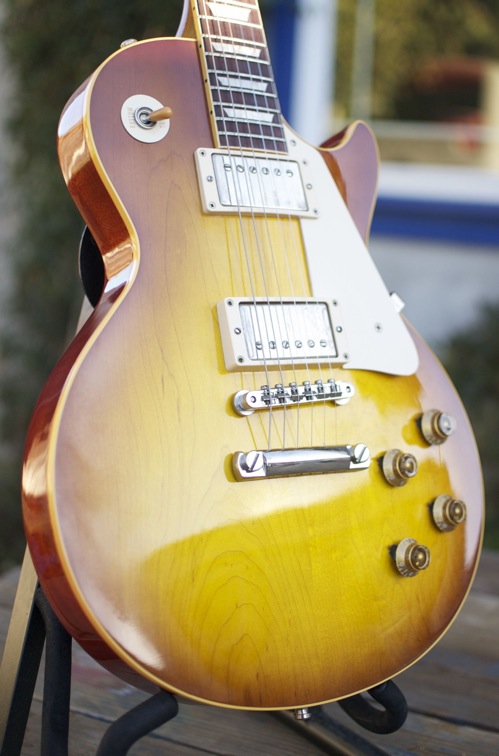
  6. They keep on coming out with kick-ass new Les Pauls that I want. For instance, this one. Then I get even more GAS.
  7. I’ve become obsessed with Les Pauls, dammit! And I’m not an obsessive person – or am I? 🙂
  8. But besides Les Pauls, they make the ES-335. I want yet another – dammit again!

Dammit! Dammit! Dammit! I hate you Gibson! You ROCK and I hate you so much that I’m giving you my hard-earned cash! 🙂

Yeah, yeah, I know all you anti-Gibson naysayers out there. I’ve heard your arguments, and I’m not getting into a debate. Gibson guitars just do it for me just as PRS, Fender, Taylor, etc. do it for others. Give me a Les Paul, or Nighthawk (2009), or ES-335, and I’m a happy man!

But I still hate Gibson for triggering my frequent GAS attacks.