Feeds:
Posts
Comments

I’m not a metal player, not even a real fan of metal, or I should say the real heavy stuff, and being more of a middle-of-the-road kind of guy in real life, have never really gotten into the fashion. That doesn’t mean it’s bad to me, it’s just not, well, me. So my appreciation of metal and the metal culture and style has always been somewhat on the periphery at best. But I do have to say that some of the styling cues are so over the top, I find them very intriguing.
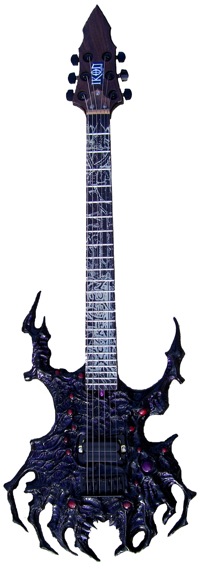
This morning I received a press release about a new company called Ikon Custom Guitars. The picture of the guitar that accompanied the press release gave me a bit of pause. It was one of those moments where you think, “That has to be about the fugliest goddam guitar I’ve ever seen, but at the same time, it’s cool. By the way, this company is so new that their web site isn’t even complete – it’s just a splash page.

The guitar shown here is called the Arachnoid 1. When you take a close look at it, it really looks like a spider. In fact, the first impression I got was Gene Simmons meets the Lord of the Rings. Here’s an excerpt of the press release copy:

Guitar Strikes Fear in Community

Custom guitar builder, Ikon Customs takes guitar building to a new level with unique custom body shapes and materials…all without sacrificing the tones and performance of the instrument.

Houston TX  February 10, 2010 – Ikon Custom Guitars is introducing its first production models to the guitar market.  The Arachnoid 1is 100% hand built in the USA using traditional and innovative techniques.  After years of effort to challenge conventional appearances and styles of guitars, Ikon Customs feels it has finally reached a new pinnacle in guitar design, appearance and manufacturing.

The body of the Arachnoid 1 is constructed of a poplar wood core for strength and tone and a proprietary resin compound that allows the builders to sculpt and shape finished bodies into new and innovative designs.  The resin compound took many prototypes and years to finalize before committing to final production.  In addition to the proprietary compounds, Ikon Customs also builds bodies using other materials such as fiberglass, carbon fiber and Kevlar.  Founder and President, Marc Anthony H. Bertone feels that with these new materials, his design concepts will be limitless.

The Arachnoid 1 is available in three models:

Arachnoid1 Weaver:

  • Red Oak neck and fretboard
  • Dyed fretboard, printed graphic “tatooed” on
  • Poplar headstock with a walnut veneer
  • Death Dealer high output passive pickup
  • Top loading fixed IKON USA Bridge
  • IKON Grip USA locking tuners
  • Proprietary resin formula over Poplar body
  • Adjustable aluminum nut
  • Custom airbrushed paintjob
  • Available in Flat, Satin or High Gloss finish
  • chrome, black or gold hardware
  • 25.5″ scale, 24 jumbo frets, available in flat or 20″ radius
  • MSRP: $999

Arachnoid1 Recluse:

  • Maple, Walnut, Bloodwood or Purpleheart neck and fretboard
  • Inlaid Aliencult Skull logo
  • Poplar headstock with Carbon Fiber or exotic burl veneer
  • Death Dealer high output pickup or Stealth active pickup
  • Top loading fixed IKON USA Bridge
  • IKON Grip USA locking tuners
  • Proprietary resin formula with  hand-laid fiberglass over Walnut body
  • Adjustable aluminum nut
  • Custom airbrushed paintjob
  • Available in Flat, Satin or High Gloss finish
  • chrome, black or gold hardware
  • 25.5″ scale, 24 jumbo frets, available in flat or 20″ radius
  • MSRP: $1999

Arachnoid1 Widow:

  • Cocobolo or Bocote (or any other exotic wood; subject to availability and may affect final pricing) neck and fretboard
  • Inlaid Aliencult Skull logo, LED glowing fret markers
  • Poplar headstock with Carbon Fiber or exotic burl veneer
  • Death Dealer high output pickup or Stealth active pickup
  • Top loading fixed IKON USA Bridge
  • IKON Grip USA locking tuners
  • Proprietary resin formula with  hand-laid fiberglass and carbon-fiber over Walnut body
  • Adjustable aluminum nut
  • Custom airbrushed paintjob; ours or your choice of colors
  • Available in Flat, Satin or High Gloss finish
  • chrome, black, gold or any painted color hardware
  • 25.5″ scale, 24 jumbo frets, available in flat or 20″ radius
  • MSRP: $2999

About Ikon Customs

Established in 2006 with the intent of changing the world of guitars and musical instruments, Founder and President Marc Anthony H. Bertone set out to find new and unique approaches to designing musical instruments that defied tradition and style.  What started as a hobby in the garage has now turned into a lifetime pursuit and career.  www.ikoncustoms.com

On a final note…

While I’m intrigued by the offering, weird body shapes for guitars aren’t anything new. Halo Guitars was doing that for a long time, though they seem to have gone back to selling more traditional styles – go figure. So I do wish Ikon luck. Hopefully Marc Anthony Bertone will achieve a following.

Oo-la-la! T-Rex will soon be releasing a new distortion pedal called the Tonebug Distortion. Not much info on it yet, but it is supposed to lay on tons of gain. I was fortunate enough to see a video from the folks at GearWire that quickly demonstrates what this pedal can do.

Admittedly, I’ve preferred overdrives over distortion boxes, but I’m really liking the tone from this puppy! Don’t know if I’d shell out $399 for it, though. But T-Rex pedals are premium pedals, so that’s not a surprising price.

For more information, check out the T-Rex site!

or… Doc Brown in Back to the Future saying, “I finally invented something that works!” Speaking in reference to the Flux Capacitor. Nah, it’s nothing of the sort, but it is by no means less cool. The Flux Density Modulation Speakers are a new approach to attenuation where the attenuation happens right at the speaker! Giving you up to -9 dB attenuation, while keeping your tone, that is what I call cool, and something I must check out! You know me, I’m an attenuator fan, and something like this has me absolutely GAS-ing! From what I could tell from the videos below, the tone is really preserved. Now, mind you that -9 dB of attenuation won’t get you down to conversation levels, but it’ll sure provide enough attenuation to take the bite off the volume. If you need to go lower, hell! Get an Aracom attenuator, and get it down REAL LOW! Check out the NAMM vids!

and from GuitarWorld…

I was persuing YouTube today to check out some cool stuff from NAMM, so I got a few vids that I thought were worth sharing.

The first if from Fender (yeah, I know, it’s mainstream, but Fender has been doing some interesting stuff). This is Acoustasonic Tele, which is a half acoustic / half Tele. As you know, I have the Acoustasonic Strat, but this looks like it’s even better! Check it out:

Here’s a really cool thing for acoustic guitars – no more string pegs!

Ever wanted a Tube Screamer in an amp? Well Ibanez has come out with a 15 Watt amp they appropriately call “The Tube Screamer.” It features an authentic Tube Screamer circuit in the front end, and has a half-power switch (pentode-triode) switching. It will only cost $299. Probably mostly solid state, but it has 2 X 12AX7’s in the pre-amp stage and a pair of 6V6’s to power it up. Interesting. Here’s a demo… At least the amp sounds decent (read: I don’t necessarily like how it’s being played): 🙂

And here’s a new overdrive… the HAO OD-16, handmade in Japan. The NAMM vid I found on this was private, so I did a search for another. Apparently it has a street price of $300… yikes! I’ll do a bit more research on this one. Sounds very nice!

That’s it for now. If I find more stuff, I’ll post it here. There are lots of videos to wade through….

So… This is weird, but…

…actually kind of cool once you give it a listen. It’s called a Woogie Board, and it’s the world’s first – you got it – electric washboard. Before you laugh in disbelief – I actually couldn’t believe the PR company that sends me press releases on new products would send this out – but this thing is for real.

The Woogie Board features a solid mahogany body with dual piezo pickups, a three-way switch, and a Tele control plate, completely handmade by Saint Blues Guitar Workshop in partnership with Cody Dickenson. Sounds like I’m describing a guitar! Ha!

But this thing is meant to be plugged into effects boxes like a wah, delay, flange – whatever. And it produces some VERY cool sounds. Check out the Woogie Board video and sound page!

Admittedly, something like this really ain’t for me, but if you do roots style music, this could be an instrument that you can add to your sonic arsenal.

I’ve been using the Aracom PLX18 BB Trem in my studio for the past couple of months, and it is simply a great amp. As I’ve written in the past about this amp, I’ve made some modifications to it such as replacing all the stock pre-amps with NOS (the JJ EL84’s are killer in this amp, so no need to even look for NOS for these), and replacing the stock speaker with a Fane Medusa 150.

As most GuitarGear readers know, my go-to gigging amp is my beloved, customized Aracom VRX22. But every now and then, I like to take my other amps out for a spin. For this evening’s church gig, I took the PLX18. Based upon tonight’s experience, it looks like I’m going to gig with this amp a lot more.

One thing that I’ve come to love about Jeff Aragaki’s amp designs, is that he has got the vintage Marshall mojo down. Mind you, he doesn’t make clones. He takes the original circuit designs and innovates on top of them. The PLX18 BB started out as a classic “Bluesbreaker” design, but with improvements to the circuit to make it much more efficient. The result is a real smooth-sounding amp that – like the amp it is modeled after – has tons of clean headroom, and needs to be absolutely cranked to get grind. But when it grinds, it’s so rich and smooth and dynamic, you just close your eyes and let your fingers do the talking!

Such was the case tonight. About a year ago, I re-arranged a classic Catholic hymn and gave it a bluesy, folk-punk vibe (think a cross between Death Cab and Clapton). I know, it sounds like a weird mix, but amazingly enough, it works. People know the song really well, but this arrangement gets them nodding their head in time – it’s cool to see! In any case, I also arranged it so that there was plenty of room in between verses for little solos. It’s a somewhat slow song, so you can’t go overboard, but the phrasing really lends itself to a lead played with an amp just at the edge of breakup, with lots of bends and vibrato.

And it helps to have an amp that has a lot of natural sustain. The PLX is just so damn good at that! I played the amp in the “clean” channel that I had almost cranked up all the way, since that’s where a vintage Marshall sounds great, and of course, it was plugged into my attenuator so I could crank it and still have a manageable volume level. The PLX is so responsive to attack and volume knob adjustments that it makes playing just a dream. Throughout the song, I just closed my eyes and got into pure expression mode. It was one of those occasional experiences where the tone just takes you right into the Zone! When you’re in the Zone, you just can’t do wrong. Hearing the PLX sing with my Squier CV Tele – I just floated away in absolute bliss.

For our closing song, I actually didn’t play, and gave “Blondie” over to my guitar cohort Dave so I could thump out on bass. For that song, I activated the wonderful Kasha overdrive pedal, in the Hot channel to really slam the amp with gain. The great thing about the Kasha overdrive is that it’s a really transparent overdrive pedal, and allows you amp to do it’s magic. With the OD engaged, the PLX took on this incredible character. It’s a bright amp by nature, but the tone became really jangly and ringy, with just a touch of compression coming from the EL84’s. It helps that I replaced the original JJ pre-amps with the NOS ones. In any case, talk about creamy smooth but articulate overdrive! Listening to that just got me thumpin’ out on the bass! We had a lot of fun with that song. Kind of felt like the White Stripes as we only had two instrumentalists (though it was two guitars, or a bass and guitar – no drums). It was raw and edgy, but oh so cool! You gotta just dig moments like this!

As I’ve mentioned, the PLX18 BB Trem is Jeff’s oldest amp design and unfortunately, his least-known amp. It’s tough to compete in the market when there are so many boutique, vintage Marshall-style amps on the market. I’ve played many, but the PLX18 BB is special. Others who own one of these will attest to just how special this amp sounds. Even though it’s not quite as versatile as the VRX22 that can get me over-the-top gain, for what it does, I can’t think of a better amp. Mind you, this ain’t just a one-trick pony. For blues, classic rock, and country, it’s simply killer. So if you’re looking for that classic “Bluesbreaker” tone at a price that won’t break you at the same time (the head is $1345, and the combo – which I have is $1750), I encourage you to check this amp out! And if you do get it, you won’t regret it in the slightest!

As far as equipping it, pay the extra for NOS pre-amps (the JJ EL84’s are just fine – I actually prefer them), and even though Jeff recommends an Eminence Red Fang Alnico to be paired with the PLX18 BB, for my personal tastes, I prefer something with a bit tighter bottom end; hence, the Fane Medusa that I swapped in. If you still want bright tone, then an Eminence Governor works insanely well, and will give you nice mids and high-mids, and I hear the Celestion Gold sounds killer in the the combo! YMMV…

For more information on this wonderful amp, check out the Aracom Amps site!

Gear Find: Toadworks Ajax

Toadworks AjaxBeing sick sometimes has its advantages because even though I’m half brain-dead with a head cold, I can take some time to surf the web in search of gear. This morning, I read a press release on Harmony Central about the new Toadworks Fat City Dual Overdrive. Being a big fan of overdrive pedals, I went to the Toadworks site to read about this new pedal.

I had tried a Mr. Ed distortion awhile back – it was okay – but I wasn’t thrilled – but I’ve always dug dual overdrives and stacking, so this looked promising. I read about the pedal, and it sounds really cool. All hand-wired with high-quality components. Also, a little out of my price range at around $300. Still, it looks like it’s worth checking out just to see how it sounds.

While I was on the site, I started looking at all the other pedals Toadworks offers, and the one that REALLY caught my eye was the Toadworks Ajax. Rather than try to explain it (since I’ve never even used one), here’s the product summary from the Toadworks site

Ajax is essentially a 2-channel line mixer, combined with a buffered Y-splitter, with the ability to invert (180°) the phase of one input signal, as well as one of the output signals.

Ajax has a wide range of uses, including:

– Two-channel mixer – With independent input level controls, Ajax can act as a simple 2-channel mixer.
– Multi-guitar interface – Ajax has two buffered inputs, allowing you to connect (and play) two different instruments at the same time.
– Input phase correction – When combining two signals, there is always the possibility that the signals may be out of phase with each other. Ajax can invert the phase of one input to eliminate unwanted frequency cancellation.
– Multi-amp interface – Ajax has two output jacks, allowing you to send the signal to two different amplifiers simultaneously.
– Output phase correction – When connecting the two output jacks to two separate amplifiers, you may find that the amplifier outputs are out of phase with each other. Ajax can invert the phase of one output to eliminate unwanted frequency cancellation.
– Stereo expander – when using two amplifiers (or recording direct to a stereo interface), it can be desirable to invert the phase of one of the amplifiers, creating an ‘expanded’ sound – this is especially useful with modulation effects such as chorus, flanger, etc. The output phase inversion is performed using the stomp switch, so this can be done on the fly.
– Effect Combination – If you are lucky enough to have two Ajax devices, you can split the output signal of the first unit, applying varying amounts of effects to each signal indepentently, and recombining the signal using the second Ajax. Using this method, you will have access to new sounds and effect combinations that are otherwise impossible.
– Simple buffer – Putting Ajax first in your signal chain will provide a simple buffer, eliminating concerns about signal loss in true-bypass effect chains.
– Clean boost – Both the input and output Level controls are capable of linear boost, making Ajax a simple clean boost with no frequency attenuation.

This pedal is very intriguing to me, as I’ve recently been experimenting with playing two amps simultaneously. I know, you can do that with an ABY pedal, and I do that, but I really like the phase inversion and the input and output boost. This has lots of possibilities. Funny though, this pedal has been out for a year, and there is very little information or reviews on it.

Top Dawg: Anton Oparin

13 years old and can play like Paul Gilbert! This kid rocks the house! He’s the real thing fo-sho! Not just your mechanical prodigy, this kid has feel. Check it out!

I announced the Skull Crusher back in September when it first came out. Based upon the KASHA overdrive (but with some upgraded wiring and electronics), it has since gotten the attention of several prominent guitarists. Now George Lynch is playing through it, and HE LOVES IT! Check out this video:

How’s that for an endorsement. I’ve said all along that the KASHA overdrive is just about the best overdrive I’ve ever played, and I’m not alone in saying that. With guys like George Lynch touting how good the Skull Crusher is, you owe it to yourself to check it out! I know, some people don’t go for the look, but it’s the tone that matters.

For more information, go to The Tone Box site!

I’m not ashamed to say that I’m very involved in my church’s music program; and I also play music for my kids’ school masses as well. I’ll admit that a primary driver of my involvement comes from my sense of duty to my parish community, but much of it also comes from just wanting to play guitar – ALL THE TIME! So even though it’s a church service, I don’t care; at least I get to play. 🙂 Today, for instance, was my turn to do music for my kids’ school’s weekly mass. I usually do it solo, but this time I invited a couple of my cohorts from Mass Hysteria, my Sunday Mass band to play. Only one of them showed, which was no big deal. The point was to play some music together, and get the kids rockin’!

And that’s exactly what we did. With my buddy Dave on acoustic, and me on piano and Blondie, my Tele, we just played our hearts out, both in praise, but also because at least for us, it’s pure enjoyment. Dave and I have been playing together for years, so we inherently know how either of us is going to react to pretty much any situation. There are no expectations, no judgments. It’s just loving to play music together, and sharing that love with whoever’s listening! Today was particularly special because the kids (about 500) really sang their voices out with us, and clapping their hands, and rockin’ the house. It was such a charge that it made my whole day.

And I guess that’s the point of me wanting to play so much. I just want to share the joy that I get from playing music. It’s not about image or how good or bad I am relative to others. If I can spread a little joy, maybe that’ll have an effect on others, and they in turn will share their joy with even more people.

You see, playing music to me is like a drop of water falling into a still pond. The drop might be insignificant in and of itself, but once it strikes the surface of the pond, its impact sends ripples in all directions, affecting the entire pond. For me as a musician, I’ve always been aware of that effect that music has on people. Joy is contagious. And joy spread through a medium like music can change the world.