The Dawg always has his nose to the ground, trying to pick up the scent of new gear. And for the past few months with the economy in a deep recession, new gear has been tough to find; especially from the small-run manufacturers. Well, I just picked up the scent of a brand new amp from Aracom Amps, and despite the recommendations of its maker, Jeff Aragaki to wait until he updates his site, sorry Jeff, this alert just can’t wait!!! 🙂
The new amp is called the Vintage Rox Series, and is based upon his absolutely kick-ass RoxBox series, which is an EL84-based, 18 Watt head or combo. The Vintage Rox, or VRX, series on the other hand, uses the same chassis and layout as the RoxBox, but is 6V6-based, producing 22 Watts of output. Now you have a choice in low-wattage solutions from Aracom!
Time to come clean…
Okay, I’ll admit it: I didn’t just discover this amp. I was actually the primary tester for the amp (there are distinct advantages to being local to a manufacturer), and I have been literally waiting weeks and chomping at the bit to announce it. I’ve hinted at its existence in previous article, but couldn’t provide any details.
Why am I so excited? For lots of reasons. But I’ll name two. First, with this amp, I think Jeff has definitely hit the sweet spot for low-wattage amp solutions! With the RoxBox 18 and the VRX 22, players have a voicing choice that not many boutique builders offer. But even more special, both the RoxBox and VRX amps sell for significantly less; in many cases more than half as much as other boutique amps at the same or similar wattage.
Secondly, the tone this amp produces is freakin’ marvelous! So much so, that I’m taking delivery of the first production amp. When Jeff brought the first prototype to me several weeks ago as an “experiment” he was working on, my immediate feedback was that this was a special amp, and I couldn’t wait until he had a production model because that was the amp I wanted to get from him.
I’ll have a full review of the amp once I get some pictures from Jeff, but for now, start checking out the Aracom Amps site for the VRX 22 announcement. It should be up by tomorrow!
Folks, I haven’t been this excited about an amp since I reviewed the Reason SM25! It’s one special amp that really deserves your attention. Also, if you subscribe to Vintage Guitar mag, you should see a review of the Aracom Evolver there in the newest issue!
I love writing this blog. In order to keep my content fresh, I have to top into a lot of resources. No doubt, I get A LOT of announcements and stuff. Most of it I just let rot in my inbox, but there are some, like this press release from Orange that really catch my eye. Here’s the verbiage:
British amplifier manufacturer Orange, have for decades produced their instantly recognisable, brightly coloured Orange Amplifiers and picture-frame cabinets and more recently offered Black as a standard option. Their revolutionary styling, have not only set them apart, but literally helped guitarists the world over, stand out from the crowd.
Orange can now announce a ‘limited edition 2009’ white finish on their UK built, valve amps and cabs. The cabs have a stunning white finish, complete with black fittings and come with the classic Orange front grill cloth, Orange logo and crest. This finish has previously only been available for artist’s special orders and is now being offered as a special limited edition for the duration of 2009 and will cease to be obtainable thereafter.
The white finish has already been used by artists as diverse as Madonna, Monte Pittman and The View and following numerous requests, Orange are able to offer this for a limited period only at the same price as existing Orange amps and heads.
For further information contact:
UK and rest of world info@omec.com and for the USA info@orangeusa.com
If you’ve read this blog for any length of time, you’d know that I’m into tube amps – real tube amps – and I typically eschew modeling amps or modeling anything because they’re well, models. But I’m VERY intrigued by IK Multimedia’s Fender Edition. Thanks for this information goes to John over at Gear4Music in the UK for bringing this to my attention.
I will share a video demo in a bit, and based upon the videos and clips I’ve seen and heard, I’m incredibly impressed! Here are the amp models that this edition portrays:
’59 Bassman® LTD
’65 Twin Reverb®
’57 Deluxe™
’65 Deluxe Reverb®
’64 Vibroverb™ Custom
Vibro-King® Custom
Champion™ 600
Super-Sonic™
MH-500 Metalhead™
Pro Junior™
Bassman® 300
TBP-1 Bass Preamp
I’ve used AmpliTube with ProTools in the past, but I had just the simple plug-in that came bundled with the LE version. IK Multimedia has really made huge leaps forward with these models. Check out a video:
…was the question my wife recently asked me, to which she added, “You already have a bunch of guitars, and amps are sometimes stacked like a wall in the garage, and you’ve got pedals on the floor that aren’t even on the board that you gig with. It’s not that I want to you to get rid of anything, I’m just trying to understand your obsession with gear.”
I replied, “I’ve been trying to understand that myself, and for years. Just when I think I’ve found the perfect tone, I come across some piece of gear that really turns me on, and well, I just have to get it.”
That brief conversation led me to into a bit of introspection, and I asked myself, “Is there a perfect tone out there?” And the answer I came up with is: Yes and No.
“Yes” from the perspective that for certain periods of time, I totally dig my tone. But “No” from the perspective that that satisfaction is fleeting. It’s not that I get tired of my tone, it’s just that I periodically want to enhance it; add a different kind of distortion color, try out a British-style amp. Fundamentally, it still sounds like me, but just different. Sometimes the changes I make are good, and they become permanent, other times, I tire of them. And there are times where I go practically bare-bones, and strip back to the basics.
So I guess it’s not really about searching for the perfect tone, but exploring the different types of tones that may tickle my fancy from time to time. Sometimes it involves buying gear. But the kicker is that I won’t get rid of anything because I never know when I might return to a different tone from days gone by. Besides, who doesn’t like a bit of change from time to time?
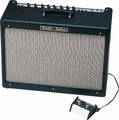
If you’ve had your ear to the ground about the oncoming Fender price hike well, it’s real, and it’s here. I was in a shop today, and a brand new Fender Hot Rod Deluxe – the exact same amp I own that I got for $599, for a whopping $839, with a list of $1200! For cryin’ out loud! This amp is NOT a boutique amp. While a tube amp, it has a solid state well, everything. All the electronics are on PCB boards, and the damn thing’s not even assembled in the USA!
If I was looking for my first tube amp, at these prices, I’d ignore Fender, and get something like an Orange Tiny Terror, or an Aracom RoxBox. The Tiny Terror costs $550 new, and RoxBox head is $895. I’ve played both, and they both sound way better (at least to my ears) right out of the box than the Hot Rod, which I had to spend even more money on mods and better tubes than the stock GrooveTubes that come with it.
Make no bones about it: Fender amps at this level ain’t boutique, not in the slightest, but they’re approaching boutique amp prices. Well, I guess it’s the sign of the economic times.
I’ve always associated Orange Amps with metal until I actually played a Tiny Terror. What a great amp! It’s got nice, bright EL-84 tone, and for $550 new, it’s a great little amp! Hmmm…. looks like I should do a review of it… 🙂
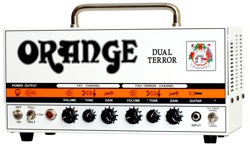
But Orange is taking the amp a step further and has just announced the Dual Terror, which is a 30 Watt, dual channel amp that is switchable down to 15 and 7 Watts! Oooo… From the announcement I read, it looks like this will be a real versatile amp! Can’t wait to test one out. FYI, here’s a copy of the press release I just got from Orange….
Orange Amplification launches ‘Dual Terror’
British amplifier manufacturer, Orange Amps launched the Tiny Terror amp in 2006 and has already sold over 30,000 units, making it one of the most in-demand amps in the world. The concept of the Tiny Terror was simple: squeeze every drop of Orange’s unique signature tone into a lunch-box sized amp to create 15 watts of unmistakable Orange Class A Tone weighing only a few kilos – and at a price every guitarist can afford.
Orange can now announce the next generation of the Tiny Terror concept – the ‘Dual Terror’: a twin channel, 30-watt head, switchable from 30 to 15 or 7 watts giving more choice and options shrunk into a size that belies its power!
The 30 watt Class A dual channel amp incorporates the unique Tiny Terror channel and a new ‘Fat Channel’ bringing a new ‘fatter’ chunkier sound, whilst keeping the classic Tiny Terror sound.
The power options make this a truly versatile amp, capable of dominating at bigger venues and subtle enough to be perfect for recording, studio work and home playing. Switchable between 30, 15 and 7 watts and switchable between 4 and 2 output valves, the combinations of options provide for unmatched levels of performance and flexibility.
The Dual Terror OS-DT30-H is built to the usual Orange high quality standards, using top quality components and its roadworthy rugged construction (supplied with padded gig bag ) is everything you’d expect from an Orange amp. The proven ‘Orange Terror’ concept of combining portability, versatility and delivering most importantly a great sound, is all here.
The original Tiny Terror has legions of fans, with users including Gary Moore, Mark Knopfler, Steve Jones, Eddie Van Halen, Andy Dunlop, Kaiser Chiefs and Eddie Kramer. The new Dual Terror will have even wider appeal to professional users and enthusiasts alike.
For further information contact:
USA info@orangeusa.com or outside USA info@omec.com
Summary: Nice, simple, and versatile studio/practice/small venue amp with sporting happening EL-84 tones.
Pros: Sweet and chimey EL-84 tones with Class A circuitry; simple and straightforward to use. Switchable between 5Watts and 3Watts, ensuring usability in just about any smaller venue. 3W mode kicks ass for getting power tube saturation at a reasonable volume.
Cons: I wish it had a Master Volume, but that’s just a nit.
Price: $349 street (used to be $249 when it first came out! Damn! Shoulda gotten one then.)
Specs:
• Single-ended Class A circuit
• All tube signal path
• One 12AX7/ECC83 dual-triode preamp tube and one EL84/6BQ5 pentode output tube
• Pentode (5W rms) Triode (3W rms) switch
• Solid-state rectifier
• DC filament power supply for all tubes
• 3-band EQ
• 16-gauge (1.5 mm) thick, folded and spot welded steel chassis
• Double-sided custom color PCB with 2 oz. copper
• 15-ply, 18 mm thick, void-free birch plywood construction
• Custom-designed 12″ Eminence Blackheart speaker
• 16 ohm, 8 ohm, and 4 ohm speaker outputs
Tone Bone Rating: 4.75 – Very musical and expressive amp. Nice cleans, with a decent amount of headroom.
I first heard about Blackheart amps back in 2007. They were so new that very few people knew about them. And while a local shop was listed as a dealer, only the owner knew about the amps, and they didn’t carry them in stock! Blackheart Engineering is sort of an overseas spinoff from Crate which produces cool, yet affordable tube amps. As a home studio enthusiast, I keep my ear to the ground about low-cost, low-wattage combo amps. When I first heard about the BH5-112, I was excited. I thought it was a bold move for Crate, and a smart one, considering Crate is a huge manufacturer with huge lineup of gear; adding even something cool like the Blackheart line would just get lost in the mix. But Blackheart was pretty low-key. No ads, spotty coverage on the Internet.
So it was a very pleasant surprise to see a few Blackhearts at a local shop yesterday, and among them, the Little Giant. I was actually there to play that G & L Tribute Comanche I wrote about last week; the last time I was at the shop, they didn’t have any Blackhearts, so I wasn’t expecting to see them at all. But with them there, I naturally had to try one out, and luckily they had the Little Giant.
Fit and Finish
This little amp has a real cool vibe going on. I really like the cabinet that Blackheart uses. It’s a closed back cab, and for an amp made overseas, it’s appears to be very well constructed. There were no apparent flaws in the tolex layering, and Blackheart logo on the front is killer. I dig the white vinyl trim used on the front around the grille cloth. Real boutique styling at a pretty affordable price!
The control layout is simple: An input jack on the left, volume and three-band eq knobs, an indicator light and an on/off switch, making it simple to plug in, dial in your tone, and start rockin’.
How It Sounds
I’ve really come to love the EL-84 tones, especially when they’re saturated, and the Little Giant doesn’t disappoint when delivering its sound. With the EQ knobs at 12 o’clock, the natural tone of the amp leans toward a slightly scooped tone with a bright voicing. Even with the specially-made Eminence 1 X 12, it’s bright, but it does retain a taut low-end that really smooths out the tone. Quite pleasing. I only tested the amp with that Tribute Comanche, but it didn’t matter. When I test an amp, I play it clean for a lot of my tests to see if it will deliver the natural tonal character of the guitar, and the Blackheart Little Giant fulfills its mission.
The amp is very responsive to volume knob and pick attack. With the volume set at about halfway, and cranking the guitar volume, I was able to get that AC30-like response: Clean and shimmery, with just the slightest bit of breakup when you dig in. Very pleasing to the ears.
Amazingly enough, even though its power rating is a minuscule 5 Watts, with the 12″ speaker, this amp can put out some volume! Hence its name “Little Giant.” It probably couldn’t keep up with a drum set and a band going all out, but it can pack a good enough punch to work well in a small venue where lower volume is critical, and it definitely could be put to great use in a studio!
Overall Impressions
What can I say? I dig this amp, much like I dig the Fender Champ 600. But unlike its Fender cousin, the 12″ speaker really lets the amp breath. And speaking of volume, I was quite impressed with the volume control. Unlike many amps that practically max out by 6, the sweep covered by the Little Giant’s volume knob is nice, even and more importantly, wide. Two thumbs up!s
Here’s a video (excuse the dude’s misinformation about Class A amps – damn! That’s even worse than my faux pas about modes 🙂
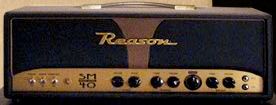
Reason Amps SM40 HeadSummary: Deep, lush cleans, with bright, ballsy and aggressive overdrive. The SM40 is a classic rocker’s wet dream come true.Pros: Touch-sensitive and expressive. The voltage sag in the 5U4 is just enough to create almost a reverb quality as the signal fades. Truly lovely sound!
Cons: None.
Price: $2195
Specs:
• Output: 40 watts RMS @ 10% THD
• (4) EL84 output tubes, in Class A Cathode Biased configuration
• (2) 12ax7 preamp tubes
• 5U4 Rectifier tube
• 3 way Stack switch – Normal, Stack, Bright
• Normal channel – Volume, Tone
• Bright channel – Volume, Tone
• StackMode™ – Bright & Normal channel controls are active, Stack Volume & Hi-Cut
• Oversized extra capacity power supply
• Harmonics Switch – works in the final output stage to change the harmonic structure of the
overdrive.
• Power Switch
• Standby Switch
• Half-power switch
• Independent output jacks for 4,8, 16-Ohm operation
• Footswitch access to all three channels/modes
Tone Bone Rating: 5 – This is a blues and classic rock machine!!!
This review is a long time in coming as I evaluated the SM40 over a month ago, but as they say, better late than never. As many may know, I’ve had a love affair with the SM25 that the Reason guys sent me to review, and that amp will be in my rig (see my review here). In my view, very few amps can match it in versatility. It is an extremely expressive amp that is capable of producing lush, ringing cleans, to searing overdrive. And according to both Anthony Bonadio and Obeid Kahn, the founders of Reason Amps, the SM25 Combo was built specifically with versatility in mind. It is very pedal-friendly, and StackModeTM is the greatest thing since sliced bread!
But sometimes, you just don’t want or need that kind of versatility because with versatility comes compromises. For instance, the SM25’s Normal or clean channel breaks up a little earlier than you’d expect though I actually rarely if ever play at the volume so it’s a none-issue for me. Since I play a variety of styles, versatility is a key factor in my decision on an amp. But that versatility is lost on those who just don’t need it. And mind you, that’s not a bad thing. It’s merely a matter of choice, which is why you have a number of amp options to choose from with Reason Amps. Premier Guitar already covered the SM50, which gives a fair picture of the SM50’s capabilities – though I do have to take issue with Premier Guitar giving it the “Loud As Hell” award. It’s not just a noise-maker. It’s just that you’d swear the SM50 is 100 Watts as opposed to 50 Watts. It’s an extremely powerful and expressive amp with classic EL-34 goodness.
The SM40, on the other hand is a very interesting take based upon EL-84 output tubes. Where the SM25 and SM50 are based on EL-34’s in Class AB fixed-bias configuration, the SM-40 is built around two EL-84’s operating in Class A Cathode Bias configuration. Like the other Reason Amps, the SM40 has two independent channels with the trademark StackModeTM “channel,” that combines the fully amplified signals from both Normal and Bright Channels in a series with an extra gain stage, while retaining both the volume and EQ control that each channel contributes to the combination.
The Story Behind the SM40
I called the Reason guys up to shoot the breeze a bit yesterday, but to also pick their brains about the SM40, Obeid Kahn (Reason’s amp designer) and I had a great conversation about the story behind the SM40. For all intents, and purposes, the SM40 was Reason’s first production amp. Obeid had gone through several prototypes before he finally produced the SM40 which included StackMode. Previous versions had completely independent channels with separate inputs, then evolved into switching between the two, then finally evolved into connecting the two channels in a series. So the SM40 could be considered the eldest sibling in the Reason amp line and the first successful incarnation of StackMode.
How It Sounds
The SM40 is targeted at blues and classic rock players, and it definitely shows that in the way it’s voiced. Moreover, there’s something really special about the clean tone of an EL-84-based amp. It’s naturally chimey and glassy, and guitars that have that natural quality bring that tone out even more. On the Normal channel, the kind of voicing is beautiful; chimey with lots of mid-range, but not overdone. And there’s TONS of clean headroom in this channel, which makes it ideal for use with pedals. Put a booster in front of this channel, and you get that AC-30-like breakup, which is subtle and smooth. Very nice.
The Bright channel, on the other hand, is actually not that much brighter than the Normal channel. In fact, the tonal differences between Normal and Bright are so subtle that you’d think there’s no difference at all. But that’s by design. Unlike the SM25 which was built around versatility, the SM40 is a much more focused machine, which is why you only get volume and tone on any channel or mode, as opposed to the SM25 which includes a 3-band EQ on the Normal channel. The idea behind that makes sense: Players who buy this amp will mostly play a certain style of music and don’t want to be bothered tweaking knobs to dial in their sound. Not that the amp can’t be used in a variety of genres, but players who play this won’t want to stray from the general tone the SM40 produces.
Similarities between the channels aside, the real kicker for me is the StackMode “channel,” which combines Normal and Bright channels in a series, while retaining both volume and tone shaping in both channels. This really opens up a whole new pallette of tones you can produce. It’s super-expressive, and because you’re essentially working with three gain stages in a series, this mode makes the amp incredibly responsive to volume knob and attack. Dime the volume on your guitar, and you can get tons of overdrive. Back it down and pick lighter, and the tone cleans right up. In my tests of both Reason amps, StackMode was pretty much all I used, unless I was playing something where I needed a pure, glassy clean tone for which the Normal channel excels.
An interesting switch labeled Odd/Even resides on the control panel. This is a harmonics switch that works with the phase splitter in the final gain stage. The idea behind it is that at super-high gain, you start getting a “notch” type of distortion. Flipping the switch smooths that out. I actually didn’t notice that much of a difference with the switch in either Odd or Even positions, but maybe that was because I was only 3 feet from the amp, and it was cranked! 🙂 For the most part though, the switch won’t have too much of an effect until you get into really thick overdrive.
Playing It
The SM40 was tested with a Strat copy and a Saint Guitars Benchmark with humbuckers. With the Strat copy, you’re immediately taken to the roots of blues. The chimey vibe really comes out with single coils, and I found myself closing my eyes to take in the sweetness. With the Benchmark, the SM40 grew big balls of steel. Not that you’d do metal with this amp, but humbuckers make the SM40 want to growl. It’s really nice.
Overall Impressions
The SM40 is a sweet amp, and like its sibling, the SM50, it’s really made for the stage. It’s expressive and ballsy, and is meant to be played hard. As both Anthony and Obeid have both told me, this amp is made for active musicians. And while I wouldn’t want to keep people from buying it because it sounds so good, by the same token, I wouldn’t recommend it for bedroom use. You wouldn’t be able to take advantage of its full range of tones.
What? Less gear? I must be speaking blasphemy, especially considering I’m such a gear freak – especially with my proclivity for pedals. But there’s also a practical side to this, as I am also a gigging musician. And especially when I do solo gigs, having less gear means less trips to the car. So as much as I can consolidate, I do. I was thinking about this because Christmas time through the New Year is usually a very busy time for me as far as gigs are concerned. For the past month, I’ve had at least three gigs each weekend, playing parties and other events. So you can see that I’m fairly sensitive to lugging gear.
So here I am in a coffee shop this morning, having put the finishing touches on my latest gear review on Aracom Amps RoxBox. In the article I mentioned that Channel 2 suffered from being flat at lower volumes, and that I ultimately solved the problem by running the amp through an attenuator between he power amp and speaker. I’ve had to do that practically every tube amp I’ve tested, so it got me to thinking: Why don’t more manufacturers just add these to their amps? I suppose production cost has a lot to do with it, but amp makers such as Faustine Amps have a -18db reactive attenuator built into their Harlequin line of amps and the Fender Princeton Studio also has a built-in attenuator as well. It’s a cool feature, and one that will allow you to get power tube saturation at lower output volumes.
Let me explain what I mean by way of a diagram:
As you can see, the traditional master volume circuit contains an attenuator between the pre-amp and the power amp. This means that you can crank the pre-amp and get pre-amp distortion, while limiting power to the power amp; thus limiting output volume. But it also means that in many cases, you won’t get power amp distortion unless you crank the master, which tends to be too loud, especially in small clubs and restaurants. But in the second illustration, with a second attenuator between the power amp and the speaker, it is now possible to crank the master volume to get power tube saturation while limiting overall output. I currently do this with the use of a Dr. Z Air Brake. But going back to the topic of this article, it’s just another piece of gear that I have to bring with me to a gig. Ugh!
In addition to production cost, there is a danger of possibly burning out the power tubes if you really overdrive them. I’ve done it to my Fender Hot Rod, by turning the attenuator to maximum attenuation, and diming the Drive knob for too long a time. Not good.
As I mentioned above, Faustine does this with their Harlequin line of amps (not sure about the others), and while -18db of attenuation may seem like a lot, it’s actually not that much – it takes the edge off. There must be a happy medium, say -24db or maybe -30db? Who knows? But whatever… this is a case where less gear is much better!
 I love writing this blog. In order to keep my content fresh, I have to top into a lot of resources. No doubt, I get A LOT of announcements and stuff. Most of it I just let rot in my inbox, but there are some, like this press release from Orange that really catch my eye. Here’s the verbiage:




 Guitar Gear