Feeds:
Posts
Comments

Posts Tagged ‘aracom’

Aracom Amps VRX22 - First in the series

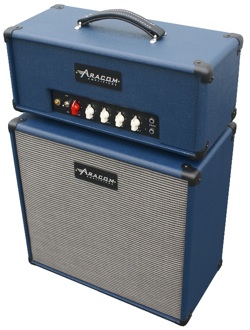
The Aracom VRX22 has been my primary amp for quite some time now – almost 2 years – and I’m still discovering the beauty of this wonder 22 Watt amp. It’s no small wonder that it has been my “Go-To” amp since I’ve gotten it. It sounds so killer both clean and dirty, and tonight, I realized just how great it is with pedals!

Since I’ve had the VRX22, I haven’t been using my overdrive pedals as much. I know, I used to be a real nut about overdrive pedals, and I have several. But this afternoon, I reconfigured my board, and placed my favorite drive pedals on it with the intention of using them. This included my Doodad Guitars Overdrive/Booster, Tone Freak Abunai 2, and my KASHA overdrive.

For my gig, I set the amp up in the clean channel, with the volume at a level where I’d have to dig in a bit with my Les Paul to get some grind. This would leave me with lots of headroom to work with, and not break into overdrive so early that all I get is more overdrive, and not volume.

Then I tweaked the overdrive pedals so I’d get different characters of overdrive, depending upon what I was after. I set the Doodad up for Tube Screamer like overdrive, at just over unity gain, but with the drive knocked up a bit so I’d get lots of sustain. I set the Kasha on “Classic” at just above unity gain for a more biting, trebly tone. Then I set up the Abunai 2 for a more thick, compressed overdrive.

The one thing I love about overdrive pedals is that as opposed to providing all the distortion as with a distortion pedal, they are meant to interact with the amp so what you get is a combination of distortion characteristics from both the pedal and the amp. This combination doesn’t always work so well. I’ve played many amps and some just want to overdrive by themselves. Using an overdrive pedal with those amps just muddies the tone. It’s not pretty.

Not so with the VRX22. I’ve thrown all sorts of pedals at it, and it handles them all without a hitch. It’s especially good with overdrive pedals, and in my gig, I just kept smiling because it sounded so damn great with them! And with second channel on the VRX22 that has another gain stage that acts as a built-in overdrive, I had yet another overdrive voicing to use, and I used all four either individually, or in many cases, I’d stack two or more together. And that’s a key thing with the VRX22. It can deal very well with stacked overdrives, retaining its touch sensitivity and note separation. Other amps I’ve used when stacking just can’t deal with the stacked overdrives very well.

In any case, this kick-ass amp is something you should consider. At $895, it’s simply tough to beat for a true hand-wired, boutique amp. And for those of you who already have Jeff’s PRX150-Pro or -DAG attenuator, you already know the build quality that goes into Aracom gear. It’s simply killer!

For more information on this wonderful amp, check out the VRX22 product page at Aracom’s web site!
Read Full Post »

When you’ve got a guy like Lance Keltner singing the praises of your equipment and calling you a genius to boot, you must be doing something right. Jeff Aragaki of Aracom Amps is someone I’ve been praising for quite awhile, and I’m glad he’s finally getting the recognition he deserves.

As far as the DAG unit is concerned, that’s available exclusively through Destroy All Guitars. I’ve played through one of those units myself, and the high-cut filter works great, and definitely takes the edge off, without throwing a blanket over your tone and dynamics like many attenuators do that include one. If you have an amp that outputs lots of highs when cranked – or somehow hear high-frequency transients –  then the DAG unit is the way to go.

Coming up…

While Jeff has gained lots of popularity with his attenuators, often overlooked are his wonderful amplifiers of which I have three. In the next couple of days, I will be getting a 50 Watt Evolver to test out in my studio. I’m so excited! I’ve played through an Evolver at Jeff’s workshop and that amp has tons of balls! It’s definitely Marshall-esque, but with Jeff’s particular twists. I’m excited to be getting this unit for a full test!

Read Full Post »

Wow! Who woulda thunk it? The latest issue of Premier Guitar has a great review of the Aracom PRX150-Pro Attenuator. If you receive the magazine, it’s in the latest issue, but here’s the review online. Here’s the reviewer’s final mojo:

Sonically, the Aracom PRX 150-Pro attenuator stayed very true to every amp I paired it with. My tone stayed stable as I lowered the dB level to its minimum amount (the variable control doesn’t turn the sound completely off). Even super-quiet bedroom settings sounded very good and responded to picking and touch extremely well. This attractive, sturdily built unit would be a great addition to any guitarist’s tone arsenal.

PG gave it a 4 out of 5 picks which, for them is a great rating. I’m so happy for Jeff Aragaki that he was able to get a major guitar mag like PG to do a review on the unit. And the reviewer’s positive feedback just affirms what those of us who have one know: No other attenuator maintains the feel and dynamics of our amps at any attenuation level.

Read Full Post »

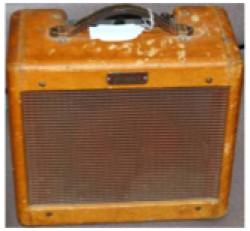
I know, not a very good picture, oh well…

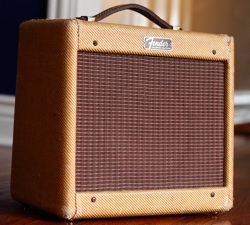
In any case, I recently won this amp in an eBay auction. As soon as I got it, I turned it over to Jeff Aragaki of Aracom Amps for him to inspect it, clean it up, and make it “safe.” The amp was in excellent working condition, considering it’s 52 years old, but to be safe, I wanted to make sure there was nothing amiss.

One of the first things Jeff looked at were the capacitors. Visual inspection didn’t reveal any leaks, but they needed to be measured to ensure that they were still able to keep a charge. Amazingly enough, they were still measuring well within operational tolerances, and none had to be replaced, which Jeff said indicated that the amp was being used. With those old paper capacitors, if they sit for a long time without use, they’ll eventually leak acid. But these were in great shape!

The next thing Jeff checked was the speaker. Interestingly enough, the speaker was a replacement, and not only that, it was a 16 ohm speaker, which actually attenuated the amp a bit, so I had Jeff replace the 8″ speaker with a new ceramic speaker.

Since the amp used a two-prong electrical plug, I asked Jeff to upgrade it to a three-prong medical-grade plug. Unfortunately, the way the amp was designed, doing that would require playing with the heater voltages, and while that wouldn’t necessarily harm the amp, it may have had an effect on the tone – not a good idea. So I just had Jeff replace the cord, which was in decent physical condition, but according to him, wasn’t carrying a full load of current to the amp.

In addition to cleaning it up and making sure it was in good working order, Jeff wired up an A/B switch box to the amp, so I could flip between using the internal speaker and an external cabinet (which is how I’ll normally play this amp). Jeff did this to avoid having to install a 1/4″ jack which would alter the amp from its original condition. Being a vintage gear collector, Jeff thinks about that stuff… This amp is going to be a player, so that wasn’t much a concern to me, but he kind of insisted, just in case I decide to sell it later.

Finally, since the amp didn’t have a back plate (which accounts for the great price I got it for), Jeff cut a nice 1/2″ ply board to protect the chassis. We’ll do a proper back plate with a tweed cover later, but I wanted to start using the amp right away, so we’ll do that as a future project.

Gig Report

With the amp complete, I played it all week to get used to how it responded. Now that I have one of these, it’s no small wonder why these have been long-time residents in studios all around the world. Hooked up to my 2 X 12, loaded with a Celestion Blue and Gold, the amp’s voicing is super rich, if a little on the bright side. But no matter. The cleans are absolutely incredible! They ring with a vintage chime that at least to me, invokes a visceral response in me that’s hard to explain. It’s a classic Fender clean, and through my 2 X 12, the cleans resonate and float through the air! As far as dirty is concerned, the Champ is no high-gain amp. Overdriven, it’s a dirty grind, perfect for blues- or classic-rock tones.

The Champ is also incredibly pedal friendly. I hooked up my super-versatile Doodad Guitars Check-A-Board RED overdrive/booster up to it, and the amp just responded! The overdrive is wonderful on this pedal, adding great sustain without overly compressing the signal, but where the pedal really worked with the Champ was with the booster. Slamming the front-end of the amp, I was rewarded with a gorgeous, smooth overdrive tone. Again, I thought to myself, this is why this little monster has been on so many songs over the years!

Yesterday, I took the amp to my church gig. Being the 4th of July, we had a skeleton crew: Just one other guitar besides myself, but no matter, I wanted to play it live. For this gig, I just used my custom Aracom 1 X 12 with a Jensen P12N, and I played my “hybrid” Fender Stratacoustic Deluxe through it. Despite the fact that I was ostensibly playing an acoustic guitar through the amp, the tone was absolutely natural. I was like, “This really shouldn’t sound that good, but I’m amazed at how it sounds!” Granted, the Stratacoustic is more like a hollow-body electric than an acoustic, but the Champ just took its natural voice and amplified it beautifully.

Once I have my studio set up again (just finished construction on the house, so I lost my recording space temporarily), I’ll make some recordings!

If you live in the Silicon Valley area and need some amp work, though Jeff sells his own line of amps, three of which I own, with a fourth on the way, Jeff is one of the best amp techs I’ve ever worked with and he’ll hook you up! He thinks of things I would’ve never thought of! Check out his site at http://www.aracom-amps.com. Needless to say, he is also the creator of the best attenuator on the market, the Aracom PRX150-Pro.

Read Full Post »

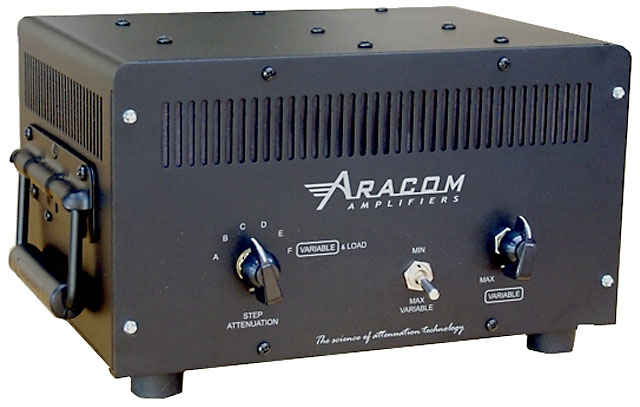
The venerable “Destroy All Guitars” shop has teamed up with Aracom Amplifiers to come up with a new version of the fantastic Aracom PRX150-Pro. Sporting a smaller cabinet (sorry, not reduced weight), and a couple of very cool new features, the $785 PRX150-DAG is the answer to anyone who wants to go to the extreme in transparent power attenuation.

Here are the features:

* Proprietary SRT Power Attenuation Technology
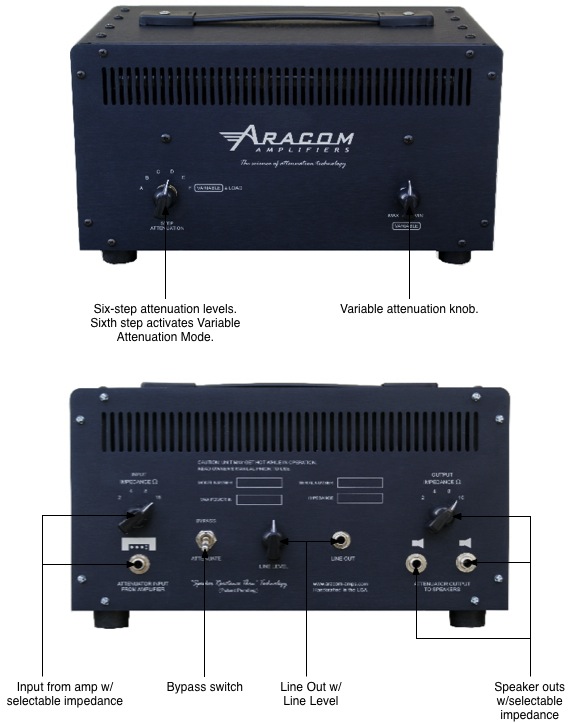
* Six levels of step attenuation, plus a continuously variable attenuation control (bedroom mode)
* 40dB of attenuation–attenuates 150 watts down to .015 watt
* 150 watt power rating
* Independent input and output impedance selector switches:
– from the amplifier and into the attenuator, select from: 2, 4, 8, 16 ohm
– from the attenuator and to the speaker cabinet(s), select from: 2, 4, 8, 16 ohm
– uniquely allows 16 possible Input and Output impedance combinations
* Hi Frequency Cut Filter with a True Bypass Switch
* Features a Load setting and is equipped with a Line Out Jack and Line Out Level Control
* Rack Mount Option
* Handwired in the USA

The two notable features are the Hi-Cut Filter, and the increased attenuation down to -40dB attenuation. With respect to the high-cut filter, some people had mentioned that they heard a high-frequency artifact coming through when they hooked up the original PRX150-Pro. I myself have never heard it, though I suppose anything’s possible. In Jeff Aragaki’s (of Aracom Amps) words:

The PRX150-DAG is equipped with a High Frequency Cut switch, that rolls off the highs above 6KHz, that some users might find useful with amplifiers that have a pronounced high end frequency response. Some guitarists go to great lengths to control the high end response of their amplifier, by carefully selecting speakers, tubes, and other components to roll off the highs. Now with the PRX150-DAG, a guitarist might not need to rely on changing these components; the high cut filter switch allows the flexibility of rolling off the high end or not. The true bypass switch allows the filter to be completely bypassed, providing the full frequency response of the attenuated amplifier to pass through to the speakers.

The other great feature is the Min/Max variable attenuation modes Jeff has introduced. Minimum attenuation mode is the traditional -16dB down to about -30dB variable attenuation, whereas the Maximum variable attenuation mode goes from -27dB to -40dB. With a 100 Watt amp, that’s taking down the output power to .015 Watt!!! Wanna have full dynamic response at bedroom levels with your 100 Watt amp? Look no further!

The Aracom-DAG PRX150-DAG is available exclusively through Destroy All Guitars. Check it out!

Read Full Post »

I’ve always had an appreciation for vintage gear, though the most “vintage” that I’ve ever gone is purchasing several sets of NOS tubes over the years. And quite frankly, though I’ve appreciated vintage gear in general, I’ve never been compelled to be a vintage gear collector as I’m an active musician who uses his stuff all the time.

But despite that, I have wanted to get an 50’s tweed Champ for quite awhile. I love small, low-powered amps, and the tweed Champ from the 50’s has been on my list to get for quite some time. After all, that little amp has been used in studios around the world for recording hundreds, if not thousands of Rock ‘N Roll songs.

My only problem with ever getting a tweed Champ was that I didn’t want to spend upwards of $1500 for a mint-condition unit, which is what these puppies go for. And since I’d use it as a player, I’d have to make modifications to it as soon as I got it to make it safe and usable with different cabinets; thus immediately reducing its value.

But luckily there are tweed Champs out there that aren’t in pristine shape, and they’re low enough in cost to warrant consideration. My criteria was that the amp had to work. Period. As long as it did, I wouldn’t have to do too much once I got it. So I found a ’58 Tweed Champ on eBay for a decent price that was missing the back plate, but was still in great working condition, so I purchased it, knowing I’d have to do some mods to make it safe, plus add some longevity to it.

Right now, it’s on transit here, and should arrive tomorrow – I’m so excited! But I will not plug it in until I have a few things done to it, that my good friend Jeff Aragaki of Aracom Amps will be doing:

  1. First of all, it still has the original two-prong plug. Jeff will install a three-prong grounded plug in it – I’m probably going to go with medical grade on this just to be extra-safe.
  2. It was clear from the pictures that a couple of the original capacitors had leaked a little, so they will be replaced with Sprague caps.
  3. The speaker is also hard-soldered to the amp output, so I’m having Jeff install a 1/4″ female jack so I can use different cabinets with the amp.
  4. Finally, Jeff will create a simple backplate to provide some protection to the electronic components.

All of these “mods” will be reversible, so at least I can retain some value in the amp should I ever sell it. However, I probably will keep this amp forever. I don’t even have it yet, and it still holds some nostalgic value for me. Can’t wait until it arrives!

Read Full Post »

I’ve never hid from the fact that I own Aracom gear, and as I’ve said in My Rig page, I’m a faithful customer who just digs the stuff that Jeff Aragaki, Aracom’s founder, comes up with. I’ve extolled the wonders of his attenuator, the PRX150-Pro, and I’ve mentioned my Aracom amps, the VRX18, VRX22, and PLX18BB several times.

One thing I’ve learned over the years with respect to gear is that you go with what works for you, and my Aracom gear simply works for me! In fact, my Aracom equipment has had a lot to do with me using less pedals, and relying on the raw sound of my guitar and amps; especially when I’m playing straight rock and roll.

I have yet to play a bad-sounding Aracom amp. When they’re cranked to the hilt, they have such an incredible mojo that’s just too hard to describe. Of course, I couldn’t crank them without the PRX150-Pro attenuator. No matter, there’s magic in Jeff’s creations! To demonstrate this magic, I’m going to share an excerpt from a song that I’m working on. I just finished laying down the instrument parts. Give it a listen:

The rhythm part is played with my Squier CV Tele in the middle switch position, and running straight into Channel 2 of the PLX18BB, which was cranked up all the way. Talk about cranked Marshall-esque tones! It sounds even better live! The lead was recorded with my Gibson Nighthawk 2009 into my VRX22. Master was at 3pm and Volume was at 2pm. This setting gives me a sweet, singing lead voicing that sustains for days due to the awesome solid-state sag circuit! Again, the guitar was plugged straight into the amp – no frills whatsoever. I did add some reverb to both parts, but other than that, that the raw sound of the guitars/amps with no EQ. Pretty killer tones!!!

To top it off, both parts were recorded at bedroom level as both amps ran into the PRX150-Pro! We’re talking conversation level, so if you heard some transient clicks in the clip, it’s stuff that was making noise in my garage/studio!

You gotta check this stuff out. Jeff is a true wizard with amps! Both the VRX amps start at $895, while the PLX18BB combo starts at $1750 ($1350 for the head only). If you’re after vintage Marshall tone at a non-vintage price, you owe it to yourself to check out these amps!

Read Full Post »

This is a hotly debated topic, and there are great arguments for or against using one. I’m of the former group and have used attenuators to great success over the years. To demonstrate how useful an attenuator can be, I put together a quick video. Here you go:

I wanted to be as non-technical about the usage of an attenuator because there are so many attenuator designs on the market. So I kept this video at a fairly high level. I’ll get into more detail in the next video when I discuss the Aracom PRX150-Pro.

Read Full Post »

The Aracom PRX150-Pro to be exact. I’ve actually known about this for awhile, but Jeff Aragaki, owner of Aracom Amps asked me not to say anything until someone else had mentioned it. Jeff told me the news right after Joe purchased it, but I respected Jeff’s wishes to wait to mention it. So I did. And none other than Doug Doppler, guitarist extraordinaire and author of “Get Killer Tone,” happened to mention it in a thread on the The Gear Page recently about how Joe had told him about the unit. So the cat’s out of the bag! Joe Satriani is a proud owner of a PRX150-Pro, and his words to Jeff were “Great unit. I like it a lot.”

That’s about all the information I know other than how he raved about it to Doug who, in turn, contacted Jeff to get a unit; and since he got it, Doug has been raving about it on The Gear Page, and will be featuring it in his DVD.

This is not so much a plug for the PRX150-Pro as it is meant to underscore that even guitar heroes like Satch see the virtues of using an attenuator. Speaker breakup aside, some amps just don’t hit their sweet spot until they’re cranked up and played wide open. Unfortunately, the volume level at that point is too high to be comfortable for most human ears. With an attenuator – and a great one in the PRX150-Pro – players can crank their amps to their sweet spot, and not worry that their ears are going to bleed.

I know, there are several people who eschew attenuators as being tone suckers. But the new breed of attenuators such as the Aracom PRX150-Pro are so much more transparent than the older attenuators on the market; and yes, they are particularly more expensive than their older counterparts, but how much is great tone worth? We gear sluts think nothing about spending a few hundred bucks on a pedal. For what a great attenuator gives you, it’s totally worth the investment.

For more information on the Aracom PRX150-Pro, go to the PRX150-Pro product page!

Read Full Post »

I’ve been using the Aracom PLX18 BB Trem in my studio for the past couple of months, and it is simply a great amp. As I’ve written in the past about this amp, I’ve made some modifications to it such as replacing all the stock pre-amps with NOS (the JJ EL84’s are killer in this amp, so no need to even look for NOS for these), and replacing the stock speaker with a Fane Medusa 150.

As most GuitarGear readers know, my go-to gigging amp is my beloved, customized Aracom VRX22. But every now and then, I like to take my other amps out for a spin. For this evening’s church gig, I took the PLX18. Based upon tonight’s experience, it looks like I’m going to gig with this amp a lot more.

One thing that I’ve come to love about Jeff Aragaki’s amp designs, is that he has got the vintage Marshall mojo down. Mind you, he doesn’t make clones. He takes the original circuit designs and innovates on top of them. The PLX18 BB started out as a classic “Bluesbreaker” design, but with improvements to the circuit to make it much more efficient. The result is a real smooth-sounding amp that – like the amp it is modeled after – has tons of clean headroom, and needs to be absolutely cranked to get grind. But when it grinds, it’s so rich and smooth and dynamic, you just close your eyes and let your fingers do the talking!

Such was the case tonight. About a year ago, I re-arranged a classic Catholic hymn and gave it a bluesy, folk-punk vibe (think a cross between Death Cab and Clapton). I know, it sounds like a weird mix, but amazingly enough, it works. People know the song really well, but this arrangement gets them nodding their head in time – it’s cool to see! In any case, I also arranged it so that there was plenty of room in between verses for little solos. It’s a somewhat slow song, so you can’t go overboard, but the phrasing really lends itself to a lead played with an amp just at the edge of breakup, with lots of bends and vibrato.

And it helps to have an amp that has a lot of natural sustain. The PLX is just so damn good at that! I played the amp in the “clean” channel that I had almost cranked up all the way, since that’s where a vintage Marshall sounds great, and of course, it was plugged into my attenuator so I could crank it and still have a manageable volume level. The PLX is so responsive to attack and volume knob adjustments that it makes playing just a dream. Throughout the song, I just closed my eyes and got into pure expression mode. It was one of those occasional experiences where the tone just takes you right into the Zone! When you’re in the Zone, you just can’t do wrong. Hearing the PLX sing with my Squier CV Tele – I just floated away in absolute bliss.

For our closing song, I actually didn’t play, and gave “Blondie” over to my guitar cohort Dave so I could thump out on bass. For that song, I activated the wonderful Kasha overdrive pedal, in the Hot channel to really slam the amp with gain. The great thing about the Kasha overdrive is that it’s a really transparent overdrive pedal, and allows you amp to do it’s magic. With the OD engaged, the PLX took on this incredible character. It’s a bright amp by nature, but the tone became really jangly and ringy, with just a touch of compression coming from the EL84’s. It helps that I replaced the original JJ pre-amps with the NOS ones. In any case, talk about creamy smooth but articulate overdrive! Listening to that just got me thumpin’ out on the bass! We had a lot of fun with that song. Kind of felt like the White Stripes as we only had two instrumentalists (though it was two guitars, or a bass and guitar – no drums). It was raw and edgy, but oh so cool! You gotta just dig moments like this!

As I’ve mentioned, the PLX18 BB Trem is Jeff’s oldest amp design and unfortunately, his least-known amp. It’s tough to compete in the market when there are so many boutique, vintage Marshall-style amps on the market. I’ve played many, but the PLX18 BB is special. Others who own one of these will attest to just how special this amp sounds. Even though it’s not quite as versatile as the VRX22 that can get me over-the-top gain, for what it does, I can’t think of a better amp. Mind you, this ain’t just a one-trick pony. For blues, classic rock, and country, it’s simply killer. So if you’re looking for that classic “Bluesbreaker” tone at a price that won’t break you at the same time (the head is $1345, and the combo – which I have is $1750), I encourage you to check this amp out! And if you do get it, you won’t regret it in the slightest!

As far as equipping it, pay the extra for NOS pre-amps (the JJ EL84’s are just fine – I actually prefer them), and even though Jeff recommends an Eminence Red Fang Alnico to be paired with the PLX18 BB, for my personal tastes, I prefer something with a bit tighter bottom end; hence, the Fane Medusa that I swapped in. If you still want bright tone, then an Eminence Governor works insanely well, and will give you nice mids and high-mids, and I hear the Celestion Gold sounds killer in the the combo! YMMV…

For more information on this wonderful amp, check out the Aracom Amps site!

Read Full Post »

« Newer Posts - Older Posts »