Feeds:
Posts
Comments

Posts Tagged ‘attenuator’

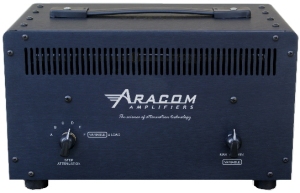
PRX-front-543You ever have an itch you can’t scratch? Well, it has been like that keeping my mouth shut about the Power Rox PRX150-Pro. Ever since I played with the early prototypes, I’ve been completely blown away by this attenuator! This is a totally new take on attenuator technology, folks, and I’m hoping it takes the industry by storm. Why? Simply because what we’re talking about with the Power Rox is true transparency in tone when this is in your signal chain; not “almost” transparent, but truly transparent.

Check out the Power Rox PRX150-Pro page at Aracom Amps!

Most comparisons between attenuators revolve around what’s the “most transparent” attenuator, indicating that really none of them are transparent, so people pick the best of the lot. And frankly, I’ve tested out several attenuators and ended up with the Dr. Z Airbrake, as I felt it was the most transparent out of the ones I tested. But nothing could have prepared me for the transparency of the Power Rox.

I could go on and on, but I won’t. In fact, I had already written a significant amount of text, but decided to just point you in the right direction. Go to the product page. Read through the product description, but more importantly, read the supplementary documentation behind the links at the bottom of the page. Jeff Aragaki has graciously provided some very in-depth articles on how attenuators work, and also provides a high-level explanation of the technology behind the PRX150-Pro.

Other manufacturers may brag about the safety and transparency of their attenuators, but none is willing to back up their claims with the engineering behind their attenuators (and if you knew what some were doing, believe me, if you care about your tone and the safety of your amp, you’d get worried). If you’re interested in or even use an attenuator, you owe it to yourself – and your tone – to check this unit out!

Read Full Post »

This piece of gear is so new, it’s not even in production yet, but I just had to share the news!

A few months ago, I was watching a video on YouTube about the Faustine Amps VT-58 amp, which is based on the 5E8A “Low Power Twin” circuit. Very nice, compact amp. But that’s not the story. Faustine is just about to debut a standalone version of their built-in attenuator.

One thing to note about Faustine amps is that all models have a built-in attenuator that gives you from -3dB down to -18dB attenuation. I played at VT-57 at Tone Merchants, which is a 35Watt, 3 X 10 amp – classic, sweet Tweed tone. But it was the built-in attenuator that really sold me on the amp, and actually one of the things that started me thinking about using an attenuator in the first place. As you know, I ended up going with a Dr. Z AirBrake, which has totally served me well, and will continue to do so in the future, but I remember the attenuator working so well on the Faustine, that I was wishing that Faustine had a standalone attenuator.

My wish has been granted.

If you watched the video (and I will present it in its full glory at the end of this entry), the reviewer mentions it being released in early 2009. That prompted me to contact Tim Gregoire, Faustine Amps designer and owner to see if and when it will be released. According to Tim, full production models will be available by the end of this quarter or early next quarter. He’s currently building a set of pre-production models for select clients in the SoCal area, and once he’s done with those, he’ll begin production of generally available models.

So what’s so special with this attenuator? From my personal experience with the built-in one, the attenuator circuit Tim has created is totally transparent – at any level. While I love my Dr. Z, at high attenuation levels, it starts sucking tone, and that’s not good. But with the Faustine, I didn’t detect any tone loss, even when I cranked up the attenuation to its highest setting!

According to Tim, the standalone model will have a wider attenuation range than the built-in attenuator. He shared that it will attenuate within the range of -2dB all the way down to -26dB – that’s conversation-level! Freakin’ awesome! No price yet, it probably won’t be cheap. But sometimes you have to pay for transparency. Once out, the unit will be sold exclusively for a time through Tone Merchants. Stay tuned, as I will hopefully be able to get a unit to review!

Here’s the video of the VT-58. This is a great little low-power amp, with wonderful, vintage Tweed goodness!

Read Full Post »

What? Less gear? I must be speaking blasphemy, especially considering I’m such a gear freak – especially with my proclivity for pedals. But there’s also a practical side to this, as I am also a gigging musician. And especially when I do solo gigs, having less gear means less trips to the car. So as much as I can consolidate, I do. I was thinking about this because Christmas time through the New Year is usually a very busy time for me as far as gigs are concerned. For the past month, I’ve had at least three gigs each weekend, playing parties and other events. So you can see that I’m fairly sensitive to lugging gear.

So here I am in a coffee shop this morning, having put the finishing touches on my latest gear review on Aracom Amps RoxBox. In the article I mentioned that Channel 2 suffered from being flat at lower volumes, and that I ultimately solved the problem by running the amp through an attenuator between he power amp and speaker. I’ve had to do that practically every tube amp I’ve tested, so it got me to thinking: Why don’t more manufacturers just add these to their amps? I suppose production cost has a lot to do with it, but amp makers such as Faustine Amps have a -18db reactive attenuator built into their Harlequin line of amps and the Fender Princeton Studio also has a built-in attenuator as well. It’s a cool feature, and one that will allow you to get power tube saturation at lower output volumes.

Let me explain what I mean by way of a diagram:

Output attenuator

As you can see, the traditional master volume circuit contains an attenuator between the pre-amp and the power amp. This means that you can crank the pre-amp and get pre-amp distortion, while limiting power to the power amp; thus limiting output volume. But it also means that in many cases, you won’t get power amp distortion unless you crank the master, which tends to be too loud, especially in small clubs and restaurants. But in the second illustration, with a second attenuator between the power amp and the speaker, it is now possible to crank the master volume to get power tube saturation while limiting overall output. I currently do this with the use of a Dr. Z Air Brake. But going back to the topic of this article, it’s just another piece of gear that I have to bring with me to a gig. Ugh!

In addition to production cost, there is a danger of possibly burning out the power tubes if you really overdrive them. I’ve done it to my Fender Hot Rod, by turning the attenuator to maximum attenuation, and diming the Drive knob for too long a time. Not good.

As I mentioned above, Faustine does this with their Harlequin line of amps (not sure about the others), and while -18db of attenuation may seem like a lot, it’s actually not that much – it takes the edge off. There must be a happy medium, say -24db or maybe -30db? Who knows? But whatever… this is a case where less gear is much better!

Read Full Post »

« Newer Posts