Released in May (how did I miss this?), the Severe is “Tone Freak Effects’ answer to high gain distortion.” Oh man… This looks like a incredibly mean pedal. Set up like the Abunai 2 with a 3-way clipping switch, with level, gain, and tone, the Severe also sports a 3-way bright switch so it can be used with different amps. Very cool.
As Derek Tabata mentions on his site, the Severe will never turn your tone into a compressed mushy mess. The distortion can be laid on thick but, remains open. I can attest to this with the Abunai 2. You can lay on thick overdrive with that pedal, but it’ll never turn super thick.
With the Severe, Derek has taken high-gain distortion to another level! I’m amazed at how it sounds in the sound clips! Check ’em out!
Severe Demo Clip
Les Paul
Les Paul
Tom Anderson
Personally, I’m not a high-gain type of player, however, as I’ve gotten more and more comfortable soloing, I’ve found that I’m pushing more and more into high-gain territory. The only problem is that to achieve that with an amp means it has to be LOUD. That’s why I love pedals like this! You get the effect you need at far lower sound levels.
What’s handmade, black and gold, and has the potential to catapult you into tonal heaven without breaking the bank and more importantly busting your eardrums? Simple: The soon-to-be-released Reason Amps Bambino! This article is the first news glimpse of this brand-new 7 Watt amp from the Reason guys that has all the tonal goodness you expect from a Reason amp but at volume level that won’t make your ears bleed, and almost as importantly, is easily within the financial reach of most cash-strapped gear sluts.
When I first reviewed the Reason SM25 and the Reason SM40, I knew that what I was hearing was something special. These amps weren’t clone designs, and didn’t sound like anything that I had played before. Yes, they were based on classic 6V6 and EL84 power tubes, but the thing with those amps was that the power handling was magic, and either of these amps sounded way louder than you would expect with low to medium wattage amplifiers. Make no bones about it, what Obeid Kahn has figured out in the power transformer section of his amps is totally proprietary and SICK! Even as well as I’ve gotten to know Anthony and Obeid, that’s a subject they hold close to their chests.
So imagine my excitement when they shared with me several months ago that they were coming out with a brand-new low wattage amp. I wasn’t allowed to say anything about it at the time because Obeid was still working out the design, and hadn’t decided on the power tube he was going to use. All they would tell me was that it would be a sub-$700 amp that would have all the tonal goodness you’d expect from a Reason amplifier. Yeah, really definitive… ☺
But as luck would have it, I happened to give the Reason guys a call to see how they were doing, and much to my extreme pleasure, Anthony mentioned that they were almost ready to release the new amp, and that they were calling it the Bambino. After Anthony described the amp’s features, I started salivating. I LOVE LOW-WATTAGE AMPS! And this amp’s features totally kick the shit out of a lot of the low-wattage amps on the market, boutique and production alike. So let’s go over the features, shall we?
Reason Bambino Specs
Preamp Tubes: Three 12AX7’s
Power Tubes : Two 6AQ5’s in a push-pull configuration.
Output Power: 7 Watts, switchable to 1 Watt
Channels:
Normal – British cleans to Vox-like top-end. Includes a “thick” setting via pull-switch to get thick “Beano-like” grind.
Bright – Very American, SoCal type of bright and scooped tone, with smooth overdrive when pushed. Bass knob scoops the mids when you dime it, and the pull switch will add extra shimmer to the top end.
StackModeTM – As with all amps in the Reason Amps family, the Bambino also sports StackMode, which runs Channel 1 into Channel 2 plus an extra gain stage in a series. Want to get over-the-top grind? StackMode is it!
Sounds basic enough, but wait! There’s more!
Built-in Speaker Load Box Simulated Line Output with Level Control – The line output is not just another line output. It starts with a fully inductive speaker impedance simulator, which then goes onto a complex frequency shaping network that simulates the sound of a classic 2×12 speaker cabinet. The fully balanced TRS ¼” connection allows for connection to any recording devices or slave amplifiers. Can you say “re-amp” anyone? ☺ You can also use this output to perform true silent recording. Of course, nothing beats a speaker moving air, but when you need a straight guitar sound to record, now you have it.
Separate Headphone Output – Want to practice and not wake up the significant other? No problem, mahn!
If you’ve followed this blog for awhile, you know how much I love Reason Amps! They don’t pay me anything for telling their story – all you have to do is play a Reason Amp and you’ll be hooked! And at the price-point that the Bambino is coming in at, there is NO reason (excuse the pun) that you shouldn’t seriously consider this amp when it’s ready for shipping!
Not Your Daddy’s Oldsmobile
It would be so easy to dismiss this amp as yet another boutique amp. But you’d be wrong. One of the reasons I dig Reason amps so much is because they have a sound all their own. It’s also the reason I dig Aracom Amps so much. Manufacturers like these don’t settle for making copies of classic designs. They’re true innovators, taking the classic designs, improving on them, and adding their own special touches. The net result is that you get amps that have tones that are uniquely theirs.
And on top of that, Obeid Kahn is one of the leading amp designers around, the meticulous care and innovative spirit he has put into his designs is evident in the amps he has produced over the years, and with Reason Amps, that skill and innovation are at their paramount. These amps are special!
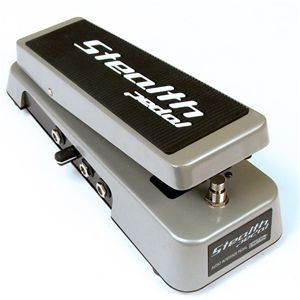
For those computer-based DAW jockeys, you know about IK Multimedia’s Amplitube software. I recently wrote a review of Amplitube Fender Edition, and loved it. Now I have an even bigger reason to love it, and that’s IK Multimedia’s StealthPedal which looks like an expression pedal but is actually a fully-functional, USB-powered audio interface WITH a built-in expression pedal. How friggin’ cool is that?
Folks, this thing works, and it works well, as my full review, which will be released in a few days will bear out. As an audio interface, it may not have a lot of bells and whistles, but for the home recording studio buff, this is a great, affordable, high-res audio device that can take a direct in from your guitar or pedal board, or a line out from a pre-amp to use for layering tracks.
But because the pedal has the ability to act as a controller for any “Powered by Amplitube” software or plug-in, you may not even need an amp to record your guitar parts! There are enough fantastic-sounding amp models packed into the various Amplitube packages that you’ll be sure to find a model that works for you. Plus the software effect plug-ins that the StealthPedal can control give you added tone shaping abilities.
In my impending review, I’ll have more clips to share, but here’s a “torch song” that I’ve been working on that features the StealthPedal in action as an audio interface:
Except for the drum loop, all the instruments were recorded using the StealthPedal as the audio interface. I did a line-in directly for the electric piano. For the guitar parts, the amps are both software amps! For the rhythm part I used a Fender Champ 600 with a virtual compressor rack plug-in and my Strat plugged directly into the StealthPedal. For the lead part, I plugged into my pedal board and used my Tone Freak Effects Abunai 2 overdrive, and a Hardwire RV-7 Reverb. For the amp, I used a ’59 Bassman model. Imagine that! Software that sounds this good!
I know, nothing sounds like or feels like a real amp, but the convenience and the general sound quality of these models, plus the high-fidelity of the StealthPedal isn’t lost on me. It’s a nice, compact audio solution that combined with the software, will definitely make a difference in how you approach recording guitars.
This is a bit of a continuation of my previous article about not getting fooled by pedigree. While I was singing the praises of a Saint Guitar Goldtop Benchmark that I was testing, my buddy commented to me, “You sure about wanting to get one of these? It’s gorgeous, and it plays and sounds amazing, but the problem I have with most boutique guitars is I’m not sure how well they retain their value. What if I wanted to sell it later on? Would I get what I paid for it? Will it appreciate in value?”
All valid concerns, but I simply replied that it’s all about your perspective: Are you a collector or a trader?
If you’re a collector, chances are you obtain gear to keep it and use it for a lifetime, or even just hang it on a wall (I know of someone who has 300+ guitars, most of which he never plays). I consider myself a collector. And from that standpoint, I’m what’s called “brand blind.” All I care about is if the gear looks good, plays good, and sounds good, no matter what the brand.
On the other hand, there are those whom I call “traders.” They get gear, but are always open to trading for another type of gear that might be better from their point of view. From that standpoint, brand awareness is important as people will tend gravitate toward known entities, and the brand-names definitely attract more traffic.
Mind you, I’m not saying one is better than the other. It’s just a matter of perspective in making a purchasing decision. I used to be pretty brand-centric, but ever since I started writing this blog, I’ve come across some awesome gear that I don’t think I would’ve even considered evaluating had I focused on the brand-name stuff.
And let me say that it’s not that you’re either one or the other. It also depends on the gear. For instance, I swear by V-Picks and Red Bear Picks. I won’t use any others. But I’ll buy off-brand pedals and guitars and amps.
I admit it: I’m an incurable GEAR SLUT! I jones for vintage and vintage style gear, as the music I play leans toward the blues and classic rock. And to satisfy that never-ending craving, I pore over the Internet and various magazines in search of all sorts of gear; hence, the existence of GuitarGear.org where I share with you, dear reader, the things that I come across.
Now in my search for gear, I occasionally buy things. They tend to be vintage-style modern gear because I just don’t have the money to buy real vintage gear; and that usually means I gravitate towards boutique gear; but not just any boutique gear. Remember, I don’t usually have all that much money to afford the real high-end stuff, so I spend a lot of my scouring my information resources to find boutique gear that I can afford. That’s what gravitated me towards Aracom Amps.
When I saw the price of a VRX series amp, my jaw dropped! Here was a hand-wired, vintage-style tube amp for $895!!! When I finally hooked up with Jeff Aragaki (founder of Aracom), and got a chance to play the VRX18, he shared that one of the ways he was able to keep the cost down was by using a solid-state sag simulating rectifier circuit. When I heard the words “solid-state,” the purist in me started reeling a bit. But then that amp sounded so freakin’ good that I didn’t give a flying you-know-what about the rectifier!
And that’s the point of this article. When you’re looking for and buying gear, don’t let yourself be swayed by an instrument’s or equipment’s pedigree or “all-tubeness” or lack thereof. LISTEN to the fuckin’ thing, and see if it turns you on! If it sounds good, and it works for YOU, then that’s all that matters, in my not so humble opinion on the subject. 🙂 If I had let the purist in me take over, I would’ve never ended up with my VRX22! And for the record, I’ve listened to many, many, many amps, with and without tube rectifiers, and the circuit that Jeff Aragaki employs in the VRX series simulates the sag of a rectifier tube so well, I can’t tell the difference. And if there is one, it’s probably so minute that it doesn’t matter anyway. I’ll put that amp up against any other boutique amp in the same wattage range, and it’ll sound just as good, if not better. And I paid less than half the price of a similarly configured amp!
Give the following clip a listen. I’m playing my Strat plugged straight into the clean channel of the VRX22. In some sections you could swear that the amp has a reverb, but that’s the solid-state rectifier simulating the sag of a tube rectifier. Also, this is the raw recording of the amp: No EQ, no filtering. The master volume was flat out, with the gain control around midway. My mic was about about 10″ away pointed directly at the center of the speaker cone.
I originally recorded that clip with my Prestige Heritage Elite. But that guitar has so much inherent sustain, it would’ve been cheating. 🙂 A Strat on the other hand doesn’t have that much sustain, so it brings out the sustaining quality of the amp much better. The result is just amazing.
And as to the tube vs. solid state rectifier issue, at least in the Aracom VRX series, it doesn’t make one whit of difference, especially when you’re playing live at gig levels. When I’m gigging, I almost never use reverb unless it’s a song where I can really isolate my guitar. Sag gives the effect of reverb, but at loud gig levels, you’ll never hear it.
Another great example of buying what sounds good to you is my friend Vinni Smith of V-Picks. That dude is one of the best guitarists I’ve ever known, and he gigs all the time! You know what he plays through? A freakin’ Roland Cube 30 cranked all the way up and miked into the PA. When he told me that, I almost flipped. Here was a true pro guitarist, playing through a $200 amp!
So don’t be taken in by pedigree. Buy what sounds good to you, and what you can make sound good. After all, 90% of your tone is in your hands.
Summary: Based on the original “RoxBox” (no longer available), the VRX18 sports an improved master volume inherited from the VRX22, and a reworked, smoother overdrive profile.
Pros: As dynamic and expressive as its 22 Watt sibling, the VRX22, but oozing that bright, chimey EL84 goodness. When driven, produces a nice, tight overdrive.
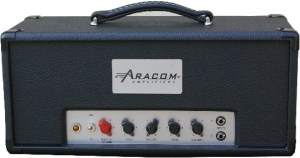
Head Cabinet
Standard Tolex: Black Levant. See options below for other colors.
– Dimensions: 19″w x 8″h x 8.25″d
– Weight: 23 lbs
Also available in 1 X12 and 1 X 10 combos (or Jeff can custom build one to your liking)
Tone Bone Score: 5.0. When I can swing it, I’ll be getting this amp to complete the VRX Series!
Jeff Aragaki, founder and builder of Aracom Amps, always chuckles when I tell him that he’s onto something with his VRX (short for Vintage Rox) series amps. With the VRX22, he seemed to have stumbled onto a sweet spot that produced an amp that has an incredible and beautfully balanced tone that bring out the best tonal aspects of the 6V6 tube. He’s done it yet again with the updated RoxBox 18, now renamed the VRX18, but incorporating many of the same features he built into the VRX22.
I just purchased the VRX22, having fallen in love with the tone that it produces, and I’ve fallen love yet again, but now with the VRX18. I’m like a hopeless romantic that loves two women for their individual virtues, but in this case, the women don’t mind – they can co-exist with each other. Okay, bad analogy… 🙂
I originally reviewed the RoxBox 18 back in December. At the time, I totally dug its tone, but took marks off because of the mildly harsh breakup at lower volumes. There’s nothing harsh about the tone of this amp now – at any volume! It’s a great amp to play, and as expected, it’s pedal friendly, and responds really well to overdrive pedals. Also, I played four guitars through it, and it sounded incredible with all of them!
I won’t go into a lot of detail, since I already covered pretty much all the descriptive information I needed to in the original review, so I’m going to cover some important things I’ve learned about the VRX 18 and the VRX series in general. But first, as opposed to doing this last, here’s a short clip featuring the VRX18 to show you how kick-ass it sounds:
For this clip, I used a Strat with just the middle pickup, plugged directly into the VRX18. I just dig that EL84 grind! I had the Channel 2 volume dimed, and the master volume at halfway in full-power mode. It was very loud, much to the chagrin of my wife. 🙂 But I needed to capture at least some of that EL84 compression.
What’s cool about the EL84 is that it compresses nicely when pushed, but still seems to retain a certain openness in its overdrive. This is unlike something like a KT-66 that compresses so much when pushed you lose volume.
The Best Master Volume in the Business
I don’t say this lightly when I say Jeff has the best master volume in the business. I’ve played many amps. But when Jeff created the VRX22, he did something with the master volume that is pure magic. It has a nice, even volume sweep that seems to act independently of the channel volume. This means you can crank the channel volume to get some serious grind, but control the output via the master, and it won’t suck your tone! I’ve found this to be a real problem with other amps. That master volume is incorporated into the VRX18.
The Best Half-Power Switch in the Business
A lot of manufacturers use a pentode/triode switch to achieve half-power settings in their amps. I’ve played several amps with this feature. But in half power mode with the pentode/triode configuration, I’ve noticed a distinct tonal difference between the two modes in amps configured this way. It’s not that the tone is bad. In fact, many I’ve played around with sound great in half-power mode. But it’s like two different amps.
Jeff Aragaki takes a different approach and instead adjusts the B+ voltage to maintain the usage of all pins in the power tubes. I’m not an electrician, and can’t even begin to explain this technically, so I’ll just say it this way: When you switch to half-power mode in any Aracom Amp, the amp doesn’t change its tonal characteristics. It sounds and plays the same!
The Difference Between Old and New
In addition to the great master volume Jeff incorporated into the VRX18, the first thing I noticed was that it was nowhere near as easy to get this amp to overdrive in channel 2 as it was with the original RoxBox 18. This is not a negative thing at all because as I mentioned in my original review, the overdrive was pretty harsh at lower volume levels. I spoke to Jeff about this, and he said that based upon my original tests and review, he decided to mellow out the extra gain stage in the VRX18 so you could get a nice overdrive tone at any volume level.
You won’t get over-the-top gain with the VRX18. But for that, I have a simple fix-all: Get a great booster pedal like a Creation Audio Labs Mk.4.23 (again, the best booster on the planet), and SLAM the front-end of the amp. 🙂
But all that said, if you’re in a venue where you can dime both master and channel volumes, you will be rewarded with gorgeous harmonics and overtones and luscious feedback!
Overall Impressions
Like I said, this is my next amp… It just rocks the house! And at $895 for the head, you could get both the VRX22 and VRX18 for under the price of a single boutique amp! This isn’t a sales pitch. The value proposition of the VRX series is something that should be seriously considered. You’re not getting a production line amp that’s built overseas. With the VRX series of amps, you’re getting a US-made, handwired amp for under a grand!!!
Admittedly, I was a little skeptical when I first ran across Aracom Amps. But I’m now a believer, and a faithful customer!
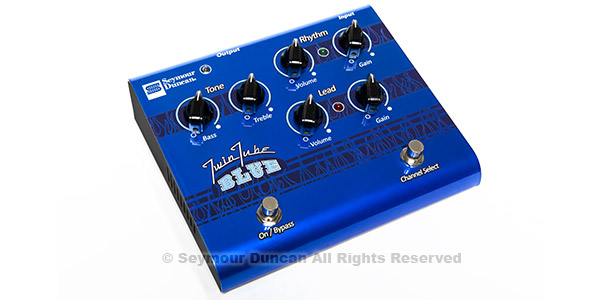
Seymour Duncan Twin Tube Blue Image c/o Seymour Duncan
Seymour Duncan is known for its outstanding pickups, and I’ve known they’ve made pedals for awhile, but haven’t really paid attention until they came out with the Twin Tube Blue (SFX-11). This is a very cool little preamp/overdrive box that sits – gain-wise – right in the middle between their Twin Tube Classic and their Twin Tube Mayhem.
Run by two 6111 mil-spec, USA Philips-Sylvania tubes, the Blue can get you some nice, pre-amp snap, to sweet, sustained gain. Here’s the description from the Seymour Duncan site:
Too often, inexpensive tube gear runs in “starved plate mode,” where the tubes function like clipping diodes and do not actually amplify. The Twin Tube Blue’s high-plate voltage and 100% vacuum tube signal path allows the tubes to operate at their fullest potential and provide maximum dynamic range. This means you get the most gain and all the smooth tone you expect from a high-quality tube preamp. Two channels provide versatility. Like all Seymour Duncan stompboxes, the Twin Tube Blue is true bypass and features a fully encapsulated toroidal transformer for quiet operation. Heavy duty steel chassis.
Wow! I can’t believe that in all this time, I haven’t reviewed a speaker! I’ve focused so much on amps and guitars, and pedals, and other kinds of gear, yet I haven’t even touched upon this particular subject. I suppose it’s because a speaker isn’t something you actually see – it’s a part. Now I’ve made mention of how much I like particular speakers in a combo or a cab, but never a speaker itself. I’m going to remedy that now.
The cool thing about testing gear for someone, namely Jeff Aragaki of Aracom Amps is that in order to effectively give feedback on the gear you’re testing, you have to play it in different configurations. I’ve played a lot of Jeff’s amps through various combos and cabinets to get a feel of how his amps sound.
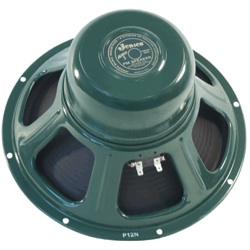
When I was testing the Aracom VRX22 prior to its release, Jeff installed a Jensen P12N in a cabinet for me to try out. In short, it was love at first strum! The P12N has to be one of the most musical speakers I’ve ever played through. It has a real punchy midrange that is balanced by a real smooth low-end response. The highs are present, but not overdone. The tone is – for lack of a better word – versatile.
To me, that versatility is its strength. The cleans are pure and chimey, whether you’re playing single coils or humbuckers, and the overdrive tone, again, at least to my ears, is to die for.
The P12N is actually a re-issue of the famed P12N from back in the ’60’s. Some claim that it’s shadow of the original with respect to tone, but tone is such a subjective thing. For instance, there are those that rave about the Celestong Blue. I’ve played through that speaker, and frankly wasn’t all that impressed by it. It could’ve been the amp/cabinet/speaker combination just didn’t work very well. In spite of that, it was nice, but just not all that special to me.
On the other hand, the P12N in the custom cabinet I got from Aracom sounds so incredibly smooth and lustrous. Granted, it helps that before Jeff installed it in my cabinet, it had already seen many hours of use: About two weeks straight from me alone, and several test runs from a variety of guitarists playing everything from blues to modern alternative rock. In short, the speaker cone was already somewhat broken in. As an aside, I hate breaking in new speakers. To me they’re all harsh-sounding out of the box. But I can tell that with my P12N, if it sounds sweet now, in a few months to a year, it’s going to sound even better!
How It Sounds
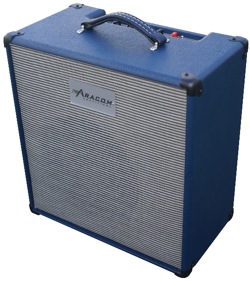
In a closed back cabinet, the bass response really shines, but never overpowers. And with an overdriven amp through a closed back cabinet, the distortion is tight and ballsy, yet not so thick that you lose clarity. In my custom Aracom 1 X 12 cabinet, when it’s closed, sometimes I think I’m playing through a much bigger amp. The tone is just so tight and well-defined. And for rockin’ songs, the P12N in a closed cab well, rocks!
With an open back cabinet, the P12N brings on the chime, especially with single coils. It’s 11:15 right now, and I actually started writing this article around 10pm. But I kind of got carried away jamming on my Strat with the back opened on my cabinet. The tone was so voluminous; much more open, and it was like each note just kind of hung in the air. The overall tone also brightens up significantly, with a definite emphasis on the midrange, which I love.
So which do I prefer? Closed back or open back? Actually, neither. Each brings its own unique qualities to the table, which now obviates the need for me to get a second cabinet from Jeff so I can play both simultaneously, which would sound totally awesome. 🙂
But, be aware that this speaker is not cheap. At retail, the lowest I’ve seen it is $220. But I do have to say that it is worth every single penny! Mind you, that is with the bell cover. I’m not sure about the tonal differences between having a bell cover versus not having one. All I know is that the P12N with the bell cover sounds absolutely dynamite!
Here’s a clip that I recorded to demonstrate the VRX22, but the P12N was used in all guitar parts. The rhythm parts were played through an open-back 1 X 12 cabinet, while the lead was played with the back of the cabinet closed:
For how awesome this speaker sounds, it gets a 5 Tone Bones! For more information, visit the Jensen site.
Yeah, yeah, I know… My last few posts have pretty much centered around this amp, but hey! I just can’t contain my excitement about how good it sounds! This afternoon, I brought it to my weekly church gig to try it out in a live situation. I already loved it in my little home studio, but you just don’t get to really know what am amp can do until you play it live.
Today was one of the first days that I didn’t use my pedal board all that much. In fact, I only used my chorus on one soft song, and then only used my booster at the very end of last song to throw the gain over the top to finish off the service. Other than that, I just played the amp straight. Most of the songs I played were through Channel 1, and with my Strat, the VRX22 delivered gorgeous, bell-like tones that seemed to hang in the air, with so much presence that you could almost touch them – it doesn’t even have presence knob to up the mids and highs! Switching over to Channel 2 for a couple of numbers, I was rewarded with layers of open and complex overdrive that were so very smooth; none of that phasing in and out that you often get with lesser amps at high gain. It stayed nice and even. And the sustain and touch sensitivity at high gain was just to die for – all on a Strat, no less!
When I slammed the front-end with my booster pedal, I was in compression heaven! But luckily the 6V6’s don’t compress so much that they make the amp lose volume. The compression is noticeable, but the gain tone stays fairly open. It tightens up, but not too tight.
I’ve tested several Aracom amps, and they’re all very sweet sounding. But the higher wattage amps need tons of volume before they really start sounding good. The VRX22 is so versatile. With a 1 X 12 cabinet, it can be used with ease in small to medium-sized venues, like clubs and small halls. For larger venues, a bigger cab will get you the volume you need. On top of that, both the amp and cabinet are pretty light in weight, making lugging to and from a gig real easy!
Summary: This brand-new 22 watter is the newest in the Aracom low-wattage amp series now called the Vintage Rox or VRX series, which includes the original RoxBox 18 (now called the VRX18). Loaded with a pair of 6V6 power tubes, this amp oozes vintage American clean and dirty tone ala Stevie Ray Vaughn.
Pros: More clean headroom in Channel 1 as compared to its EL84-based 18 Watt sibling. And despite its lower wattage rating, this amp is capable of getting LOUD! Plus the VRX series sports what I think are the best power switching and master volume in the business!
Cons: None.
Price: $895 Head / $995-$1095 for Combo (dep. on speaker)
Specs:
– (2) 6V6 Power Tubes
– (3) 12AX7 Preamp Tubes
– S.S. Rectifier with “sag” circuit
– Hi/Low B+ voltage switch (22/10 watts)
– On/Off Switch
– Indicator Lamp
– Custom Heavy Duty Aluminum Chassis
– Custom Wound Transformers
– 4, 8, 16 ohm Speaker Jacks
– Custom Handcrafted
Turret Board
– HandwiredTone Bone Rating: 5.0 – Jeff Aragaki has hit the ball out of the park with this amp! I loved the original RoxBox 18, and gave it a 4.75, but with this amp, Jeff “fixed” the harshness of the breakup at lower volumes. To me, it’s the perfect amp!
Let’s roll back the clock a couple of months. I get a call from Jeff Aragaki. The conversation went something like this…
“Hey Brendan! How’s it going?” asks Jeff.
“Not bad. Howzit with you?” I ask.
“It’s going good. Listen, I’m experimenting with a new tube compliment for the RoxBox and put a pair of 6V6’s in it to see how it sounds,” says Jeff.”
“Oh REALLY? Kinda tryin’ to get an American voicing, are ya…”
“Yeah, plus the output rating should be bit higher at around 22-25 Watts,” Jeff states.
“Okay,” I say, “Now you’ve got my attention. When can I try it out?” I ask.
<chuckle> “Well, I called to see if could bring it over to you for you try out and give me some feedback,” replies Jeff.
“Brand new amp? Experiment? Need you ask to see if I’d like to try it out? I’m free Saturday morning!” I exclaimed.
Fast-forward to the following Saturday, and Jeff lets me try the amp for a couple of days before he has to take it back, and I immediately start taking it through its paces. I even gig with it. I’d instantly fallen in love with it! I call Jeff and tell him that I think he’s onto something with this amp. He’s glad for the feedback, then a couple of days later, he picks it up to finish it out.
A few days later, he calls and tells me that he had to tweak the circuits a bit to handle the increased power. Uh-oh. So I asked, “Did it change the tone?”
“Hahaha… not at all. In fact it was actually running at way below 22 Watts. Since I reworked the circuitry, it has tons of power now, and it sounds even better. I even adjusted Channel 1 so you get even more clean headroom, and Channel 2 breaks up real nicely now. In any case, I’m going on a business trip to Indonesia and you can play with the amp for a couple of weeks while I’m gone.”
And play I did! That was one of the most exhausting two weeks of my life because I was up till late (like 2-3 am) playing that amp. I just couldn’t get enough of it, especially playing “Goldie” (a Saint Guitar Goldtop I recently reviewed) through the amp. And in all that time, I wanted to write a review of it, but I had agreed with Jeff to not talk about it (though I hinted a lot) until he got back from Indonesia and turned it into a production amp.
Once he returned from Indonesia a couple of weeks ago, he came over to pick the amp up. He asks me the usual questions about how I liked it, and I just said, “Jeff, this is a PERFECT amp! I can’t say anything bad about at all. Channel 1 is gorgeous and works great with pedals. Channel 2 just rocks the house! It’s the channel I used the most, and it’s also real pedal-friendly. And for once in my life, I’m at a total loss for words; that’s how much this amp affects me to the core.”
Jeff just laughed, and said, “Well, I’ve got a couple of other amps for you to try out…”
I cut him off, and told him that it’s fine if he wanted me to review them, but as far as what amp I’d choose to go with for my personal amp, the VRX22 was it. Search over. He laughed again, and said he’d get started on it….
Okay… fast forward to yesterday…
Jeff called me up to give me a status on my amp, and that he talked to someone this past week who is also getting one, choosing the VRX22 over a well-known boutique manufacturer. So it was definitely going into production, and he was almost done with the web page and announcement. Of course, I couldn’t keep my mouth shut and immediately wrote an announcement, despite his recommendation to wait until today). 🙂 I just promised I wouldn’t say too much, which I didn’t because I wanted to write a review.
What’s in a name…
To create alignment in the series, Jeff has renamed the “RoxBox” line to the “Vintage Rox” or VRX series. If you recall, the original RoxBox 18 sported a pair of EL84 power tubes and is now called the VRX18; and the only difference between the two amps is that the VRX22 employs 6V6’s and circuits that can deal with the increased power. In essence, with the VRX series, Jeff is providing both British (VRX 18) and an American (VRX 22) voicing options. The EL84-based VRX18 breaks up very similarly to a VOX AC15, with a lot of high-freq shimmer. The VRX22, on the other hand, breaks up like a classic Tweed. Frankly, once I have the bucks, playing both together will sound absolutely awesome!!! And priced at $895 each for the head models, that’s A LOT cheaper than a single hand-wired amp from most boutique manufacturers.
Hand-wired goodness at an affordable price
I can’t stress this enough: The thing that originally blew me away with Aracom Amps was the price of the RoxBox. I couldn’t believe Jeff could sell a hand-wired amp for less than a grand – even with a solid-state rectifier! As I’ve gotten to know Jeff, and I’ve come to understand one thing about him: He’s an incredibly shrewd businessman. As he shared with me this morning, “It’s a matter of philosophy. Some guys make boutique gear, give their stuff a nice paint job, then charge a bunch of money for their gear. Then there are other guys who just want to make a few bucks off their gear, but sell it at a lower price so more people will play it.”
The net result is that we consumers reap the rewards of that philosophy, and probably one of the reasons why Jeff’s amps are starting to gain a lot of traction in the industry. And artists have started to find out about Jeff’s amps. Gene Baker of B3 Guitars fame plays an early-model Evolver, and just recorded his new album using the Evolver in all the songs. Obviously, a guy like this who gigs all the time is a believer. I’m nowhere near Gene’s abilities, but I totally dig his amps – I think you can tell. 🙂
How It Sounds
I’m not going to rehash features here, since the features are the same as the original RoxBox 18 that I reviewed a few months ago. Again, the fundamental difference is the use of 6V6’s.
If you’re looking for a classic American tone, this amp is it. Yeah, you COULD go with a classic Tweed from Fender or other boutique manufacturers. But you’d pay way more for the sound. But I also need to qualify that. The tone is “American-like.” It has a voicing that whether Jeff stumbled onto it or not, is a voicing that is at once familiar, but all its own at the same time. To me, I don’t give a rat’s ass about the power rating of this amp. All I know is that it sounds like nothing I’ve played before. That’s the feeling I get with the Reason SM25, which is another 6V6 beauty, but has a sound all it own.
Channel 1 is bright and gorgeous. It’s chimey as you’d expect from a classic Tweed sound, but it’s amazingly very lush as well – which is where this amp is really distinct. The words that come to mind with this clean channel are “subltely sensuous.” It’s not like a hot chick dressed in a tight mini skirt. It’s more akin to a gorgeous woman dressed in a simple cotton summer dress who doesn’t need any makeup to enhance her looks, and she has nothing to prove. She just looks to be all-woman. The net result is that you’re just drawn into aura without really knowing why – nor caring. The clean channel of the VRX22 has a similar effect on me. It’s just a gorgeous tone with any guitar (though I especially loved play “Pearl,” my Strat through it. The raw tone just draws you in, and when you add effects, it just handles them beautifully.
Channel 2 is also bright and ballsy, but its breakup is incredibly smooth. This is the channel where I think Jeff has really hit the ball out of the park. One of the things that has bugged me about the power tube distortion in a lot of Tweed-types of amps is the harsh grind from the power tubes that you oftentimes have to tame with some filter cap and capacitor changes – it’s a bit too open. Not so with this amp. The “hidden” gain stage that acts as a tube overdrive pedal that’s always on helps smooth out the distortion by making it a bit tighter, but not so much that you lose that openness that you expect from a Tweed-type amp. I loved slamming the front-end of the amp with tons of input gain, and pushing both pre-amp and power tubes at the same time. Talk about compression and sustain!
Here’s a clip I used for my review of “Goldie.” The amp is in Channel 2 for the lead, and I added just a tad of Tube Screamer to get a more punchy midrange response. The TS overdrive was maybe at 10 am – not much at all. Plus I layered on some reverb with my Hardwire RV-7 Reverb. The bulk of the breakup came from the amp. The rhythm track was recorded with Pearl on Channel 1.
Man! I just listened to that track again, and can’t get over how great the amp sounds. Normally I record at bedroom levels, but I wanted the amp to move a bit more air this time, and I recorded it at gig levels (for me, that’s around 90-100db, so it’s fairly loud but not over the top), and I used a ribbon mic to pick up the ambient a bit better. The mic was placed at a 45 degree angle along the speaker cone about a foot and a half away from the amp.
Overall Impression
I just can’t rave about this amp more! To me, it’s the perfect balance of tone and power for practically all my needs! I’m getting the head with a 1X 12 cab, both wrapped in that awesome blue tolex that you see in the picture above!
Admittedly, the purist in me originally scoffed at the idea of a solid-state rectifier in the original RoxBox series. But as I told Jeff this morning, what people are typically after is the voltage sag you get with a tube rectifier. Jeff has built a custom “sag simulator” circuit that does the job so well that frankly, I can’t tell the difference. Besides, it’s what the amp sounds like that counts, not necessarily its components. Look at the classic Roland JC-120. That has to be one of my all-time favorite amps – even Satch played with one for years. It’s completely solid-state and it sounds freakin’ awesome!
But circling back to the VRX22. You can’t go wrong with this amp. Yes, it’s priced for value, but the tone that you get for that far surpasses anything that I’ve played at these lower wattages.
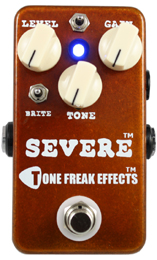 Released in May (how did I miss this?), the Severe is “Tone Freak Effects’ answer to high gain distortion.” Oh man… This looks like a incredibly mean pedal. Set up like the Abunai 2 with a 3-way clipping switch, with level, gain, and tone, the Severe also sports a 3-way bright switch so it can be used with different amps. Very cool.

 Guitar Gear