Feeds:
Posts
Comments

Posts Tagged ‘fender’

There’s something about “Fender” and “high-gain” that seems like an oxymoron. Most people equate the Fender tone with lush cleans and open, low-gain overdrive. They’ve tried to break into the high-gain market in the past with the ProSonic and SuperSonic models, and they haven’t fared too badly, considering the likes of Matthias Jabs of the Scorpions uses a ProSonic. But it’s hard to break through an image, decades-long in the making.

To help “cut” (pun intended) through that image, Fender recently released the new Machete. This is a two-channel, 50 Watt, 1 X 12 combo that has the capability of producing the classic Fender cleans we all know and love, to some very high and over-the-top high-gain tones. Each channel has independent 3-band EQ. But there are other features that will help players dial in their tones such as an input pad switch for use with guitars with active pickups; a Notch control that changes the midrange point, and a Damper control to roll off highs.

All in all, this is a pretty smart offering from Fender. Here’s Fender’s official demo video:

It’s very cool-looking with that 60’s-70’s, black, retro styling. But it does cost around $1900. That’s actually not too bad of a price, but it’s not cheap either. That’s the other image thing with Fender. They’re known for inexpensive gear relative to their competition. I suppose if they’re competing against the boutique manufacturers, then they’re staying true to that practice. However, most popular boutique amps follow a more vintage path to tone.  I suppose they could be going after Soldano and Hughes & Kettner for high-gain.

No matter, it’ll be interesting to see how this amp fares in the market.

Read Full Post »

This morning, I ran across this article stating that Fender has filed with the SEC for a public offering of $200 Million. $100 Million of that will go to pay down debt; currently Fender has a debt load of $246 Million. The other $100 Million will be used to grow revenue.

Personally, I have mixed feelings about this. For one, I’ve seen and been involved with companies that have gone public. There’s nothing that kills innovation and creativity more than going public and having to answer to Wall Street and financial analysts’ expectations. Granted, those companies have been tech startups, and Fender is far from being a technology company. So perhaps this infusion of cash will help them. But the following excerpt kind of bugs me (not completely mind you, but it’s a bit of a concern):

With sales in 85 countries, Fender said revenue could get a boost from growing interest in guitar-based music from emerging markets like China, India and Indonesia. But it warned that increasing popularity of other types of music, such as rap or house, could hurt demand for its guitars.

Let’s face it: Asia is the land of cheap ripoffs and unabashed product forgery, so I’m a bit concerned about the expansion into the Asian market. However, that said, Fender has a great brand, and it can get a lot of mileage trading on that brand.

Don’t get me wrong; I really wish Fender well. I’ve got and have had several Fender products over the years, so yeah, I’m a believer. I only hope they’re not over-reaching and hope that they can maintain their quality by being traded publicly.

Read Full Post »

Just this email from Fender this morning. Usually I take my time with manufacturer ad emails, and this particular one was no exception. So I waited until a few minutes ago to read the email, and my mind stopped dead in its tracks. For on my screen in front of me was a Strat that has finally blown me away. Don’t get me wrong, I love my American Deluxe Strat. For single-coil work and especially the Kinman pickups it has, I get some freakin’ awesome tones.

But I was always thinking that I would love a Strat that had two humbuckers as opposed to the HSS; in fact, my wish was to have an HSH. My thought was that I would love a Strat that always had the fat tones of a humbucker, while still retaining that Strat vibe, and lo and behold, here was a picture of a brand-new American Standard Hand Stained Ash Stratocaster® HSH!!!

Talk about getting some serious GAS! Not only does it have the HSH pickup configuration, it has an alder body, a maple neck, and a rosewood fretboard: Exactly how I like my Strats! Fender lists it at $1569 MSRP, but I’ve seen some stores online advertising it pre-order for $1149.

You can read details on the Fender product page.

Damn! Just when I was over my latest GAS attack with my DV Mark Little 30 L34, here comes more gear that’s seriously – and I mean seriously – giving me GAS.

I’ll take the Wine Red one, please!

Read Full Post »

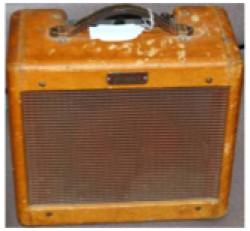
This morning, I was taking stock of gear that I hadn’t played in a awhile, and saw my little ’58 Fender Champ sitting on my workbench. I hadn’t played it for several months. So I hooked it up, and started playing. Now mind you, I’ve had some serious work done on it. I had to have the leaky caps replaced, and I had the amp set up with an A/B switch so I could bypass the stock, internal speaker and use a different speaker cabinet if I wanted. Plus, my good buddy, Jeff Aragaki lent me a custom tweed cabinet that he built that houses a Weber 10″ Alnico speaker.

After getting it all hooked up (I ran the amp into a 1 X 12 with a Jensen Jet Falcon speaker), one thing struck me right away after playing my Strat through it. To me, this is THE classic Tweed sound. But it is also the perfect platform to record completely raw signal, then tweak, which has been done in lots of studios over the years, as a Champ was used to record all sorts of rock and roll.

Take, for instance the following recording:

This was recorded straight into my computer with no EQ, no nothin’ attached. It’s a clean, dry signal that simply captures the tone of my Strat. But apply some reverb and delay effects, some compression, EQ, and that plain signal becomes something else entirely. Here’s the same track, but this time, I’ve textured it with reverb, delay, compression and EQ.

Had the compression make-up gain a little high, so there’s a tiny bit of clipping, but what I was able to get was a super-rich and full sound.

Even dirtied up, the Champ is simply a great platform. Here’s a raw clip of the Champ completely cranked up:

Again, this is simply a fantastic platform from which to shape the guitar sound. So, in this next clip (which again is the same track, but tweaked) I added some compression, reverb, a tiny bit of stereo delay and beefed up the lows with some Fat EQ:

It’s no surprise to me why so many studios have these Champs in their amp lineups.

As for gigging this bad boy, I always run it through speakers that have a good bottom-end response. What results is a nice, scooped tone – VERY American tone-wise.

Anyway, if you can find one of these, get it. Or you can get the ’57 Champ re-issue, which lots of players love. Me, I got mine for $700 (that’s the actual picture of the amp above), and spent roughly $200 on getting the caps replaced and putting in some NOS tubes. Still comes out under the price of the ’57 reissue.

Read Full Post »

If you read this blog regularly, you know that I wasn’t too excited about Fender’s ’57 Champ re-issue. But in a collaboration with Eric Clapton, the Fender custom shop has come out with three new tweed amps that I think are worth a good look. Here the verbiage from the site:

In a historic collaboration, Fender introduces its first artist signature amplifiers—EC Series amps bearing the name of legendary guitarist Eric Clapton. Built to the exacting specifications of Clapton himself, the three amps—the EC Twinolux™, EC Tremolux™ and EC Vibro-Champ®—are fascinating variations on their original ’50s-era ancestors (the ’57 Twin™, ’57 Deluxe™ and ’57 Champ®, respectively), and are our answer to his call for special models with distinctive features.

Handmade in the United States, all three amp models feature ’50s—era output tube bias tremolo (which produces a more throbbing pulse than later Fender tremolo circuits) and a switchable power attenuator (reduces speaker output), in addition to other premium features. In a historic career now in its sixth decade, Eric Clapton has long been known as one of the world’s foremost exponents of classic Fender tweed amp tone, and the three new amps bearing his imprint present the pinnacle of personally inspired amp tone for stage and studio alike. Each is a must for Clapton fans and guitarists who want the ultimate in tweed tube amp performance.

I dig that each has a built-in attenuator, and each has tube tremolo, which I totally dig. I have a tube tremolo on one of my Aracom amps, and it is suh-weet!

For more information, check out the Fender site!

Read Full Post »

My American Deluxe Strat is the very first Strat that I actually liked. A lot of it has to do with the pickups, which are Kinman Hx noiseless single coils. These have a bit more output than stock Strat pickups and they make a HUGE difference in the tone of the guitar; fattening up the sound significantly.

Traditionally, I have absolutely abhorred the middle pickup of Strats. To me, with the stock set, though it is mid-rangy, which is a tone I like, I always felt the middle pickup was a little lifeless. Even EVH with the Frankenstein removed the middle pickup, and replaced the bridge pickup with a humbucker I suppose to fatten up his tone. With my Kinmans, the tone is not quite ‘bucker-fat, but it is much fatter than the stock pickups. As for the middle pickup, it’s my favorite pickup on the guitar when I’m playing with distortion. It produces tons of mid-range that cuts right through a mix.

Plus, at least to me, it has the best balance of sustain and fatness to simply be an ideal pickup. Take this demo that I recorded this morning called “The Way The Truth The Life:”

I actually recorded this a few years ago, but couldn’t get a groove with the song. So I finally got it put together, and after I recorded the acoustic guitar and piano parts, realized that it needed a driven electric guitar sound; specifically, my Strat through a cranked Marshall. 🙂 To be honest, I tried recording with the neck pickup which is my usual go-to pickup, but that was way too fat, and the bridge pickup was way too thin. But the middle pickup was just right… (yikes! sounding like Goldilocks and the three bears).

When I spent time with Doug Doppler way back when, he talked about the middle pickup being one of his favorites. I personally didn’t “get it” at the time because up until that point, I hadn’t heard a middle pickup on a Strat that I liked. But after recording this song, I’m sold. When I want a smooth drive with lots of mid-range, the middle pickup is it!

Read Full Post »

Just got an e-mail from Fender today, announcing the 60th Anniversary of the Telecaster. They’re calling it their “Tele-bration.” Nice. The beauty above is called the “Modern Thinline” Tele, and it’s an absolutely gorgeous guitar! Fender calls it a chambered body.

In any case, in honor of the 60th Anniversary, Fender is releasing special edition models throughout the year; some of which you can see here. One of the models that has particularly caught my eye is the “Old Growth Redwood” model. This is made from salvaged redwood from old buildings, and has the knots and nail holes from those buildings to give the guitar a really distinctive look.

MSRP on all these guitars is $2499, so count on street prices being around the $1500-$1800 price mark. That’s very attractive pricing for these models. 🙂

BTW, I found a GREAT video demo of the Old Growth Redwood model from none other than Andy @ ProGuitarShop.com:

Read Full Post »

5 Tone Bones - Gear has stellar performance, value, and quality. This is definitely top of the class, best of breed, and it's a no-brainer to add this to your gear lineup!

cb_tele

Squier By Fender Classic Vibe Telecaster 50’s

Summary: Finally! An inexpensive guitar that isn’t just a pretty face like many cheapo guitars. This guitar backs up its great looks with great sound and playability!

Pros: Spectacular, lush cleans from the neck pickup. Nothing twangy about this guitar. The bridge pickup is nicely “trebly,” but not piercing at all! The thin, 50’s-style C-shape neck is to die for!

Cons: This is just a minor nit, and nothing to give points off, but the frets are a little small, and with heavy use, they’ll wear down. But hell! At this price, you can buy two and be way ahead of the game!

Features:

  • Body: Pine (very cool)
  • Neck: 9.5″ Radius, Solid Maple
  • 21 Frets
  • Pickups: 2 Custom-Style Vintage Tele Pickups with Alnico 3 magnets
  • Controls: Volume and Tone
  • Tuners: Vintage-style tuners

Price: ~$349 street

Tone Bone Score: 5.0 – Not sure if I’ve ever rated a Fender product my highest rating, but that’s how good this guitar is!

Being the eternal optimist, I’m always looking for ways to turn a negative into a positive. As I’ve gotten older, my back has started to get a bit sensitive, and gigging with heavy guitars can sometimes be – literally – a real pain!  So I’ve been looking for a lighter alternative that would give me a good range of sounds, from great cleans to hot grind when I need it, and something that I could comfortably gig with and not worry about throwing out my back. I’ve found the guitar: It’s the Squier Classic Vibe Tele! If you don’t look at the headstock, you could swear you’re playing a regular Fender Tele! But this one has a great sound all its own. After last year’s price hike, I had lost hope that Fender would be able to produce anything that was inexpensive that had decent quality and sound, but I stand completely corrected, especially after the price drop of the Champ 600 down to $149, and now, this little secret, the Squier Classic Vibe Tele.

Fit and Finish

The guitar I played today was so well-made, I could’ve sworn that it was an American Tele. The blonde, vintage finish was luscious, and the 9.5″ radius vintage C-shape neck, with its gloss finish was perfect. No air bubbles, no uneven finish. The frets were well-dressed, if a little small, and I could detect nary a burr or sharp edge. It was obvious that despite this being a “bargain” brand, great care was put into building this instrument. Of course, only time will tell how well this instrument holds up, but from what I can tell from this brand-new specimen, it appears it’ll be be a long-lived instrument.

I also love that black pick guard that provides a very cool contrast to the blonde body finish! Nice!

How It Sounds

I’ve played a lot of guitars – especially “budget” guitars, but one thing that seems to be a common theme among the bargain guitars is that lots of them look great, but plug them in, and they’re less than – ahem – inspiring. This is where the Classic Vibe Tele stands head and shoulder above the rest. If I didn’t know better, I’d swear this was an American Tele based upon the quality of tones it produces. But unlike its American cousin, this Classic Vibe Tele has a slightly different tone, and that is not a bad thing at all. A lot of this can probably be attributed to the solid pine body. It’s very resonant, and it is not a bright-sounding wood, which probably accounts for the lack of “Tele” twang. It’s there, but it is definitely not as pronounced as I was expecting. Granted, I was playing through a Fender Hot Rod DeVille 2 X 12, which is known for its ample bottom, so that probably could account for the lack of twang. But hey! That is definitely not a bad thing at all!

The neck pickup, when played clean, has a very Strat-like neck pickup vibe. I love that! It’s smooth, and deep, and when slathered with some gorgeous Fender reverb, has a gorgeous, almost ethereal quality where the notes seem to just hang in the air. The bridge pickup adds top-end sparkle, as expected but surprisingly not so much that it sounds thin and tinny. It’s a slightly brighter version of the neck, which makes sense since the two pickups are the same. But quite frankly, I liked playing in the middle selector position where both pickups are engaged. The tone and gain balance between the two pickups in that position is fantastic.

“Balance” is a great way to describe the tone of the Classic Vibe Tele. It sounds and feels balanced; not bright, not deep. Balanced. And the sustain is absolutely breathtaking! I played a song where I comp chords up and down the fretboard with lots of sliding, bending and vibrato, and the sustain and ring that the guitar produced just made me close my eyes and smile. The guitar guy at the store even chided me with, “Aw Brendan, you play so sweetly!” That got a laugh out of me, but luckily he followed it up with, “That sounds so awesome. That guitar… for guys who are in the know with tone, is the one they’re getting. It’s a great guitar at any price” I’ve known this guy for years, and for him to say something like that is pretty profound.

I didn’t get a chance to really get into high gain, as I was in a store and wanted to be considerate of the other customers, but getting into the Drive channel of the DeVille was a real treat, especially with the bridge pickup engaged. I could tell that this guitar, even though it has that vintage vibe, would produce some singing overdrive. Even with the preponderance of pre-amp overdrive I was using, this guitar was a winner for me!

Overall Impressions

It is absolutely no surprise to me why Guitar Player Magazine gave this guitar an Editor’s Pick in this month’s issue. I first played the guitar at the GP offices a couple of weeks ago, and they told me it had gotten an Editor’s Pick. I didn’t get a chance to really play with it then, but based upon that conversation, I had to try one out. Looks like I’m GAS-ing again, dammit! This is one great guitar! Don’t let the price fool you; instead, let the price guide you. This is truly one of the deals of the century!

Read Full Post »

Fender Champion 600 Re-issueAs much as I have been ranting about Fender gear pricing as of late, and their latest “supposed” price drop (who knows for how long), my Champ 600 has been a tried and true companion in my studio ever since I got it. I’ve even used it at small venue gigs hooked to a 1 X12 cab, and it has performed wonderfully! This is a great amp!
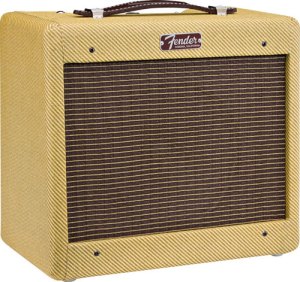
Anyway, As I was doing a bit of research on the Fender price drop, I happened to go to GuitarCenter.com and couldn’t believe the pricing of the Champ 600 there! At $149, this is even cheaper than what I got it for two years ago!

Folks, this is phenomenal! While diminutive in size, this amp packs tone! You want classic Fender tone at a lower volume for home recording or just futzing around, this is the amp to get! And because it’s a low wattage amp, you can push it and not worry that your eardrums will start to bleed.

For my own purposes, this has been one of most pedal-friendly amps I’ve ever owned, so I retubed it with a NOS JAN-Philips 12AT7 and a JJ 6V6 to get maximum clean headroom out of the amp. Now, I have to open up the amp full to get even mild breakup. But that’s why I have my OD pedals. My thought behind this is that I want to get as pure character out of my OD’s as possible, so playing through a really clean amp will accomplish that.

So what’s the point of all this? As I mentioned above, this is a GREAT amp, and at $149, it’s a steal. Go get one at GC today!

Here’s a sample I recorded with the amp hooked up to my 1 X 12 extension cab:

Disclaimer: I’m not in any affiliate program with GC, so I get nothing out of announcing this. 🙂

Read Full Post »

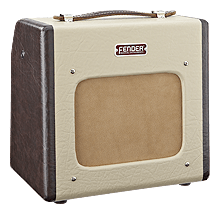
Fender-'57-Champ-Reissue

I’ve had a love/hate relationship with Fender over the years. When I’ve loved Fender, I’ve really loved them, and when I’ve hated them, I’ve really hated them. Right now, I’m really hating them. I’m just aghast at the prices they’re charging for their new gear! This Champ ’57 Reissue from the Fender Custom Shop lists at $1295 with a street price of $999! This for a 5 Watt amp with a diminutive 8″ speaker.

Make no mistake: The parts for this cost less than $400! This pricing is absolutely outrageous. Yeah, I’m familiar with its history, blah, blah, blah. And even though I’m no electronics dude, and couldn’t possibly construct an amp myself, I know a few manufacturers who build hand-wired amps with more power and GREAT sound for even less!

Take for instance, the Aracom VRX22. This is a hand-wired, 22 Watt amp that simply kicks freakin’ ass, and the head sells for $895! Then, there’s the upcoming release of the Reason Bambino. This is an 8 Watt amp that will sport that distinctive Reason sound. This head costs $699! It’s my next amp.

I’m sorry folks, this is the same issue that I had with the Fender Roadworn series of guitars. I’m not really in to reliced guitars, but there’s no way I could justify paying $999 for a freakin’ MIM guitar, especially when I paid less than $400 a couple of years back for my MIM Strat.

MAYBE Fender’s production costs are much higher than the smaller run manufacturers (not likely), which is how they justify the price-point for this amp. But this amp is nothing special from my point of view, and as I mentioned above, the parts for this cost less than $400. Lots of people have built 5F1-based amps. Look at the Valve Train Amps Concord. This is a 6 Watt point-to-point, hand-wired combo with a 10″ speaker. It sells for less than $500.

Go ahead, you can argue all you want about the classic sound and history of the Fender ’57 Champ reissue. But to me, Fender’s just again trying to trade on nostalgia. If that’s what floats your boat, more power to you – and mind you – I’m not questioning the quality or the tone of this classic. It has done much to contribute to the sounds of rock and roll. I just want to make it very clear that there are clear alternatives out there that may not have the name but undoubtedly have great tone, and watt-for-watt, and dollar-for-dollar have A LOT more value.

Note that I have the Champ 600 and it is one of my all-time favorite amps. But it has limited usability outside of my home studio. And that’s another thing that bugs me about the ’57 re-issue. It’s a hefty price to pay for an amp that would see limited if any use outside of my studio.

Like I said, if this floats your boat, and the price of this classic reissue, more power to you. For me, I demand a lot more value for the money I pay.

Recent Update

I’m still not sold on this amp, even though I have indeed played it, and it has some real vintage mojo. The sounds it produces are fantastic, but I still can’t justify buying it for the price Fender wants for it. Besides, I’ve seen some late-50’s originals that sell for the same price on EBay! I would buy one of those before I’d buy the re-issue.

Read Full Post »

« Newer Posts - Older Posts »