Feeds:
Posts
Comments

Posts Tagged ‘GAS’

Okay, boys and girls… After announcing this guitar over a year ago, Gibson has finally released the Firebird X er… system. Not just a guitar, this baby packs built-in effects, completely on/off switchable and coil-tapped pickups. It also includes a piezo pickup for getting an acoustic sound. But wait! There’s more! The pickups can be switched to run in series and parallel. But we won’t stop there! The on-board effects can be controlled by sliders on the upper bout of the body, and with the included switch pedal, you can activate those effects.

But just to make sure Gibson didn’t forget anything, they also include an expression pedal for the effects. By the way, the effects are all programmable via USB interface to a computer. Oh yeah… There’s also a boatload of software included.

Even the case is revolutionary (Gibson’s words). It’s lightweight, and includes the obligatory straps, but it’s strong enough to withstand a fall from a six-story building (I wonder if that’s with the guitar in it). 🙂 Oh! And let’s not forget the robot tuning system.

So what’ll all this cost? Supposedly, somewhere in the neighborhood of US$5500.

My thoughts? I’m not sure. It’s certainly very cool. All this in a 7 pound guitar! Wait! It’s not a guitar, it’s a system! 🙂

It certainly is a system, and mind you, I only mentioned a fraction of the features of this guit… er… system. The technology that has gone into it is pretty amazing in both breadth and depth. That, I can’t deny. And to have your pedalboard right in your guitar is pretty freakin’ cool – ala Matthew Bellamy of Muse.

There’s a part of me that says this screams of overkill. But on the other hand, it’s not as if this guitar will be a high-production model. It’s a limited edition. But who knows? If demand is high, Gibby may turn it into a sales platform.

Also, for myself, and myself only, I just want to play. I’m not sure that I’d want to spend a lot of time niggling over effects patches. And besides, though the effects may very well be good – perhaps even awesome – I’ve got the effects I like on my board, and for the most part, especially for my modulation effects, I rarely change where they’re set to (well… except for my Deep Blue Delay).

Don’t get me wrong. I’m really not trying to be cynical here, but something like this would take me awhile to dial in. Like I said, I’d rather pick up a guitar and just start playing, knowing what sounds the guitar will make.

For more information, check out Gibson’s Firebird X site!

Read Full Post »

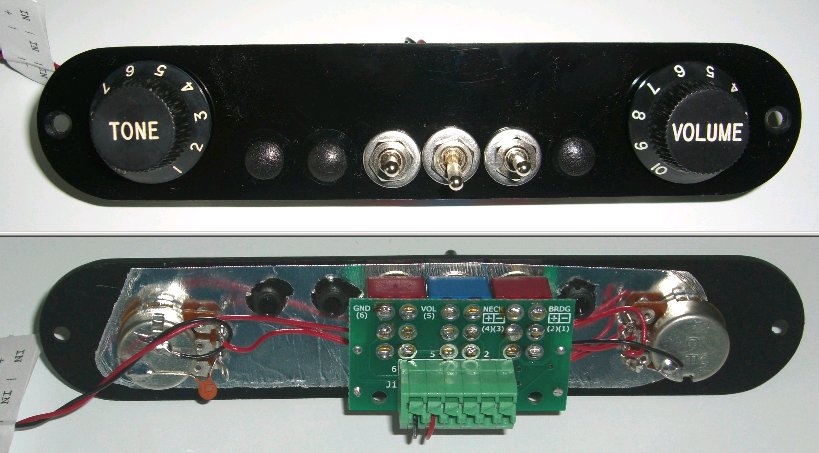
Awesome Guitars TCP-T2 Telecaster Control Plate
Summary: Want to expand the tonal possibilities of your Tele? This solderless control plate assembly will give you six distinct tones.Pros: Undoubtedly, the pros here are that you’re going to get tones that you’ve never heard from your Tele.

Cons: Not quite as easy to install as advertised – but what is? One of the bridge settings created a far too thin and reedy tone for my liking. As there were no instructions to be found as to what switch does what, it took awhile to figure out the different switch settings (though note that the wiring diagrams are all available online).

Features – Check out the link above…

Price: $127.97 direct

Tone Bone Score: 4.5 ~ Though I didn’t like that one setting for the bridge pickup, I do like the fact that I have a couple more very usable tones for my Tele.

I’m pretty wary of hyperbole, especially when it comes from a manufacturer. So when Awesome Guitars contacted me about their products, I was a little dubious, especially since the original email read like an Adam St. James guitar lessons spam. It’s not that I doubted what their Tone MultiplierTM could do, it was the delivery that made me a bit wary. But having an open mind, I replied to see if they’d send me a control panel replacement unit for my CV Tele. I got a very quick reply saying they’d send one right away. That was about six weeks ago. Due to vacation, and leading a busy life in general, I didn’t get the unit installed until recently, but since then, I’ve been messing around with my Tele a lot, and have played it in a couple of gigs.

So what’s the verdict? The manufacturer’s claims of the products being life-changing aside, this is a solid product, and something that I’ve been able to put to use. To be fair though, the unit I tested will only give you 6 different tones. But with dual humbuckers, the other products they offer will give you up to 68 different tones! Pretty amazing stuff.

Ease of Use

Okay… so you lose the sliding 3-position switch, which is replaced by three mini-toggles. On the surface, that might seem to be a burden, but once you’ve played around with the system, it’s fairly easy to get to the tones you want. Even without the instructions, I was able to figure out the functions of the switches relatively easily, and was up and running- and gigging – in a matter of an hour. By the end of the gig, I knew where I wanted the switches. Admittedly, it will take a little more time to switch on the fly during a song, but I was still able to do it pretty easily, if not completely cleanly.

How It Sounds

Sounds like my Tele, but with a couple of more very usable tones. I wish I had the instructions that charted what switch does what, so I could tell if the pickups were in or out of phase or serial or parallel when both are on, but I did manage to figure out the two different sounds for each different pickup combinations. In a way, I’m sort of glad I didn’t have the instructions because it forced me to explore what tones worked for me, which is probably more important than the actual knowledge of each switch configuration. That would probably be a different story if I installed the six-switch model on a dual-humbucker guitar. For that, I’d want to know what each switch is doing.

In any case, here are six versions of the same phrase with each different configuration:

Neck 1

Neck 2

Both 1

Both 2

Bridge 1

Bridge 2

With both pickups on, and switching between parallel and serial configuration (mind you, I still don’t which is serial or parallel), the tonal difference is extremely subtle, and admittedly the recordings didn’t seem to capture that, but suffice it to say that I heard a difference; but also, and more importantly, the dynamics were different. Bridge 1 setting was pretty thin – too thin for my liking, but I my favorite is Bridge 2, which gives me the full power of my bridge pickup, which I love for playing leads.

Overall Impression

At least to me, this upgrade isn’t life-altering, but it does expand the tonal palette of my Tele, and that’s a great thing, and who knows, I may find a use for the thin tone of the Bridge 1 setting. With the Neck 2 setting, I get a similar sound to the neck/middle setting of a Strat, which is jangly. I dig that sound for playing finger-style rhythm. So all in all, I’m pretty satisfied with this unit.

As for the lack of instructions, as I mentioned that’s not a bad thing, necessarily – at least the wiring diagrams were online. The site does mention that two of the switches control the pickups, the other switch controls whether the pickups are in parallel or serial. But which two and which one? 🙂 Doesn’t matter because it was easy to figure out.

Read Full Post »

The other day, I was at my good friend Jeff Aragaki’s (of Aracom Amps fame) home/workshop and noticed his ProLine multi-guitar stand where he always keeps five or six guitars. I was thinking to myself that I could use one of these in my home studio, as I have at least five guitars and a bass out at any time; especially as of late, since I’ve been recording quite a bit. All my guitars are on individual stage stands, and they take up a lot of space. I was thinking that with a multi-guitar rack, I could put out several guitars and not take up too much space on my studio floor.

But one thing that I thought about when considering a multi-guitar stand was it would be great if there was one made of wood. It just looks better to me. And wouldn’t you know it, today I received an email announcing a new company called Rock Solid Guitar Stands that make their stands out of wood. Cool! Check this out!

THAT is exactly what I was looking for in a multi-guitar stand!

Here’s the press release they sent:

———–

NEW MULTI-GUITAR STANDS FROM ROCK SOLID GUITAR STANDS
Two new models coming in October 2011.

Is your studio, family room, or living space crowded with guitar cases or single stands? Rock Solid Guitar Stands will compliment your space, and more importantly, showcase your collection at the same time. Rock Solid Guitar Stands are multi guitar stands that were specifically designed for the home or studio and designed by a collector. Your guitars and basses will truly be at home, and finally given the attention they deserve.

Unlike the typical metal multi-guitar stands out there, which are not very stable or attractive, Rock Solid Guitar Stands flow quite well in any decor in your home or studio. They are also very stable. For more information visit http://www.rocksolidguitarstands.com.

In October of 2011, we will be introducing “The Classic 4,” and “The Show 5.” These two new multi-guitar stand models will offer an alternative for players with guitar collections of various sizes.

The Classic 4 is perfect for someone with limited space. It is only 33” wide x 28” high x 18” deep.

The Show 5 is truly a unique design. Let’s face it, you want to show off your favorite guitar and have it accessible at all times. That’s why The Show 5 has a specially designed fifth slot which let’s your most precious guitar stand out and get some extra loving!
Be sure to visit Rock Solid Guitar Stands on the web in the following places:
Official website: http://www.rocksolidguitarstands.com
Store: http://shop.rocksolidguitarstands.com
Twitter: http://www.twitter.com/rocksolidstands
Facebook: https://www.facebook.com/pages/Rock-Solid-Guitar-Stands/178352512182913

———–

The stands come in three different colors: Honey, Dark Cherry, and Ivory. Personally, I like the Dark Cherry color. Also, they only weight 12 lbs.; not at all heavy, which is cool. The price is $199 direct, which might be a bit steep, but these are solid wood, not press-board. When you order one, assembly is required, but an allen wrench is provided and you’ll just need an adjustable wrench or pliers. From what I gather, the kit takes less than a half-hour to assemble.

Read Full Post »

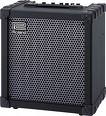
At last night’s weekly gig at the restaurant I play at, I brought my trusty Roland Cube 60. I was in a rush, and just wanted a lightweight amp that I could easily set up.

To be honest, I hadn’t played that amp for a long time, preferring to use my tube amp combos or my SWR California Blonde. But those amps are also HEAVY. The Blonde weight over 50 pounds! My Cube 60, on the other hand, weighs just 30 pounds, and is roughly half the size of any of my other combos.

But weight aside, the Roland Cube 60 is simply a great-sounding amp. Solid-state or not, it doesn’t matter. If it sounds good, then who cares about its circuitry? I was reminded of that last night. I put the amp in Acoustic/JC Clean mode and was rewarded with a gorgeous clean tone that rivaled the cleans of any of my tube amps. Admittedly, the onboard time mod effects aren’t very good (at least to my ears), so I just used my own.

And that brings me to the point of this entry and my previous entry centering on the title: Let sound guide your decisions in buying gear; not the circuitry. With respect to the Cube 60, its Acoustic/JC Clean is modeled after the venerable JC 120 amp; an amp that has proven itself over the years as a viable tone platform. Players like Joe Satriani and Albert King used this amp. I believe Satch used a JC 120 to record Surfin’ with the Alien. And it’s no small wonder these guitar greats used it: The JC cleans are spectacular. They’re not as basso as Fender cleans, being a bit more mid-rangy, but they’re gorgeous just the same.

One thing that struck me last night as well was the wide sound dispersal from that little amp. I was concerned that the diminutive cabinet would be a bit too directional, but all that worry was laid to rest when I did my sound check. The Cube 60 filled the space incredibly well, and was clear from even extreme angles. Needless to say, I’ll be using the Cube 60 for most of my solo gigs going forward.

So definitely a lesson learned once again, that it’s the sound that matters…

Read Full Post »

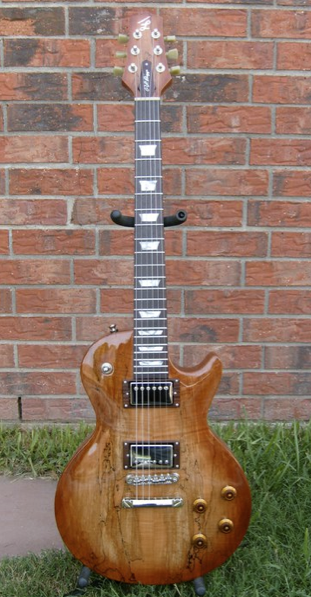
As I’ve said in the past, there’s always room for people who are good. I said it about Barron Wesley Guitars, and I’m saying it for Slash L guitars made by Perry Riggs. Look at the guitar to the left. Notice anything familiar? It’s patterned after a ’59 Les Paul with a mahogany body and neck, but with a neck-through construction. I have to tell you, Perry’s neck-through design works really well. As I mentioned in a previous article about “Lana”, his guitars sustain for days owing to the that neck-through design. Not only that, if this guitar is similar to Lana, it’ll be less than 8 lbs. (Lana weighed 6.5 lbs).

But as to the overall design of this guitar, it’s gorgeous! Of course, being a Les Paul guy, I love that shape, and that spalted maple top and the translucent tea burst finish is killer! The guitar comes equipped with Lollar Imperials (coil tapped), and has a rosewood neck. Love those trapezoidal fret inlays!

By the way, Perry doesn’t have a site, but he’s got a Facebook page (https://www.facebook.com/perry5610). Friend him. He’s uploading pictures of his build process. Very cool stuff.

Read Full Post »

A friend of mine shared with me a Top 50 list that was published by Guitar Player mag back in 2004. I vaguely remembered reading that list back then, and when my buddy shared the list with me again a couple of days ago, it reminded me of the Rolling Stone Top 100 guitarists list from a few years back.

I understand why a mag would publish a list, but you have to understand that those lists aren’t supposed to be definitive. It’s just one person or a group of people’s view of what they think is “best.” As with gear, the “top” whatever is a pretty subjective thing. One person’s top will most likely be different from someone else’s because we all have different tastes.

This leads me to the title of this entry. I think the mags publish these lists to piss people off. 🙂 To put it more kindly, I believe they post these lists simply to stir the pot and create a buzz. If you think about it, the thing that the lists ultimately do is attract visitors. Someone might see a list, then go to a forum and post, “Did you see this list? I can’t freakin’ believe what they say the top 100 is! What a crock!” Look at the Rolling Stone Top 100 list. Talk about flame bait! When that came out a few years ago, it caused a huge stir on the forums! Most people hated that list, and certainly didn’t agree with the rankings.

To tell the truth, I don’t really have a problem with “top” lists. But I know now not to get all worked up about them. They’re there simply to create a buzz. But go ahead: Get pissed off if you want. 🙂

Read Full Post »


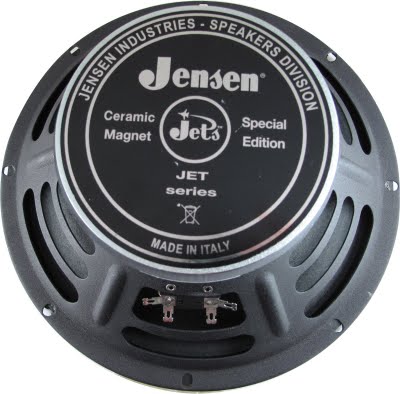
Jensen Jet Electric Lightning JC10-50EL 10″ Speaker

Summary: A single 10″ speaker is NOT supposed to sound this big! Sure, Jensen may be marketing as a real “rocker” but this speaker will absolutely KILL with any style.

Pros: Big, ferrite magnet produces a fat, bottom end that is absolutely to die for! No loss of definition, no muddiness. This speaker absolutely KILLS!

Cons: None.

Features – It would be best to check out the link above to see the specs.

Price: ~ $69.00 street

Tone Bone Score: 5.0 I’ve been using this speaker for a couple of weeks now in a little, 6-watt amp, and I’m simply loving the sound that this speaker produces.

I hate cliches. But sometimes a cliche is the only way to describe something. The cliche I’m thinking about regarding the JC10-50EL is “Big things come in small packages.” In this case, it’s a big sound that comes in a small, 10″ speaker. Every time I play through this speaker, no matter what guitar I use, I’m floored by the big sound (I know, I used that term before) that this speaker produces; not to mention the clarity. I’m so impressed with it that I’m going to put together a 2 X 10 or a 3 X 10 cabinet with these speakers in it.

How It Sounds

This afternoon, I quickly recorded a couple of demo clips this afternoon. All clips were recorded using my American Deluxe Strat, straight into my VHT Special 6 combo where the speaker resides. Note that I close-miked the amp and had it cranked! No attenuation, no sound dampening. What you hear in these clips is pretty much the raw sound with just a touch of reverb with the dirty clips (<10% wet). But I did no mastering or EQ. You’re getting the full range of sound in all the clips.

Clean (Neck pickup)

Dirty (Bridge pickup)

Dirty (Neck pickup)

Overall Impression

Like I said above, a single 10″ speaker is NOT supposed to sound this big. You normally need at last a couple of 10″ speakers to get a decently rich sound. But just one of these can move some serious air! I can’t wait to get my new cab put together!

The VHT Special 6 and JC10-50 combination is a match made in heaven, as far as I’m concerned. I mentioned in my previous gig report that I used this with my church band. That combo held its own throughout the service! Admittedly, I had to set the amp on a chair, but it worked out great!

Read Full Post »

I know, I usually do a gig report AFTER I write a review of a product, but I used the speaker in a gig yesterday, and had to write about it. First though, let’s go over some general stuff…

The Jet series from Jensen is a break from Jensen’s vintage roots to go after more modern styles of music. Having two of their Jet Falcon 12″ speakers, I readily concur. For a long time I was into vintage tone, but as the music I’ve been writing as of late has taken on a bit more of an edge, the warmth and general mellowness of Alnico just hasn’t done it for me, let alone my music. Going to speakers that have a bad-ass attitude has really helped me explore different musical depths.

When I first heard the Falcon, I absolutely fell in love with that speaker. It has a big, bold tone and is supposedly reminiscent of old “green backs.” I’ve never heard original green backs, but I do know one thing: For straight-up rock and roll, the Falcon excels!

Enter the Electric Lightning. I got an announcement from the Jensen distributor that the Electric Lightning 10 had just come out, so I asked him if I could do a review on it. He replied by sending me a speaker for review. He’s not getting it back (I’ll pay for it), and I’m going to order one more to create a 2 X 10, or maybe get a couple of more to build a 3 X 10.

If you read this blog with any regularity, you know I don’t bullshit when it comes to gear. Gone are the days when I buy something based on hype. I have to play it to see if I like it, and with the Electric Lightning 10″, I found a speaker that completely blows me away – enough so that I’m going to be buying it!

To test the speaker out, I installed it in my VHT Special 6, which has a pretty small cabinet, and I expected that the speaker would be pretty bright, considering the small resonating space, and the size of the speaker. I was completely wrong.

I happened to be working on a new song before I installed the speaker, so the I just grabbed the guitar I was using, which was my Yamaha APX900 acoustic-electric. I took one strum, and got a queer look on my face thinking, “Does it really sound that rich?” I couldn’t believe it! I started playing through a few different tunes, and I just couldn’t believe my ears! The lows that I was expecting to be subdued were big and bold, and not at all flabby or mushy. Mids were well-controlled and smooth, and the highs were nice and dynamic without being over-pronounced. Even with an acoustic-electric, the net result was that this speaker had lots of presence.

As you can see on the frequency response chart below, the graph supports what I described above:

The low-end response is nice and wide, with gentler mids, and with a sharp high-frequency peak to help round things out.

Of course, this speaker is touted as a speaker to be used for heavier music, and perhaps that wide bottom definitely supports that, but I then used the amp in my church gig yesterday to test the speaker out in a live setting. For the service, though I was tempted to bring a couple of guitars, I just brought my American Deluxe Strat.

In a word, the combination of the Strat with that amp and speaker was stupendous. I chose to use my Strat because I haven’t liked any single coil guitar with that amp since I got it. But the bottom-end on the speaker completely tones down the highs; though I do have to admit that the amp itself is pretty bright, so I turned the tone knob down to about 11am to roll off some of the real high-freq sounds that amp makes.

Did I mention that the speaker is loud? It really is. Even with a little 6 watt amp, that speaker is so efficient that it seriously moves air. Another guitarist in my band looked at the amp quizzically, to which I said, “Don’t sound like a 10″ speaker, does it?” He replied, “Well, not just that, I mean, look at the size of the cabinet it’s in, and it’s making that kind of tone and volume.”

That really just sums it up for the Electric Lightning. A 10″ speaker is not supposed to sound this big and loud; especially when it’s only being driven by a little 6 watt amp. It’s simply uncanny.

Another thing about this speaker is that it is very well-behaved with overdrive and distortion. Before our service I cranked up the amp to really drive the speaker so I could get some speaker distortion, and the sound that speaker made was heavenly. Then I cranked up my EWS Little Brute Drive distortion pedal, and it took it with ease. No matter what type of drive/distortion I threw at it, note separation and clarity was fantastic!

As for cleans, if you’re into that scooped clean sound, this is your speaker. The wide bottom-end really helps give clean notes lots of oomph, while the high-freq spike provides for warmth and sparkle.

All in all, I’m totally impressed with this speaker! I’ll be doing a review with sound clips in the near future, so stay tuned! I know, there’s not much information on the speaker on the Internet right now, but there are some decent sound clips and videos that can be found.

Read Full Post »

This is SO AWESOME!!! I’ll let the videos speak for themselves:

Read Full Post »

I get lots of press releases, but there are some that compel me to share. This is one of them:

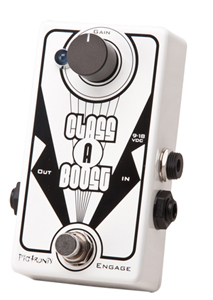
Pigtronix announces release of the Class A Boost – Elegance In Tone

Pigtronix Class A Boost is the final word in high performance guitar preamps. This pedal’s elegant exterior and single knob layout cloth an ingenious “Class A” J-FET design that will fatten up the sound of any instrument or sound source.

Featuring discreet transistor topology (no opamps) this device can boost passive or active pickups and even line level signals up to 20db without ever clipping. Perfectly flat frequency response from 20Hz to 20kHz ensures that your instrument’s tone and expressive character remain intact as signal power is increased.

The Class A Boost’s noise free performance allows you to put the effect anywhere in your pedal chain. It adds punch and extra output when placed after a classic overdrive or will happily push your gain pedals into new levels of saturation. The Class A Boost is also ideal for hitting the front end of a tube amp to achieve an added layer of sweetness and fat tone without unwanted clipping or noise.

The Class A Boost runs fine on a standard 9-volt supply, but ships with a Pigtronix 18-volt adapter in order to achieve superior headroom and maximum punch. Make your sound 1 louder with this handsomely dressed, J-FET masterpiece from Pigtronix.

“Pigtronix Class A Boost is crucial to my sound because it makes my guitar tone clearer and louder, without adding distortion.”  – Eric Krasno (Soulive)

Pigtronix Class A Boost carries a list price of $149 and is available now at Pigtronix dealers everywhere.  Check out the Class A Boost and the whole line of 2011 Pigtronix effects at http://www.pigtronix.com.

I’m a big proponent of boost pedals, especially when used to slam the front end of a tube amp to push it into full-on overdrive. What’s attractive about this particular pedal is that it is Class A – at least from an audiophile’s perspective – which means that it will not clip throughout its operating range. Don’t confuse this with the definition of Class A for an amplifier. They’re two different things. Here’s a great explanation of Class A operation with respect to amps.

In any case, this could be a VERY cool pedal to have…

For more information, visit the Pigtronix Class A Boost page!

Read Full Post »

« Newer Posts - Older Posts »