I’ve never been much of a distortion box kind of guy; at least until recently when I got my EWS Little Brute Drive. I didn’t think I’d be using it all that much, but I have to admit, it is quickly becoming an indispensable addition to my pedal board. It’s as transparent as my Timmy, which is a HUGE plus in its favor, but the gain and distortion goes way beyond what the Timmy can do. But at the same time, it behaves insanely well with the Timmy. For instance, at my church gig yesterday, I was playing a song and had the Timmy engaged to give me some mild overdrive. There was a lead break in the middle of the song where I had to do a short 8-bar solo. But instead of switching the Timmy off, I just activated the LBD. OMG!!! I was immediately rewarded with tons of sustain, and singing, sweet distortion that was not at all over the top (I had the single gain knob set at about 11 am)
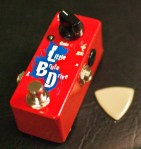
Amazing that all this comes from this little pedal that’s about 1 1/2 times longer than a 9 volt battery!
One thing though is that both the Timmy and the LBD are making me rethink how I approach my overdrive tone. Since getting them, I haven’t been cranking my amps near as much as I used to. I still love that saturated power tube sound, but tend to put my amps on just below the edge of breakup, then use my Timmy, the LBD, or a boost to push it over the edge. Mind you, I still have the Master volume up there. It’s just full out like it used to be.
Summary: Similar to the Alpha that I recently reviewed, this guitar sports Honduran mahogany, and the tonal difference is HUGE. I really liked the last edition (#5), but this rendition of the Alpha has it all going on. Ringing clean tones and lots of muscle. Nice.
Pros: Again, all hand-made, and the cleans – oh, the cleans – have a gorgeous bell-like tone. The body and neck resonate beautifully.
Cons: None.
Features
Scale length: 25″
Frets: 22 (medium)
Color: Natural
Top Wood: Quilted Maple
Back/Neck Wood: Honduran Mahogany
Finish: Hand-rubbed Tung Oil
Fingerboard Cocobolo Rosewood
Nut Material: Bone
Bridget TonePros AVT II
Pickups: Manilus Vintage/Modern PAF+
Controls: RS Super Volume/Bourns Push-Pull Tone/Switchcraft 3-way Toggle
Tuners: Gotoh Magnum Locking
Weight: ~7.5 lbs.
Build Completion: July 2011
Price: $1800 – Yes, you read that right. This guitar is for sale, and I would buy it myself if I had the cash on hand; this is a KILLER guitar!
Tone Bone Score: 5.0 ~ From the moment I plugged it in, I fell in love with the tone and feel of this guitar!
It’s great to be close to local gear builders; especially when they make super-high-quality gear for a freakin’ fantastic price. Aracom was the first local builder whose gear I just had to have, and now it’s Barron Wesley Guitars. Russell at BWG, though a relative newcomer to the luthier scene is insanely talented. The workmanship of his guitars is on par with guitars that cost three to four times more, but more importantly, his guitars play and sound absolutely killer.
Last night, Russell dropped off Alpha #7 at my gig at Max’s Opera Cafe in Palo Alto, CA. When I took it out of its case, I just had to play it right away, so I plugged it in and was rewarded with such a natural, musical tone that I ended up finishing my last set playing that guitar. The clean tone was absolutely mesmerizing to me, and the fretboard made playing so effortless – it was scary easy to play. But I’m getting a bit ahead of myself…
Fit and Finish
There’s not much else to say that I didn’t say in my previous review of Alpha #5. Russell’s work is flawless. However, there are some differences in the finish that Russell explained to me last night. For instance, he put on fewer coats of Tung oil on the cocobolo fretboard as he wanted a much more “natural” feel to the fretboard. To me, the result was spectacular! Right out of the box, that fretboard had just about the best feel that I’ve ever experienced. The finish is silky-smooth.
One thing I didn’t mention in my previous article was that I absolutely love Gotoh hardware, and I love wraparound bridges as well. With a single point of contact, the string energy transfers almost directly to the body.
Finishing my last set with Alpha #7
Playability
Again, in a word just like last review: Awesome. The neck on #7 is absolutely perfect! Not sure what extra or even less shaping Russell did on the guitar, but to me, this neck feels just right, and moving around on it is a dream!
How It Sounds
Alpha #7, with the Honduran mahogany gives the guitar a real Les Paul-like quality when playing with lots of crunch. The resonance in the wood is such that like an LP, you feel the string vibrations as they course through the body and neck. When I first picked it up just to feel how it plays, I immediately took notice of how the body and neck resonate, which is why I had to play it right away. As I mentioned above, I played it clean, but the cleans were so delicious, I finished my last set playing the guitar.
This evening, I spent some time with the guitar – actually, several hours – and have not been able to put it down, save to write this article. I put together some quick clips to demonstrate the sound of this guitar (all clips were played through my beloved Aracom PLX18 “plexi” clone):
First, we’ve got the riff to Neil Young’s “Rockin’ in the Free World”
Amp was cranked, and I played it through the bridge pickup. Next, we’ve got the riff to the Doobie Brothers “Listen to the Music” to demonstrate the neck pickup played clean:
Next, I just started playing some random stuff fingerstyle in the neck pickup:
Then I played a riff to one of my own tunes in the middle position with both humbuckers coil tapped:
Finally, I quickly played a lead over a song idea I’m working on. The first part is played in the neck pickup, then I switch to the bridge to show the difference. VERY Les Paul-like in both response and dynamics:
By the way, those Manilus Vintage/Modern PAF+ pickups are absolutely KILLER! Russell made a great choice in these, as they complement the guitar perfectly!
Overall Impression
OMG! I’m freaking out by how incredible this guitar is! If I had the money, I wouldn’t be giving it back to Russell. That’s just how damn good it is. But as I mentioned above, the guitar is for sale. The price is a VERY reasonable $1800, and from how it looks, plays, and sounds, you’d be hard-pressed to get a guitar this good for that kind of price. If you get it now, you’ll be one of the lucky few who get one before he raises prices. Right now, you can take advantage of Russell wanting to get his instruments out and his name known. Once he’s established, the prices will go up as I imagine he’s selling these for just a little over his cost right now.
My trusty DigiTech Vocalist Live 4 is pretty much on its last legs. It has lasted four years of regular gigging – at least two gigs a week – and things are starting to become loose or not function at all. That’s okay because it was expected, so I’ve been slowly saving my pennies for a new TC Helicon VoiceLive Touch. This is a great harmonizer that not only will harmonize using guitar, but also keyboard; something that my Vocalist Live 4 could not do. It also has a built-in looper, which I had the opportunity to see in action a couple of months ago at an in-store demo with singer/songwriter Christine Havrilla. Check out this link in which Christine shows how she builds up a song using the VoiceLive Touch.
Pretty cool, huh? TC Helicon has placed A LOT of emphasis on the VoiceLive Touch’s looping capability. Even during the demo I saw, Christine focused on the looper. Now I’m not knocking it, but using a looper can be somewhat limiting, especially if you’re looping a chord progression. I have a small looper that I use occasionally, but I typically just use it for creating underlying rhythms. In that respect, it’s VERY useful. I’ve tried to use it with chord progressions for songs, but it’s difficult because songs have different parts, so it can be a bit impractical for that.
But as a harmonizer, this unit rocks! It has over 200 factory presets, and customizing harmonies on the fly is a snap. You simply hit the buttons on the right side of the unit to add or subtract harmonies. Very cool! The keyboard harmonization is a huge selling point for me, as I can hook up a digital piano and get harmonies that way as well.
All in all, this is a great little unit, and at $499, it’s pretty affordable, considering what it does – though you do have to pay an extra $50 for the foot switch controller, which is an absolute necessity for live work. I should be getting one of these within the next couple of months.
Summary: Nice, moderate vowel-tone envelope filter box for guitar. You can get downright funky with this pedal. While it may not get as “vowelly” as competitive products, it certainly has a lot of tone on tap.
Pros: Great features and tone, and the pedal’s super quite when active. The controls are super-easy to manipulate.
Cons: While I love the sound of this pedal, its physical footprint is just plain big, making it impractical to put on my pedal board. Also, the plastic enclosure makes me a little “iffy” about its gig-worthiness.
Features
21 Filter Sounds including 2 Pole Low Pass, 4 Pole Low Pass, Single Peak, Triple Peak, Peak and Notch and Phasers.
Positive and Negative filter sweep with variable range and sensitivity.
Dual range speed control allows equal adjustment of Attack and Decay speeds, or alternatively, a fixed, fast attack and adjustable Decay.
Modern Design — a thoughtfully designed box that features rugged construction and sleek looks.
State-of-the-art DSP — our proprietary 56-bit Digital Signal Processor, the SA601 and crystal clear 24-bit converters.
Motion Control — all Soundblox™ pedals are “Hot Hand® Ready” and can be used with any Hot Hand motion sensor to extend the capabilities of the unit.
Active Analog Bypass — bypass is fully routed around the DSP and active input ensures zero signal degradation.
Dimensions: 7 in/17.8cm (length not including 1/O jacks) x 4 in/10.2 cm (width) x 2 in/5cm (height, including knobs).
Price: ~$120 Street
Tone Bone Score: 4.75 ~ On tone alone, I’d give this a 5, but its size and plastic enclosure give it a lower mark.
A few months ago, I was thinking that the next tonal territory I wanted to tackle was using an envelope filter. I love that “auto-wah,” vowel tone. I’ve tried out a few over the months, but I got a chance to spend a good deal of time with the Source Audio unit in my studio, and I have to say that tonally, it’s a real winner for me.
Out of the different envelope filters I’ve tried, this one has just about the most features I’ve seen to date, with 21 filter sounds, which means you can get A LOT of different tones out this box. But despite the amount of tweakability, it’s super-easy to dial in tones, and to be completely honest, though I’ve had this unit for a couple of months to play with (thank you Source Audio – and no, this is just demo unit, though I’ll probably buy it), I have yet to touch the manual. Source Audio even sent me a wired “Hot Hand” controller that allows you to manipulate the signal with a ring that’s wired to the pedal. But I haven’t used it yet – the Hot Hand-less configuration has just worked for me.
There are only a couple of things that really irked me about the pedal. The first, and this goes for all Soundblox pedals in general is its large footprint. For me to use it at gigs with my pedal board, I’ve had to remove my wah pedal. It’s 7″ long, for goodness’ sake! Plus the plastic enclosure makes me a little nervous. I gig a lot, and I’m not sure just how well this would hold up getting banged around in my car.
But despite those little annoyances, I still dig the pedal – A LOT. For one, it’s insanely priced at around $120 street. Plus, it’s dead quiet on or off due to the analog true bypass switch, which is a great feature for a lower-price-point pedal.
How It Sounds
Of course, its sound is what sold me. But it’s even more than that because the pedal also reacts to input gain. So in addition to getting the 21 different voicings, by adjusting your input volume and pick attack, you can affect the tone of the pedal. I’ve literally spent hours playing around with this pedal, and every time I play it, I discover something new. Love it!
The following clips were all played with my Fender American Deluxe Strat into my trusty Roland Cube 60, set to a clean “Blackface” setting. I didn’t want to color the tone with any kind of drive or distortion. Note that I don’t remember any of the settings that I used on the pedal. In fact, when I recorded these, I just set the pedal to what I though would sound good, then hit “record.” 🙂
First off, is a little ditty that I put together with a clean rhythm track, and doing a lead over it.
Second is another lead track, but I added in some reverb and delay to give the tone some space.
Next, it’s just my guitar and the pedal. The first part of the clip demonstrates the pedal’s response to pick attack. Then I just play a random lead and some fast funk chords.
Finally, I set the pedal to extremes. I was after the most raunchy tone that the pedal can produce without going over the top (which it can), and this is the result:
Overall Impression
This is a fantastic pedal! Even with the misgivings I have with its size and construction, there’s no denying that the tone it produces really moves me.
So much focus in the Les Paul world seems to be on the Les Paul Historics; especially the R7 through R0 models. Perhaps rightfully so, as those Custom Shop models are built to those specs. I myself have an R8, and it’s my go-to guitar. But before I got really interested in the Historics, I totally dug on the Les Paul Supreme – actually still do. I dig the look of it from the headstock logo to the brass hardware to the striped mother-of-pearl inlays. Plus, the AAAA figured maple top and back are simply gorgeous to me. I’m normally attracted to plain top bursts, but that figured top and back just ooze tons of mojo to me. I love the thick binding all around. This is a beautiful, artistic guitar.
Yeah, I know, I’ve heard the complaints about the Supreme not having control access panels on the back. I suppose that’s a big inconvenience for tweakers who’ll want to swap out the stock pickups. Personally though, I have no problem with the 490R and 498T pickups. They’re ballsy and expressive. I have a 498T in my 2009 Nighthawk, and it rocks.
One thing that’s important to me with a Les Paul is that it has a 50’s-style neck; to be more precise, a ’58 or ’59 neck, and the Supreme has that style of neck – not the ’57’s baseball bat neck.
In any case, to me, it’s a fine instrument, and one that I would like to own sooner or later. Here’s a great video I found on YouTube showcasing the Les Paul Supreme:
I might’ve posted this before, but here’s a great video of the making of a Les Paul Supreme.
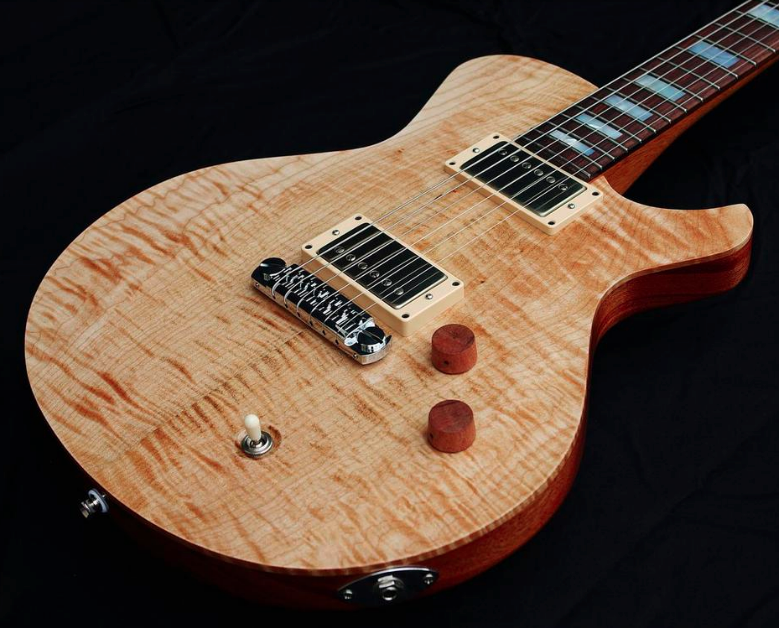
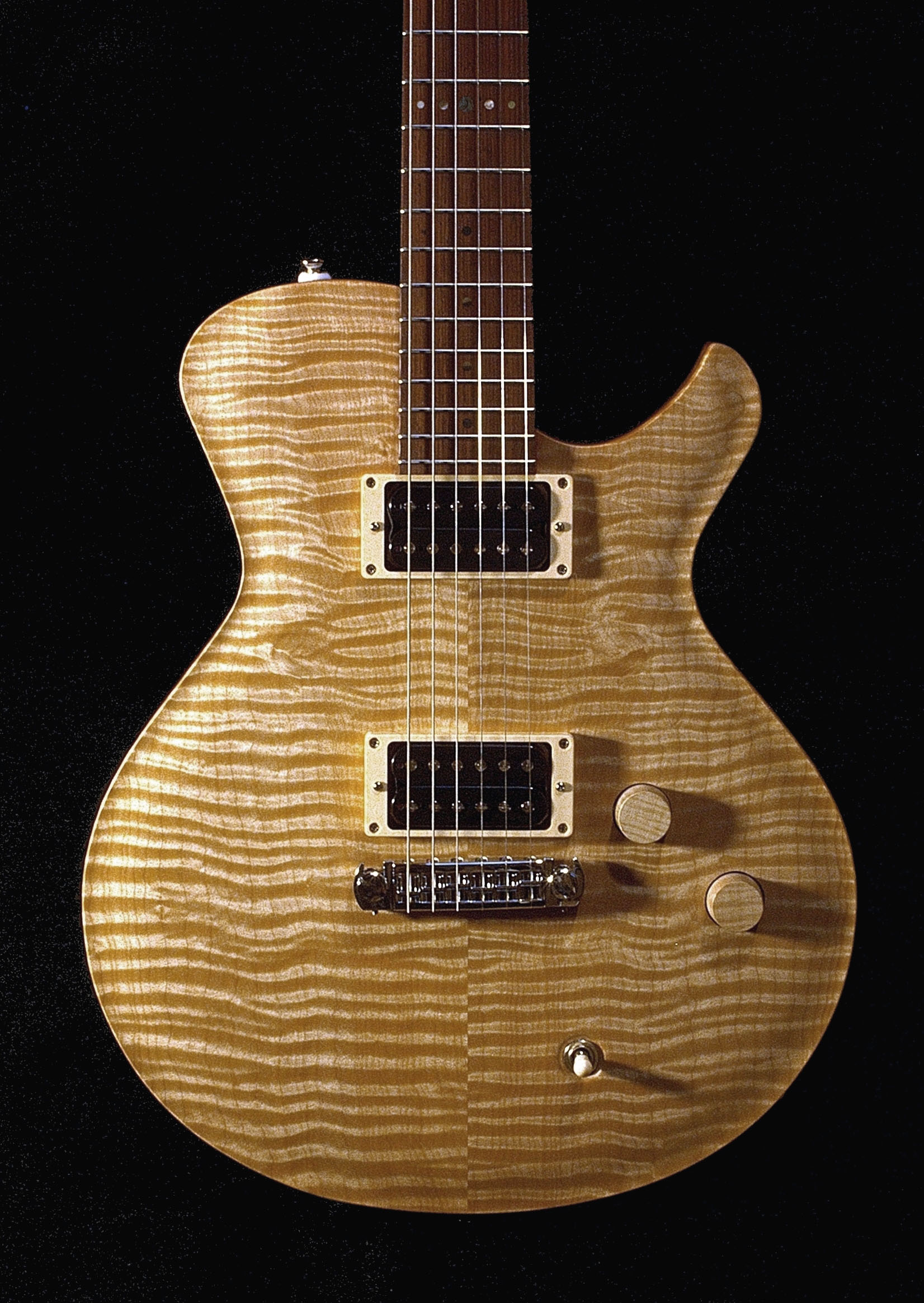
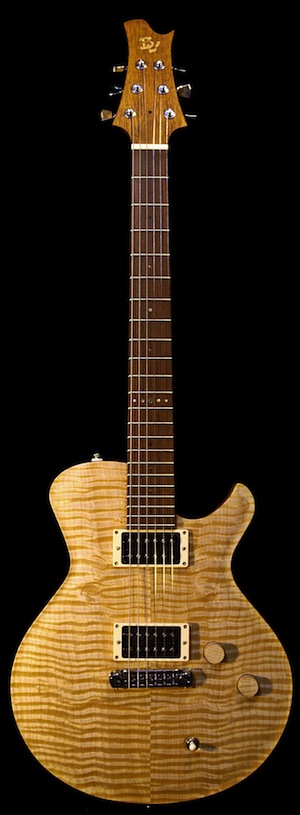
Barron Wesley Guitars AlphaSummary: From new luthier Russell comes an amazingly affordable custom guitar that’s a joy to play, and has a unique sound without losing that classic tone that you’d expect from a PAF-equipped guitar.
Pros: All hand-made. I’ll estimate its weight to be around 8 lbs, so it’s easy on the shoulder. Position of the neck is perfect, making it easy to get into the high frets. Tung Oil finish is wonderful, giving the wood a real natural feel.
Cons: This is just a nit, but it would’ve been great to have independent volume controls for each pickup.
Features
Scale length: 25″
Frets: 22 (medium)
Color: Natural
Top Wood: Quilted Maple
Back/Neck Wood: African Mahogany
Finish: Hand-rubbed Tung Oil
Fingerboard Cocobolo Rosewood
Nut Material: Bone
Bridget TonePros AVT II
Pickups: Manilus Vintage/Modern PAF+
Controls: Master Volume / Push-pull Master Tone for coil splitting / 3-way Toggle
Tuners: Gotoh Magnum Locking
Build Completion: April 2011
Price: < $2000 (Yup, that’s right. A handmade guitar for less then 2 large)
Tone Bone Score: 4.75 ~ I’ve been testing out the guitar for the past couple of days, and it is a player, that’s for sure. This is just a super-comfortable instrument, and I could see myself logging several hours with it!
There’s always room in this world for someone who’s good…
About 25 years ago, I got kicked out of college for a year to get my act together. It wasn’t that my grades were bad, it was that I had three consecutive quarters of minimal progress, so my dean told me to take a break. When I was ready to come back, the dean was reluctant to let me back in. I was dumbstruck. “Why won’t you let me back in?” I asked him.
He replied, “Because as you know, I see you perform all over town. I’m not sure that the sciences are right for someone with your passion and talent in the arts. My son was in the same boat you’re in now and I told him, ‘There’s always room in the world for someone who’s good.’ He left his major, went with music and he’s now playing his horn in Les Brown’s Band of Reknown.” Long story short, I ended up getting back in and completing my coursework in Biology; didn’t do me much good as I’m now almost 20 years into my software engineering career. But those words have stuck with me since, and I’ve used them as a battle cry for both myself and others who may have doubts in their abilities.
Enter Russell LaRoche of Barron Wesley Guitars. He’s a newcomer to the luthier scene, and has only formally been in business since the beginning of this year. He’s the epitome of the saying that there’s always room in the world for someone who’s good, and I think he’s onto something with his guitars. If the model I played is any indication, I have no doubts that he should see some success.
Fit and Finish
There’s really nothing like a handmade instrument. Even though I don’t play my own handmade “Goldie” any longer, there’s a certain “mojo” in the look and feel of a handmade instrument, and the Barron Wesley Alpha has tons of mojo on tap. The quilted maple top is to die for! And though finished with oil and not lacquer, it still retains that three dimensional quality. Personally, that Tung oil finish is sexy as hell!
For those unfamiliar with Tung oil, it is the oil that comes from the nut of the tung tree, and is what is generally called a “drying oil” in that it cures and hardens upon contact with air. It also ages very well, and doesn’t darken over time, making it a perfect finish for fine woods. It is also used as a sealant for marble to protect the stone. For wood, it gives it that satiny, wet wood look. I love it! I imagine that the finish will wear, and unlike lacquer, will be susceptible to scratching, but the cool thing is that the finish can be re-applied (not sure how often, but I don’t anticipate that it would need it that often).
Russell’s attention to detail in the finish of this guitar was spot on. No crooked or uneven joints; everything fits well together. The guitar also “feels” sturdy, though it’s probably only about 8 lbs. in weight. This is a guitar that could be gigged with on a regular basis.
Playability
In a word: Awesome. The neck shape is much like a 50’s Les Paul neck, so I was right at home with it. Mind you, if you don’t like that deep C, then Russell can probably shape it to your specifications.
The cocobolo rosewood fretboard is a dream. Though harder than Brazilian and Indian rosewood, to me, it feels like ebony as it has a lot of oil content, but with a rosewood texture. This makes it VERY easy to move around the fretboard.
The body shape is also perfect, and it is super-easy to get into the high frets. I like the 25″ scale length as well. It’s very close to a Les Paul, so again, I felt right at home playing this guitar.
How It Sounds
Of course looks and playability mean nothing if the guitar doesn’t sound good, and this is where the guitar absolutely shines. The Manilus Vintage/Modern PAF+ pickups are a bit more aggressive than traditional PAF-style pups, but that’s okay. It’s clear that this guitar was meant to rock. But being that they are PAF-style pups, they have that honk and a bit of bite to them that’s absolutely pleasing to the ears. In fact, the tone reminded me of my ’59 Les Paul re-issue, but with a deeper tone.
Here’s a clip I recorded of it. The rhythm riff was played in the neck pickup, and I played the lead in the bridge pickup with the ‘bucker tapped to get a slightly spanky single-coil tone. My Timmy pedal provides the drive for the lead, and both tracks were played through my Fender Hot Rod Deluxe in the clean channel – completely clean, mind you. I added a bit of spring reverb from the amp to each track.
Man! What a sweet sound! In fact, I had been playing the guitar over two hours before I decided to record that track. In fact, the main riff has inspired me to write a new song. You gotta love how a great instrument can sprout the seeds of creativity!
Overall Impression
Fantastic guitar from a new, talented luthier. It’s a great combination!
Summary: Proving the old adage that “big things come in small packages,” the EWS Little Brute Drive is an absolute distortion machine, capable of mild crunch to face melting distortion. Don’t let the “drive” in the name fool you. This ain’t an overdrive – but who cares? 🙂
Pros: Though it has output level and treble controls inside the enclosure, the pedal is set to unity gain, so no need to mess with output volume. You just set the gain knob where you want it, then turn it on. It’ll instantly turn your guitar a fire-breathing dragon!
Cons: None. Absolutely none.
Features
Single gain knob. All the way left gives you about the max overdrive of a soft OD pedal like the Timmy. All the way right is evil – very evil – distortion. 🙂
True bypass
Runs on either a 9V battery or 9V power supply (I use a 1-spot).
Price: ~$129 Street
Tone Bone Score: 5.0 ~ I could barely pull myself away from playing this evening to write this review! I was having way too much fun with this pedal!
I have to admit that I haven’t been too much into distortion pedals in the past, but since I got a Strat, none of my overdrive pedals could give me the kind of creamy crunch that I love for playing rock songs. It’s not a problem with my Les Paul, and though my new Strat does have some higher-output pickups, it’s still not the kind of gain that a Les Paul produces. So I figured that I’d try a distortion pedal. Enter the Little Brute Drive.
After watching some very good videos and listening to some sound clips of the pedal, I knew it would do the job. I wasn’t mistaken. This freakin’ pedal has more gain than anything in my arsenal. I was amazed that at even with the gain all the way down, it was more than the gain that my beloved Timmy produces! But the even cooler thing is that even at the highest gain setting, note separation is incredible! I was concerned about that because my past experience with distortion pedals is that they get really muddy and compressed at high gain settings; not the LBD. The distortion is tight, but it never gets muddy, and the EQ response is pretty flat to boot.
Fit and Finish
Though it is diminutive in size, it’s built like a tank, and it is definitely gig-worthy. It has a nice red powder coating – almost like a warning that this thing breathes fire!
How It Sounds
Make no mistake: This is NOT a low-gain pedal. It is meant for crunch and face-melting. So if you’re looking for something milder, best stick with an overdrive pedal. But if you’re looking for lots of gain and sustain AND clarity, this is a pedal that will do the job in spades.
I recorded a couple of quick clips to demonstrate the pedal. I had the gain knob set to noon on both clips. I used a Barron Wesley Alpha with humbuckers – though I played both clips in split coil to at simulate a single-coil guitar, and I used my Fender Hot Rod purely clean. With the first clip, I do a comparison riff. The first part is the guitar with no effect, then I switch on the LBD. The second clip is just me noodling.
Yowza! I really had to have a much lighter touch on the fretboard playing this pedal, and since the guitar I was playing is so resonant, I had to mute the strings I wasn’t playing because the pedal picks up EVERYTHING! It’s incredible! And to think that I was able to get that kind of gain with the gain knob set at noon!
Overall Impressions
I love it. ‘Nuff said. The sustain, the drive, and most importantly the note separation and clarity make this pedal a winner.
Summary: This amp is a classic and loved the world over for its great sound.
Pros: Great acoustic sound, but it’s versatile enough to use as a clean amp for solid-body guitars.
Cons: This is a nit: It’s heavy at 50lbs.
Features:
120 Watts
Speakers: 200 Watt 12″ and a 25 Watt high-freq tweeter
Instrument Input Jack
Stereo Input Jack
Tuner Out Jack
Balanced Mic Input Jack
Gain Controls with LED Overload Indicator and Pull Phase
Aural Enhancer Control (Channel 1)
Two independent channels
Two independent effects loops with independent effects blend knobs for each channel
On-board reverb – it’s nice and subtle
Price: ~$300 – $600 Street (if you can find one)
Tone Bone Score: 5.0 ~ I’ve used this amp in a variety of settings, and with a variety of guitars, and it has NEVER let me down. The sound is rich and full, no matter what guitar you put in front of it, but it doesn’t take away from the natural tone of the guitar.
My first exposure to the California Blonde was through a church bandmate who would use it for our services. My initial impressions of the amp were NOT good, mainly because this guy just doesn’t take care of his gear. The knobs were scratchy and the jacks were loose and would occasionally crackle. But one thing was for sure: When he had it working, it had a great tone. I was always impressed by the sound of that amp, and REALLY impressed by its ability to project – it is a LOUD amp.
SWR now has a second edition of this amp, and the original is no longer available, but I got mine through my friend Jeff Aragaki of Aracom Amps who acquired one from an estate sale. He had a bunch of gear to sell, and one of the items was this classic California Blonde.
I wasn’t planning on getting an amp at the sale. I just wanted one of the many guitars he had, and ended up getting my gorgeous Strat. But just for shits and giggles, I checked out the amps. The ‘blonde immediately caught my eye (blondes have a way of doing that to me 🙂 ), so I asked Jeff if we could hook it up. Luckily I had my acoustic in the back of my SUV so I could give the amp a proper test. So we hooked it up, powered it on, I strummed a chord, turned to Jeff and said, “I’ll get this too…” I did play through it for about 15 more minutes to really go through its controls, but from having to adjust my buddy’s ‘blonde in the past, I was pretty familiar with the amp.
Since I purchased it, I’ve used it with my acoustics, as a clean amp for my Strat (and using a distortion pedal with it – it rocks), and just last night, I used it for its intended purpose: as my guitar amp for my outdoor gig, using my Gretsch Electromatic. As I mentioned above, no matter what I’ve thrown in front of it, this amp has delivered the goods.
Fit and Finish
Despite the amp being several years old, it has withstood the test of time. That’s a testament to how solidly built this amp is. Even my buddy’s amp – despite being mishandled – was still rock solid. My amp was and is in absolutely pristine condition. This thing is built like a tank. The enclosure, though made with a combination of plywood and particle board is THICK. Chrome-plated corner protectors adorn all the corners (this amp was made for gigging). No stray joints here folks, the build quality is fantastic.
The tilted control panel is an absolutely nice and convenient touch, allowing for quick access to the knobs. This is much better than the Genz-Benz Shenandoah 150 upright that I’ve played that has a flush control panel. Makes it hard to adjust. The metal speaker grille on the ‘blonde demonstrates again that this amp was meant to be gigged.
The only nit that I have with the amp is that at 50 lbs, it’s really heavy. But that’s understandable and forgivable considering the thick wood of the cabinet and the magnet of the 200 Watt speaker, which must be pretty big (I haven’t taken off the back panel). I’ll trade weight for ruggedness any day; besides, that’s what hand carts are for! 🙂
How It Sounds
The California Blonde has a rich, deep tone, but as I mentioned above, it doesn’t take away from the natural tone of the guitar. And though I mentioned that the amp is loud, the cabinet really disperses sound at a wide angle, creating a three-dimensional effect that makes the sound seem to float in the air.
I used it outdoors at my gig yesterday, and it was fantastic! I ran chorus, delay and reverb through the loop, and I have to say that the effects blend knob is a god-send, allowing me to mix as much or as little of my board signal into the dry signal. Because of how the amp disperses sound, I used very little reverb, and many times just had it off. For ambient tones, I used my MXR Carbon Copy delay set to a mild slap-back. That seemed to work best with the amp.
The tweeter’s effect is subtle, but a very nice addition indeed, as it provides just a touch of shimmer to the tone. I tried the amp with the tweeter switched off, and just turned it back on because I wanted the shimmer. With a Strat, the tweeter is a necessity in my opinion.
Last night, I started out running my guitar signal only through the amp, but then later added some signal into my Fishman SA220 PA so I could get even better sound dispersal. The line out is great on this amp, and reproduces the signal very true to the original. In fact, when I’ve used this amp at church, we run it right into the board, and the sound is very nicely balanced.
Overall Impression
This amp is a workhorse. I really couldn’t be happier with this amp. It totally delivers the goods for me!
I guess my love affair with overdrive pedals hasn’t waned one bit – even with getting my Timmy. Don’t get me wrong, my Timmy will NEVER leave my board, but this totally cool, ultra-compact “Little Brute Drive” from EWS Japan is nothing short of amazing to me. Lots of overdrive/distortion on tap, right out of the box! And look at the bottom of the picture to the left: It ain’t much bigger than a freakin’ 9V battery! Amazing!
The way I envision using this particular pedal is for when I need heavier distortion than my Timmy, which is a light- to medium-gain device. The Little Brute has a much wider range of distortion; from fairly light to searing. And like the Timmy, the distortion is fairly open and uncompressed from what I could tell from clips. But even more important is that like the Timmy, it’s fairly transparent. I couldn’t detect much tone alteration from the clips I heard. So awesome!
You can fine-tune the output level and tone from inside the box – see the two blue adjustment screws in the picture? But from what I could tell, the factory settings are perfect.
How can anyone complain about a great-sounding boutique pedal at mainstream prices? Taking its design cues from industry-veteran Gary Hoey who wanted to ensure a great-sounding, built-for-the-road but affordable pedal, HBE has created just that. This is a simple, road-worthy standalone overdrive that costs just $99. Nice!
Not much media on this pedal yet since it’s so new, and I’ve only seen one video of this so far, which was okay, but the demonstrator only used a single guitar, and only made a few adjustments; frankly, to me not enough to give a good representation of the pedal’s capabilities. But based upon what I heard in that video, this pedal is more standalone distortion than overdrive, but really a better test will determine that.
In any case, you can find a bit more information at ProGuitarShop.com. Andy hasn’t done a demo video of it yet, but since he praises it, I’m sure he’ll produce something soon.
Myself, I think this pedal is going to be worth a serious look just based upon the principle of it being so affordable. Damn! I’m GAS-ing again! 🙂
 I’ve never been much of a distortion box kind of guy; at least until recently when I got my EWS Little Brute Drive. I didn’t think I’d be using it all that much, but I have to admit, it is quickly becoming an indispensable addition to my pedal board. It’s as transparent as my Timmy, which is a HUGE plus in its favor, but the gain and distortion goes way beyond what the Timmy can do. But at the same time, it behaves insanely well with the Timmy. For instance, at my church gig yesterday, I was playing a song and had the Timmy engaged to give me some mild overdrive. There was a lead break in the middle of the song where I had to do a short 8-bar solo. But instead of switching the Timmy off, I just activated the LBD. OMG!!! I was immediately rewarded with tons of sustain, and singing, sweet distortion that was not at all over the top (I had the single gain knob set at about 11 am)
 My trusty DigiTech Vocalist Live 4 is pretty much on its last legs. It has lasted four years of regular gigging – at least two gigs a week – and things are starting to become loose or not function at all. That’s okay because it was expected, so I’ve been slowly saving my pennies for a new




 How can anyone complain about a great-sounding boutique pedal at mainstream prices? Taking its design cues from industry-veteran Gary Hoey who wanted to ensure a great-sounding, built-for-the-road but affordable pedal, HBE has created just that. This is a simple, road-worthy standalone overdrive that costs just $99. Nice!
 Guitar Gear

