I gotta tell ya… I’ve got a new love, and it’s in the form of my new Gretsch G5122DC Electromatic. I’ve been playing it at my solo acoustic gigs, and I’ve been playing it at my church gigs. It’s an incredibly versatile axe! Clean, it has a very natural, acoustic tone, and even though the pickups have enough gain to push an amp into overdrive, it helps to use a drive pedal to give it that extra oomph. Of course, I use the Timmy that retains my guitar’s tone, and I just LOVE the overdrive tone this guitar produces!
Which brings me to the title of this article: Why have I avoided hollow body guitars for so long? It’s probably because I always equated them to jazz guitars, and I was always pretty much a straight-up, four-on-the-floor rock and folk guy. So it was either an acoustic or a solid- or semi-hollow body guitar for me.
But then I completely overlooked one of my very favorite rock guitarists: Ted Nugent. I forgot that back in the 70’s, that madman used a Gibson Byrdland, and he totally ROCKED THE HOUSE!!! The sounds he could get out of that guitar were incredible!
After having used my own Electromatic for the last few weeks, like I mentioned above, I’m totally in love! Clean, dirty, you name it, the guitar can do it. It is definitely going to be a part of my arsenal from now on.
What about my Les Pauls? Don’t get me wrong, they’re not collecting dust. I’m still playing them, and to be honest, while the Electromatic sounds great in overdrive, the natural sustain and the balls-out power of my Les Pauls just can’t be matched. But the Gretsch has a completely different sound than my LP’s, and when I need that particular sound, that’s what I’ll play. But to be frank, I probably won’t be using it too much for my rock gigs; that’s what I have the LP’s and my Strat for. But the Electromatic has completely replaced my acoustics at my acoustic gigs. It has an acoustic enough sound to pass for an acoustic guitar, but the tone is so much more smooth and mid-rangy.
If you get a chance, try one out. Its sound will blow you away! And at less than $700, you get a gorgeous-looking and -sounding guitar.
The Internet for the most part has been great for guitar! I was just thinking that had it not been for the Internet – specifically, the World Wide Web – I wouldn’t be able to gather all the information I get for this blog. If I get wind of something, I can look at the manufacturer’s web site, get some contact information, and communicate with them. The speed at which this happens can be measured in seconds. Just a decade ago, it wouldn’t have been that easy, and I’d have to rely on the printed trade rags to get information. By the time I’d get that information, what would be the point of writing something? It would already be a couple of months old, as magazines usually run a couple to a few months ahead of schedule. But with the speed and ease of information access on the Web, fresh information is readily at hand.
The Web has also enabled the creation of instant communities of like-minded individuals, freely able to communicate with each other and share their ideas and viewpoints. But there’s a darker side to that as well. The most obvious is that face-to-face communication, where you can hear someone’s tone and/or read the expressions on their face is practically eliminated. This impersonalization can result in some very interesting – or more to the point: Annoying behavior.
I’ve been writing blogs since 1995 – even before the word “blog” was coined. And one insidious thing that I’ve encountered time and again is plain rude behavior. We’ve all seen it on forums, and I’ve seen it on my blogs. People come in and rip on someone or some piece of gear, offering nothing in terms of constructive criticism. It’s almost as if the impersonalization is a license to be a jerk.
Some of the more clever writers spout epithets to discredit others; using metaphor or worse yet, their professional credentials to steer the unwary towards their point of view. I’ve found those people to be the most insidious of individuals, never saying what they truly mean, and always speaking in innuendos and implications.
So why am I writing this? Simply because I believe good manners and honesty are important in everything we do. One of the great things about being a musician is the natural camaraderie among musicians. When I get together with other axe-slingers, it doesn’t matter what each of our skill levels are (I tend to be on the lower end of the scale 🙂 ), there’s support and encouragement, and verbal judgment is left unsaid, though courteous, constructive criticism is always at hand.
But sometimes online, that camaraderie seems to be lost, devolving into harsh criticism with no filters. One of the things I swore when I created GuitarGear.org was to always play nice. It’s tempting to rip on someone or some manufacturer, but what does that do but alienate people and in some cases, spread lots of misinformation?
Hey, I’m not saying that one shouldn’t express their opinions – especially about gear – but I’ve witnessed so many campaigns and crusades to discredit people and manufacturers that I had to speak out about it. I have to admit that even I’ve engaged in that in the past, but I decided that it doesn’t do anyone any good, and especially with this blog, it would be a disservice to my readers. What I came to realize is that what may suck for someone will work more than just fine for another. In other words, there’s really no definitive “right” or “wrong.” There’s just a description of experience.
I’ve heard some great advice, and hopefully have even given good advice about guitar gear over the years. So after a lot of thought, I decided to compile a list of stuff I’ve either heard or shared in this blog or on the forums. They’re not in any particular order, so I’ll just put them in bullets:
“I get the best gear that my money will buy so that if I suck, at least I’ll know it’s not the gear…”
A friend jokingly once shared that with me. But there’s really a ring of truth to it; at least as far as quality is concerned. Remember, you don’t have to pay top-dollar for great quality. There’s lots of stuff on the market that will do the job and then some, and not cost you an arm and a leg. On the other hand, sometimes quality does cost.
Think for yourself. No one can tell you what YOU should think “good” tone is; they can only share their version of it.
This is one my pet peeves of the online forums. There are lots of forum rats who live there who speak eloquently enough that the unwary will hang on every word they say. They could claim that what most players might think is a buzz-saw-sounding tone is great tone, and their “followers” would take that as an edict from heaven.
There is no “best” __________
This is a corollary to the point above. To me, there’s nothing worse than listening to or reading someone’s bombast about what gear’s the best. There is no best. Take overdrive pedals, for instance. There are TONS on the market. But I can’t tell you how many threads I’ve read where so and so says that such and such is the best overdrive pedal on the planet. If there were a best overdrive, we’d only have one, and it would be the Timmy. 🙂
No amount of gear will make you sound like _______________
There’s the “brown sound” and Slash’s tone and SRV’s tone and Robben Ford’s tone. You could get all the gear they have, and guess what? You’ll sound like you. Deal with it. 🙂
If you’re new to tube amps, start out with an inexpensive and “tweakable” amp.
Some might disagree with me on this point, but it’s advice that I got from Neal at Tone Merchants in Orange, CA when I was considering buying a tube amp after having played a Line 6 FlexTone III and other solid state amps for years. He actually recommended a Fender Hot Rod, which I ended up getting, but there are some great inexpensive tube amps on the market to start out with. And frankly, if I had to do it all over again, I’d start out with a low-wattage tube amp like a Fender Champ 600 or VHT Special 6. These both cost less than $200, and will help teach you about tube overdrive and how a tube amp responds to various inputs. I still have the Hot Rod, and I still use it, but it’s loud – real loud. With a low-wattage amp, you can crank it and not blow your ears out; even if you hook it up to an extension speaker.
There isn’t necessarily a correlation between higher price and “better.”
Just because something costs more doesn’t mean it’ll make you sound better or will work with your rig. It goes back to never taking anyone’s word on what’s good. There might be some gear that’s all the rage, but until you try it, you’ll never know how it’ll sound. You might do just as well with something that costs half the price. For me, that’s the Mad Professor Deep Blue Delay. I have the original, hand-wired version. But I tried the PCB version and it does the job good enough for my uses. It’s slightly different with respect to being just a tad brighter to my ears, but that’s not something that can’t be fixed with EQ.
Don’t buy gear based upon songs you hear on the radio or on your iPod.
Keep in mind that professionally mixed and produced recordings have been tweaked to the hilt. Compression and reverb have been added, EQ has been adjusted, perhaps even stereo imaging has been applied. All these affect the original tone. Even if you go to a concert, you’re at the mercy of the sound engineer. For instance, last year I went to see the Experience Hendrix show with Joe Satriani. When Joe first came out, he sounded like crap! Way too loud, and super-compressed as to be muddy. The sound guys and Joe made adjustments, and it sounded fine after that. But it was a lesson for me to only trust an evaluation to being right in front of the gear to make the adjustments myself.
Take your time with your decisions, and try out several if you can. You never know what you might turn up.
Last year, a couple of weeks after I got my Yamaha APX900 acoustic/electric, I realized that I needed a chorus pedal. So I went down to my favorite store and tried out four pedals from different manufacturers, and lined them all up in a row so I could make a comparison. Mind you, I didn’t look at the prices, I just lined them up to see how they worked with the guitar through an acoustic amp. I tried the MXR, BOSS CE-5, Homebrew THC, and Red Witch Empress.I immediately dismissed the MXR, kind of liked the CE-5, but could only get a couple of good tones, loved the THC for its simplicity, yet wide range of tones, and really dug the Red Witch. I ended up getting the THC because it was so smooth. The Empress was out of the ballpark with respect to price for me, and though the THC was pushing it price-wise, I went with it because I really bonded with its tone. The point to all this is that I had a few to try out. I originally was just going to get a CE-5, but after doing my comparison, it was clear that it wasn’t going to work for me. And to be honest, I had never heard of the THC before I tried it out. But I’m glad I did as I’ve never tired of it, and it has stayed on my acoustic board since.
If it ain’t broke, TRY not to fix it…
People who suffer from GAS can never stop trying and buying gear, so I’m not even going to say “don’t fix it.” It’s futile. However, I will say this: Take some time to bond with your gear before you make any snap decisions. For me, buying gear is all about how I’ll use it on stage and in the studio. I control my urges by keeping those in context, and always asking myself, “Will this work for me when I’m performing or in the studio? And have I explored the possibilities of the gear that I have?” I suppose anything can be rationalized. But I’ve found that my rate of acquisition has really reduced since I started adding context to my gear evaluations.For instance, until I got the Timmy, I hadn’t purchased an overdrive for well over a year – probably almost two years. I evaluated them, yes, but didn’t purchase them. The primary reason is that I got a great attenuator, and mostly used tube overdrive from my amps. So I stopped using many of my OD pedals except for my Tone Freak Effects Abunai 2. I actually removed the other two from my board (the KASHA, and Doodad Check-a-bord), and just went with a single for a long time. Now the Timmy sits on my board with the Abunai, and the two will stay.
Finally, don’t ever be embarrassed by the gear that you have…
Way back when I played nothing but acoustic guitar, and occasional electric, I used to worry about the “cheapness” of my gear. I actually felt embarrassed that my acoustic was a cheapo Yamaha, and the electric I was using was a hand-me-down, beat up Ibanez Strat. I one time expressed that to a close friend whom I worked for in several theatrical orchestras (he was a conductor). His reply to me was, “Dude, who cares? You sound awesome. You could probably spend on some great equipment, but you sound great and are obviously comfortable with your gear, so why be embarrassed?” This was backed up by the drummer who was playing in the show who told me to keep on using the Ibanez because it had such a great dirty, ratty tone. I wasn’t even half as good as I am now, but I learned a great lesson that it’s what you do with your gear that matters, not necessarily how “good” that gear is.
In all honesty, this article took me about a month to finish. I originally thought it would be a slam dunk to write, but I realized after the first couple of points that I wanted it mean something, and hopefully it does. ROCK ON!!!
I’ve had two Gibson ES-335’s in the past, and I never kept them. It’s not that I didn’t like them; I actually loved my first one, Rusty, and even though I have remorse over parting with Rusty, I suppose I didn’t love either ES-335 enough to hold onto them. And frankly, I didn’t even have an interest in any hollow body or even semi-hollow body guitars until I laid my eyes upon and played my beautiful “Rose.”
There’s really something special about her; especially in the tone department as she can cop natural-sounding acoustic tones to really rockin’ out crunch. To demonstrate this, I created a few clips. Before I go on, personally, I love her clean tones, and I will be using her mostly for this. And note that her pickups are not very high-gain at all. In order to get overdrive, I had to use my Timmy pedal with the gain knob at about 3pm, which is close to wide open. But she plays VERY well with OD pedals as you’ll see. So without further ado, let’s get to the clips!
Bridge Pickup – This is a quick song that features the bridge pickup, which really sounds like an acoustic guitar. Even the lead sounds like an acoustic lead, but it plays like and electric – well, it is an electric. 🙂
Middle Position (both at equal volume) – This gives you the deepness of the neck pickup and the spank of the bridge pickup. With this clip, I copped the Police’s “Message in a Bottle” riff, and added some light chorus.
Neck Position – This by far is my favorite pickup position, though I will probably use the middle position more often. This has an eery, ethereal sound! In this clip, I just closed my eyes and started playing after hit the record button. This tone really inspires me!
Short Song (Rhythm: Middle position, Lead: Bridge position) – Here’s a quick song I put together. Again, both parts are clean, and I played the lead fingerstyle. This is just a purely fun guitar to play!
Rockin’ It – As I mentioned above, the Electromatic needs help to overdrive an amp, but hey! That’s what overdrive pedals are for! Here I’m playing my song “Strutter.” Just before the chorus, I stack my Tone Freak Effects Abunai 2 on top of my Timmy for some serious sizzle. Then I activate my wah pedal just for shits and giggles. Rose can handle it!
By the way, I played all the clips through my trusty Aracom VRX22.
What can I say, but “Wow!” This is an absolutely impressive guitar, and one that I’m so glad that I added to my stable. I’ll be using her mostly in my solo gigs, but she’ll also see some band time as well.
It pays to be a good customer of a local, independent retailer. When I first saw the Electromatic at Gelb Music in Redwood City, I fell in love with it; unfortunately at the time, I didn’t get it. I came back a few days later wanting to by it, and Jordan (the guitar gear manager) reported that he had sold it. 😦 In fact, he hasn’t been able to hold onto any of the walnut finish Electromatics for more than a couple of days. So I told him that as soon as he got one in to contact me. Well, after a couple of months (which was good because I could set aside some money for it), Jordan finally got one in, sent me an email, and I put a down-payment on it over the phone on Thursday. I picked it up yesterday and immediately used it at my weekly restaurant gig.
Jordan had even set up the guitar for me knowing that I might gig with it on Friday, and set the action and intonation perfectly! But that’s a testament as to why I’d rather deal with small-box retailers than big-box ones like GC. The folks at the small-box retailers get to know you, and over the years, you establish a great relationship with them, if not a friendship. I’ve gotten to know all the great folks over at Gelb, and if you’re in the area, you owe it to yourself to get to know these guys. They won’t steer you wrong! Anyway, enough of that, let’s get on to the guitar, shall we?
So, so pretty…
Usually, I’m less concerned with looks than I am with tone, but the finish on this guitar immediately drew me to her when I first saw her hanging on Gelb’s Gretsch rack. By the way, I’ve already named her “Rose,” for her rose-wine-hue, walnut finish. As with any Gretsch, it’s all about classic styling, but the finish on Rose is simply incredible, as it takes that classic styling and dresses it up with a gorgeous finish that immediately draws your eyes to it. The picture I’ve provided does not do her justice at all. Suffice it to say that the translucent walnut finish gives her a red wine hue that is so alluring – sexy, you might say. Last night, several customers commented on her beauty. I gotta tell you, it was like showing up to a party with the prettiest girl hanging on my arm! 🙂
In any case, I shot a few pictures of her this morning. Rose is AMAZING!!!
This slideshow requires JavaScript.
…sings like an angel…
Playing a G5122DC at Gelb made my decision for me. While it doesn’t have the deep tone of a standard body Gretsch, it still has lots of depth, and as with any Gretsch, the tone is as smooth as silk, no matter what pickup you’re playing. I love the scooped, ringing tones (but not twangy) of the bridge pickup, and the neck pickup has an eery, ethereal, three-dimensional tone that’s perfect for finger-style. I used the middle selector last night quite a bit as well to blend in both pickups for certain songs.
Last night, I was plugged directly into my DigiTech Vocalist Live, that adds some reverb and chorus, then goes directly into the restaurant’s PA board. While it sounded great, coming out of the PA speakers, monitoring was an issue, as the restaurant only has a single 6″ monitor that just doesn’t give a good representation of the sound. But hearing it in the house, I was just blown away! The tone was rich and full, and seemed to fill the room, even at a lower volume. That kind of three-dimensional sound is inspiring! It floats in the air, and feels so close that you can almost touch it.
I’ll be recording clips really soon!
…and I could hold onto her all night!
Rose’s neck is very much like a 60’s Les Paul neck, so playing her felt immediately familiar. I had her set up with 10’s, which are on the light side for “acoustic” playing but provide a real versatility – and heck, with a four-hour gig, lighter strings are just easier to play. 🙂 The guitar is fairly lightweight – probably in the vicinity of 7 to 8 lbs., so prolonged gigging will not be an issue with Rose. Last night, everything about her felt so great. I love the position of the master volume, and with the pickup switch being in a similar position to a Les Paul, switching pickups mid-song was a breeze!
I didn’t quite like the action that Jordan had set on Rose originally, as it appeared to increase towards the bridge, so once I set up my rig, I made a couple of adjustments to the action on both sides of the floating bridge. What a different that made! It actually took me a few minutes to get used to how easy Rose was to play. And being that I’ve been playing this gig with an acoustic, I had to remind myself to really relax my left hand and not dig in. 🙂 That’s actually a good problem to have, and a testament to just how easy this guitar is to play.
A buddy of mine sent me a link to the latest in tone-improvement: Essential Sound Products’ MusicCord Pro, a six-foot, $179 power cord that they claim will improve your tone because of its more efficient power delivery. C’mon now! A power cord? I suppose that if you have a fluctuating power source a power cord will help, but you’d have to have some sort of built-in power conditioning to make sure the power you feed to your device is consistent. The MusicCord doesn’t have that. ESP simply claims that they use 14-gauge wire as opposed to their standard 16-gauge wire.
Frankly, I don’t know what to believe, though I’m leaning on the side of extreme skepticism; and even though some major trade rags such as ProAudio Review and Premier Guitar have weighed in with glowing reviews. I read through all the reviews that ESP provides and ALL of them are purely qualitative reviews. None include frequency response charts or RTAS charts to show that the sound wave is different using the MusicCord Pro as opposed to a standard power cord. Without hard data, it’s kind of hard to believe all the hullabaloo. Truth be told, I think it’s a crock.
Here’s an excerpt from the Premier Guitar review:
“The second stage of the test was less ambiguous. Are you going to hear a difference? Yes. Simply put, hearing is believing. Is it a big difference? For me it was. I tested the MusicCord Pro with a pair of EL34-powered amps (Goodsell Black Dog 50 and 50W Egnater hot-rodded. Plexi-type) and a humbucker-equipped guitar (Duesenberg MC signature); the improvement in clarity was immediate and unmistakable.
Imagine sitting in a convertible with the top up and the windows down all the way… adding the MusicCord Pro to your rig is like dropping the top-you get the idea. While you might not need it to power your practice amp, it’s an investment worth considering for just about any other application.”
The reviewer’s second stage of his test might’ve been less ambiguous than his first test, but his description of his second test is all qualitative and just as ambiguous as the first. I think the effect is more psychological than anything else… Another review that a friend mentioned from Vintage Guitar stated that the MusicCord Pro actually reduced the 60Hz hum from his single coil guitars. Now that’s really pushing it. Are you telling me that the MusicCord Pro actually modified the magnetic field of his pickup? Yeah… uhh… right… Wonder if he just happened to turn in a different direction once he plugged in that power cord, which usually solves the 60Hz hum. Methinks those two reviewers have been spending way too much time on The Gear Page forums. 🙂
All the reviews harken to the used car salesman who gives you a wink and winning smile and says, “Trust me.” Uhhh… no thanks… Like I said above, give me hard data, preferably in the form of charts and graphs that definitively show a positive modification of the sound wave, and I’ll take it a bit more serious. A graph may just show an improvement, but I think one reason why ESP nor any of the reviewers show them is that the improvement is meager at best.
But I will admit that my ears may not be as sharp as other folks’, so I’ll let you decide for yourself. I downloaded two clips of a song from the ESP site to compare where the sound engineer claims there’s a huge improvement in the quality of the recording due to the MusicCord Pro. Here they are (note the file are raw, unmastered WAV files so I have links to them as opposed to using the player):
Personally, I can’t tell a difference between the two, and I used flat-response studio cans to evaluate the clips. I would say that my hearing is normal, so if there is any difference, it’s subtle at best.
I think you could get by with a good quality power cord. Me? I use medical grade power cords for all my equipment. These are tested and certified for reliability. Also, I recently had a dedicated power source with its own breaker run out to my garage/studio to handle all the equipment I was plugging in, and I had the electrician also install a power conditioner so my power load would always be consistent. I think a consistent power load will do more for your tone than a cord.
But hey! If you want to buy into the latest snake oil, I have a couple of properties in Peru, Indiana that I could sell to you… 🙂
One of my biggest problems with Strats in the past is that while I loved their tone, the stock pickups never really satisfied me; being a bit too bright and not powerful enough. Plus, the Strat is not a guitar that sustains very well. With my new Strat, I’ve solved the brightness problem, and most of the power problem with the Kinman pickups that came with the guitar. But the sustain issue still exists. Mind you, this particular guitar has some very nice inherent sustain and resonance; still not as much as a Les Paul, but more than what I’ve experienced with other Strats in the past.
Among those in the know, a Strat really needs help in the sustain area, which is why overdrive pedals will never go away. They provide extra gain yes, but more importantly, they provide sustain. For me, as the title states, the Timmy overdrive has completely changed the game for me. Being a transparent overdrive, it retains my tone then gives me more of it, as well as giving me some extra sustain. Oy vay!!! I love this pedal! The note definition and separation is incredible with the Timmy. There’s nothing washed out at all.
There’s a song I recorded a couple of years back called “In the Vibe.” I liked the tune itself, but I was never happy with the guitar tone. I was using my old MIM Strat with a Tube Screamer, plus a cranked up Reason SM25. I just felt that the guitar didn’t have enough bite, and no amount of EQ was going to get me that. I even re-recorded the song using my Les Pauls, but the song was made for a Strat. So I just let it sit in limbo.
But last night, I thought I’d revisit the song and use the Timmy with my Strat, and I WAS BLOWN AWAY!!! The guitar parts have the bite I want, and the Timmy just adds tons of balls to my tone. Here’s what I recorded last night:
The first guitar part is played in the neck pickup. I love that pickup on this guitar as it has the real vowelly-like tone. The second part is in the bridge pickup that has a lovely drive and a Les Paul-like honk to it. Yummy! For that song, I set the pedal with volume at about 11 am, gain at 1pm, bass at noon, and roll off just some of the highs with the treble at 9am. My Aracom VRX22 was set with both Master and Volume at 1pm, which is on the edge of breakup for the guitar cranked up. I gotta tell you: The Timmy is absolutely marvelous!
What about the Dano TOD?
There has been lots of discussion about the Dano Transparent Overdrive being a ripoff of the Timmy circuit. From demos that I’ve heard, it’s close, but to me, the Dano doesn’t have near the amount of clarity that the Timmy does. Conceivably, you could get it close, and in a performance situation it may not matter. But in a studio situation, where you want as much clarity as possible, I don’t think I’d ever use a Dano. Yeah, I paid three times as much for the Timmy and waited for 6 months. But at $129 it is so well-worth the wait, and at that price it’s near the cost of a BOSS pedal.
So in my mind, the Timmy wins hands down, and as I’ve mentioned in the past, it will never leave my board.
Summary: Others boast transparency, but the Paul Cochrane Timmy overdrive is one of the very few transparent overdrives I’ve ever used, and to me it is the best OD I’ve ever owned!
Pros: Super-simple to dial in a great tone for the guitar you’re using. Bass and Treble cut knobs make all the difference in the world with respect to dialing in your tone!
Cons: None.
Features:
Separate Bass (pre-distortion) and Treble (post-distortion) cut dials
Gain knob to control amount of clipping
Volume/Boost to control output gain
Three-way clipping switch to choose between two types of symmetrical clipping (up, middle) and asymmetrical clipping (down)
Price: $129 direct (twice as much on ebay if you don’t want to wait 6 months)
Tone Bone Score: 5.0 ~ I’ve only played with this for a little over an hour this evening, and already I’m in love with this OD pedal! You know me, I love OD pedals, but this one was well worth the wait. I can confidently say that this will NEVER leave my board.
Like many, I had heard of the Tim and Timmy pedals from Paul Cochrane, but I had never played one. I had only heard accounts online, then heard one in action at a concert. After speaking with the guitarist (Dylan Brock of Luce), and hearing him rave about the pedal, I finally got around to ordering one from Paul Cochrane back in October 2010. I finally got the pedal today, and it is hands-down the best damn overdrive pedal I’ve ever played in my life – and I’ve played a lot of them.
I now have only two overdrive pedals on my board: My trusty Tone Freak Effects Abunai 2, and now, my Timmy pedal. They will never leave my board. The Abunai 2 is much more of a distortion pedal than an overdrive and I love the color and compression it adds to my signal. The Timmy, on the other hand, is truly transparent. It takes your tone and give you more of it. And while other pedals will give you a midrange hump or scoop your tone, the Timmy lets you dial in (actually cut out) the amount of bass or treble you want in your signal.
Volume and Gain are pretty standard, so no need to go into those features. What makes this pedal special are the EQ knobs. Both are cut knobs. Fully counter-clockwise, they let in all the bass or treble. As you turn the knobs clockwise, they cut out. It’s a little backwards, but it makes sense once you start messing with the pedals. Paul says he made these like that because of the taper of the pots and doing it in reverse avoided dead spots.
The bass knob functions pre-distortion or before the clipping circuit. Other pedals dial out bass at a fixed level to avoid the bass being too muddy. The Timmy allows you to dial in as much or as little bass as you want. The treble knob functions post-distortion. Again, other pedals have treble set at a fixed point after the circuit to avoid fuzziness. The Timmy lets you dial in as much or as little as you want. The net result is a finer level of EQ control than I’ve ever experienced with an OD pedal, and those two knobs make that pedal very special for me.
I thought I was done with Overdrive pedals…
I actually thought I was done with Overdrive pedals for the most part, and instead started relying on my clean boost and occasionally would fire up my Abunai 2 to add some color and compression to my tone. But that all changed when I got my latest Strat. Even though the Kinman pickups and the X-Bridge pickups have more gain than stock Strat pickups, even cranked, they don’t have enough gain to get my vintage Plexi-style amps into their sweet spot – even with the amp cranked. For instance, I had to use my clean boost and/or my Abunai 2 this past weekend to push my amp into its sweet spot.
The clean boost works great in giving me the gain I need, but it doesn’t give me much sustain. The Abunai 2 gives me sustain, but it colors my tone and adds compression (I like that only for certain situations). Enter the Timmy. With the Timmy, I can get the gain boost I need to push my amp into its sweet spot, and with its clipping circuit, I can get a bit of sustain – but without the compression, which is HUGE for me. Mind you, this is all for a Strat. It’s a completely different story with my Les Pauls, as they have plenty of gain on tap, and have LOTS more natural sustain than a Strat. With a Strat, you always need some help. It’s not a bad thing, it’s just it is what it is.
With the Timmy, I think I’m now all set for OD pedals for awhile. Notice I didn’t say I was done… 🙂
I know, I normally do some description of how it looks and how it’s built, but suffice it to say that the pedal’s built solidly, and the purple finish is cool. ‘Nuff said. It’s how it sounds that is important.
How it sounds…
As Paul explained to me six months ago, the Tim and Timmy were designed to be transparent overdrives; that is, they take your tone and give you more of it. Though the signal path does include a clipping circuit, unlike other OD pedals, the Tim/Timmy circuit doesn’t add any color. In any case, here are a couple of clips.
In both clips, I have my Aracom VRX22 set up in its drive channel with the master and and volume knobs set to about 1pm each. With a Les Paul, cranked up in its bridge pickup, this will give me a sweet overdrive tone with lots of harmonics. With a Strat, these gain positions set it at the edge of breakup, and I have to really dig in to get distortion out of the amp.
The first clip is just a raw recording switching between just the Strat cranked up in its bridge position, then playing the same thing with the Timmy engaged. I did add a bit of extra volume to the Timmy so I could make sure that the amp got pushed into its sweet spot. Give it a listen:
The next clip is a re-recording of the song that I used for my Strat review. This time, I play the first part with the raw Strat, then in the second part add the Timmy to finish the song:
Overall Impression
In my mind, there’s nothing not to like about the Timmy. When Dylan Brock said to me, “Man, I just love my Timmy pedal,” I really couldn’t understand what he was talking about at the time. I now understand, and I mentioned above, the Timmy will never leave my board.
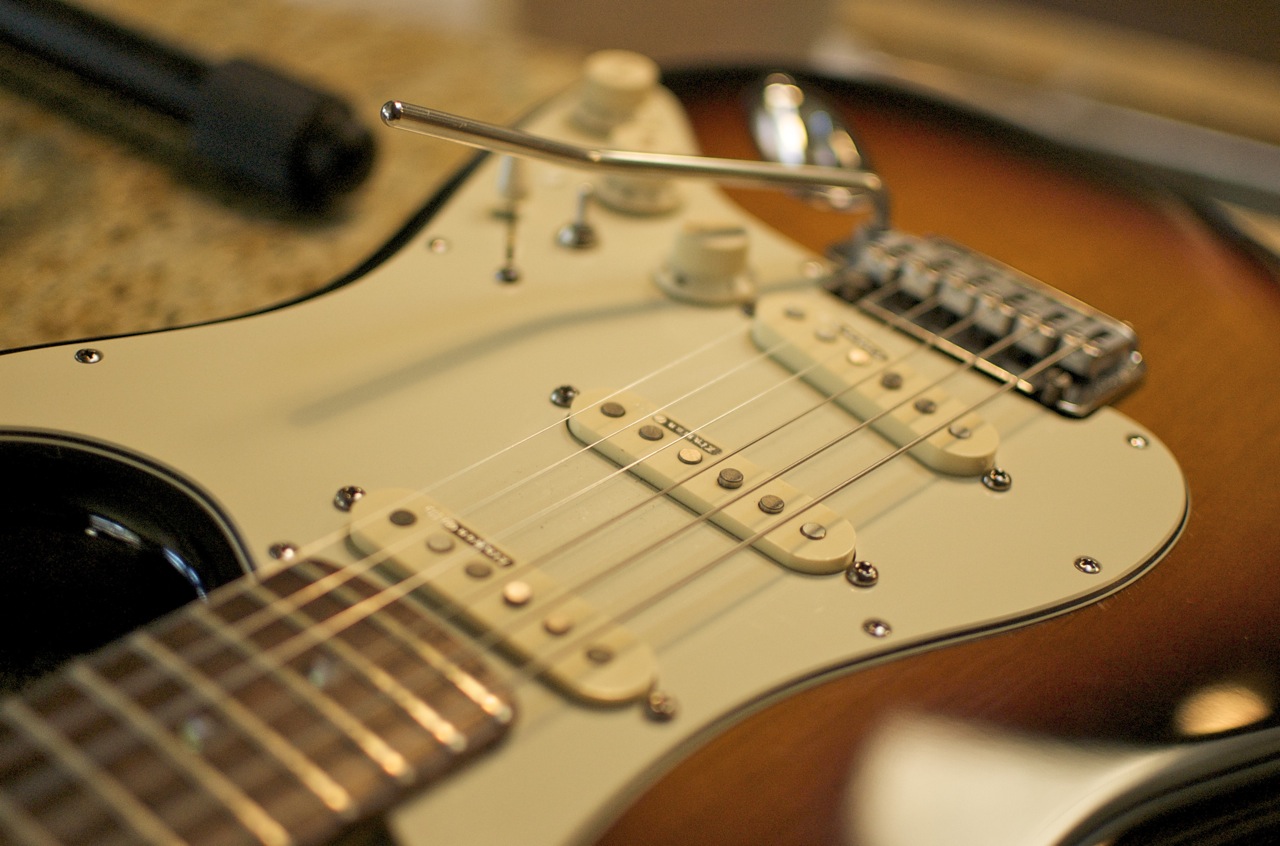
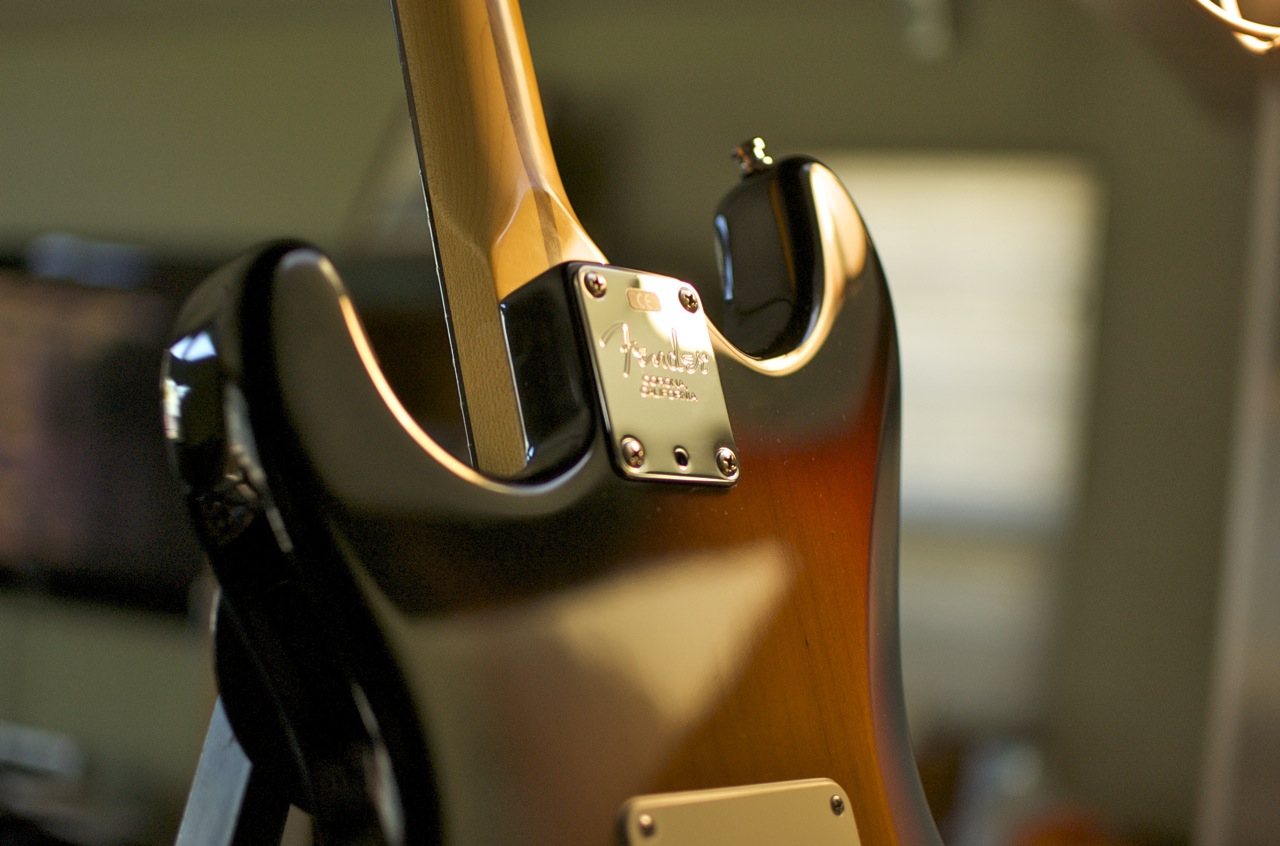
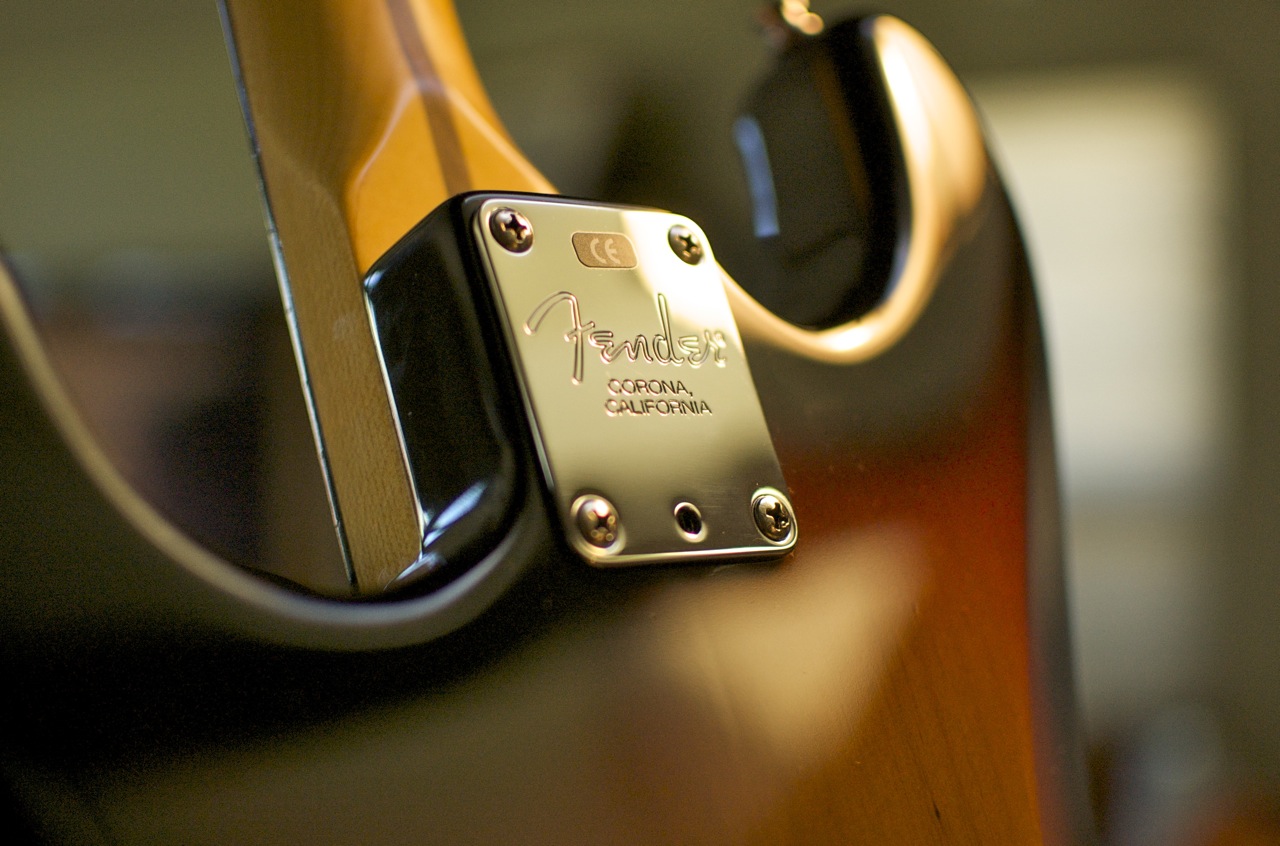
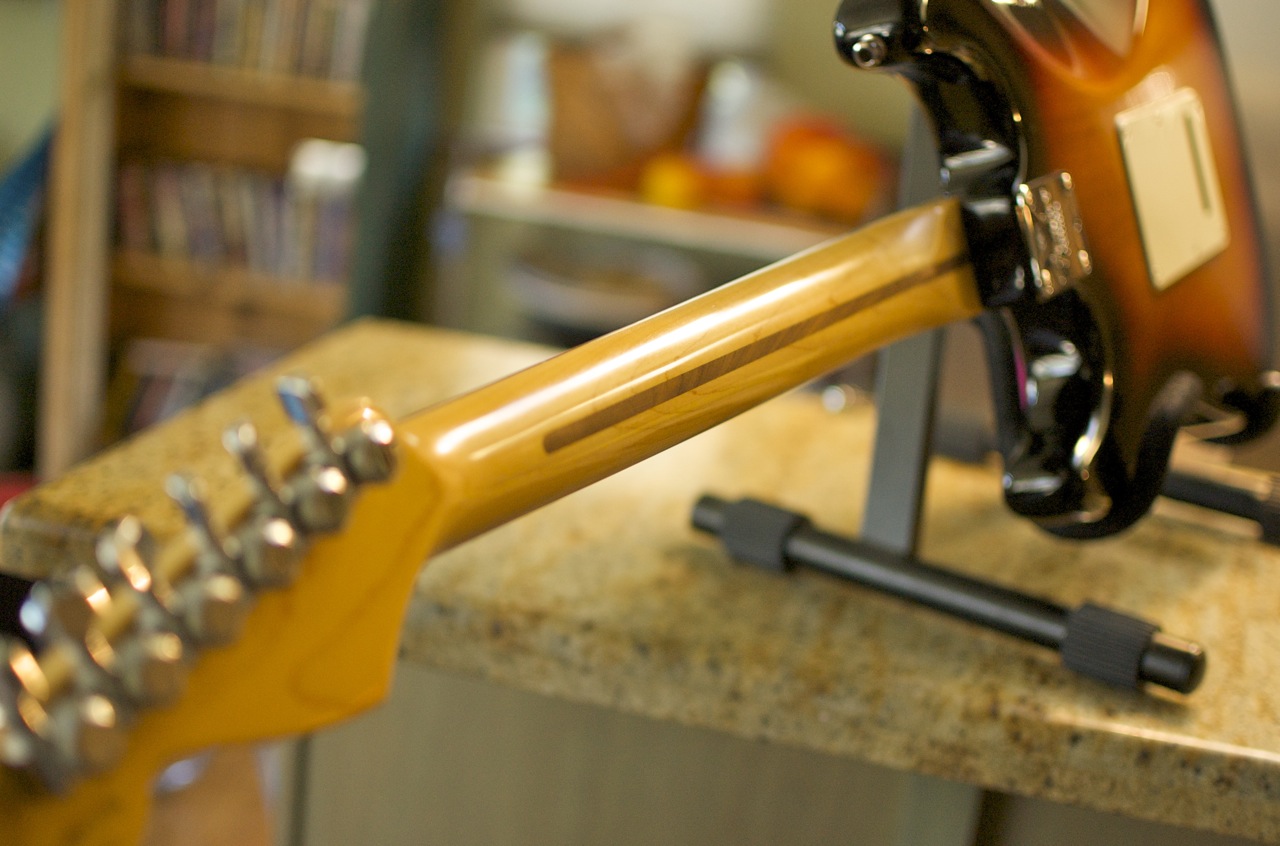
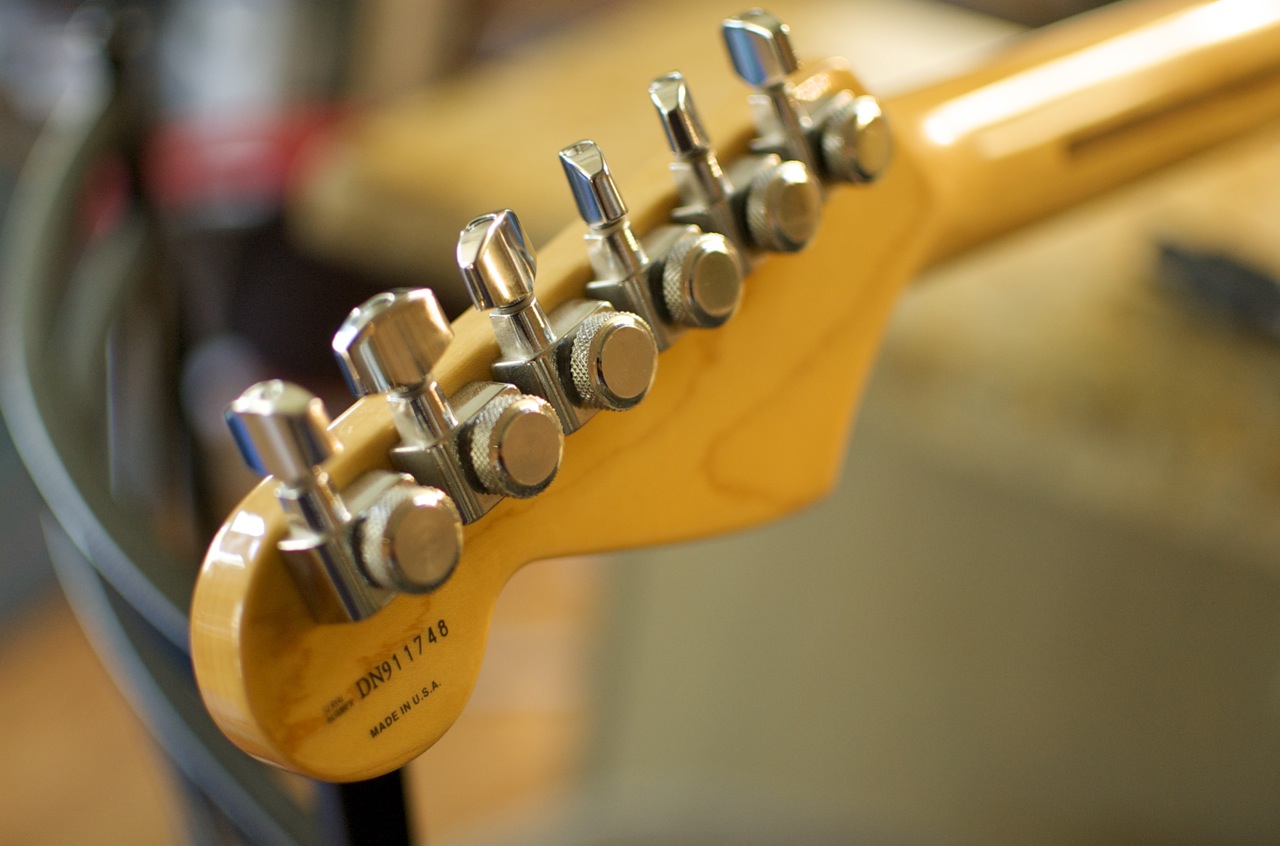
Fender American Deluxe Stratocaster Summary: Finally a Strat that I love to play. This one has been upgraded with Kinman pickups and an L. R. Baggs Ctrl-X X-Bridge pickup.Features:
Alder Body with 3-Tone Sunburst Finish (my favorite Strat Color)
1-piece Maple Neck
22 Frets
Rosewood Fretboard with Abalone Dot Inlays
Nut appears to be synthetic tortoise shell – very cool!
Locking Tuners
L. R. Baggs Ctrl-X Drop-In Tremolo/Bridge Replacement
Kinman Noiseless Pickups
8.5 lbs
Value: ~$1500-$2000
Tone Bone Score: 5.0 ~ Wow! What a tone machine! The Ctrl-X pickup has tons of gain on tap, and will give you plenty of crunch when you need it! The Kinman Noiseless pickups really smooth out the tone, and flatten the significant midrange that tends to be in stock Fender pickups.
I love estate sales because you can find some real gems. A friend of mine happened to get a bunch of stuff at an estate sale recently, and picked up this fine specimen of a Strat. What drew me to it initially was the 3-tone burst, which I love. Of course I had to try it out, so we hooked it up to a cheapo amp, and I couldn’t believe my ears! I was expecting that typical bright Strat sound, but what issued – even from that cheapo amp – was a much smoother tone. The tone definitely spoke “Stratocaster,” but it was in another dimension. Of course, I had to take it home with me to bring into my studio and to gig with this weekend… 🙂
For me, I had all but lost hope with Strats. I just couldn’t find one that really appealed to me. But with the changes in this particular Strat, I’ve regained my faith. This is an absolutely killer guitar!
Fit and Finish
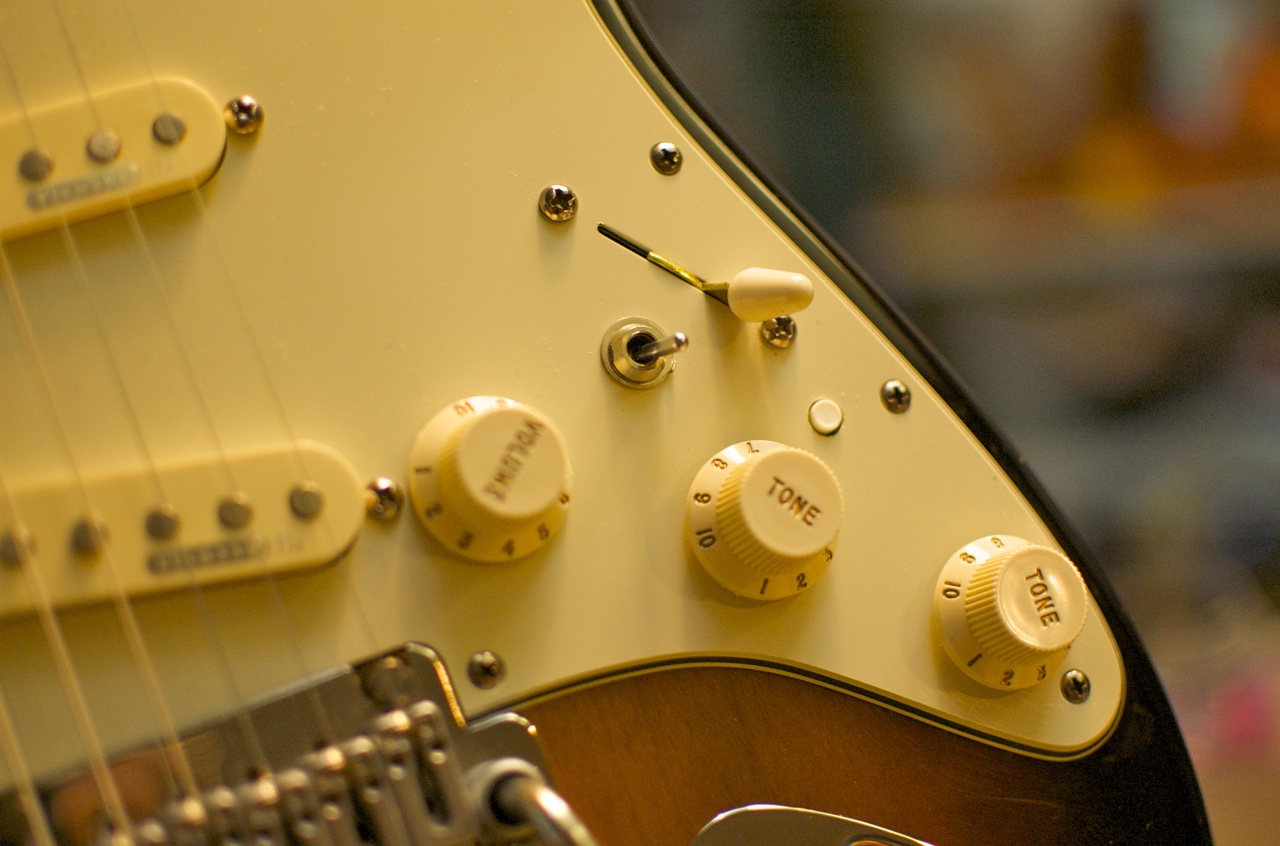
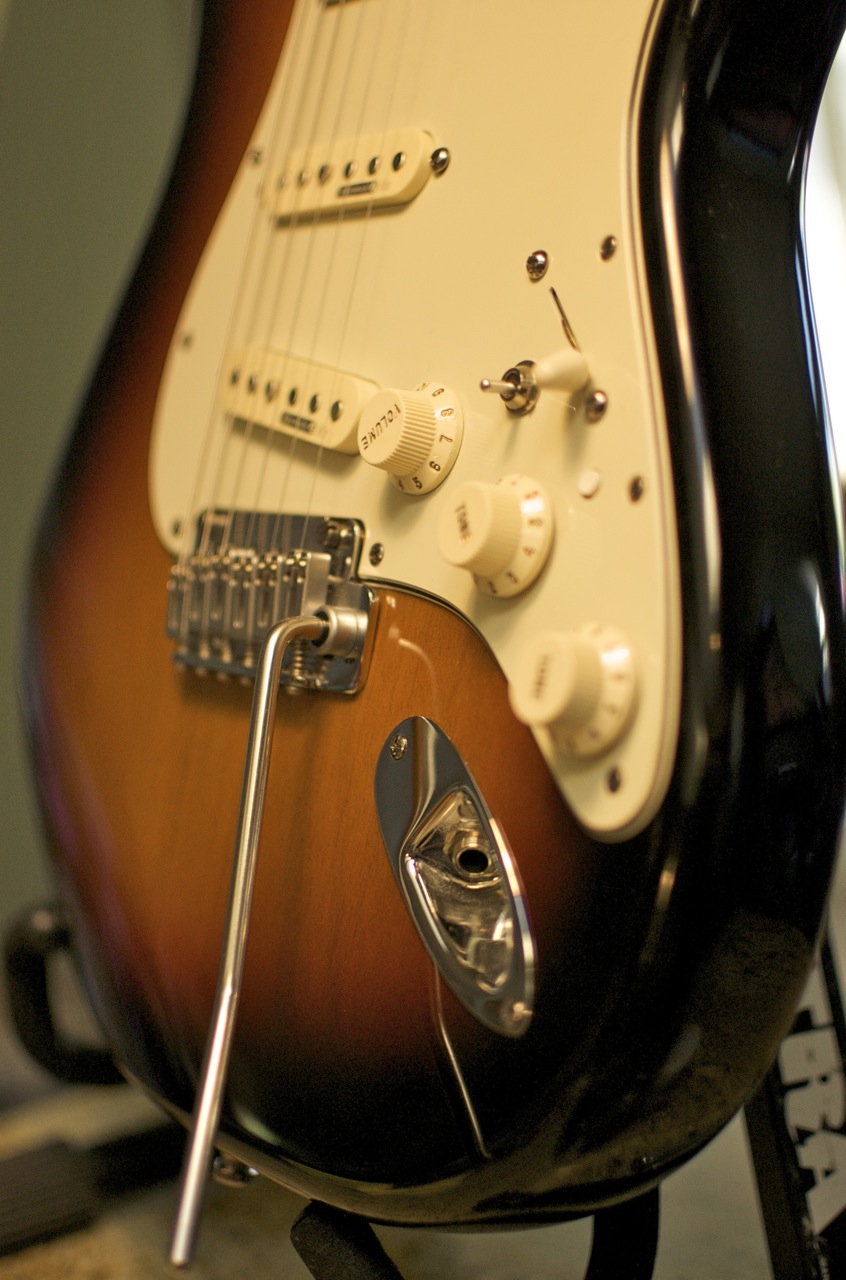
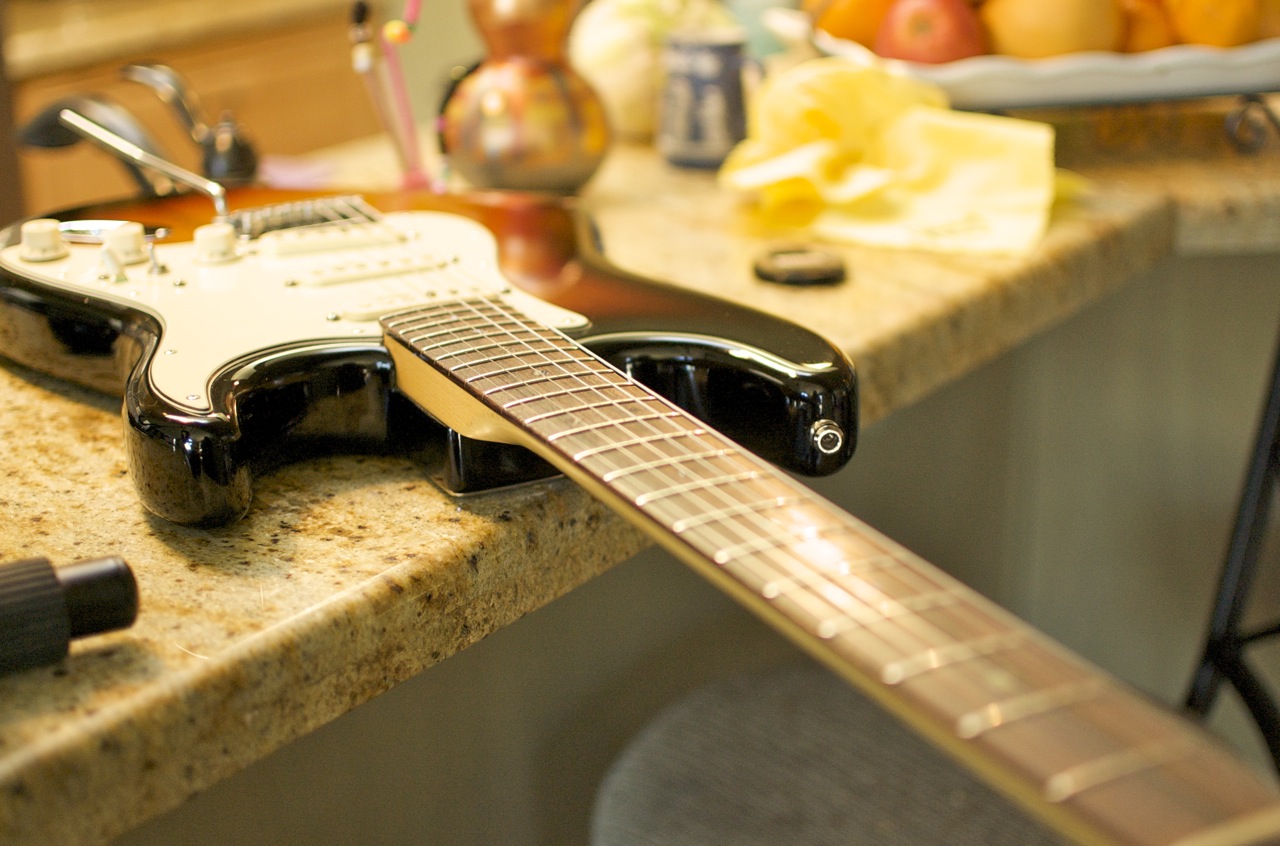
The previous owner tragically passed away a few years ago, and the dude was a total gear nut! As a result, he just didn’t play his gear all that much, and so the guitars that were in his collection were in absolutely pristine shape. This particular Strat has the most signs of usage, but there is absolutely no major scratches, and just a tiny ding on the neck. Other than that, the guitar is perfect. The rosewood fretboard is in particularly great shape, and still retains a gorgeous sheen. The abalone dot inlays are a great touch. Here are some pictures:
Playability
Unlike a lot of Strats that have really narrow nut width, this Strat’s 9.5″ nut radius is perfect. The neck is a gentle C and even with my short fingers, I have no problem reaching the lower strings high up on the fretboard. The shape of the neck is simply terrific, and provides a nice balance between solid-feel and speed. I could play this guitar for hours and never get tired. It’s really a player’s guitar.
How It Sounds
As I mentioned above, it sounds like a Strat, but it has a much smoother tone. This is due to the Kinman Noiseless Pickups that replaced the original “noiseless” ones on the stock Strat (don’t have the stock ones, but don’t want ’em). This Strat also has tones of sustain, which really surprised me. It’s not on the order of a Les Paul, but it sustains a lot more than other Strats I’ve played in the past. The Kinman pickups also add a lot of depth and complexity to the tone, picking up subtle harmonics that give the tonal presentation a real 3-D effect – it’s almost reverb-like. How cool is that?
On top of that, the original owner replaced the tremolo with an L. R. Baggs Ctrl-X system. This adds yet another pickup to the bridge that has all sorts of gain; very humbucker-like, but retaining the single-coil characteristics – there’s just more of it. The Ctrl-X system is cool in that you can switch between going fully magnetic to blend with Ctrl-X or fully Ctrl-X. The full-on Ctrl-X is great for soloing!
To demonstrate the gain differences, here’s clip I recorded this morning (actually, the two clips were included in my previous article that I wrote this morning). But here’s the first:
Finally, here’s the quick song that I recorded this morning that has the rhythm part in fully magnetic mode in the 4th switch position (neck/middle). The lead is played in the first position with the Ctrl-X system:
Both clips were recorded using my Aracom PLX18 BB Trem, a fantastic 18-Watt Plexi clone. I was originally going to record with my Fender Hot Rod because the guitar sounded great through it. But my problem with Strat tone came from switching to vintage Marshall-style amps like my PLX that have lots of midrange. Strats just didn’t sound right to me with these amps. But this one blew me away!
Overall Impression
It’s difficult being a gear freak and having so many avenues to evaluate great gear. I have to have this guitar. Period. It’s completely changed my view of Strats!
I started out as a Strat guy. Then when I moved over to vintage Marshall-style amps, just couldn’t stand the reedy, thin sound of my Strat with my amps. It sounded fine clean, but the overdrive sound was horrid. Well I finally came across a Strat that has much more balls than my old one. It’s an American Strat that has been hot-rodded with noiseless Kinman pickups and an L. R. Baggs Ctrl-X upgrade, which places a pickup in the tremolo bridge called the X-Bridge pickup. This includes a three position switch that functions similarly to a Les Paul switch: Fully up is magnetics only, middle is a mix of X-Bridge and magnetics, then all the way down is X-Bridge only, which is produces a fat, gainy tone.
I think that’s the problem that I had with my Strat and other Strats I’ve played. They don’t have enough gain to really push my vintage Marshall-style amps. But with the X-Bridge, I can get enough gain to push my amps to their sweet spots. I should say that that’s only for my non-master volume amps. It works great with my Fender Hot Rod; in fact, I was playing around yesterday and getting gorgeous overdriven tones with that amp using this guitar.
As an example of the effect the X-Bridge has on gain, here’s a comparison clip. The first part is just the magnetics, then the second part is played the same with the same chords and same pick attack. Gives you lots of gain. 🙂
I’ll tell you what: The X-Bridge seals the deal for me.
Next, here’s a short song applying both magnetics and X-Bridge. The rhythm part is played with just the magnetic pickups, and the lead is played with the X-Bridge. I have the amp set with the volume at 6 on Channel 2 of my Aracom 18-Watt Plexi combo and the tone at 3pm (optimum for a Plexi).
Where I had the amp set, it was just at the edge of breakup for the Strat in magnetics only mode. Then when I engaged the X-Bridge, I got a nice gain boost that pushed the amp over the edge. That gives me a nice, light overdrive that adds just a tiny bit of compression and sustain.
This is really profound for me because I had all but given up hope on Strats, even though I love their tone. My old Strat just doesn’t have the balls that this one has. It’s just way too thin and bright; which reminds me that the Kinman pickups are absolutely fantastic! They have a bit deeper tone than a vintage Strat pickups – I have the ’57 Tex Mex in my MIM Strat – and THEY ARE NOISELESS! No more 60Hz hum! 🙂 Frankly, I didn’t know too much about these pickups, but they’re apparently very popular replacements among Strat and Tele players. They’re not cheap at $300 for a set, but they’re well worth the money.
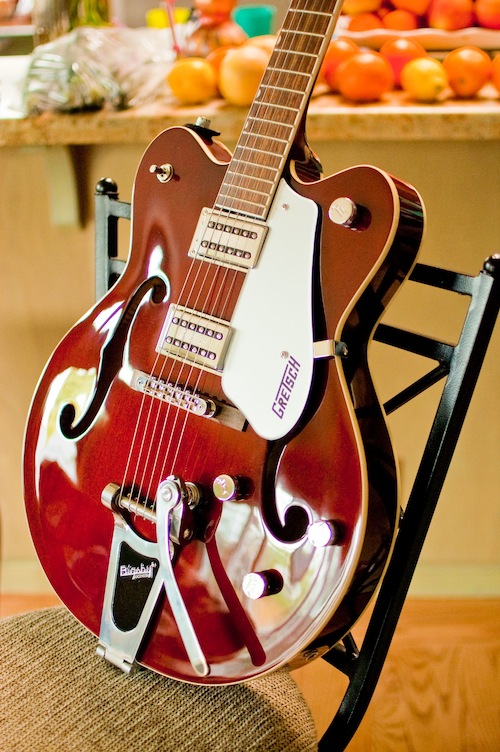 I gotta tell ya… I’ve got a new love, and it’s in the form of my new Gretsch G5122DC Electromatic. I’ve been playing it at my solo acoustic gigs, and I’ve been playing it at my church gigs. It’s an incredibly versatile axe! Clean, it has a very natural, acoustic tone, and even though the pickups have enough gain to push an amp into overdrive, it helps to use a drive pedal to give it that extra oomph. Of course, I use the Timmy that retains my guitar’s tone, and I just LOVE the overdrive tone this guitar produces!
 I forgot that back in the 70’s, that madman used a Gibson Byrdland, and he totally ROCKED THE HOUSE!!! The sounds he could get out of that guitar were incredible!










 Guitar Gear
