Feeds:
Posts
Comments

Posts Tagged ‘gear announcements’

You’ve heard of it happening to other guitarists, and how could it possibly happen to you? That’s right, your guitar gets stolen at a gig. Over the years, I’ve heard of countless stories of players having their axes taken right off the stage during a break; especially at small clubs where the stage can get obscured by the crowd. Bands have devised numerous ways to protect their gear from taking their guitars with them during breaks, to always leaving at least one band member in the stage area to keep watch over gear to even cordoning off parts of the stage area.

Myself, in my solo acoustic gigs where I play outside at a busy outdoor mall, I cordon off the open, rear area – I play in a “patio” at the end of a busy walkway – to prevent people from walking through my “stage.” But I also do this as a mild deterrent from possible theft. In other gigs, the stage is either raised or in an area that’s secure enough so as to offer more reasonable protection from theft. But still, that’s not complete insurance, so when I take a break, I either do it within line-of-sight of my rig, or have the servers and bussers keep watch over the stage when I can’t be within eye-shot. But if in the rare chance that any of them get busy and can’t keep watch, it’s possible for a cunning thief to come along at take my guitar.

Just a couple of weeks ago, this kid wandered over to my stage area and started checking out my rig while I was on a break. He was even audacious enough to twiddle with my pedals – he even lifted my Deep Blue Delay to inspect it! And while I was trying to get through the crowd back to the stage, he picked up my guitar! I finally got out there and asked him what the hell he was doing, and told him to put my guitar down. It turned out that he was just a young, high-school kid who turned out to not have any filters for manners. Some of the stuff he blurted out during our conversation made me open my eyes wide (had to say a brief prayer that I make sure my kids have filters 🙂 ). In any case, he just assumed that since he played he could just go up and mess with another player’s gear. I was friendly enough so as not to make him too uncomfortable, but I was quite firm when he asked me if he could play my guitar while I was on break that no, he couldn’t, and it was just not cool to just pick stuff up.

So what are we gigging musicians to do?
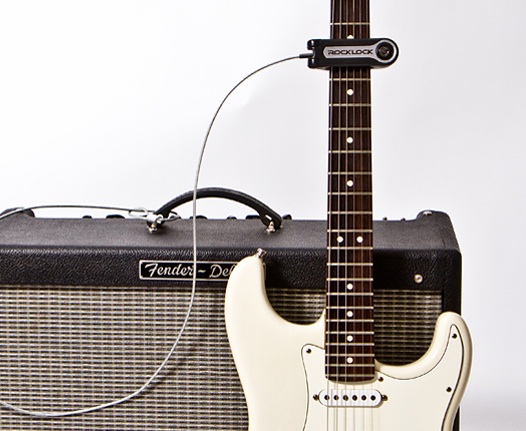
Enter the new Rock Lock from The Rock Lock Company. This is one of those inventions where you say, “Damn! Why didn’t I think of that?” The Rock Lock is much akin to a laptop tether with a loop at one end to attach to a fixed, stationary object (like a guitar handle as shown in the picture to the right), and a locking mechanism that wraps around the neck of your guitar.

Folks, this is the answer to guitar security! Talk about a theft deterrent! I’m totally excited to get one of these as it will certainly set my mind at ease when I go on breaks!

Here’s some information about the Rock Lock from the site:

  • MADE IN USA!!!
  • PATENT PENDING
  • Core Constructed from Cutting Edge Metal Replacement Technology
  • Nitro-Cellulose Safe Over-Mold
  • Heavy-Duty Braided Steel Cable
  • 1 Year Full Warranty with Registration
  • 2 Keys Included, with optional Key Registration
  • Fits almost all standard 6 string Guitars.
    This excludes: 12 String Instuments, Flamenco/Spanish Guitars, and Bass Guitars.

Pricing and Ordering

The Rock Lock will retail at $49.99, and if you’re one of the fortunate first to pre-order, you’ll get free shipping.

Note that the Rock Lock is not widely available just yet, but you can submit your name and email address to be notified when the next shipment is available (apparently, the first short, test-run sold out immediately). I exchanged info with the manufacturer, and he indicated that the first large production batch will be available on December 1, 2010, so get your name in ASAP!

You owe it to yourself to be comfortable to leave your stage knowing that your axe(s) are safe!

Read Full Post »

As you may know, I recently purchased the Mad Professor Deep Blue Delay, and wrote about how much I absolutely LOVE this pedal! While I can’t say enough about it, I anguished over getting it for a long time because of the price. At $335, it was so difficult to justify buying the pedal. But though I’m very budget-conscious, and a lot of this blog is about getting great tone without spending a lot of money, sometimes great tone just costs what it costs.  I’m glad I finally did break down and get it because it is by far the best delay pedal I’ve ever used!

So what’s the big news? Well, one of the biggest complaints about Mad Professor pedals is that they’re super-expensive. People who have purchased them, like myself, are very happy with them, but their price still smarts a bit. So in response to that complaint, MP made a great move: They added a line of less expensive pedals that mirror their current line. But instead of being hand-wired, these pedals are built using PC boards. Also the case they’re using is much less expensive. The net result is that you can get into Mad Professor pedals in the $200 price point range as opposed to the $300+ price point. Nice.

In any case, here’s what Mad Professor has to say about their new offerings:

Mad Professor was at Summer NAMM 2010 in Nashville 18-20 June 2010. We did show there the first redesigned pedal, a new Little Green Wonder.

Same tone, same look, but we did design a new pcb that helps us build these lot faster and for better price. The quality is the same, same parts but now pcb mounted pots, jacks and switch.

The box is also not the same Made In Sweden Elfa box that is made for heavy industry but a high quality pedal box that is bit lighter but very durable. That helps us to save a lot of money.

The only complain we have heard about the pedals have been the price, this is our answer to that.

We still make the handwired pedals for those who prefer them. Coming soon new Deep Blue Delay and Sweet Honey Overdrive.

Conceivably, if the circuit is the same, the tone should still be the same, but based upon experience, different build materials create different tones. They may be slight, but there’s always a difference. My only concern with the less expensive line would be response. As long as the response and dynamics remain the same or as close to the same as the original hand-wired pedals, these pedals should

Read Full Post »

Click for larger image

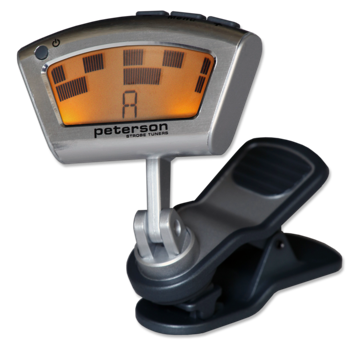
Peterson is at it again. I did a review on the Peterson StroboRack awhile back, and loved the unit, though as a pedal guy, the rack didn’t make much sense in a gig situation. I’ve seen the StroboStomp in operation, and that’s a cool unit. Now, Peterson has just released the new StroboClip, which combines the strobe technology Peterson is known for along with several “Sweeteners” for specific types of musical instruments, and provides 0.1 cent accuracy; all in a clip-on tuner! How cool is THAT!

True to Peterson build quality, the StroboClip isn’t made of cheap plastic. It is housed in a metal casing, so it should be quite durable, and the backlit LCD display should help a lot in making the tuning bars readable.

If you’re new to Peterson tuners, they use a pattern of left-right moving bars to indicate tuning. Movement left is flat, movement to the right is sharp. Once the bars stop moving, then the instrument is in tune. It takes a little while to get used to, but once you get the hang of tuning with a strobe tuner, it’ll be hard to go back to another type. I had trouble parting with the StroboRack when I had it, but also didn’t want to pay the price of a rackmount unit.

With the StroboClip, I might just be enticed to get one – especially for my solo acoustic gigs. My onboard tuner works okay, but it’s not as accurate as I’d like, and I oftentimes have to do some post-tuning tweaks to get it dialed in. But with a super-accurate tuner like the StroboClip, that might solve that problem.

I’ll hopefully be getting one of these units in for review, and I’ll do a full write-up on it. For now, here’s the press release from Peterson:

——–

PETERSON IS NOW SHIPPING THE WORLD’S FIRST CLIP-ON STROBE TUNER

Unrivaled accuracy in a small package strobe tuner

Alsip, Illinois, USA – 8-6-2010 – Peterson Strobe Tuners has added a clip-on style strobe tuner to their Virtual Strobe™ series line-up. The StroboClip™ is designed for acoustic instruments and contains many new features not found in traditional clip-on tuners. The large strobe display maximizes the StroboClip’s screen area by moving the strobe bands horizontally, rather than vertically as in previous strobe tuner models, to guarantee easy viewing in various lighting conditions.

New and exclusive Sweetened Tuning® presets for banjo, mandolin, and ukulele offer dedicated settings for players of these instruments to facilitate tuning. A variety of other presets including Dobro®, lap steel, and settings for the violin family come standard in the StroboClip. Settings for eclectic instruments such as lute, bagpipes, and oud are also covered along with additional Eastern Temperament settings for instruments of the like.

The StroboClip also features an exclusive Sustain mode™. In Sustain mode, the StroboClip can be set to hold the tuning pattern for a short time after the note has decayed so that instruments with short voices, such as banjo and mandolin, can be tuned quickly and easily. For regular tuning, the Sustain mode feature can be turned off.

“Musicians have been asking for the convenience of a clip-on tuner that has the accuracy and real-time tuning of a strobe tuner for a long time,” says John Norris, Peterson Sales Manager.  “Many features with a low price point is what the target was and we feel we hit the mark with this product.”

The StroboClip is encased in a brushed aluminum shell to help it withstand the rigors of the road and the included cushioned, metal carrying case will keep it safe when not in use. Soft, rubber pads in the jaws of the StroboClip protect the instrument’s finish while providing a firm grip for maximum signal conductivity.

The MSRP of the StroboClip is $89.99 and it is now shipping. Visit www.petersontuners.com or www.stroboclip.com for more information.

***

About Peterson:

Peterson Electro-Musical Products, Inc. has been manufacturing strobe tuners since 1948. The Virtual Strobe™ series was introduced in 2003 followed by the first ever True Bypass tuner of any kind, the Peterson StroboStomp™ in 2004. The StroboSoft software tuner was released in June 2005.

Read Full Post »

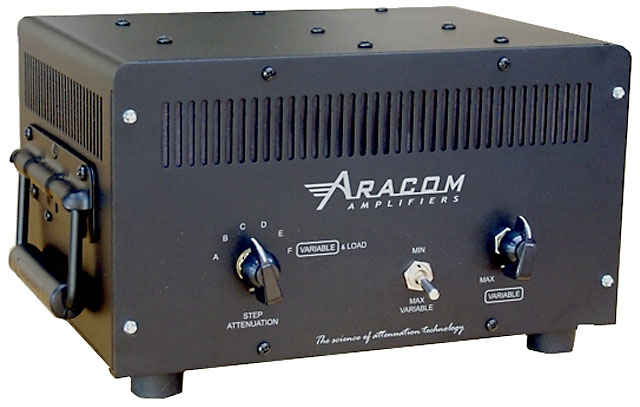
The venerable “Destroy All Guitars” shop has teamed up with Aracom Amplifiers to come up with a new version of the fantastic Aracom PRX150-Pro. Sporting a smaller cabinet (sorry, not reduced weight), and a couple of very cool new features, the $785 PRX150-DAG is the answer to anyone who wants to go to the extreme in transparent power attenuation.

Here are the features:

* Proprietary SRT Power Attenuation Technology
* Six levels of step attenuation, plus a continuously variable attenuation control (bedroom mode)
* 40dB of attenuation–attenuates 150 watts down to .015 watt
* 150 watt power rating
* Independent input and output impedance selector switches:
– from the amplifier and into the attenuator, select from: 2, 4, 8, 16 ohm
– from the attenuator and to the speaker cabinet(s), select from: 2, 4, 8, 16 ohm
– uniquely allows 16 possible Input and Output impedance combinations
* Hi Frequency Cut Filter with a True Bypass Switch
* Features a Load setting and is equipped with a Line Out Jack and Line Out Level Control
* Rack Mount Option
* Handwired in the USA

The two notable features are the Hi-Cut Filter, and the increased attenuation down to -40dB attenuation. With respect to the high-cut filter, some people had mentioned that they heard a high-frequency artifact coming through when they hooked up the original PRX150-Pro. I myself have never heard it, though I suppose anything’s possible. In Jeff Aragaki’s (of Aracom Amps) words:

The PRX150-DAG is equipped with a High Frequency Cut switch, that rolls off the highs above 6KHz, that some users might find useful with amplifiers that have a pronounced high end frequency response. Some guitarists go to great lengths to control the high end response of their amplifier, by carefully selecting speakers, tubes, and other components to roll off the highs. Now with the PRX150-DAG, a guitarist might not need to rely on changing these components; the high cut filter switch allows the flexibility of rolling off the high end or not. The true bypass switch allows the filter to be completely bypassed, providing the full frequency response of the attenuated amplifier to pass through to the speakers.

The other great feature is the Min/Max variable attenuation modes Jeff has introduced. Minimum attenuation mode is the traditional -16dB down to about -30dB variable attenuation, whereas the Maximum variable attenuation mode goes from -27dB to -40dB. With a 100 Watt amp, that’s taking down the output power to .015 Watt!!! Wanna have full dynamic response at bedroom levels with your 100 Watt amp? Look no further!

The Aracom-DAG PRX150-DAG is available exclusively through Destroy All Guitars. Check it out!

Read Full Post »

Being “GoofyDawg,” it’s always cool to find gear with the “dawg” moniker. 🙂 So when I came across Li’l Dawg Amps on one of the forums, I had to check out their web site. All I can say is, “Wow!!!” The reason for that is because I was completely blown away by the prices of these handmade amps! For instance, a 5F1 Champster (based on the 5F1 circuit) in a metal lunchbox enclosure is only $399! After seeing the prices of his amps, I had to get the low-down on the low prices, so I called Jim Nickelson up.

The story of how Li’l Dawg started is actually really cool, and Jim tells the story well in his Story page. What started out as a labor of love turned into a full-on amp business. What a way to retire! This was “supposed” to be a hobby. 🙂 Well personally, I’m glad he took up the hobby because many people have benefited from it.

Jim’s approach to Li’l Dawg is no-nonsense. He can keep the price down because he does all the work himself. He doesn’t advertise, which is another cost saver, and he’s worked out a product system where he turn around an order within 2-3 weeks! That’s amazing as most single man shops typically take months to complete an order.

But what about the amps? Well, I haven’t played one – yet. But Jim specializes in classic Tweed circuit amps, like the Champ and Deluxe. The model that I’m particularly interested in is a hybrid amp that has a 5E3 preamp (replete with jumperable inputs – nice) and a 5F1 power section, called “The Mutt.”

Now, Jim could probably just stop there and produce reproductions, but he has some nice added touches with his amps, such as Mercury Magnetics or Heyboer trannys, Sprague caps, and choices of steel or aluminum chassis.

As Jim shares, he wants to create a “candy store” experience when people choose an amp, and provide a basic foundation from which options can be added. So very nice, indeed! Then when you see the prices well, how could you not consider one of these amps?!!!

In any case, here are a few clips of the Mutt to whet your whistle:

Bright Rock Style

Clean, Chords

Jumpered

I don’t know about you, but that has TONS of classic rock mojo going on! Can’t wait to try one out! Or maybe I shouldn’t – I just may leave with an amp. 🙂 Well, that’s NEVER a bad thing. 🙂

Read Full Post »

Why? Because every time I satisfy my GAS, they come out with new stuff that gets me GAS-ing all over again, dammit! 🙂 Here I was innocently reading my e-mail this morning when I got Prestige’s latest newsletter that said they were about to release a line of acoustic guitars! Knowing the fantastic stuff they produce, and given that they didn’t release anything more than announcement that they were releasing a new line, I had to give them a call to get more information. I shouldn’t’ve done that. I’m now GAS-ing so damn bad that it’s killing me!

But I got the scoop on these guitars, and before you start thinking, “Yeah, here we go, another import guitar… How good could it be?” Well, let me just say that a major publication already reviewed it and gave their top-of-the-line model a very – excuse the pun – prestigious award. And after I heard the details of these guitars, it’s not a surprise that even before their official release, they already won an award. So here’s at least some preliminary information that I found out…

They will have three guitars in various price ranges. I didn’t get model names, but I did get the makes of each model:

  • The top-of-the-line model has a koa body and koa top
  • The intermediate features a rosewood body and Adirondack spruce top
  • The lowest tier (and only by materials) features a mahogany body and Adirondack spruce top

Though not set, the guitars will range in price from about $1000 to $2100 street, so even the lowest-tier model isn’t anything to shake a stick at; and before you balk at the price, there’s a good reason for the pricing. Prestige didn’t skimp on the features that all three models share:

  • Adirondack spruce X-bracing designed in partnership with Balaz Prohaszka, a well-known European luthier
  • 12″ radius
  • 25.35″ scale length
  • 1 3/4″ nut width
  • D-shape neck
  • Split Bridge Saddles
  • Bone nut, Bone Saddles
  • Ebony Fingerboard, Ebony Bridge, Ebony Bridge Pins, Ebony Strap Pin.
  • Ebony Headstock face
  • Satin Mahogany Neck, Laser Etched Logo and Serial Number behind the headstock.
  • Beveled Cutaway with Paduck inlay, Mother of Pearl Logo, Mother of
  • Pearl Eclipse Fingerboard Inlay, Abalone Rosette
  • Gotoh 501 21:1 Tuners with Ebony Buttons.
  • Paduck/Abalone Body Binding, Paduck/Maple fingerboard binding.

An option for each guitar is the Fishman Ellipse Matrix Blend pickup system. This is a very non-invasive soundhole pickup system that combines an undersaddle pickup with a gooseneck condenser mic. I’ve heard one of these installed in a Taylor acoustic, and it sounds marvelous!

So the pricing is really a reflection in the difference in tone woods used; otherwise, they’re all the same. That is incredibly COOL!

I’d be remiss if I didn’t have pictures, so here are a couple of the Koa/Koa model. These aren’t the pro pics as you can see the reflections of background objects – that’s how glossy the bodies are! Freakin’ awesome!!!

This slideshow requires JavaScript.

These are serious guitars, folks. Can’t you just DIG that beveled cutaway? Damn! I dig little things like that, and the outer bracing is absolutely superb! And another nice touch is the satin finish on the neck. I always prefer that because it allows me to polish it with my own body oils after time. For me, the ebony fretboard is a HUGE selling item! There is absolutely nothing like the feel of ebony; it’s smooth as silk and feels so nice to the touch!

I can’t wait to get a demo into my studio to give it a whirl! I TOTALLY DIG the Koa/Koa! Now do you see why I hate Prestige Guitars?!!! 🙂

For more information, please go to the Prestige Guitar web site!

Read Full Post »

Never really been into fuzz that much, but some of my latest stuff could really use some fuzz, so I was pleasantly surprised this morning to receive Fat Tone Guitars’ newsletter this morning that featured an announcement that they’re the exclusive sellers for Earthquake Devices’ new Zap Machine Fuzz. This is a brand-new pedal, released just this past Monday, and from what I can tell, it sounds VERY COOL! Here’s a video:

As I mentioned, it’s only available through Fat Tone Guitars, and this is a limited edition pedal, so get ’em while they’re hot! 🙂

Read Full Post »

Yup, you guessed it… yet another overdrive pedal. I came across this pedal while perusing the forums over at Mark Wein Guitar Lessons. Mark occasionally posts “Pedal of the Day” entries, and this was his latest. I know, lots of people complain about “yet another OD pedal.” But if you stop to think about it, there’s probably a great reason why there are so many OD’s on the market. What comes to mind for me is that no one overdrive can cover everything. Let’s face it, a Tube Screamer or TS-like OD can only take you so far tonally.

Don’t get me wrong: Not all OD’s are created equally. Admittedly, there’s lots of crap out there, which is a fallout of the boutique gear movement. I’ve suspected several boutique gear “manufacturers” of simply building gear based on kits, putting a nice paint job on them, then selling the pedal for hundreds of dollars; which is why I’ve always stressed to folks – try before you buy!

The LovePedal Kalamazoo is no exception to this rule. While it has some very cool features (I’ll list them below), you really never know how a pedal will work with your rig until you put it in your chain. But despite that, I’m really intrigued by LovePedal’s twist on the overdrive with the Kalamazoo.

So what’s to like? As you can see, there are two little knobs called Tone and Glass under the common Level and Drive knobs. I believe this is where the magic of the pedal lies. Tone is a treble content roll-off, while glass is a treble booster that doesn’t affect the lows. These are wired in series, so they interact with each other. From what I could gather from the demo from ProGuitarShops I’ve seen, these two knobs offer up a world of tonal possibilities.

Another thing that appeals to me is that I prefer a more “open” kind of overdrive to let my power tubes do the compression. To me, it sounds more natural that way. The Kalamazoo was designed to create an “open” type overdrive tone. With it, you can slam the front-end of your amp, and make that gain push the power tubes into compression.

And from what I could gather, the Kalamazoo is VERY responsive to input gain, which is demonstrated in the ProGuitarShops video.

Here are the pedal’s features (from the Love Pedal site):

9VDC Input
True Bypass LED Status
Compact Die cast Aluminum Case 4.37″ X 2.37″ X 1.07″

Controls:
DRIVE – Sets the amount of overdrive
LEVEL – Master volume control
TONE – Softens the treble content
GLASS – Increases treble without cutting bass response
STOMPSWITCH – Turns effect ON or OFF

Cost: $199

To top it off, the pedal has a mirror finish! I really dig that! My Creation Audio Labs Mk.4.23 booster has a mirror finish as well. Sweet! And at $199, this is a pedal that will not break the bank!

Here’s LovePedal’s Intro Video:

And here’s ProGuitarShop’s Demo:

For more information, visit the LovePedal site!

Read Full Post »

VOX Big Bad WahThe one thing about pedals is that eventually, they wear out; especially pedals that have moving parts like a wah. It may take years, but they do wear out. It’s a fact of life.

My Dunlop Cry Baby has been on the fritz on and off for the past few months. Not wanting to take the time to replace it, and considering that it is easy to clean and adjust, I’ve occasioned to just do a DIY job on it and get it working again. No problem. But I finally just got tired of doing that, and decided to look at a new one.

About a year and a half ago, I evaluated several wah pedals but finally just went with a used Original Cry Baby, figuring it would tide me over for my wah needs. It certainly served me well, and I got a lot of mileage out of it. At the time of my original search though, the VOX Big Bad Wah hadn’t come out, so I really couldn’t consider it. But time went on, and I completely forgot about it until I saw the announcement for the new VOX Ice 9 overdrive pedal. Then suddenly, a light went off in my head, and I just nodded to myself, “That’s right. Joe helped design a wah pedal.”

So I did a bit more research, and saw an excellent video on YouTube with Joe discussing the idea behind the Big Bad Wah, and I knew I had to try it. So I immediately hopped into the car and went down to my local Guitar Center to try it out. I spent about an hour in the GC isolation room playing around with the different settings, and I have to say that Satch and VOX really did well putting their heads together on this wah pedal.

One thing that struck me before I played it was a comment that Joe had made in the video and how he described how Jimi Hendrix used a wah-wah pedal as an “extension of the music,” and the notes that were being played, and not something that was merely a rhythmic effect within an ensemble. That really spoke to me because even though I couldn’t hope to have their chops, I’ve always looked at the wah pedal in that light. So it was with great hope that when I did play it, I could use it in that way.

To make a long story short, the Big Bad Wah (“BBW”) lived up to my expectations and even more! I was thoroughly impressed! The sweep is perfect on this pedal, and unlike other wah pedals I’ve tested, doesn’t have a “breaking point” where the wah effect comes on suddenly. It’s nice and gradual. The total physical sweep of the pedal was also well-though out. It’s wide enough so you can add subtle portions of the effect in, but not so wide that you have to travel a lot to create a dramatic wah effect.

The one thing that used to irk me with my Cry Baby was how it would sound REALLY thin when I got to its full extent. Not so with the BBW. It gets trebly at the top, yes, but not so much that it’ll shatter glass, which means that in the middle of a lead, you can peg the pedal and get some great trebly voicing! On the other end of the spectrum, the lowest setting didn’t put a complete muzzle on my tone. It’s more of a compression effect, with a bleeding off of the highs. That means that your notes still stay fairly clear. Very cool!

Another thing that got me diggin’ the pedal was the different voicings. It has two: Vintage and Modern. The Vintage is a classic VOX wah tone, while the Modern includes the Vintage voice and adds a 10 db boost which is controllable via a Drive knob. Not only that, the Big Bad Wah also has an inductor switch that allows you to choose between a classic UK type of inductor, or a more modern USA type of inductor. The tone shaping possibilities with the BBW are immense!

Needless to say, I walked out of the store with the pedal. 🙂 Once I got a chance, I got a backing track going from one of my songs called, “In the Vibe,” and recorded a quick clip. I realize that I could probably have been a bit more dramatic with the wah effect in certain places, but I’m still getting used to the sweep. I’ll have better clips once I do a full review. In any case, give it a listen.

Also here’s the video I was talking about earlier:

Read Full Post »

Debuted at Musikmesse 2010, the Ice 9 is the newest member of the VOX Joe Satriani line of pedals, named after a song with the same title on Joe’s “Surfin’ with the Alien” album. While it uses the same box and layout as the Satchurator, this is a completely different animal. The Satchurator is a distortion box, while the Ice 9 is an overdrive. Okay… so it’s yet another overdrive pedal entry into the already – excuse the pun – saturated overdrive pedal market. But the Ice 9 has some interesting features that are worth noting.

First of all, it has a Vintage/Modern switch. This switch provides different overdrive voicings. According to VOX, the Vintage circuitry models the classic Tube Screamer tones, while the Modern circuitry adds a bit more top-end bit and a bit of compression. In addition to the Vintage/Modern switch, the Ice 9 features a Bass knob for dialing in more bass response; perfect for getting really scooped, modern drive tones. Finally, like the Satchurator, the Ice 9 has the JS line’s signature “More” toggle, which adds a 10dB clean boost when engaged.

Pretty cool features, IMO. The Ice 9 is slated to be shipped in June. I don’t have any pricing information on it yet, but I don’t doubt that it’ll be reasonably priced if the rest of the JS line is any indication. Here are a some videos:

VOX Ice 9 Introduction Video

VOX Musikmess Demo

Musikmesse Demo from PremierGuitar

Read Full Post »

« Newer Posts - Older Posts »