Feeds:
Posts
Comments

Posts Tagged ‘gear reviews’

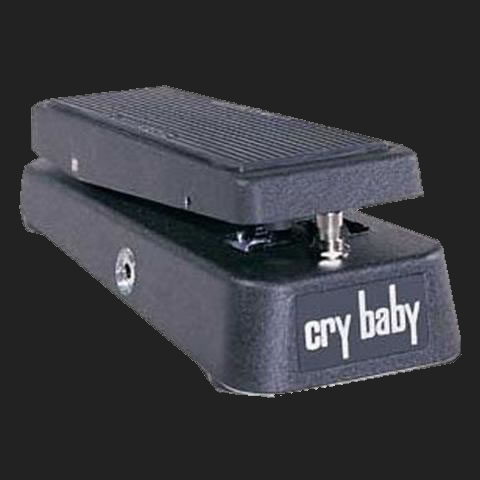
Dunlop Cry Baby GCB-95

Dunlop Cry Baby GCB-95

About a week ago, I wrote an article about getting a wah pedal. I had tried out and listened to several, and actually dug on a lot of them, but I just kept on coming back to the original Cry Baby. There has just been something about the classic sound of the Cry Baby that just makes me close my eyes with a smile of complete satisfaction while I’m playing.

For other players, this classic wah sound may not be their cup of tea, but this is the sound I grew up with. Every cop show on TV in the 70’s had a guitar played through a wah, and of course, let’s not forget Jimi who took it to another dimension. And it’s not like I’m going to try to play like Jimi – frankly, no one can – it’s just a sound that I’m used to, and it puts me in a time warp, back to when I was a kid.

Did nostalgia make me pick the GCB-95? It probably had a lot to do with it, but that’s the thing about tone: It’s what you like that matters. I didn’t get that nostalgic feeling of my youth with a lot of the other pedals. Yeah, I do admit there were some really awesome ones out there that I was ready to buy, but I figured that those could actually wait. I just couldn’t justify making a substantial investment into something that was so new to me. But I could get a Cry Baby at a fraction of the price, and I figured that since I was so new to playing with a wah, it would be best to instead make a minor investment to try out the technology before I spent a couple of hundred on a more expensive model. So, I forked out a reasonable $49 bucks at my local used gear shop for Cry Baby in excellent condition and saved even more money to hedge my bet.

So after a day, what’s my take? Well… I should’ve gotten a wah a long time ago! Don’t know what it is about it, but I’ve taken to it like a fish to water! Not to say that I’ve completely mastered it in a day, but it sure does feel natural. And you know what? The Original Cry Baby may be bordering on the vintage with respect to tone, it may only cost $69 used, and may be considered way too low tech for more modern players’ likings, but it totally does the job for me. I’m very satisfied.

Read Full Post »

GIG-FX Mega Wah

GIG-FX Mega Wah

I never thought that I’d say this, but I’m now looking for a wah pedal. I was working on a song recently and was using my MicroVibe to add a pulse to my signal, but it just wasn’t happening for me. The tone was kind of okay, and as a demo, would’ve been okay. But I realized that I really wanted a wah sound. So I started researching wah pedals.

I tried out a few and really liked the Fender Fuzz wah, dug the sound of the Dunlop GCB-95F Fasel Cry Baby, and liked the Morley Vai Bad Horsie Wah (didn’t know if I wanted to wait for Vox and Satch to come out with the Big Bad Wah). I was just about to pull the trigger on the Cry Baby, when I ran across the GIG-FX Mega Wah. GIG-FX claims that the Mega Wah is six wah pedals in one. That sounds promising, but the problem I’ve had with multi-function pedals in the past is that their voicings have sounded like a collection of compromises, resulting in mediocre tone at best.

But the Mega Wah seems interesting enough, and the reviews on Harmony Central have generally been favorable, for as few of them as there are. From my point of view, having a variety of wah sounds is quite useful. Sometimes you want that big Fasel wah, then sometimes you want the wider sweep of a more modern type of wah, or anything in between. The Mega Wah may just deliver. Of course, I have to try it out to really be sure, but that’s what I love about this hobby of mine!

The only thing that would probably hold me back from buying it, if it indeed sounds great is the price. At $199, it’s not cheap, whereas at $99, the Cry Baby is very well positioned for my budget. But it’s all about bang for the buck with me, and I’m willing to pay a bit more for much more capability. We’ll see…

Read Full Post »

Durham Electronics Crazy Horse Fuzz Distortion Pedal

Durham Electronics Crazy Horse Fuzz Distortion Pedal

If you’re not a Neil Young fan, read no further. But if you dig that big fuzz drive sound like I do, you’ll love the Crazy Horse Fuzz Distortion pedal. I haven’t personally played this one, but from what I’ve heard, it’ll serve up that “Crazy Horse” sound! But wait, there’s more!

This pedal is very cool in that it is a drive AND a fuzz pedal in one. So not only can you get the Crazy Horse sound out of this, but by varying the mix of drive and fuzz, you can achieve all sorts of different distortion characteristics. But in addition to drive and fuzz level controls, plus the standard tone and level knobs, a VERY cool feature of this pedal is the voltage knob, which will allow you to “starve” the pedal of its voltage, so you can vary the output from thin and fizzy to thick and ballsy!

Being a boutique pedal though, this kind of functionality comes at a price: $249.00. It’s not quite as steep as others in its class (think Fulltone, Mad Professor, etc.), but it’s also not cheap. View the video below for a great demo!

Read Full Post »

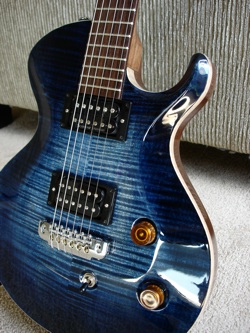
SAINT Guitar Company - Faded Blue Jean Benchmark Guitar

Saint Guitar Company Faded Blue Jean Benchmark Guitar

Saint Guitar Company Benchmark

Summary: Introducing a pure tone machine, with sultry, sexy lines to boot!

Pros: Dense walnut body and maple top give this guitar a natural brightness without sounding “tinny.” Coil tapped humbuckers enable you to serve up a huge tonal palette.

Cons: Nit: Volume and tone knobs are a bit too easy to turn. High-gloss finish on the neck was a little sticky until I got some body oils on it – my personal preference is a satin finish on the neck – this is just a nit as well.

Price: ?

Specs:

  • Reserve Stock Curly Maple Top (“Faded Blue Jean” stain)
  • Walnut Neck and Back (Medium natural stain)
  • High-gloss Finish
  • Koa Headstock Plate
  • High, Wide Frets
  • Handmade Rosewood Nut
  • Rosewood Fretboard
  • Gotoh 510 Tuners
  • Gotoh 510 Bridge
  • Neck Pickup: Seymour Duncan SH-2 Jazz (coil tapped via Volume)
  • Bridge Pickup: Seymour Duncan SH-12 Alnico II Pro (coil tapped via Tone)
  • Master Volume/Tone knobs.
  • 25 1/4″ Scale

Now I know how a guitar made to my specifications plays and sounds! If you’ve read this blog for any length of time, you’ve known about my relationship with Saint Guitar Company, a little manufacturer in Fresno, California. A couple of months back, Adam Hernandez (luthier) contacted me and asked me to spec out a guitar he was making for inventory. The body and neck woods were already picked out, but he said I could spec the rest. I finally got the guitar this past Sunday, and have had a hard time pulling myself away from it!

This is simply a pure tone machine. Unplugged, the resonance and sustain are simply incredible. All the pieces are pressure fit together (Adam claims the fit is so tight, he doesn’t even need glue – though, of course he uses it). 🙂 The net effect is that the sound waves just resonate through the tone woods, and produce a wonderfully rich tone that you can get lost in for days. Then you plug the guitar into an amp, and you have to catch yourself for fear of fainting – the sound is so incredible. But enough flowery phraseology. Let’s get into some particulars!

Playability

Adam likes to make his fretboards wide, but he compensates for this by not making the neck cut too deep. The end result is an extremely fast neck. In fact, when I gigged with it, I was able to move around the neck so easily that I was messing up! Mind you, this was not a bad thing because I was able to relax my left hand a lot, and play with ease. Add to that the tactile feel and feedback of a rosewood fretboard, and you’ve got one playable guitar.

The fretboard also features wider and higher fretwire, with nice, wide frets. Talk about being able to dig in and create ballsy vibrato! OMG! It’s simply insane!

From the standpoint of the right hand, controls are super easy to reach, and I just love the position of the pick selector! Switching pickups was literally as simple as reaching out with my pinkie – the same with the volume knob; though I did mention in the summary the volume knob is a bit too easy to turn. In the middle of a fast riff, volume adjustments are not easy when they’re that easy to turn. You almost always adjust too much!

An interesting thing I discovered with the guitar is that pinch harmonics were extremely easy to generate on any string – even the first and second strings. While I don’t use them much, I was amazed at how easy I was able to generate them.

Finally with respect to playability, I was afraid that with the walnut body and neck that the guitar would weigh a ton. To my overwhelming surprise, this was not the case. It wasn’t as light as my Korina Explorer, but it was way lighter than my Strat. Just a real comfort hanging from my shoulder strap!

Sound

As I mentioned above, this guitar is a pure tone machine. The tone was a bit brighter than I originally expected, but it was bright without being too trebly. The SH-2 Jazz in the neck position produces rich, deep cleans, and amazingly gritty, growly grind, while the APTL-1 Alnico II Pro in the bridge position can produce ringing cleans to gnarly drive. My favorite position is the middle position, which produces a gorgeous, complex, chimey clean tone, and serves up a nice, smooth drive when you have the master volume dimed. Speaking of the volume knob, this guitar is extremely responsive to volume knob changes, cleaning up nicely around 3 or 4, then adding progressively more grit as you turn up.

Interestingly enough, played through my Fender Hot Rod Deluxe, this is the first guitar I’ve played with that amp that really sounded great in my drive channel. Normally, I just keep the amp in its clean section and add grind via my Tube Screamer and OCD. But for some reason, the guitar played through my clean channel sounded kind of hollow. Once I switched over to my drive channel, my power tubes just sang!

As far as pedals are concerned, the guitar produces enough grit so I only had to use my Tube Screamer set to about the 12 o’clock position for the drive once I reached unity gain (around 9 to 10 o’clock). If I chained my OCD, the tone became way too dirty, so I just used my OCD as a booster for when a song went into a lead break.

I mentioned above the copious amounts of sustain the guitar produces. With the Tube Screamer, I was able to achieve practically over-the-top sustain; especially in the upper registers where it really counts. In one lead break, I did a bend/vibrato at the 18th fret, and leaned back with pure joy from how the guitar just sang as I bent and wiggled the string. It really was an ecstatic moment.

October 22, 2008 Follow-up: As Chris pointed out, the bridge pickup is an Alnico II, not a Screamin’ Demon as I originally worte, so I wanted to refine the sound section above. This guitar is definitely NOT a guitar made for heavy metal. When I spec’d the guitar, I had a blues/classic rock guitar in mind, as that is the style of music I write and play. I was a bit surprised when he told me it was Screamin’ Demon, because that is a fairly high-gain pickup, but hey, it’s all about tone, and to my ears, it really didn’t matter what pickup was in there: It sounded GREAT! But I do want to be accurate… In any case, my original description still stands.

As a pickup for doing the style of solos I play, the Alnico II Pro is simply amazing. I have to admit that I’ve never been one to use the bridge pickup by itself for leads because almost all the guitars I’ve had just sounded way too thin for my preferences. And while in the bridge position the Alnico II Pro does register a more trebly sound, it’s not thin sounding; it’s VERY complex, and it sustains for days! I just loved digging in and letting a note wail away!

As for the SH-2 Jazz, it’s hard to describe the sound it produces. The clean tone is simply magnificent; rich and thick and well-balanced between all the frequencies; almost like a cup of pure Kona coffee: Not light, not dark, and not even right in the middle. It’s really a conglomeration of different flavors all served up at the same time. Nice.

Wrapping It Up

Granted, a guitar like this isn’t for everyone – even for me. I just can’t afford the money to pay for something like this. But to have the honor to test it, along with having a guitar that was made to my specifications, what can I say? It looks like I’ve got to mortgage my house to get this friggin’ axe! 🙂 Seriously though, there’s nothing like playing a custom-made guitar, and if you’re in the market for one, Adam Hernandez and the Saint Guitar Company will make your guitar dreams come true.

Read Full Post »
Just got my latest issue of Guitar Player, and as usual, went to the gear section first to see if there were any new and interesting pieces of gear. Normally, the stuff there is pretty tame, but I got really intrigued by a short product review on the Harmonic Capo. Unlike a normal capo that you place on a particular fret to play open chords at a particular fret position, the harmonic capo is placed at a harmonic fret: 12th, 7th, or 5th, and it will play the harmonic there. But the really cool thing about this is that unlike a normal capo, where you can only play the frets above the capo’d position, with the harmonic capo, you can play at frets above AND below the fretted position of the capo. It’s a very interesting concept that can yield some very interesting tonal possibilities. Check out this video by the inventor:

Read Full Post »

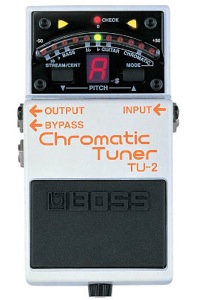
BOSS TU-2 Chromatic Tuner

BOSS TU-2 Chromatic Tuner

BOSS TU-2 Chromatic Tuner
Summary: Basic, no-frills chromatic tuner in a convenient stomp box that can also double as a power source.

Pros: Super-convenient stomp box makes on-stage tuning a breeze. Tuning mode automatically cuts off signal to the rest of your board for relatively “silent” tuning.

Cons: Only has 11 total LED’s, so fine adjustments aren’t possible.

Price: New $99 Street

Features (fr. BOSS site):

  • BOSS world-renowned TU-Series tuner accuracy in a convenient stompbox design
  • Mute/Bypass select for silent tuning with a single stomp
  • 11-point LED indicators and new “stream” meter display tuning discrepancy via speed and direction of LEDs (speed of LED movement gets slower as pitch becomes more accurate)
  • 7-segment LED displays string and note names, easily visible on dark stages
  • Seven easy tuning modes include Chromatic, Guitar Regular, Guitar Flat, Guitar Double Flat, Bass Regular, Bass Flat, Bass Double Flat
  • Tuning mode setting and display style choice stored in memory
  • Adjustable reference pitch from 438 to 445Hz
  • 8-octave tuning range–the widest in its class
  • Footswitchable Tuner Off mode preserves battery life by disabling LEDs

Let’s face it: Tuning is a fact of life when you play any musical instrument. And if you’re like most gigging musicians, you don’t have a guitar tech at your gigs to tune your guitars in between songs. For that, you need a tuner. For years, I used a cheap, hand-held analog tuner with a sweep meter for tuning. It was very accurate and did the job well, but as I started to gig more and more, having to turn the volume down on my amp to tune soon became irritating.

So I decided to get a stomp box tuner, and went down to Guitar Center and bought the TU-2. Now I will be the first to admit that I didn’t do much research before buying the TU-2. I’d recently read an interview with Joe Satriani and he had a TU-2. I figured if something’s good enough for Satch then it’s definitely good enough for me. It was a safe bet then, and it’s a safe bet now. The TU-2 is solid performer that’s fairly accurate, though no LED-based tuner could even possibly suss the accuracy of a strobe or analog tuner. But for what it does, I’m pretty satisfied with it.

Another nice feature about the TU-2 is that it can also act as a power source for up to either other pedals. I power up my board with a Dunlop DC Brick, but once I used up the 6 available 9V ports, I couldn’t add more
pedals without having to get another brick. For one or two pedals, that’s just not a good justification when you’re spending 100-bucks. The TU-2 comes with both a DC-in and a DC-out port. You can use a standard 9V cable to hook up another pedal, but it probably makes more sense to spend  the $12.99 and buy the BOSS PCS-20A power cord, which will route power up to eight pedals. Caveat: The cable runs between connectors are short. BOSS assumes you’ll be using nothing but BOSS pedals, but with tone freaks, that’s rarely the case. But it is a cheap, convenient solution nonetheless.

So what’s my verdict? I wouldn’t have it if I didn’t think it was useful. It’s not in any way, shape, or form something to do cartwheels over, but it’s a solid pedal that gets the job done. At Harmony Central, when you write a review, they ask you what you’d do if it the gear you’re reviewing gets broken or lost. Were I to review this pedal there and answer that question, I’d probably take a serious look at the Korg stomp box tuner that sports more LED’s and is a bit more accurate than the TU-2. The only thing that would probably keep me from switching is the ability of the TU-2 to provide power to other pedals.

Rock on!!!

Read Full Post »

« Newer Posts