Feeds:
Posts
Comments

Posts Tagged ‘gear’

To get ideas for articles, I subscribe to lots of press releases and music manufacturing news feeds to stay current on the happenings in the gear world. Over the past few years, there has been increasing activity in the realm of guitar building materials; specifically, tonewoods made from increasingly reduced supplies. For instance, Indian Rosewood is becoming increasingly expensive and much less available.

But in addition to the discussions focused on scarcity and perhaps eventual complete lack of availability of tonewoods has been a lot of buzz about conservation law regarding the importation of various woods products. Recently, I happened upon an article that talked about the expansion of the Lacey Act of 1900 under H.R. 2419 Food, Conservation and Energy Act of 2008. The Lacey act was put into law to prevent illegal harvesting of various protected flora and fauna. Apparently, according to the article, the expansion of the Lacey Act by the new act of 2008 dealt with not just the importation of newly taken or harvested material, but finished products consisting of illegal material, such as antiques made from Brazilian rosewood and tortoise shell.

Yikes! That’s really expansive. I suppose the gist of the law is to be extremely stringent with imported material and including processed material as well as raw material. I actually read the law (which you can read here), and in section 8204 sub-section (a) under Definitions, the law states:

(1) IN GENERAL- The terms `plant’ and `plants’ mean any wild member of the plant kingdom, including roots, seeds, parts, or products thereof, and including trees from either natural or planted forest stands.

The words “or products thereof” are the kicker that make antiques or other processed plant material applicable under the law.

So what is the law? Basically, this section of the law requires that any material imported that falls under the definition as a plant or plant produc, must have adequate documentation to prove its legality. So a company that imports plant products, i.e. exotic woods for guitars, must provide detailed documentation to customs officials when requested. If documentation is inadequate or non-existent, the company will be subject to fines.

That’s not unreasonable, and its strictness should be a great deterrent from importing illegal woods. BUT, as the Music Trades article discussed, it’s not the actual enforcement of the law that is really the problem, but the compliance with the law, as assembling and maintaining that documentation can involve significant administration expense. Companies wishing to file electronically may do so, but only through a special machine that costs $50,000! For small companies, that expense could possibly be prohibitive to running the business.

The law is well-intentioned, but I do feel that it is overly comprehensive. “Or products thereof” makes compliance difficult, especially with previously processed material like antiques that potentially could be 100 years old! I don’t disagree that there should be fairly stringent laws regarding the importation of illegal plant products, but to include already processed material, where the documentation just doesn’t exist, is a little extreme from my perspective. What this means to us as consumers is that you know what companies will do with the extra expense: They’ll have no choice but to pass that on to their customers.

But irrespective of the requirements of the law creating expense, let’s face it: Exotic woods are becoming more and more scarce, so prices will go up anyway. But perhaps this impending scarcity or unavailability could be used as an opportunity to find suitable replacement woods. For instance, I have a guitar made of walnut. Walnut has the warmth and resonance of mahogany, and better yet, it’s a easily renewable resource, in abundant supply. For forward-looking companies, this could an opportunity to move the market.

All this may have no bearing on our purchase decisions now, but it is certain that in the future the woods we’ve come to rely on for our tone today, will most probably radically different. The litigation revolving around this only enforces that idea.
Read Full Post »

Okay, I’m a Les Paul/Gibson guy, but I hate Gibson just the same. Why? Well, lemme tell ya:

  1. Just looking at Les Pauls gives me serious GAS!
  2. My Les Paul GAS makes me spend my money.
  3. I lose countless hours playing my Les Pauls because they sound so damn good, I lose track of time.
  4. Because of my Les Pauls, I’ve had an itch to get appropriate amplifiers to showcase their incredible tone (call it “ancillary GAS”).
  5. That ancillary GAS further drains my wallet.
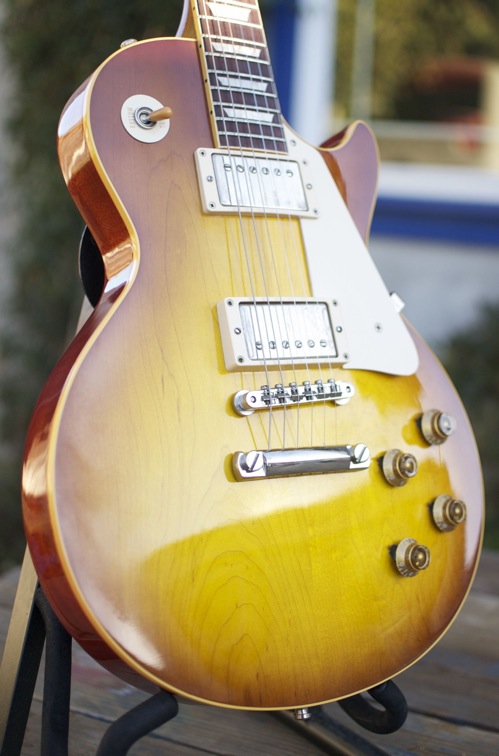
  6. They keep on coming out with kick-ass new Les Pauls that I want. For instance, this one. Then I get even more GAS.
  7. I’ve become obsessed with Les Pauls, dammit! And I’m not an obsessive person – or am I? 🙂
  8. But besides Les Pauls, they make the ES-335. I want yet another – dammit again!

Dammit! Dammit! Dammit! I hate you Gibson! You ROCK and I hate you so much that I’m giving you my hard-earned cash! 🙂

Yeah, yeah, I know all you anti-Gibson naysayers out there. I’ve heard your arguments, and I’m not getting into a debate. Gibson guitars just do it for me just as PRS, Fender, Taylor, etc. do it for others. Give me a Les Paul, or Nighthawk (2009), or ES-335, and I’m a happy man!

But I still hate Gibson for triggering my frequent GAS attacks.

Read Full Post »

I’m an avid golfer, and one of my all-time favorite golfers is Arnold Palmer. During his heyday back in the 1960’s, he was known as a hard-charger who seemed to take a lot of risks. But he was rewarded with several wins and an appreciative fan base who could dig what he was about.

So it was a real pleasure to come across an article he wrote in the latest issue of GolfDigest magazine. Each month, GolfDigest has a “10 Rules” column, and this month, the 10 Rules were entitled, “On Being a Savvy Risk-Taker.” After reading it, I got inspired by a couple of the rules and especially how they relate to guitar gear. Here’s the list of rules from the article:

  1. Measure risk against reward
  2. Think twice before reaching deep
  3. Bold putting isn’t risky
  4. Don’t compound mistakes
  5. A low ball means lower risk
  6. Don’t try things you haven’t practiced
  7. Be true to yourself
  8. Reduce risk from the rough
  9. Know the difference between risks and gambles
  10. Don’t let a partner tempt you

The two rules that got my attention in particular were rules #2, #4 and #7.

Rule #2, “Think twice before reaching deep” is related to something that I frequently say in this blog: You’re the one responsible for your own buying decisions. In the GolfDigest article, Arnie described how when Jack Niklaus arrived on the scene, he could crush the ball, and it was difficult to not try to keep up with him. The only problem was that “reaching deep” to get that extra distance usually resulted in a total loss of accuracy.

How that translates to buying gear is that while other people’s input can indeed be helpful, in the end, it’s your decision and only you can determine if some gear will work for you. And it’s also fine to want to get gear like your favorite artists, but no matter what gear you play, you’re going to sound like you. Overshadowing all this is that you shouldn’t feel pressured to “keep up” with other people’s rigs.

Rule #4, “Don’t compound mistakes” may on the surface seem to not have anything to do with gear, but from a certain, very real perspective it has a lot to do with gear, and it’s something I’ve had to learn the hard way. Most gearheads have LOTS of gear; I mean LOTS. I’m no exception. In my  quest for the Unicorn we call tone, I’ve spent a lot of time going down various paths of gear acquisition, only to find that that path is not the “right” path, and as a result have left lots of unused gear in my wake. Sound familar? To me, that’s the result of compounding mistakes.

Picture this: I get in my mind that I want a certain effect or flavor in my tone. I do some research, and finally decide on a piece of gear. I take it into my studio and gig with it, only to find that it’s missing some quality. A reasonable person would just return the gear – maybe even take a bit of a loss and take a “learning tax.” But noooooo, the stubborn gear freak in me thinks that everything can be “tweaked,” so I buy let’s say a pedal to compensate. But that doesn’t get me there. Then I buy NOS tubes. Still that doesn’t get me there. Then I swap out speakers. Almost there. And so on and so forth.

That happened with my Fender Hot Rod. To be completely honest – and hindsight is 20/20 – the Hot Rod is all about clean headroom. In stock form, its clean tones with just a tad spring reverb are simply gorgeous. But its dirty tones leave much to be desired. So I swapped tubes and swapped speakers. And I did that quite a bit. It took me about three or four rounds of changes to finally get a good dirty tone, only to find that I really didn’t want to use the amp as a dirty amp. Talk about compounding mistakes! 🙂

Rule #7 “Be true to yourself” is pretty self-explanatory, but of all the rules that impressed me the most, it was this one. The reason for this is because if it’s one thing that I’ve learned in all my gear purchases, it is to look at acquiring gear from the perspective of what it will do for the music I play; that is, is it relevant? I’ve come across and played some REALLY cool gear, and in my less wary days, if it was cool, I’d buy it. But now, I’m realistic about my gear purchases. If it doesn’t help what I play or perhaps plan to play, then chance are, I won’t buy it.

Take, for instance, the Dumble amp. Having listened to one and briefly played one, I was thoroughly impressed! But that’s also way beyond my spending limit, and musically, I don’t think it’ll get me much more than what I can get with my current rig.

Finally, here’s a funny thought. A friend of mine told me of something he read: I get the best gear that I can get because if I suck, then I know it’s not the gear. 🙂 Love it! Rock on!

Read Full Post »

In my previous article, I cited the Marshall Shoppers Guide as the definitive resource to help you make a decision in purchasing a Marshall amp, both vintage and modern. In that article, I mentioned that my very good friend, Jeff Aragaki of Aracom Amps was especially helpful in guiding me towards the type of Marshall amp sound that appealed to me. Jeff specializes in building vintage Marshall-style amps, and in order for him to be able to build those types of amps, he had to acquire quite a bit of knowledge about the vintage Marshalls. On top of that, he’s also a collector, and has an original JTM 45. Niiiiice!

Jeff’s such a great guy in sharing information, and he has written an EXCELLENT article that covers the vintage Marshall amps from 1962 to 1973. It is entitled: “History of Early Marshall Amplifiers.” In the article, he talks about the various Marshall amps and their configurations. It’s lots of information that is really geared towards the collector.

So now there’s another definitive resource on vintage Marshall amps!!!

Read Full Post »

Before I got my Les Paul R8, I spent over two years searching; not just for the right deal, but sifting through all the different models. That meant reading lots of articles, joining several forums, and participating in lots of discussions. I’m glad I took the time, but looking back, it would’ve been great to have a single, definitive source for information on the different Les Paul models. It probably would’ve cut my search time by a significant factor!

As if searching for a Les Paul was bad enough, I was also at the same time looking for an amp. Having cut my teeth on the Fender sound, once I started writing and playing more heavy stuff, I started gravitating towards the Marshall camp. Now luckily for me, I met Jeff Aragaki of Aracom Amps who not only builds vintage-style Marshall-esque amps, he owns several Marshall amps from, including a 60’s JTM 45 that is an absolute tone monster! What a machine! Anyway, he has been my source for Marshall amp information; without him to guide me to the type of sound I was after, I probably would’ve had to resort to my method for finding a Les Paul (Jeff was also instrumental in that camp as he is a Les Paul collector). In the end, the tone I dig from Marshall amps comes from the JTM and Plexi camp. By the way, he’s coming out with a new 50 Watt amp called the “FlexPlex” that includes circuitry for both JTM and Plexi amps, and even has some Dumble-esque features. That’s my next amp!

Circling back to searching for a Marshall amp, I recently came across two articles that include pretty much everything you need to know about the different flavors of Marshall amps, collectively called the “Marshall Shopper’s Guide.” The articles are very detailed, and more importantly, they’re unbiased. Here they are:

Part I: Marshall’s Plexi Era

Part II: Vintage “metal panel” through JCM 2000 Series

To say I was thoroughly impressed by these articles is an understatement. The author, David Szabados, really did a great job with them, and my hat’s definitely off to him for providing such rich information. So if you’re looking for a Marshall Amp, at least in my opinion, there is no better source for getting information on Marshall amps.

Read Full Post »

Just came across this today, and it is the most comprehensive OD shootout I’ve seen/heard – EVER! This isn’t a simple A/B. This is 36 OD pedals. Very good!

NOTE: If the video keeps stopping, watch the video on the YouTube site directly: http://www.youtube.com/watch?v=WuTt8YFblcE

Read Full Post »

For years I was on an Overdrive kick. I still kind of am. I love dirt pedals despite the fact that I don’t use them nearly as much as I used to, and am patiently waiting for my Timmy to arrive. 🙂 But ever since I went on my quest to get an original BOSS CE-2 chorus, I’ve kind of gotten on a chorus kick as well; not as bad as my overdrive kick, but every time I see a new chorus, I have to at least listen to it. And if I REALLY  like it, I might just buy it. That’s how it was with my Homebrew THC. It just came along at the right place at the right time.

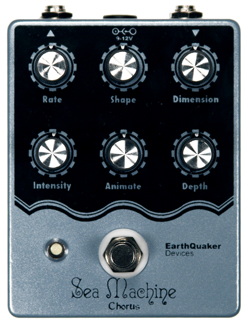
Truth be told though, while I’m not currently in the market for another chorus pedal, the Sea Machine Chorus from Earthquaker devices does give me pause. One thing that always turns me on with respect to gear is versatility, and the Sea Machine certainly cannot be blamed for lack of it. In addition to the tradition, Rate, Depth, and Intensity knobs, the Sea Machine also boasts three other knobs:

  • Animate – adjusts the width of the chorus pitch shift
  • Shape – adjusts the shape of the LFO
  • Dimension – which adds reverb/delay-like ambience to the tone.

This is impressive because from demos I’ve seen, this pedal is capable of producing TONS of different tones from your traditional chorus to leslie to vibe to all-out tweaked!

The pedal retails for $215 online. Here are some demos for your viewing/listening pleasure:

I totally dig Andy at ProGuitarShop.com’s demo as he demonstrates AND explains what the pedal can do, which is a lot. The Dimension feature is absolutely awesome!

If I had to do it over again, and I hadn’t purchased the Homebrew THC, I probably would’ve picked up the Sea Machine. Great chorus!

Read Full Post »

In my last post on cables, one of the respondents replied with a couple of great links. One of them was to Roger Russell’s site on a discussion about speaker wire. In that article, he had a very useful table on wire gauges and maximum cable lengths you should use. I grabbed the table, reformatted it for GuitarGear.org. Here’s the table:

Wire Size 2 ohm load 4 ohm load 6 ohm load 8 ohm load
22 AWG 3 feet max 6 feet max 9 feet max 12 feet max
20 AWG 5 feet max 10 feet max 15 feet max 20 feet max
18 AWG 8 feet max 16 feet max 24 feet max 32 feet max
16 AWG 12 feet max 24 feet max 36 feet max 48 feet max
14 AWG 20 feet max 40 feet max 60 feet** 80 feet**
12 AWG 30 feet max 60 feet** 90 feet** 120 feet**
10 AWG 50 feet max 100 feet** 150 feet** 200 feet**

The “**” indicate that in reality a 50 foot cable length is actually optimal.

I dig information like this because it’s a great reference for when I’m buying cables.

With speaker cables, what you’re concerned with is not capacitance, like you are with instrument cables. What you’re concerned with is resistance. You COULD use a material that has much less resistance than copper, like gold, but you’ll get much more bang for the buck by just going up a gauge (down in number). Personally, I just use 12 gauge wire for my speakers, and the lengths are only 4 feet, so I can use pretty much any load and be assured that I won’t create too much resistance between my amp and cab.

Read Full Post »

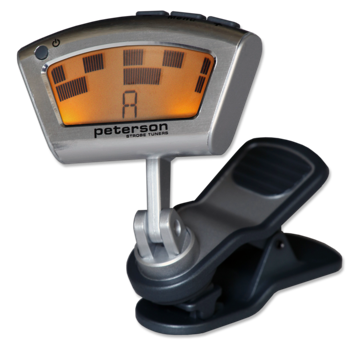
Click for larger image

I just did a review of this awhile ago, but I thought I’d go into a bit from an actual usage perspective.

As I reported in my review, I took it to my weekly solo acoustic gig, and it worked fantastically. I also took it to my Sunday church gig and used it on another guitar: My Fender Stratacoustic, which is a really tough guitar to tune. I also use it regularly in my home studio and it works flawlessly.

Okay, I know. It’s just a tuner. However, what I find so special about it is that it’s the first clip-on tuner I’ve used that is really accurate. Plus, it has Peterson’s sweeteners built in, and to me, the sweeteners make all the difference in the world. Sweetners are minute adjustments to the tuning so that chord intervals sound, well, sweeter. Guitars are generally built to even temperament; that is, they’re set up so that each string is tuned to an exact frequency.

The idea behind the Peterson tuning sweetners is that even temperament is fine until you play chords. We’ve all been there. Tune up the guitar with a standard tuner like a TU-2. The tuning sounds fine. Then you play a chord, and you have to make adjustments so the chord sounds good. The sweetners take this in to account, and instead of tuning to the exact pitch frequency, tune a little off to account for presses on the strings. The result is that when you tune with a Peterson tuner, you rarely make post tuning adjustments. Very cool.

Originally, I thought I’d simply use the StroboClip in my home studio, but I’ve found it to be an invaluable tool for gigs. For instance, as the lead guitarist in my church band, I often do solos with a lot of bending which, after awhile, will make the tuning drift a bit. With my StroboClip, it’s simply a matter of turning down my volume, then doing a quick tune. Oh that reminds me! I totally dig the LCD screen for tuning. Even for how small the unit is, the movement of the checkerboard pattern makes tuning a lot easier than trying to nail it with a bank of LED’s.

Read Full Post »

Audiophiles for years – excuse the pun – have heard cable manufacturers’ and experts’ claims of “cable break-in.” It’s a huge, ongoing debate, though most seem to believe it’s folly. In the guitar world, I haven’t heard of this from cable manufacturers; at least from the brands I buy. But I have heard it from seemingly well-informed musicians who claim they can hear the difference between a broken-in cable and a brand new cable. These people pride themselves on their “golden ears,” and often pull rank by providing their “bonafides” of degrees or what-not to add credibility to their claims. They are so convincing that lots of uninformed, unsuspecting musicians fall prey to their claims and in turn take them as scientific fact. Then in turn spend hundreds, maybe thousands of dollars on super, high-end cables that they’ll “break in,” and magically, their tone will be right. Hey! More power to ’em.

Me? I won’t mince words: I think they’re full of shit.

There is no scientific basis for cable break-in. It’s purely subjective. And with cable manufacturers who make the claim that their cables sound better after they’ve been broken in, to me it’s all just pure marketing bullshit. But some of these “pundits” and their sycophants (I love that word) will bring Einstein into the equation with the following quote:

Everything that can be counted does not necessarily count; everything that counts cannot necessarily be counted.

I dig that quote! But then it just points back to the subjectivity of cable break-in. Note that NONE of these so-called experts have ever provided numbers behind their claims. But they’ll take it further with an argument that it’s not the wire, but the insulation that breaks in; that is, the molecules of the dieletric will align to the signal over time. I _might_ buy this for a constant, uniform signal, but audio signals are random, plus the signal’s AC outside of any device in your chain. And again, they don’t have numbers to back this up. Molecules lining up to a random signal? If you buy into that, I have a couple of rental properties in Indiana I’d like to sell you (that’s actually true, and I’m trying to unload, er, sell them).

As I always advise, do your homework and find out for yourself. If you can hear those differences – though most everyone claims they’re psychological as opposed to physical – then I commend you on your auditory acuity. But my question, dear readers – especially for us regular joes – is this: If us mere mortals can’t hear that difference, does it really matter?

Read Full Post »

« Newer Posts - Older Posts »