Feeds:
Posts
Comments

Posts Tagged ‘gear’

Well you know me, I LOVE thick picks (2mm and above), and you probably also know that it’s dangerous for me to go to a guitar store because more likely than not, I’m going to walk out with something. 🙂 Today was no different…

My good buddy, Jeff Aragaki, of Aracom Amplifiers came over to the house to drop off some gear for me to evaluate: a ’59 Les Paul replica (I’ll have a review of that guitar in a few days after I’ve played it a bit) and a new Jensen 1 X 12 speaker. In turn, I was going to give him a pair of Groove Tubes Gold Series 6L6’s (GREAT f-in’ tubes). After that, we’d go get some lunch and catch up as we haven’t hung out in awhile.

We ended up going to a great Japanese curry place in downtown Los Altos. After lunch, we got in my car and Jeff said, “It’s too bad there’s not a guitar shop around here.” I of course know where all the shops are and replied, “You know, there’s one that’s about 10 minutes away. Let’s go there.” So I took him to Gryphon Stringed Instruments in Palo Alto. It’s a high-end acoustic guitar shop that has been around for years, and in addition to having a great stock of Martin, Collings and other high-end acoustics, plus a limited selection of electric guitars and some VERY nice vintage stuff including a 1960 Telecaster for $17,500,  they have high-end picks. It’s the place where I discovered Red Bear Trading pics.

I did have a motive for going there as I needed a good stage stand for my guitar, and Gryphon carries the very awesome Hamilton guitar stands. After my guitar almost got knocked over by a gust of wind at my gig yesterday, I knew I needed to get a good stand, and it was a good excuse to go there with Jeff so we could jam for a bit as well.

So the sales guy rang up my stand, and then I made the mistake of looking into the case to see what picks they had. Mistake. I didn’t know they carried Wegen picks, and there they were: Three cases full of ’em. I couldn’t resist. I had to try them out. Now I had learned of Wegen picks from various forums, but never had the occasion to play one until today. So the verdict?

Well, I liked the material enough as I ended up getting the Trimus 350, which is 3.5mm thick. That’s just a bit thinner than my V-Picks Snake. So what’s so special about this pick that I was willing to drop $20 on it?

First of all, it has a different feel than V-Picks or the Red Bear picks. The material feels softer than either the Red Bear Tortis and the V-Picks acrylic, which makes for a nice, smooth tone. The points are beveled, so you do get a snap that brings out the highs.

Now Wegen claims that the material feels a lot like real tortoise shell. I’ve felt real tortoise shell, and this feels nothing like it. But that’s not a bad thing. What really turned me on about this pick is really the feel. It’s not as smooth in feel as either the V-Picks or the Red Bear, which have glass-like finishes. In contrast, the Wegen pick has a bit of a texture. But amazingly enough, that doesn’t translate to stickiness on the strings. Whatever Wegen I tested, it just glided over the strings.

Another nice feature of the Wegen picks I tested were the grooves cut into the body of the pick. Add to that a depression in the body, and what you’ve got is a pick that you can really hold onto!

I chose the Trimus 350 because I like the shape – it is very similar to my V-Picks Snake and my Red Bear B-Style Gypsy Jazz. It’s also thinner than both – not by much – but still just a bit thinner. But Wegen has a lot of different picks. If you get a chance, check one out!
Read Full Post »

…or reliability is more important than all the whiz-bang features you throw into a gadget.

I was driving up the San Francisco Bay Peninsula this morning, along Highway 101. As usual, I was talking to my good buddy Jeff Aragaki of Aracom Amps. It’s a great time to chat since I’m on the road. Invariably we talk about gear. This morning, the conversation revolved around Jeff’s favorite topic: Les Pauls. He’s a Les Paul nut, and has several original and re-issue LP’s and LP Jr.’s. And as I love guitars, period, this is a subject about which we never tire conversing.

One would think that down a major thoroughfare such as 101, cell coverage would be good. But NOOOOOOOOO!!! I’ve got AT&T Cellular whose motto should be “More Dropped Calls In More Places.” This morning, we set a record: FOUR dropped calls between Palo Alto and San Mateo: That’s 10 miles – generously! Usually, it’s one or two, but it shouldn’t be ANY. F%&king AT&T!!! They respond to all the complaints about dropped calls by spending millions on how widespread their service is. It’s widespread, but it’s spread thin, and cannot take the volume. So instead of fixing the damn problem, they counter with a marketing campaign. And BTW, I use a Blackberry, not an iPhone. For some iPhone users it’s even worse!

Okay, flame off… what the hell does this have to do with guitar gear?

As I stated above, in my view, reliability is much more important than how good something may sound. I’ve gotten rid of (read: literally thrown away) more gear due to reliability issues than because of bad tone. Actually, I’ve never thrown any gear away because of bad tone because I only buy it if I like it. But it’s in the electronics recycle bin if it repeatedly breaks down. Once or twice, I can live with, as long as I can fix it. But beyond that, I have no patience for it, no matter how good it may sound.

Don’t buy into it? Imagine playing a gig. You’re in the middle of a song, and it’s time for the lead break. You click on your overdrive or booster, pick your first note and your amp issues – NOTHING! Tell me you won’t first: panic, then second: get pissed! That’s exactly what happened to me with my favorite drive pedal that I use with my Tele, the GeekMacDaddy Geek Driver. Turns out that the switch was loose and a wire worked itself loose. That was an easy fix, and I’m a happy camper. Since the pedal’s a boo-teek pedal, I could call Jeff, send him the pedal and he’d fix it. But for mainstream gear where you don’t have a personal relationship with the manufacturer, there’s not much else to do other than to recycle the electronics; especially if the gear’s past its warranty period.

This is one of the reasons I read a lot of reviews before buying something; even cheap gear. If I detect that there are reliability issues, I won’t buy it. There will always be “lemon” stories; that’s to be expected. But if there is a prevalence of them, caveat emptor!

Now circling back to AT&T. I think what pisses me off the most about them is not the dropped calls, though that’s certainly annoying. What makes me furious is that instead of fixing the problem, they do a “look at how good we are” marketing campaign. And the worse thing is that they have people by the short hairs – especially iPhone users. While I don’t have an iPhone, I pay for two of them on my cellular plan. I can tell you this: As soon as the iPhone is available on another carrier, we’re leaving AT&T!!!

Read Full Post »

Yeah, I know, this is a bit of a long time in coming, but I actually got REALLY sick there for awhile, and was sidelined for a few weeks. But as I say in the video, “Better late than never.” In this particular clip, Doug shares a bit of wisdom on choosing gear that’s right for YOU. I’ve been a big proponent of that on this blog, and it was affirming to hear Doug speak along these lines. Here’s the video:

Read Full Post »

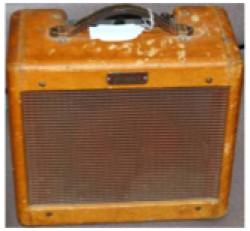
I know, not a very good picture, oh well…

In any case, I recently won this amp in an eBay auction. As soon as I got it, I turned it over to Jeff Aragaki of Aracom Amps for him to inspect it, clean it up, and make it “safe.” The amp was in excellent working condition, considering it’s 52 years old, but to be safe, I wanted to make sure there was nothing amiss.

One of the first things Jeff looked at were the capacitors. Visual inspection didn’t reveal any leaks, but they needed to be measured to ensure that they were still able to keep a charge. Amazingly enough, they were still measuring well within operational tolerances, and none had to be replaced, which Jeff said indicated that the amp was being used. With those old paper capacitors, if they sit for a long time without use, they’ll eventually leak acid. But these were in great shape!

The next thing Jeff checked was the speaker. Interestingly enough, the speaker was a replacement, and not only that, it was a 16 ohm speaker, which actually attenuated the amp a bit, so I had Jeff replace the 8″ speaker with a new ceramic speaker.

Since the amp used a two-prong electrical plug, I asked Jeff to upgrade it to a three-prong medical-grade plug. Unfortunately, the way the amp was designed, doing that would require playing with the heater voltages, and while that wouldn’t necessarily harm the amp, it may have had an effect on the tone – not a good idea. So I just had Jeff replace the cord, which was in decent physical condition, but according to him, wasn’t carrying a full load of current to the amp.

In addition to cleaning it up and making sure it was in good working order, Jeff wired up an A/B switch box to the amp, so I could flip between using the internal speaker and an external cabinet (which is how I’ll normally play this amp). Jeff did this to avoid having to install a 1/4″ jack which would alter the amp from its original condition. Being a vintage gear collector, Jeff thinks about that stuff… This amp is going to be a player, so that wasn’t much a concern to me, but he kind of insisted, just in case I decide to sell it later.

Finally, since the amp didn’t have a back plate (which accounts for the great price I got it for), Jeff cut a nice 1/2″ ply board to protect the chassis. We’ll do a proper back plate with a tweed cover later, but I wanted to start using the amp right away, so we’ll do that as a future project.

Gig Report

With the amp complete, I played it all week to get used to how it responded. Now that I have one of these, it’s no small wonder why these have been long-time residents in studios all around the world. Hooked up to my 2 X 12, loaded with a Celestion Blue and Gold, the amp’s voicing is super rich, if a little on the bright side. But no matter. The cleans are absolutely incredible! They ring with a vintage chime that at least to me, invokes a visceral response in me that’s hard to explain. It’s a classic Fender clean, and through my 2 X 12, the cleans resonate and float through the air! As far as dirty is concerned, the Champ is no high-gain amp. Overdriven, it’s a dirty grind, perfect for blues- or classic-rock tones.

The Champ is also incredibly pedal friendly. I hooked up my super-versatile Doodad Guitars Check-A-Board RED overdrive/booster up to it, and the amp just responded! The overdrive is wonderful on this pedal, adding great sustain without overly compressing the signal, but where the pedal really worked with the Champ was with the booster. Slamming the front-end of the amp, I was rewarded with a gorgeous, smooth overdrive tone. Again, I thought to myself, this is why this little monster has been on so many songs over the years!

Yesterday, I took the amp to my church gig. Being the 4th of July, we had a skeleton crew: Just one other guitar besides myself, but no matter, I wanted to play it live. For this gig, I just used my custom Aracom 1 X 12 with a Jensen P12N, and I played my “hybrid” Fender Stratacoustic Deluxe through it. Despite the fact that I was ostensibly playing an acoustic guitar through the amp, the tone was absolutely natural. I was like, “This really shouldn’t sound that good, but I’m amazed at how it sounds!” Granted, the Stratacoustic is more like a hollow-body electric than an acoustic, but the Champ just took its natural voice and amplified it beautifully.

Once I have my studio set up again (just finished construction on the house, so I lost my recording space temporarily), I’ll make some recordings!

If you live in the Silicon Valley area and need some amp work, though Jeff sells his own line of amps, three of which I own, with a fourth on the way, Jeff is one of the best amp techs I’ve ever worked with and he’ll hook you up! He thinks of things I would’ve never thought of! Check out his site at http://www.aracom-amps.com. Needless to say, he is also the creator of the best attenuator on the market, the Aracom PRX150-Pro.

Read Full Post »

Answer: Just one more!

Awhile back, my wife walked into my garage/studio, and saw me playing my Reason Bambino. She asked, “How many amps do you need?” As usual, my answer was (with a facetious grin on my face), “Just one more, honey.” Her reply to that was, “You’ve got a wall of amps! I don’t see how you could possibly need all of them.” Actually, she was right, and it didn’t help that half of them weren’t mine, as I was doing reviews on some amps at the time.

Still, I felt I owed her an explanation. After all, I do have a lot of gear, and I actually use all of it, with the exception of a couple of my very old guitars that I’m too busy to service. So I followed her into the house and said, “You know, since I don’t have a band, and I’m doing all this recording on my own, when I’m after a certain sound or dynamic, and I don’t have that sound or dynamic well, I have to find it. Ultimately, that means I get more gear.”

Or maybe I’m just an obsessed, sick individual that needs to have shiny new things all the time. 🙂 Heaven knows I’ve fallen victim to impulsive urges. For instance, just the other day, I was looking at Telecasters on CraigsList. Found a really nice black one with a mirror pick guard for $400! The guy didn’t indicate where it was manufactured (I’m “kind” of looking for an American Telecaster or American G&L ASAT). Luckily I called him up and he said it wasn’t an American because I would’ve scooped it up post-haste! Then I thought to myself, “Dude, you gotta stop this!” Dodged that bullet… 🙂

Read Full Post »

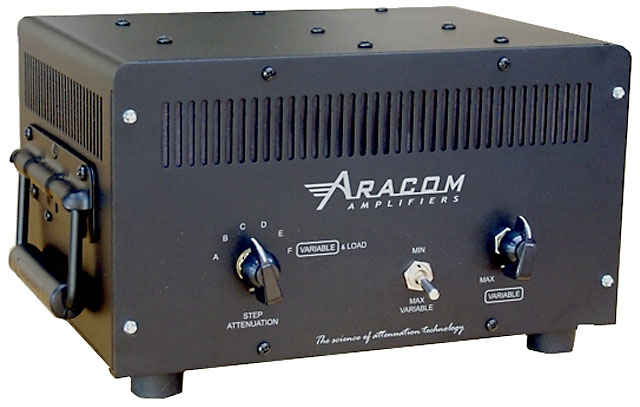
The venerable “Destroy All Guitars” shop has teamed up with Aracom Amplifiers to come up with a new version of the fantastic Aracom PRX150-Pro. Sporting a smaller cabinet (sorry, not reduced weight), and a couple of very cool new features, the $785 PRX150-DAG is the answer to anyone who wants to go to the extreme in transparent power attenuation.

Here are the features:

* Proprietary SRT Power Attenuation Technology
* Six levels of step attenuation, plus a continuously variable attenuation control (bedroom mode)
* 40dB of attenuation–attenuates 150 watts down to .015 watt
* 150 watt power rating
* Independent input and output impedance selector switches:
– from the amplifier and into the attenuator, select from: 2, 4, 8, 16 ohm
– from the attenuator and to the speaker cabinet(s), select from: 2, 4, 8, 16 ohm
– uniquely allows 16 possible Input and Output impedance combinations
* Hi Frequency Cut Filter with a True Bypass Switch
* Features a Load setting and is equipped with a Line Out Jack and Line Out Level Control
* Rack Mount Option
* Handwired in the USA

The two notable features are the Hi-Cut Filter, and the increased attenuation down to -40dB attenuation. With respect to the high-cut filter, some people had mentioned that they heard a high-frequency artifact coming through when they hooked up the original PRX150-Pro. I myself have never heard it, though I suppose anything’s possible. In Jeff Aragaki’s (of Aracom Amps) words:

The PRX150-DAG is equipped with a High Frequency Cut switch, that rolls off the highs above 6KHz, that some users might find useful with amplifiers that have a pronounced high end frequency response. Some guitarists go to great lengths to control the high end response of their amplifier, by carefully selecting speakers, tubes, and other components to roll off the highs. Now with the PRX150-DAG, a guitarist might not need to rely on changing these components; the high cut filter switch allows the flexibility of rolling off the high end or not. The true bypass switch allows the filter to be completely bypassed, providing the full frequency response of the attenuated amplifier to pass through to the speakers.

The other great feature is the Min/Max variable attenuation modes Jeff has introduced. Minimum attenuation mode is the traditional -16dB down to about -30dB variable attenuation, whereas the Maximum variable attenuation mode goes from -27dB to -40dB. With a 100 Watt amp, that’s taking down the output power to .015 Watt!!! Wanna have full dynamic response at bedroom levels with your 100 Watt amp? Look no further!

The Aracom-DAG PRX150-DAG is available exclusively through Destroy All Guitars. Check it out!

Read Full Post »

Click to enlarge

“Guitar Player” mag took a recent poll asking: If you could only have a single pedal in  your rig, what would it be? Overwhelmingly, and actually not too surprising to me, most pollsters chose an overdrive pedal. I personally didn’t take the poll, but I would definitely fall into the majority. You know me, I just can’t enough of overdrive pedals!

So much to my great pleasure, Maxon has released the new ST-9 Pro+ Super Tube Screamer Overdrive. Based upon Maxon’s classic “808” circuit, and building upon the original Ibanez ST-9 and its ability to control the amount of “midrange hump,” this “reissue” adds features that have the potential of making this a truly great Tube Screamer-class pedal.

  • First of all, the ST-9 Pro+ sports 9V or 18V operation. 18V mode adds more headroom and warmth. This is controlled by a slider switch in the battery compartment.
  • In addition to the Drive, Level, and Tone Knobs, the ST-9 Pro+ also has a “Mid-Enhance” knob which controls where the mids are boosted. Clockwise moves the boost towards the high mids, while counter-clockwise moves the boost to the lower mids. To me, this is probably the most useful feature, as you can dial in the mid boost to adapt the pedal to different amps.
  • The ST-9 Pro+ also has a switch that selects either “Classic” or “Low Boost.” Low Boost gives a 12dB boost at 100Hz and a 4dB boost a 500Hz. This can be quite useful for fattening up single coil guitars!
  • Finally, the ST-9 Pro+ has true-bypass switching.

OMG!!! I love the features on this pedal! Were I to consider getting another pedal in the Tube Screamer lineage, this pedal would be at the top of my list! However, with a street price of around $206, it’s not a cheap proposition. But with it’s features, it certainly warrants a close look; and based upon my experience with Maxon pedals, their build and sound quality is undeniable. While I don’t use it much any longer, my CP-9 Pro+ compressor is a testament to that quality (I paid $250 used for that pedal), and it’s a pedal I’ll always have. As for the ST-9 Pro+, I’ll see if I can find a place where I can audition it.

Finally, here’s a great demo video that shows off the ST-9 Pro+ quite nicely:

For more information, check out the Maxon ST-9 Pro+ page!

Read Full Post »


Click to enlarge

Click to enlarge

Fishman SA220 Solo Amp

Summary: Compact and weighing in at just 25 lbs., the SA220 Solo Amp is an ideal PA solution for the solo acoustic guitarist/vocalist, but it’s versatile and loud enough to be used as a PA for a band (if you have a couple of them).

Pros: It may not have the Bose name, but I’d put this up against the L1 Compact system any day. With built-in, independent, 3-way EQ, and a variety of other features, if you’re a solo acoustic artist, you owe it to yourself to check this unit out! I got it set up in less than a minute!

Cons: None

Features:

  • Drivers
  • – Six 4″ mid-woofers, patented dual gap, high excursion design, neodymium magnets (200W)
    – One 1″ neodymium soft dome tweeter with level control (20W)

  • Auxiliary Stereo Input with Level control
  • Four Digital Reverb effects with master level
  • Balanced XLR D.I. outputs for both channels and main mix
  • Independent effect loops for Channel 1 and Channel 2 (OMG!!!)
  • Unique Monitor I/O for improved on-stage ensemble monitoring
  • Mute with remote footswitch input
  • Tuner Output
  • Ships with Stand and padded Carry Bag (w/ wheels)
  • Dimensions: 41.5″ H x 5.6″ W x 6.6″ D
  • *Weight: 25 lbs without Stand, 35lbs with Bag and Stand

Price: $999 Street

Tone Bone Score: 5.0 ~ Talk about ease of use! As I mentioned above, I got the SA220 set up in less than a minute! And my Yamaha APX900 sounds absolutely killer through this, not to mention the great clarity of the vocals. This is a winner, folks!

Year over year, I play between 100 to 150 gigs a year, with about half of them as a solo acoustic act. My solo gigs have consisted mainly of my weekly restaurant gig, but I do lots of weddings and special events throughout the year as well. Of late, the restaurant I gig at moved my act outside in a public patio area as the weather is gorgeous.

To make a long story short, even though the restaurant has a decent PA system, I ended up bringing my own PA last week, which was the first week we did the outdoor show. That worked pretty well, and my PA has a great sound. But it also made me realize that the old mixing board, and big 300 Watt speakers was just too much gear to haul around. Even if I ended up using the restaurant’s PA, which is a nice one, I’d still have to lug the board and speakers and stands down from the office upstairs. Enter the Fishman SA220 Solo Amp.

Plug It In and Go!

I finally received my SA220 today after having to wait for a couple of weeks for it to arrive (had to be ordered). So when I got home, I knew I had to try it out to see how it sets up, and of course, to work out kinks before I gig with it. There’s nothing worse than fighting your rig or sound DURING a gig – especially when you’re solo.

The guys at the shop assured me that Fishman’s claims of easy setup were true. I am now a believer! I had the SA220 set up in exactly 42 seconds!!! That didn’t include hooking up my pedal board, guitar, and microphone, but I had the system on its tripod stand and plugged into power, ready to go, in that short amount of time. That just blew me away! Plus, everything you need to get up and running fits into a single carrying unit that consists of two bags: One for the array/PA, and one for the tripod that buckles to the main bag. Talk about convenience! Fishman really had the solo artist in mind when they built this!

How It Sounds

For my audition, I just plugged my guitar into the SA220 directly, and hooked up my microphone. All I can say is that the sound is spectacular! I was actually concerned about the bass response of the unit, but apparently Fishman distributes the bass response among the six main mid-woofers. It may not get boomy with the bass, but the sound is absolutely rich, and vocals are clear and full. Normally, I use a DI to go into a board – and will probably do the same with this unit, but my guitar sounded clear and natural and full plugged in directly without those annoying high-end transients and flattened tone that is so annoying with plugged in acoustics. Admittedly, the ART system in my Yamaha APX900 has quite a bit to do with that, but Fishman really knows how to condition sound.

At first, I had a bit of a problem with feedback, but setting the phase switch and tweaking the anti-feedback knob (it’s a variable frequency notch filter designed to subdue a resonant peak – just turn it to where the feedback gets reduced or eliminated – very cool), and attaching the rubber sound hole cover on my guitar took care of the feedback problem.

Luckily no one was home when I tested the SA220. I set it up outside so I could see how it performed. Damn! Even with just 220 Watts, the SA220 is LOUD!!! I had the Master volume set at around 10 am, and that will be enough to fill the large patio space I’ll be playing in tomorrow! It’s not a stretch to say that the SA220 can cover a lot of venues.

As far as listening angle is concerned, the SA220 disperses the sound incredibly well! Even at extreme angles, where I was almost even with the array, the sound was clear with good volume. Of course, narrower angles are better, but this unit will have no problem playing in the open space I’ll be playing.

Talk About Bang for the Buck!

The sound is great, but I have to tell you, I was ready to get the Bose L1 Compact, which is a great unit, but the mere fact that if I wanted more EQ control and other features, I’d have to spend another $499 really soured my taste for the unit. On the other hand, Fishman has packed all sorts of features into the SA220 that make it hands-down the better value. Independent 3-band EQ for each channel, phase and anti-feedback control, 4 types of digital reverb, a mute switch (that is REALLY handy!), independent balanced XLR outs to go into a board, and my favorite feature: independent effects loop for each channel! You just can’t argue about with what comes built-in on this unit!

Overall Impression

It’s hopefully obvious that I love this unit! For me as a solo artist, it’s a true game changer! It’s light and versatile, and the sound is spectacular. What more could I ask for?

Read Full Post »

Having played with a 1 X 12 for quite some time, which has served me incredibly well for both studio and stage, I had as of late been wanting a bit more bottom end response, especially live, but without sacrificing my ability to naturally cut through the mix when the band is going all out; that is, cut through by virtue of EQ as opposed to volume. I suppose I had just been after a bigger, richer sound.

So I called my close friend Jeff Aragaki of Aracom Amps – actually several times – to talk about what might work well my Aracom Amps. He’s been testing several different speakers and speaker combinations lately, and who better to strategize with than the manufacturer of my amps? Lately he’s been really big into the Celestion line, and as he knew I love that classic alnico magnet sound, our conversations started turning towards the virtues of the Celestion Gold and Celestion Blue speakers.

I myself had never heard either of those speakers before – well, except for a brief time at a guitar shop through a 65 Amps 2 X 12 – but Jeff has been raving about them, and as he and I like the same kinds of tones, I broke my own rule of auditioning gear before I buy it, and asked Jeff if he could put a cabinet together. He said he could construct a custom one for me but that would take some time, or he had a few Aracom re-labeled Avatar cabs in his workshop and he could load a pair of speakers into one of them. From the title of this article, it’s obvious I went with the latter alternative.

For those unfamiliar, Avatar Speakers has been around for quite some time, and the company is fairly well-established in the guitar and bass community. I used to think they’re a manufacturer, but they’re actually a distributor of cabs as opposed to being a direct manufacturer, so they buy in bulk and have insanely great prices on cabinets, and they’re all great quality.

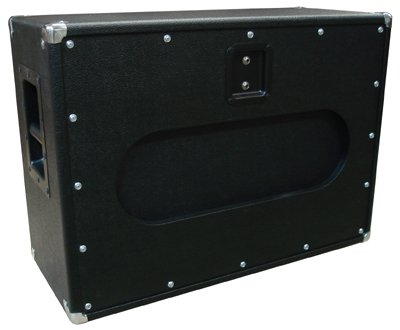
The G212H Custom is a fantastic cabinet, measuring 21″ H x 28.5″ W x 12 ” D, and made of 18mm 13-ply Baltic Birch. It’s not a small cabinet, but that’s a good thing as its size provides a resonance chamber that really brings out the bottom end – even in a semi-open-back configuration like mine, as shown in the photo of the back of the cabinet to the right.

The build quality of the G212H is excellent. The corners have nickel-plated protectors, and the cab itself is extremely sturdy. The grille cloth is actually screwed in, as opposed to being attached with velcro, and that will eliminate buzzing that can happen with velcro-attached grille cloth.

The only pain that I anticipate with this cab would be swapping out speakers, which I probably won’t do often. But the speakers are front-loaded, which many players prefer, but in order to swap, you have to remove at least two of the corner protectors so you can remove the grille cloth frame from the front of the cab. That’s not really too difficult, but it’s a lot more involved than just unscrewing the speakers like you would from a rear-loading configuration.

As far as speakers are concerned, I’ve had the cabinet configured with a Celestion Gold and a Celestion Blue. The Blue has a nice, smooth, early breakup while the Gold provides a bit more bite on the top-end and a really nice bottom-end response. What a combination! The end result is a slightly scooped tone, and that roomy cab creates an almost reverb-like effect. I’ll have sound clips in the next few days.

Overall, I’m just loving the sound that this cabinet produces. I got my wish for a big, smooth sound for sure!

The Avatar G212H Custom gets a 4.75 only because speaker swapping is a bit of a pain. But from a pure performance standpoint, it gets a 5.0.

Read Full Post »

So you want to get a tube amp, but there are literally hundreds of manufacturers, not to mention, amps on the market. That can make for a rather harrowing experience in making a choice; especially if you’re new to tube amps. Plus, there are so many amp features to contend with as well. But have no fear. It’s not as hard as it may seem on the surface as long as you take some things into account.

1. Tone is king!

The most important thing to keep in mind in your search for a tube amp is that YOUR opinion of the tone of an amp is the most important opinion of all. By all means, listen to the input of others to help guide you, but in the end, you need to make your decision based upon how good an amp sounds to YOU. To formulate an opinion, you have to play several. And for goodness sake, don’t buy anything unless you’ve heard it in person.

2. Sound clips don’t tell the whole story…

Bear in mind that sound clips are great as an initial reference, but that’s all they should be. And make sure to listen to clips that have been recorded with the raw sound of the amp; that is, the plugged straight into the amp, and no EQ on the recording medium. Be especially wary of clips of fully arranged songs where a particular amp was used because more likely than not, even if the amp was recorded straight with no pedals in the chain, the other instruments and the EQ of the song can interfere with potentially negative aspects. Nothing beats listening to an amp live or raw.

3. Higher cost doesn’t mean better

Sometimes higher cost is well, just higher cost, and it doesn’t necessarily buy you much. I’ve played some pretty expensive amps that to me sound like crap, so don’t be lured into buying an amp by its price. Also, bear in mind that some amps simply have a higher price because a well-known guitarist actually uses one.

4. Don’t jump onto the boutique wagon right away!

In your search, you’ll come across people who’ll recommend all sorts of boutique amps. Don’t jump there immediately. I recommend this mainly because a boutique amp will fix you into a certain tone or range of tones. That’s NOT a bad thing at all. It just means that they serve up a certain flavor of tone and they’re good at that; not wanting be so versatile. For instance, my Aracom PLX18-BB Trem is a great example of a fairly focused tone with its abundance of mid-range, and smooth and creamy breakup. This amp was built based upon the classic 18-Watt Marshall Plexi, which has distinctive tone and dynamics. It’s not muscular at all, and was never meant to be. Contrast that to my Aracom VRX22 which, while based upon a Marshall Plexi design is A LOT more “ballsy” with a fatter bottom end, and slightly compressed overdrive. As a foot-switchable 2-channel amp, it is much more versatile and is my “go-to” amp for gigging.

In addition to the focused tonal characteristics, boutique amps in general cost significantly more than their mainstream counterparts; let’s face it: They’re investments. But like any investment, you should choose wisely, and go more generic starting out to get an idea of what tone you’re after. A good place to start is a low-cost tube amp, and there are several mainstream tube amps on the market that cost under $500. Some of them, like the Peavey Windsor Studio or Egnater Tweaker will allow you to change power tubes to change tone and dynamics. For instance, a 6L6-based amp will sound quite different than an EL34-based amp or even a high-gain 6V6. Amps like this let you play a bit. Here’s an example list.

VOX Night Train $499
Blackstar HT-5H  $399
333 Amp JCA20H  $333
Epiphone Valve Jr. $129
Egnater Tweaker  $399
Blackheart Little Giant  $199
Fender Blues Jr. $499
Fender Champion 600 $149
Peavey Windsor Studio $399

I started out with a Fender Hot Rod Deluxe myself. I got it before Fender did their price hike last year, so I got it for a great price. It’s a great starter tube amp, and really an unsung hero among amps. But with the right tubes and a replacement speaker, that amp can keep up with many of the boutique amps out there. It’s more pricey than what I listed here, but you can find used ones for around $500. It’s also loud as hell, which makes it viable for doing lots of different venues.

5. Don’t rush… Try learning how a tube amp operates…

The worse thing you can do in making your first tube amp purchase is rushing into it. As I mentioned above, try out several before making your decision. The best advice I ever got was from Noel over at Tone Merchants in Orange, CA. I told him I wanted to get a tube amp, but he insisted that I take my time, and in the meantime get a Fender Hot Rod Deluxe because it was tweakable. That turned out to be the absolutely best advice I had gotten from anyone, and it saved me thousands of dollars. Buying that amp gave me time to learn about how tube amps operate and form an opinion on what I’d like different.

6. Use the buddy system to evaluate an amp

By all means, play through the amps that you are evaluating, but something I’ve found very useful in evaluating amp settings is to have someone else play while I tweak. When I did the Dumble amp video series, I had the fortune of the great Doug Doppler playing so I could REALLY get how it sounded. That’s sort of rare, but even when I’m in a Guitar Center, I’ll sometimes walk up to some dude playing an amp I’d like to evaluate, and ask him if I could tweak while he plays. It’s a great way of quickly evaluating an amp’s capabilities.

So… Not rocket science by any stretch of the imagination, but useful, practical advice that you can hopefully use to your advantage.

Read Full Post »

« Newer Posts - Older Posts »