Feeds:
Posts
Comments

Posts Tagged ‘gear’

The other day, I was at my good friend Jeff Aragaki’s (of Aracom Amps fame) home/workshop and noticed his ProLine multi-guitar stand where he always keeps five or six guitars. I was thinking to myself that I could use one of these in my home studio, as I have at least five guitars and a bass out at any time; especially as of late, since I’ve been recording quite a bit. All my guitars are on individual stage stands, and they take up a lot of space. I was thinking that with a multi-guitar rack, I could put out several guitars and not take up too much space on my studio floor.

But one thing that I thought about when considering a multi-guitar stand was it would be great if there was one made of wood. It just looks better to me. And wouldn’t you know it, today I received an email announcing a new company called Rock Solid Guitar Stands that make their stands out of wood. Cool! Check this out!

THAT is exactly what I was looking for in a multi-guitar stand!

Here’s the press release they sent:

———–

NEW MULTI-GUITAR STANDS FROM ROCK SOLID GUITAR STANDS
Two new models coming in October 2011.

Is your studio, family room, or living space crowded with guitar cases or single stands? Rock Solid Guitar Stands will compliment your space, and more importantly, showcase your collection at the same time. Rock Solid Guitar Stands are multi guitar stands that were specifically designed for the home or studio and designed by a collector. Your guitars and basses will truly be at home, and finally given the attention they deserve.

Unlike the typical metal multi-guitar stands out there, which are not very stable or attractive, Rock Solid Guitar Stands flow quite well in any decor in your home or studio. They are also very stable. For more information visit http://www.rocksolidguitarstands.com.

In October of 2011, we will be introducing “The Classic 4,” and “The Show 5.” These two new multi-guitar stand models will offer an alternative for players with guitar collections of various sizes.

The Classic 4 is perfect for someone with limited space. It is only 33” wide x 28” high x 18” deep.

The Show 5 is truly a unique design. Let’s face it, you want to show off your favorite guitar and have it accessible at all times. That’s why The Show 5 has a specially designed fifth slot which let’s your most precious guitar stand out and get some extra loving!
Be sure to visit Rock Solid Guitar Stands on the web in the following places:
Official website: http://www.rocksolidguitarstands.com
Store: http://shop.rocksolidguitarstands.com
Twitter: http://www.twitter.com/rocksolidstands
Facebook: https://www.facebook.com/pages/Rock-Solid-Guitar-Stands/178352512182913

———–

The stands come in three different colors: Honey, Dark Cherry, and Ivory. Personally, I like the Dark Cherry color. Also, they only weight 12 lbs.; not at all heavy, which is cool. The price is $199 direct, which might be a bit steep, but these are solid wood, not press-board. When you order one, assembly is required, but an allen wrench is provided and you’ll just need an adjustable wrench or pliers. From what I gather, the kit takes less than a half-hour to assemble.
Read Full Post »

At last night’s weekly gig at the restaurant I play at, I brought my trusty Roland Cube 60. I was in a rush, and just wanted a lightweight amp that I could easily set up.
To be honest, I hadn’t played that amp for a long time, preferring to use my tube amp combos or my SWR California Blonde. But those amps are also HEAVY. The Blonde weight over 50 pounds! My Cube 60, on the other hand, weighs just 30 pounds, and is roughly half the size of any of my other combos.

But weight aside, the Roland Cube 60 is simply a great-sounding amp. Solid-state or not, it doesn’t matter. If it sounds good, then who cares about its circuitry? I was reminded of that last night. I put the amp in Acoustic/JC Clean mode and was rewarded with a gorgeous clean tone that rivaled the cleans of any of my tube amps. Admittedly, the onboard time mod effects aren’t very good (at least to my ears), so I just used my own.

And that brings me to the point of this entry and my previous entry centering on the title: Let sound guide your decisions in buying gear; not the circuitry. With respect to the Cube 60, its Acoustic/JC Clean is modeled after the venerable JC 120 amp; an amp that has proven itself over the years as a viable tone platform. Players like Joe Satriani and Albert King used this amp. I believe Satch used a JC 120 to record Surfin’ with the Alien. And it’s no small wonder these guitar greats used it: The JC cleans are spectacular. They’re not as basso as Fender cleans, being a bit more mid-rangy, but they’re gorgeous just the same.

One thing that struck me last night as well was the wide sound dispersal from that little amp. I was concerned that the diminutive cabinet would be a bit too directional, but all that worry was laid to rest when I did my sound check. The Cube 60 filled the space incredibly well, and was clear from even extreme angles. Needless to say, I’ll be using the Cube 60 for most of my solo gigs going forward.

So definitely a lesson learned once again, that it’s the sound that matters…

Read Full Post »


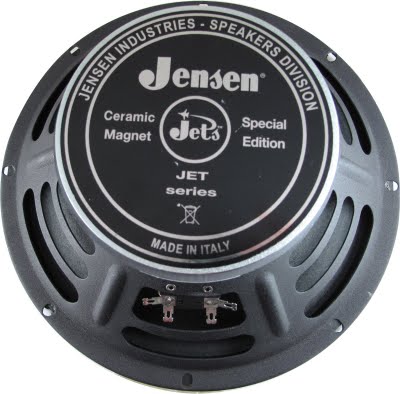
Jensen Jet Electric Lightning JC10-50EL 10″ Speaker

Summary: A single 10″ speaker is NOT supposed to sound this big! Sure, Jensen may be marketing as a real “rocker” but this speaker will absolutely KILL with any style.

Pros: Big, ferrite magnet produces a fat, bottom end that is absolutely to die for! No loss of definition, no muddiness. This speaker absolutely KILLS!

Cons: None.

Features – It would be best to check out the link above to see the specs.

Price: ~ $69.00 street

Tone Bone Score: 5.0 I’ve been using this speaker for a couple of weeks now in a little, 6-watt amp, and I’m simply loving the sound that this speaker produces.

I hate cliches. But sometimes a cliche is the only way to describe something. The cliche I’m thinking about regarding the JC10-50EL is “Big things come in small packages.” In this case, it’s a big sound that comes in a small, 10″ speaker. Every time I play through this speaker, no matter what guitar I use, I’m floored by the big sound (I know, I used that term before) that this speaker produces; not to mention the clarity. I’m so impressed with it that I’m going to put together a 2 X 10 or a 3 X 10 cabinet with these speakers in it.

How It Sounds

This afternoon, I quickly recorded a couple of demo clips this afternoon. All clips were recorded using my American Deluxe Strat, straight into my VHT Special 6 combo where the speaker resides. Note that I close-miked the amp and had it cranked! No attenuation, no sound dampening. What you hear in these clips is pretty much the raw sound with just a touch of reverb with the dirty clips (<10% wet). But I did no mastering or EQ. You’re getting the full range of sound in all the clips.

Clean (Neck pickup)

Dirty (Bridge pickup)

Dirty (Neck pickup)

Overall Impression

Like I said above, a single 10″ speaker is NOT supposed to sound this big. You normally need at last a couple of 10″ speakers to get a decently rich sound. But just one of these can move some serious air! I can’t wait to get my new cab put together!

The VHT Special 6 and JC10-50 combination is a match made in heaven, as far as I’m concerned. I mentioned in my previous gig report that I used this with my church band. That combo held its own throughout the service! Admittedly, I had to set the amp on a chair, but it worked out great!

Read Full Post »

I know, I usually do a gig report AFTER I write a review of a product, but I used the speaker in a gig yesterday, and had to write about it. First though, let’s go over some general stuff…

The Jet series from Jensen is a break from Jensen’s vintage roots to go after more modern styles of music. Having two of their Jet Falcon 12″ speakers, I readily concur. For a long time I was into vintage tone, but as the music I’ve been writing as of late has taken on a bit more of an edge, the warmth and general mellowness of Alnico just hasn’t done it for me, let alone my music. Going to speakers that have a bad-ass attitude has really helped me explore different musical depths.

When I first heard the Falcon, I absolutely fell in love with that speaker. It has a big, bold tone and is supposedly reminiscent of old “green backs.” I’ve never heard original green backs, but I do know one thing: For straight-up rock and roll, the Falcon excels!

Enter the Electric Lightning. I got an announcement from the Jensen distributor that the Electric Lightning 10 had just come out, so I asked him if I could do a review on it. He replied by sending me a speaker for review. He’s not getting it back (I’ll pay for it), and I’m going to order one more to create a 2 X 10, or maybe get a couple of more to build a 3 X 10.

If you read this blog with any regularity, you know I don’t bullshit when it comes to gear. Gone are the days when I buy something based on hype. I have to play it to see if I like it, and with the Electric Lightning 10″, I found a speaker that completely blows me away – enough so that I’m going to be buying it!

To test the speaker out, I installed it in my VHT Special 6, which has a pretty small cabinet, and I expected that the speaker would be pretty bright, considering the small resonating space, and the size of the speaker. I was completely wrong.

I happened to be working on a new song before I installed the speaker, so the I just grabbed the guitar I was using, which was my Yamaha APX900 acoustic-electric. I took one strum, and got a queer look on my face thinking, “Does it really sound that rich?” I couldn’t believe it! I started playing through a few different tunes, and I just couldn’t believe my ears! The lows that I was expecting to be subdued were big and bold, and not at all flabby or mushy. Mids were well-controlled and smooth, and the highs were nice and dynamic without being over-pronounced. Even with an acoustic-electric, the net result was that this speaker had lots of presence.

As you can see on the frequency response chart below, the graph supports what I described above:

The low-end response is nice and wide, with gentler mids, and with a sharp high-frequency peak to help round things out.

Of course, this speaker is touted as a speaker to be used for heavier music, and perhaps that wide bottom definitely supports that, but I then used the amp in my church gig yesterday to test the speaker out in a live setting. For the service, though I was tempted to bring a couple of guitars, I just brought my American Deluxe Strat.

In a word, the combination of the Strat with that amp and speaker was stupendous. I chose to use my Strat because I haven’t liked any single coil guitar with that amp since I got it. But the bottom-end on the speaker completely tones down the highs; though I do have to admit that the amp itself is pretty bright, so I turned the tone knob down to about 11am to roll off some of the real high-freq sounds that amp makes.

Did I mention that the speaker is loud? It really is. Even with a little 6 watt amp, that speaker is so efficient that it seriously moves air. Another guitarist in my band looked at the amp quizzically, to which I said, “Don’t sound like a 10″ speaker, does it?” He replied, “Well, not just that, I mean, look at the size of the cabinet it’s in, and it’s making that kind of tone and volume.”

That really just sums it up for the Electric Lightning. A 10″ speaker is not supposed to sound this big and loud; especially when it’s only being driven by a little 6 watt amp. It’s simply uncanny.

Another thing about this speaker is that it is very well-behaved with overdrive and distortion. Before our service I cranked up the amp to really drive the speaker so I could get some speaker distortion, and the sound that speaker made was heavenly. Then I cranked up my EWS Little Brute Drive distortion pedal, and it took it with ease. No matter what type of drive/distortion I threw at it, note separation and clarity was fantastic!

As for cleans, if you’re into that scooped clean sound, this is your speaker. The wide bottom-end really helps give clean notes lots of oomph, while the high-freq spike provides for warmth and sparkle.

All in all, I’m totally impressed with this speaker! I’ll be doing a review with sound clips in the near future, so stay tuned! I know, there’s not much information on the speaker on the Internet right now, but there are some decent sound clips and videos that can be found.

Read Full Post »

Back in the early 1990’s, I got into all that personal development, personal power stuff similar to those Tony Robbins’ Personal Power seminars. I got through most of the training, but then realized that the person who ran the business wasn’t actually interested in people becoming personally powerful in the world; she devised her programs so that people felt personally powerful only within the context of her programs. I saw through all that, and a few of us successfully broke away from the organization.

Mind you, it wasn’t that I didn’t learn anything. In fact, I learned life lessons that allowed me to face and process the skeletons in my closet and truly grow. For that, I’ll be forever thankful for having participated in the programs that I did. One particular lesson that I’ve carried with me since then, and have consistently applied to everything that I do comes from a simple phrase that one of the leaders riffed on during a session. It goes like this:

There’s a fine line between dreams and reality, and that line is called “willingness.”

Talk about the sky opening for me when I first heard that. It was a purely revelatory experience when I heard that phrase because it gave me a vital key to taking on any endeavor and completing it successfully. That phrase alone makes ANYTHING possible to achieve. Why? Simply because if you wish to attain anything; be it a skill, a material object, some abstract thing, all you need to do to start on the path of attaining it is to be willing to attain it; willing to do what it takes to attain it; willing to face your fears and doubts and let them move through you for you to be successful.

So where does all this lead with respect to guitar gear? I think I’ll answer that in a roundabout way, simply because the answer requires some context. At least for me, I acquire gear for one purpose: To make music. With respect to gear, it has never been about having the “best” of anything- though I have some pretty nice stuff. It has always been getting gear to expand my tonal palette. Yes, I do indeed have lots of gear, but I also have a fairly wide range of musical styles that I play, and it’s constantly in flux; sometimes it’s pretty simple; other times it’s pretty complex. I’m in a fairly simple stage right now where I’m either going direct into an amp with no effects, or only have a couple of modulation pedals in front of the amp, or running a clean amp and using just distortion and/or overdrive pedals to “help” the drive.

For me, my aim has always been to be a well-rounded musician, and have the flexibility and adaptability to play a variety of styles. While many know me as a rock singer and musician, I also sing country/western, blues, folk, broadway, contemporary christian and even opera. I never wanted to be limited to a specific genre of music. I’ve performed (and have gotten paid 🙂 ) in all these genres. To do all these different styles of music is and has been hard work. I knew it going in, but the point to all this is that I was willing to commit myself to learning all these styles. The net result is that I do over 100 gigs a year and I’m at a point in my musical career where I’m thoroughly enjoying myself.

To close out, willingness is closely related to choice. Life is a system of choices. You’re where you’re at now because of the choices you made, and you made those choices because you were willing.

Just some food for thought…

Read Full Post »

This is SO AWESOME!!! I’ll let the videos speak for themselves:

Read Full Post »

I get lots of press releases, but there are some that compel me to share. This is one of them:

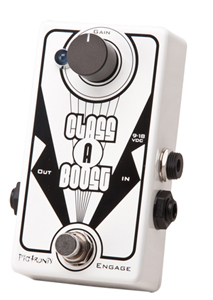
Pigtronix announces release of the Class A Boost – Elegance In Tone

Pigtronix Class A Boost is the final word in high performance guitar preamps. This pedal’s elegant exterior and single knob layout cloth an ingenious “Class A” J-FET design that will fatten up the sound of any instrument or sound source.

Featuring discreet transistor topology (no opamps) this device can boost passive or active pickups and even line level signals up to 20db without ever clipping. Perfectly flat frequency response from 20Hz to 20kHz ensures that your instrument’s tone and expressive character remain intact as signal power is increased.

The Class A Boost’s noise free performance allows you to put the effect anywhere in your pedal chain. It adds punch and extra output when placed after a classic overdrive or will happily push your gain pedals into new levels of saturation. The Class A Boost is also ideal for hitting the front end of a tube amp to achieve an added layer of sweetness and fat tone without unwanted clipping or noise.

The Class A Boost runs fine on a standard 9-volt supply, but ships with a Pigtronix 18-volt adapter in order to achieve superior headroom and maximum punch. Make your sound 1 louder with this handsomely dressed, J-FET masterpiece from Pigtronix.

“Pigtronix Class A Boost is crucial to my sound because it makes my guitar tone clearer and louder, without adding distortion.”  – Eric Krasno (Soulive)

Pigtronix Class A Boost carries a list price of $149 and is available now at Pigtronix dealers everywhere.  Check out the Class A Boost and the whole line of 2011 Pigtronix effects at http://www.pigtronix.com.

I’m a big proponent of boost pedals, especially when used to slam the front end of a tube amp to push it into full-on overdrive. What’s attractive about this particular pedal is that it is Class A – at least from an audiophile’s perspective – which means that it will not clip throughout its operating range. Don’t confuse this with the definition of Class A for an amplifier. They’re two different things. Here’s a great explanation of Class A operation with respect to amps.

In any case, this could be a VERY cool pedal to have…

For more information, visit the Pigtronix Class A Boost page!

Read Full Post »

I’ve never been much of a distortion box kind of guy; at least until recently when I got my EWS Little Brute Drive. I didn’t think I’d be using it all that much, but I have to admit, it is quickly becoming an indispensable addition to my pedal board. It’s as transparent as my Timmy, which is a HUGE plus in its favor, but the gain and distortion goes way beyond what the Timmy can do. But at the same time, it behaves insanely well with the Timmy. For instance, at my church gig yesterday, I was playing a song and had the Timmy engaged to give me some mild overdrive. There was a lead break in the middle of the song where I had to do a short 8-bar solo. But instead of switching the Timmy off, I just activated the LBD. OMG!!! I was immediately rewarded with tons of sustain, and singing, sweet distortion that was not at all over the top (I had the single gain knob set at about 11 am)

Amazing that all this comes from this little pedal that’s about 1 1/2 times longer than a 9 volt battery!

One thing though is that both the Timmy and the LBD are making me rethink how I approach my overdrive tone. Since getting them, I haven’t been cranking my amps near as much as I used to. I still love that saturated power tube sound, but tend to put my amps on just below the edge of breakup, then use my Timmy, the LBD, or a boost to push it over the edge. Mind you, I still have the Master volume up there. It’s just full out like it used to be.

Read Full Post »

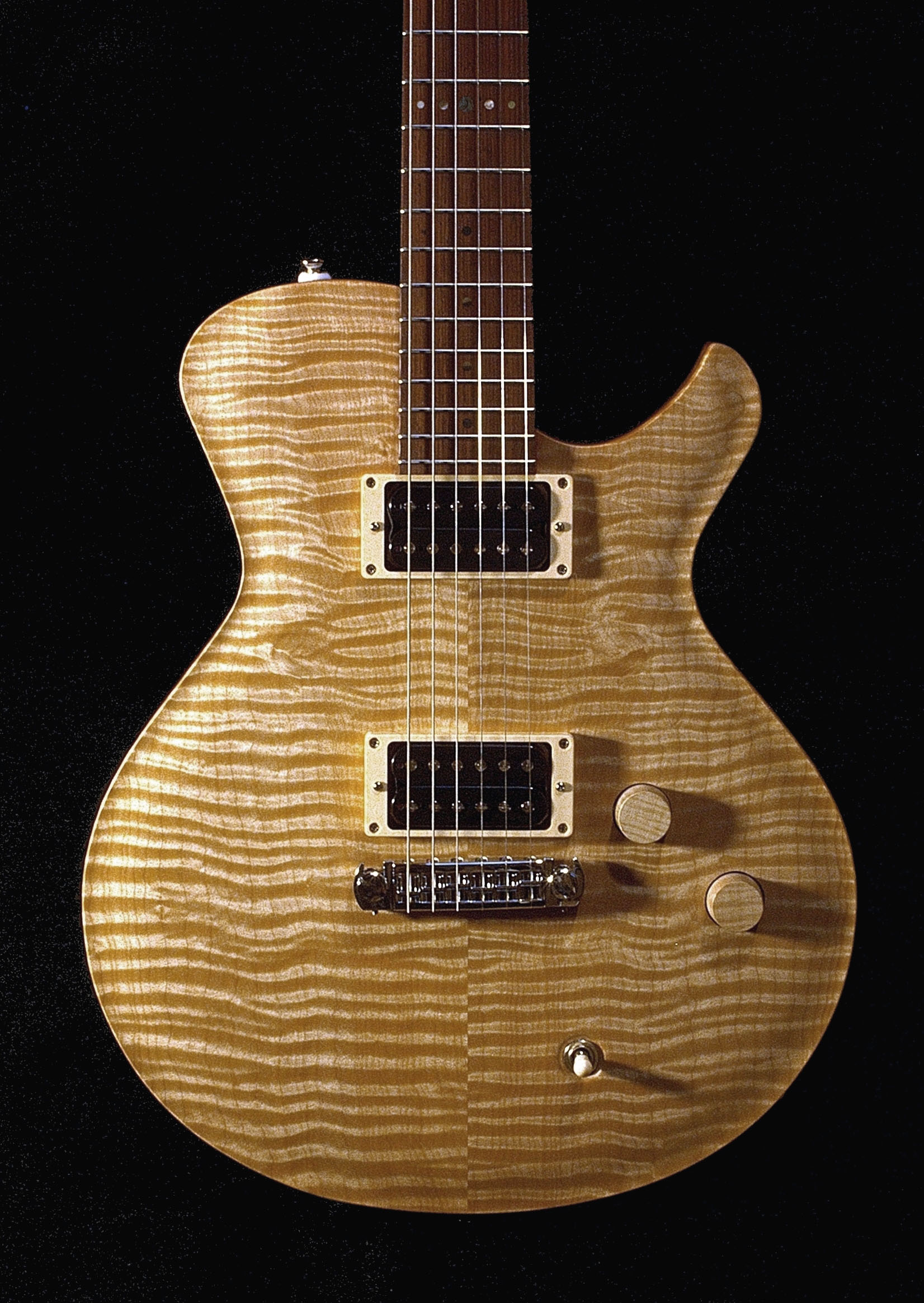
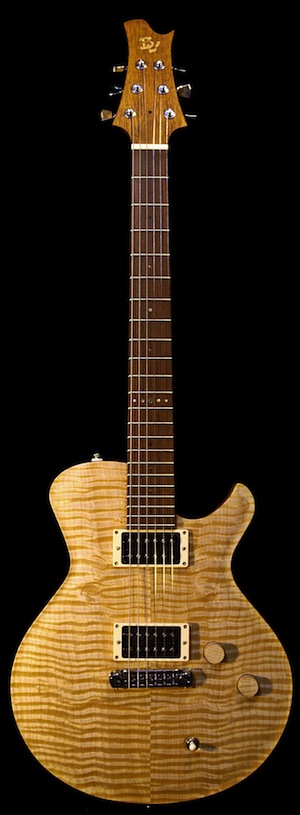
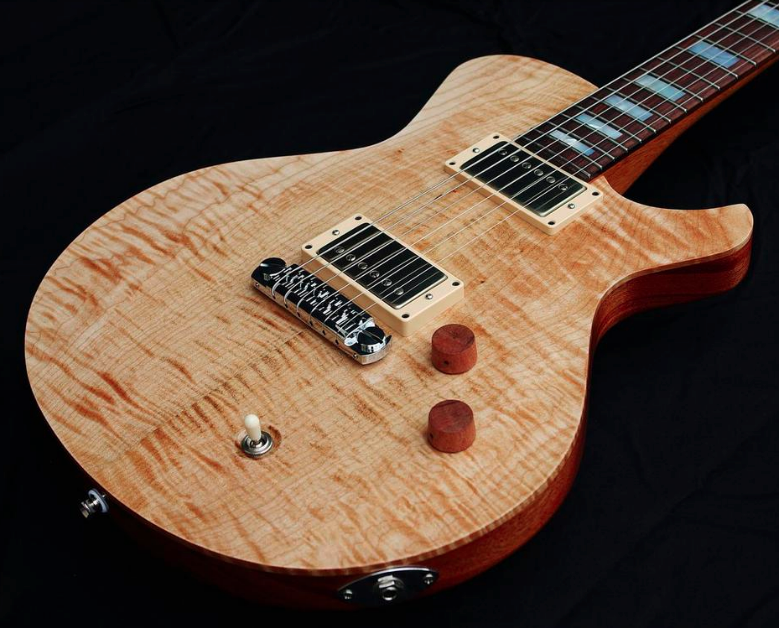
Barron Wesley Guitars Alpha #7

Summary: Similar to the Alpha that I recently reviewed, this guitar sports Honduran mahogany, and the tonal difference is HUGE. I really liked the last edition (#5), but this rendition of the Alpha has it all going on. Ringing clean tones and lots of muscle. Nice.

Pros: Again, all hand-made, and the cleans – oh, the cleans – have a gorgeous bell-like tone. The body and neck resonate beautifully.

Cons: None.

Features

  • Scale length: 25″
  • Frets: 22 (medium)
  • Color: Natural
  • Top Wood: Quilted Maple
  • Back/Neck Wood: Honduran Mahogany
  • Finish: Hand-rubbed Tung Oil
  • Fingerboard Cocobolo Rosewood
  • Nut Material: Bone
  • Bridget TonePros AVT II
  • Pickups: Manilus Vintage/Modern PAF+
  • Controls: RS Super Volume/Bourns Push-Pull Tone/Switchcraft 3-way Toggle
  • Tuners: Gotoh Magnum Locking
  • Weight: ~7.5 lbs.
  • Build Completion: July 2011

Price: $1800 – Yes, you read that right. This guitar is for sale, and I would buy it myself if I had the cash on hand; this is a KILLER guitar!

Tone Bone Score: 5.0 ~ From the moment I plugged it in, I fell in love with the tone and feel of this guitar!

It’s great to be close to local gear builders; especially when they make super-high-quality gear for a freakin’ fantastic price. Aracom was the first local builder whose gear I just had to have, and now it’s Barron Wesley Guitars. Russell at BWG, though a relative newcomer to the luthier scene is insanely talented. The workmanship of his guitars is on par with guitars that cost three to four times more, but more importantly, his guitars play and sound absolutely killer.

Last night, Russell dropped off Alpha #7 at my gig at Max’s Opera Cafe in Palo Alto, CA. When I took it out of its case, I just had to play it right away, so I plugged it in and was rewarded with such a natural, musical tone that I ended up finishing my last set playing that guitar. The clean tone was absolutely mesmerizing to me, and the fretboard made playing so effortless – it was scary easy to play. But I’m getting a bit ahead of myself…

Fit and Finish

There’s not much else to say that I didn’t say in my previous review of Alpha #5. Russell’s work is flawless. However, there are some differences in the finish that Russell explained to me last night. For instance, he put on fewer coats of Tung oil on the cocobolo fretboard as he wanted a much more “natural” feel to the fretboard. To me, the result was spectacular! Right out of the box, that fretboard had just about the best feel that I’ve ever experienced. The finish is silky-smooth.

One thing I didn’t mention in my previous article was that I absolutely love Gotoh hardware, and I love wraparound bridges as well. With a single point of contact, the string energy transfers almost directly to the body.

Finishing my last set with Alpha #7

Playability

Again, in a word just like last review: Awesome. The neck on #7 is absolutely perfect! Not sure what extra or even less shaping Russell did on the guitar, but to me, this neck feels just right, and moving around on it is a dream!

How It Sounds

Alpha #7, with the Honduran mahogany gives the guitar a real Les Paul-like quality when playing with lots of crunch. The resonance in the wood is such that like an LP, you feel the string vibrations as they course through the body and neck. When I first picked it up just to feel how it plays, I immediately took notice of how the body and neck resonate, which is why I had to play it right away. As I mentioned above, I played it clean, but the cleans were so delicious, I finished my last set playing the guitar.

This evening, I spent some time with the guitar – actually, several hours – and have not been able to put it down, save to write this article. I put together some quick clips to demonstrate the sound of this guitar (all clips were played through my beloved Aracom PLX18 “plexi” clone):

First, we’ve got the riff to Neil Young’s “Rockin’ in the Free World”

Amp was cranked, and I played it through the bridge pickup. Next, we’ve got the riff to the Doobie Brothers “Listen to the Music” to demonstrate the neck pickup played clean:

Next, I just started playing some random stuff fingerstyle in the neck pickup:

Then I played a riff to one of my own tunes in the middle position with both humbuckers coil tapped:

Finally, I quickly played a lead over a song idea I’m working on. The first part is played in the neck pickup, then I switch to the bridge to show the difference. VERY Les Paul-like in both response and dynamics:

By the way, those Manilus Vintage/Modern PAF+ pickups are absolutely KILLER! Russell made a great choice in these, as they complement the guitar perfectly!

Overall Impression

OMG! I’m freaking out by how incredible this guitar is! If I had the money, I wouldn’t be giving it back to Russell. That’s just how damn good it is. But as I mentioned above, the guitar is for sale. The price is a VERY reasonable $1800, and from how it looks, plays, and sounds, you’d be hard-pressed to get a guitar this good for that kind of price. If you get it now, you’ll be one of the lucky few who get one before he raises prices. Right now, you can take advantage of Russell wanting to get his instruments out and his name known. Once he’s established, the prices will go up as I imagine he’s selling these for just a little over his cost right now.

For more information, check out the Barron Wesley Guitars web site!

Read Full Post »

My trusty DigiTech Vocalist Live 4 is pretty much on its last legs. It has lasted four years of regular gigging – at least two gigs a week – and things are starting to become loose or not function at all. That’s okay because it was expected, so I’ve been slowly saving my pennies for a new TC Helicon VoiceLive Touch. This is a great harmonizer that not only will harmonize using guitar, but also keyboard; something that my Vocalist Live 4 could not do. It also has a built-in looper, which I had the opportunity to see in action a couple of months ago at an in-store demo with singer/songwriter Christine Havrilla. Check out this link in which Christine shows how she builds up a song using the VoiceLive Touch.

Pretty cool, huh? TC Helicon has placed A LOT of emphasis on the VoiceLive Touch’s looping capability. Even during the demo I saw, Christine focused on the looper. Now I’m not knocking it, but using a looper can be somewhat limiting, especially if you’re looping a chord progression. I have a small looper that I use occasionally, but I typically just use it for creating underlying rhythms. In that respect, it’s VERY useful. I’ve tried to use it with chord progressions for songs, but it’s difficult because songs have different parts, so it can be a bit impractical for that.

But as a harmonizer, this unit rocks! It has over 200 factory presets, and customizing harmonies on the fly is a snap. You simply hit the buttons on the right side of the unit to add or subtract harmonies. Very cool! The keyboard harmonization is a huge selling point for me, as I can hook up a digital piano and get harmonies that way as well.

All in all, this is a great little unit, and at $499, it’s pretty affordable, considering what it does – though you do have to pay an extra $50 for the foot switch controller, which is an absolute necessity for live work. I should be getting one of these within the next couple of months.

Read Full Post »

« Newer Posts - Older Posts »