Yeah, I know, this is a bit of a long time in coming, but I actually got REALLY sick there for awhile, and was sidelined for a few weeks. But as I say in the video, “Better late than never.” In this particular clip, Doug shares a bit of wisdom on choosing gear that’s right for YOU. I’ve been a big proponent of that on this blog, and it was affirming to hear Doug speak along these lines. Here’s the video:
Posts Tagged ‘guitar effects’
Doppler on Gear Part I
Posted in Guitars, tagged doppler, doug doppler, GAS, gear, guitar, guitar effects, guitar gear, guitarists, Guitars, Music, musicians, pedals on July 10, 2010| 2 Comments »
New Gear: Maxon ST-9 Pro+ Overdrive
Posted in Guitars, tagged effect pedals, Effects, GAS, gear, gear find, guitar, guitar effects, guitar gear, guitar gear reviews, guitar pedals, guitarists, Guitars, Music, musicians, new gear, overdrive, pedals, ST-9, ST-9 Pro+, tube screamer on June 21, 2010| 8 Comments »

Click to enlarge
“Guitar Player” mag took a recent poll asking: If you could only have a single pedal in your rig, what would it be? Overwhelmingly, and actually not too surprising to me, most pollsters chose an overdrive pedal. I personally didn’t take the poll, but I would definitely fall into the majority. You know me, I just can’t enough of overdrive pedals!
So much to my great pleasure, Maxon has released the new ST-9 Pro+ Super Tube Screamer Overdrive. Based upon Maxon’s classic “808” circuit, and building upon the original Ibanez ST-9 and its ability to control the amount of “midrange hump,” this “reissue” adds features that have the potential of making this a truly great Tube Screamer-class pedal.
- First of all, the ST-9 Pro+ sports 9V or 18V operation. 18V mode adds more headroom and warmth. This is controlled by a slider switch in the battery compartment.
- In addition to the Drive, Level, and Tone Knobs, the ST-9 Pro+ also has a “Mid-Enhance” knob which controls where the mids are boosted. Clockwise moves the boost towards the high mids, while counter-clockwise moves the boost to the lower mids. To me, this is probably the most useful feature, as you can dial in the mid boost to adapt the pedal to different amps.
- The ST-9 Pro+ also has a switch that selects either “Classic” or “Low Boost.” Low Boost gives a 12dB boost at 100Hz and a 4dB boost a 500Hz. This can be quite useful for fattening up single coil guitars!
- Finally, the ST-9 Pro+ has true-bypass switching.
OMG!!! I love the features on this pedal! Were I to consider getting another pedal in the Tube Screamer lineage, this pedal would be at the top of my list! However, with a street price of around $206, it’s not a cheap proposition. But with it’s features, it certainly warrants a close look; and based upon my experience with Maxon pedals, their build and sound quality is undeniable. While I don’t use it much any longer, my CP-9 Pro+ compressor is a testament to that quality (I paid $250 used for that pedal), and it’s a pedal I’ll always have. As for the ST-9 Pro+, I’ll see if I can find a place where I can audition it.
Finally, here’s a great demo video that shows off the ST-9 Pro+ quite nicely:
For more information, check out the Maxon ST-9 Pro+ page!
Mini-Review: Mad Professor Deep Blue Delay
Posted in Guitars, tagged delay, effect pedals, Effects, GAS, gear, gear reviews, guitar, guitar effects, guitar gear, guitar gear reviews, guitar pedals, guitarists, Guitars, Music, musicians on June 1, 2010| 3 Comments »
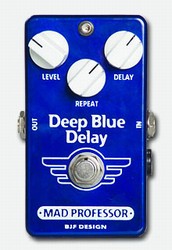 This is a “mini-review” only because I wanted to provide feedback on it after using it, and because I only used it in a limited way. The Mad Professor Deep Blue Delay is a digital/analog delay pedal meaning it is a digital delay with an analog direct signal path – or as Mad Professor puts it, the direct signal path is made of analog amplifiers with no filtering. In other words, it’s supposed to be transparent with no tone coloration.
Okay, I’ll just cut to the chase. This is about the sweetest delay pedal I’ve ever played through! It can do really subtle, ambient stuff, but also nicely textured “The Edge-” like delay. But no matter where you set it, the delay never turns to mush. It retains your tones, and is super-sweet.
At first glance, you might think this is a typical analog delay pedal, but it is a digital delay, and thus nowhere near as dark as I’ve heard analog delay pedals, which has kept me from getting an analog delay in the first place. I just don’t get into the really dark, brooding type of delay. But I’d easily consider the Deep Blue Delay. It’s simply killer!
I only used it with a Yamaha APX900 acoustic to add some subtle ambient textures to my finger picking. I was also running the signal into a nice little Genz-Benz Shenandoah JRLT. Level was at about 10 am, Delay about noon, and Repeat at about 11 am. I wanted to get just a subtle hall-like echo. All I can say was that it performed astounding well! Combined with that sweet ToneCandy Spring Fever reverb pedal, and I was awash in ambient heaven!
I did play with higher levels of each setting, and was amazed at the overall clarity of my tone. No mush or mud. My signal stayed nice and clean, and the note separation was always retained. And with this delay, smooth is the name of the game. There’s nothing harsh in the delay the Deep Blue produces.
Apparently – and I still have to corroborate this – the Deep Blue was designed to be place in front of or in the effects loop of an amp, and can be used either before or after distortion. Pretty amazing, as most time-based effects only work well in a loop and after distortion only. The folks at Mad Professor really put a lot of thought into this pedal. The guy at the shop where I tested it at – and someone whom I trust implicitly – plays the Deep Blue in front of an old Traynor amp, and loves it.
But there is a down side to this pedal, and that’s its price. At a street price between $325 and $350, it’s an expensive proposition, and like the Spring Fever, is probably the only thing that keeps me from getting this pedal. It’s tough to justify spending that much for a pedal, but that’s just me. Once a pedal gets in the $250 range, I start getting a bit antsy. But that said, if I had the scratch to get one, I’d run out right now and grab that pedal! It’s that good! (Damn! Knowing me, I’ll probably end up getting it… 🙂 ).
In any case, it gets 4.75 Tone Bones

Pros – Absolutely fantastic delay! Decay is perfect, and note clarity is like nothing I’ve heard.
Cons – Pricey
Gear Review: ToneCandy Spring Fever Reverb
Posted in Guitars, tagged effect pedals, Effects, GAS, gear, gear reviews, guitar, guitar effects, guitar gear, guitar gear reviews, guitar pedals, guitarists, Guitars, Music, musicians, new gear, reverb, ToneCandy Spring Fever on May 23, 2010| 4 Comments »
|
|
ToneCandy Spring Fever Reverb
Summary: Just about the sweetest spring reverb pedal I’ve ever heard, plus the pedal sports a nice, transparent clean booster that you can even use on its own! Pros: I’ve heard simulated spring reverbs before, and they’ve been nice, but not THIS nice! Supposedly modeled after the original BOSS spring reverb sound, but takes it way ahead! Cons: Very very pricey for a just a reverb with boost. Also, doesn’t run on batteries Features:
Price: $275 Street Tone Bone Score: 4.5 ~ I was completely blown away by the sound of this pedal, but the price completely scared me away. If cost isn’t an in issue for you, you’ll find none better than this! |

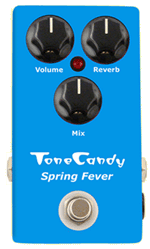
Being friends with guys at a music shop can be incredibly useful, since they’ll show off their new stock; plus, knowing that I may buy it if they show it to me, they don’t hesitate to show it off. 🙂 Luckily, I usually have enough self-control to not buy most of the stuff they demonstrate.
I have to admit, though, that I was VERY tempted to get this pedal because I haven’t heard one like it – ever! It can slather on the ‘verb quite nicely and note clarity is retained at any setting along the reverb knob sweep. Obviously ToneCandy figured out some great values for pre-delay and trail. I just couldn’t get over how great it sounded with chord progressions and single note picking!
In fact, A/B’ing it with a Fender Deluxe Reverb Reissue just blew me away! It sounded even better than an actual spring reverb! Fender spring reverb, at least to me, is the gold standard in spring reverb, and for a pedal to sound even better than that, well, needless to say, that made a compelling case to get this reverb pedal. Add to that a completely transparent boost, and you’ve got a great pedal that you can put at the end of your signal chain and get all sorts of usage out of it! I could feel the GAS really starting to build up.
Then I asked the price, and my eyes bulged! At $275 for the pedal, that made my GAS go away pretty quickly. If price wasn’t an issue for me, I’d totally go for this pedal, but unfortunately, at that price, I started thinking, “I could get a couple of decent pedals, or even a nice Squier for close to that price.”
Needless to say, I didn’t get the pedal, though I do have to applaud ToneCandy for coming up with a fantastic spring reverb tone. Maybe if I can find one used in the future for a lower price I’ll get it. But for now, I’ll just gaze at it in the glass case when I go to the shop…
Here’s a sound sample:
First Impressions: Boss RC-2 Loop Station Pedal
Posted in Guitars, tagged effect pedals, Effects, GAS, gear, gear reviews, guitar, guitar effects, guitar gear, guitar gear reviews, guitar pedals, guitarists, Guitars, looper pedal, Music, musicians on May 19, 2010| 4 Comments »
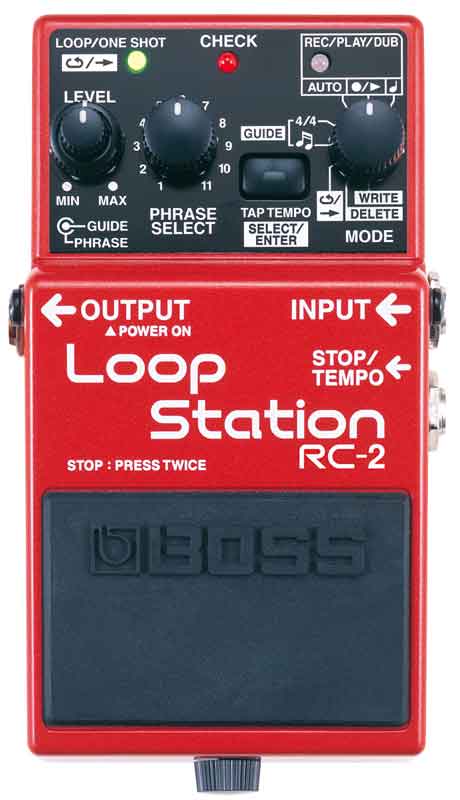 I’ve been playing a solo acoustic gig for about 7 years now, and in all that time I’ve wanted to do lead breaks in various songs. But being a solo artist, and not having all that much time to spend on backing tracks, needless to say, lead breaks were out of the question – until now.
I just picked up a used Boss RC-2 the other day, and since playing with it, I just know that it is going to change the way I do my solo gigs forever. Even if I don’t keep this particular unit (which I probably will for quite awhile, as it does everything I need for now), I’m a total convert to using a looper!
Not that it hasn’t been challenging. Consistent tempo is tantamount to creating loops on the fly. Playing solo, I’ve gotten used to doing rhythmic embellishments, which don’t quite work all the time with a looper, and I’ve had to practice cutting off the record at just the right time. That has probably been the biggest challenge so far. But I’m starting to get the hang of it, and I’m just loving the possibilities it opens up for me!
Doug Doppler on the Dumble Overdrive Special: Episode 4
Posted in amplifiers, amps, doug doppler, dumble, GAS, gear, gear reviews, guitar, guitar gear, guitar gear reviews, Guitars, Mullard, musicians, tagged amp, amplification, amplifiers, amps, doppler, doug doppler, dumble, dumble amps, dumble overdrive special, GAS, gear, gear reviews, guitar, guitar effects, guitar gear, guitar gear reviews, guitarists, Guitars, Music, musicians, overdrive on May 14, 2010| 6 Comments »
Dynamics. It’s what separates a mechanical and boring piece from something that can move an audience to tears. In this episode, Doug talks about the incredible dynamics of the Dumble Overdrive Special.
This is the last video in the series of Doug Doppler on the Dumble Overdrive Special, but it’s not the last. I’ve got many more “Doppler on…” videos to come, so stay tuned!!!
Gear Review: Doodad Guitars Check-A-Board RED Overdrive-Booster
Posted in Guitars, tagged effect pedals, Effects, GAS, gear, gear reviews, guitar, guitar effects, guitar gear, guitar gear reviews, guitar pedals, guitarists, overdrive on May 11, 2010| 2 Comments »

 Click to enlarge |
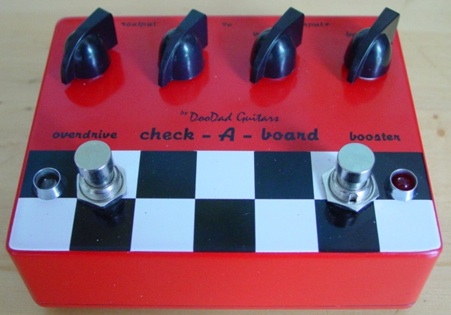
Doodad Guitars Check-A-Board RED Overdrive Booster
Summary: Two independent, true-bypass pedals in a single “bastard-proof” enclosure that can be used standalone or together. Overdrive is based upon the classic Tube Screamer, but has a voice all its own, and the booster is nice and transparent. Pros: Fantastic overdrive tone! The overdrive is super responsive, and the sustain at high drive settings is killer! Cons: I just keep the tone pot wide open. But the cut can be dramatic when you want to reduce some highs. Just a nit. Features:
Price: $139 street Tone Bone Score: 5.0 ~ I admit it, I’m partial to overdrive pedals, and while I love every single one that I have, I just never get tired of them. This pedal is going on my board! I’m buying the eval unit! |
Holland Produces More than Just the Dire Straits
I’ve been wanting to review gear from European companies for awhile; that is, European companies that don’t have much of a US presence, so TC Electronics was kind of out. So when I discovered Doodad Guitars by accident through some research on Marble amps – another Dutch company – I knew I had to find a way to check out their gear. So hooking up with Mal Stich of the The Alternative Guitar and Amplifier Company in Southern California got me the Check-A-Board RED overdrive/booster. I’ve been having TONS of fun with this pedal since I got it for review. So much fun that I’ve decided to keep the pedal. 🙂
Gig Report
Not wanting to lug my full rig to the church this past Sunday – which usually includes an amp head, cabinet, PRX150-Pro attenuator, my pedal board, plus a couple of guitars – I opted to go a bit more sparse. This time, I loaded up my Champ 600, a 1 X 12 cab, my Squier CV Tele; then threw the Check-A-Board RED pedal and my TU-2 tuner in a gig bag. Setup time: Less than five minutes. 🙂
This past Sunday, my drummer was traveling on business, but even without a drummer, I like to have a little dirt at my fingertips. And since I wasn’t using an attenuator, an overdrive pedal was my only option, so what better way to test the RED pedal?
I needed to pop in a 9V battery, and I have to say that I dig the battery compartment in this pedal! As opposed to many pedals that have a separate lead wire that you have to attach the battery to, then place into the battery housing, the RED pedal’s housing actually swings out completely! You just slide the battery into the compartment, swing the housing back into the pedal, and you’re off to the races! Nice and convenient!
For volume setup, I first adjusted the Champ’s volume to my normal gig volume which, in a church as most worship players will attest, isn’t very loud; especially when you’re sans a drum kit. By the way, my guitar was also set to just above half-way on its volume knob, so I’d have some wiggle room. Once I had that dialed in, I set the RED pedal’s drive to about 2pm, tone wide open, and set volume at just above unity. That gave me a nice rhythm grind, and with the drive set where it was, if I added more volume on the guitar, it wouldn’t produce too much more volume – just more dirt, which is what I wanted.
At those pedal settings, the RED pedal really sustains. That’s what you’d expect from a Tube Screamer-like pedal. But as I mentioned in my “first impressions article,” it has a voice all its own, foregoing the huge mid-range hump, and presenting a much flatter EQ response that brings out the highs and lows a bit more (just so long as you keep the tone wide open as it is a high-cut filter).
While it responds dynamically much like a Tube Screamer, its voicing is darker and has more “balls.” That’s a great combination, especially when you’re playing through a naturally bright amp like the Champ 600. It provides an overall tonal balance, and that’s very pleasing to me. 🙂
There were two things that struck me during the service about the RED pedal: First of all, even when I was wailing on the strings, the string separation was phenomenal! This pedal doesn’t know how to get mushy! Even on our closing song where I cranked the Drive – and we could play with more stage volume because the congregation gets LOUD 🙂 – my sound never turned to mush, and I was able to weave in and out of power chords and little fills and not worry about producing just a wall of sound. KILLER!
Secondly, where I had the pedal set up for most of the service, the RED pedal’s dynamic response was much like an amplifier’s, and it responded incredibly well to volume and knob and pick attack. For instance, there was one song near the beginning of the service where I stepped into the aisle to egg on the congregation to sing with the band. When I stepped out, we were in the middle of a nice, driving section of the song. I kind of got a bit carried away 🙂 and lingered there a bit too long and couldn’t get back to the RED pedal to switch off the overdrive before the softer verse section. So I turned my guitar volume down just a bit, and used some light hybrid picking for the verse section. The pedal cleaned right up, and had just a tad bit of dirt on the high-end which served as some shimmer. Needless to say, I pretty much kept the pedal on for each song we did, with the exception of a meditative, prayerful song where I had to play absolutely clean.
Funny thing, while I set up the booster, I didn’t even use it this past service. I’ll definitely use it when I use my regular rig, as I’ll have my attenuator and can set my amp to its sweet spot. Then I can take advantage of slamming the front end with some gain. 🙂
I DIG THIS PEDAL!!! At $139 from The Alternative Guitar and Amplifier Company – and I don’t say this often – but this is a must-have pedal for me! Looks like I’m going to have to buy the evaluation unit! Yeah, I know, I’m adding yet another overdrive pedal to my collection, but as Tony Stark said in “Iron Man,” “I gotta have it.” But unlike Stark, I won’t box it up and put it in storage. This pedal is going on my board!
How It Sounds
I’m using the clips I recorded for my first impressions article again. I’m actually working on a video review of the pedal, so I didn’t want to record more clips. But here’s a sampling for your listening pleasure. For this, I’m using my Aracom PLX18BB 18-Watt Plexi clone.
Aracom PLX18BB By Itself
Overdrive Engaged
Booster Engaged
Here’s a video to whet your appetite:
For more information, go to The Alternative Guitar and Amplifier Company and talk to Mal Stich. You will not be disappointed!
First Impressions: Doodad Guitars Check-A-Board RED Overdrive-Booster Pedal
Posted in Guitars, tagged effect pedals, Effects, GAS, gear, gear reviews, guitar, guitar effects, guitar gear, guitar gear reviews, guitar pedals, guitarists, Guitars, Music, musicians, new gear, overdrive, pedals on May 5, 2010| 3 Comments »
Click to enlarge
You know me… I LOVE overdrive pedals! I have several, and amazingly use them all, depending upon the voicing that I want, as I don’t think I’ve ever come across any two that sound exactly alike. But since I’ve been playing through really nice tube amps, I’ve come to really appreciate a great booster pedal as well. So it was very pleasant surprise to discover Doodad Guitars’ Check-A-Board RED overdrive-booster pedal that combines both OD and boost in a single pedal.
You might be thinking, “So what?” I certainly did, until I found out that you could operate either one separately or both in tandem to not only add some clipping before your amp, but to also slam the front end with more gain. That really piqued my interest!
I discovered this pedal through Mal Stich over at The Alternative Guitar and Amplifier Company (“Alternative” for this discussion) as I was searching for more information about Marble Amps, a Dutch company that makes vintage Fender clones. “Alternative” is their US dealer. I called up Mal to get info about the amps, and we had a great conversation. He shared that the amps were fantastic, but it was tough to sell them here in the states because shipping and duties are so high for such heavy gear that it makes it hard for Marble to compete in the boutique amp marketplace in the States. Then he mentioned that he was working with another Dutch company that had just released a brand-new overdrive-booster combo pedal. That got my ears up! So he graciously offered to send one to me for review.
So as a first impression, what do I think? This is a killer pedal, folks! I love both sides of the RED pedal. While the overdrive is supposedly based upon the classic TS-808 circuit, it doesn’t sound at all like a Tube Screamer (remember, I have one), but that’s a good thing, as it has it’s own voice. It can go from slightly gritty to super saturated and sustaining. But the coolest thing I dig about it is that it doesn’t compress your signal much with the drive set high. But like the Tube Screamer, at high drive settings, it sustains for days!
With respect to the booster, I dig it. It doesn’t give me as much boost as my Creation Audio Labs Mk.4.23, but very importantly, it doesn’t add any artifacts either; in other words, it boosts as expected, and does it transparently. And it comes in handy when I need a slight volume jump for a lead. I guess you might compare it to the VOX Satchurator’s “More” toggle, but with this booster, the gain is adjustable. Nice! While I really love the overdrive side of the pedal, I’ve found myself using the booster a lot more because my amps just loved to be slammed with gain on the front-end! 🙂 The booster really brings out the best in these low-wattage amps!
For controls, the RED pedal has four knobs: Three (Drive, Tone, and Volume) control the overdrive section, while the four controls the amount of boost the pedal produces when the boost is engaged. The Tone control is more of a high-cut filter than a true EQ, but that’s okay. I prefer that with overdrive pedals as I usually want all my tone, so I normally have it all the way up, or if I’m playing a naturally bright amp, like my 18-Watt Plexi clone, I just dial out a tiny bit of the highs. One thing that I noticed immediately with the overdrive besides its sustain, is the incredible note separation, even at higher drive settings. That makes it a no-brainer to use when I want singing lead tones! As I mentioned, the signal doesn’t compress that much, so having that note separation is killer!
In my short time using the pedal, I’ve actually preferred to use the overdrive and booster separately. My little low-wattage amps provide enough dirt that slamming them with overdrive AND boost is just overkill. If I had higher-wattage, high-gain amps, it probably would make more sense to use both. In any case, I have some clips of the pedal. I’m using my Squier CV Tele plugged straight into the RED pedal then into my Aracom PLX18BB Plexi-clone.
PLX18BB By Itself
Overdrive Engaged
Booster Engaged
I have some more playing to do with it before I do my full review, but I will be giving this pedal a pretty high rating!
For more information, go to The Alternative Guitar and Amplifier Company site!
New Gear: Earthquaker Devices Zap Machine Fuzz
Posted in Guitars, tagged effect pedals, Effects, fuzz, GAS, gear, gear announcements, gear find, guitar effects, guitar gear, guitar pedals, guitarists, Guitars, Music, musicians, new gear on April 14, 2010| Leave a Comment »
Never really been into fuzz that much, but some of my latest stuff could really use some fuzz, so I was pleasantly surprised this morning to receive Fat Tone Guitars’ newsletter this morning that featured an announcement that they’re the exclusive sellers for Earthquake Devices’ new Zap Machine Fuzz. This is a brand-new pedal, released just this past Monday, and from what I can tell, it sounds VERY COOL! Here’s a video:
As I mentioned, it’s only available through Fat Tone Guitars, and this is a limited edition pedal, so get ’em while they’re hot! 🙂
Revisiting the Tube Screamer
Posted in Guitars, tagged Effects, GAS, gear, guitar, guitar effects, guitar gear, guitar pedals, guitarists, Guitars, Music, musicians, overdrive, pedals on April 12, 2010| 5 Comments »
I had my weekly church gig yesterday. It was storming REALLY badly beforehand, and the thought of lugging my regular rig in the rain was just not appealing to me. It usually consists of my pedal board, a couple of guitars, an amp, a 1 X 12, cab, an attenuator, and a gig bag for cords and tools for spot emergency repairs (never leave home without some tools – I even have a soldering iron because you never know…). With all the rain, I just did not want to do that, so I opted for a solution where I could just make one trip, and that meant leaving my attenuator, pedal board, and main amp – an Aracom VRX22 – at home. I also wanted to keep things as light as possible, so I wouldn’t have to use my portable hand cart.
So I decided to use my little Fender Champ 600 and my 1 X 12 cab (because the Champ just doesn’t have enough bottom-end). The thing about the Champ is that you have to crank it up all the way to get some decent breakup, which isn’t bad in and of itself, but in a church environment, that could be problematic as even 5 Watts through a 1 X 12 can be loud. So my solution to get some grind? I took the dust off my old TS-808 Tube Screamer, threw it in my gig bag, grabbed my Tele, and went to church!
 I have to say that that was one of the most enjoyable sets I had played in awhile. I hadn’t used the TubeScreamer in a LONG time, and I mainly used it yesterday because I didn’t want to “peel” an OD off my board. But I had forgotten just how good a pedal the classic TS sound; that is, if you use it right.
So I have a big admission to make: I’m not sure if I had ever really used the Tube Screamer to its full potential before I replaced it. I loved its tone, but could never get the drive that I wanted with it. So yesterday, knowing that I was playing the Champ, which is all about clean headroom, I cranked the Overdrive knob on the TS, and set the level to just over unity gain, with my guitar volume a little past halfway.
Cranking the Overdrive knob made the Tube Screamer absolutely come alive! To me at least, it has a tasty, mid-rangy tone, and turned up as high as I had it, added tons of sustain that amazingly enough didn’t muddy up my tone. There was just a touch of compression as well. But the best thing about it was that the TS was very responsive to volume knob and pick attack at that higher gain setting. Rolling off my volume cleaned up my signal immensely, and when I’d dig in, I’d get some subtle grind; perfect for playing rhythm. During lead breaks, I’d throw my Tele into the bridge pickup, crank my guitar’s volume, and I’d get a singing lead tone!
Granted, I’ve got some fantastic drive pedals on my board right now that I’d be hard-pressed to remove. But I’ll always have my Tube Screamer for those times when I just want to keep things simple. 🙂
Here’s a clip that I recorded this evening with the Champ 600 and the Tube Screamer. Both rhythm and lead parts were recorded with the Tube Screamer’s Overdrive maxed, and the level set to unity gain, and the Tone knob set to about 3pm – close to max. The rhythm part was finger-picked with my Tele in the neck position, while the lead was played in the middle position. I added just a touch of reverb to each part to smooth out the tones. They can be quite bright on the Champ 600.
Admittedly, the Tube Screamer’s mid-rangy tone isn’t for everyone. But I love it, and the sustain that it adds really does it for me.
With regards to my Champ, for a $149 amp, it really kicks some ass! I didn’t particularly like the tubes that were originally in it, so I tried several. My latest combination is a NOS ’59 GE 12AX7 and a NOS ’53 GE 6V6. That combination works great with the amp. I highly recommend getting some good NOS tubes to put in that amp if you endeavor to buy one. For under $50 you can get those tubes. My 6V6 was a “good pull” that I got for $15! The pre-amp tube cost $30. Totally worth it!
 Guitar Gear
