Feeds:
Posts
Comments

Posts Tagged ‘guitar effects’

No, I’m not talking about a resonator guitar. This is an effect. It essentially adds tons of sustain and feedback kind of like one of those Moog guitars, but in a pedal connected to a gooseneck stand that appears to have an optical scanning device attached to the end that “reads” your strings, then processes the vibrations. It’s interesting to say the least, and Uli Jon Roth apparently uses it.

That said, I like the idea of having something like this to get super-sustain and feedback, and totally get that you don’t have to spend an arm and a leg to get at least part of what the Moog guitar does, but it’s another piece of equipment to lug around. Don’t know how I feel about that.

Don’t know how practical it is, but I’ve seen worse things.

Check out the Vibesware site for more information!

Read Full Post »

Man, I love it when gear manufacturers build stuff for a cause! Wampler has just re-released their limited run Underdog Overdrive (only 100 were originally made) to help out a friend who has breast cancer, as she can’t pay her doctor bills and apparently can’t get any insurance. All the profits from this re-release are going to help this woman out. It’s great to see this type of generosity!

Here’s a transcript of the press release:


Wampler Pedals has recently re-released their popular “Underdog Overdrive” pedal. Only 100 of the pedals were built originally.

According to Brian Wampler, owner of Wampler Pedals, “A close friend of mine has breast cancer and has no insurance, no family, and the government will not pay any medical costs for her to get the treatment she needs. Now, I’m not rich by any means, but I had to do something to help her. My wife and I came up with the idea of creating a pink pedal that is rich, dynamic, and very tweakable, and donate ALL the profits to her. Out of that limited run, famed country artist Brad Paisley bought one and loved it. A number of guitarists saw the pedal on Brad’s pedalboard and asked me to build one more for them, so I decided to start building more to keep up with demand. We are still donating all the profits to my friend, Ivy East, who is struggling to pay the doctor bills to combat this terrible disease.”

And here’s a video demo of the pedal. Apparently this is one of Brad Paisley’s favorite overdrive pedals:

For more information, visit the Wampler Pedals site!

Read Full Post »

Got a little ambitious tonight and recorded some clips of the VOX Time Machine this evening. All clips were recorded with my trusty Aracom VRX22 amp.

The first is a short song featuring my CV Tele in the rhythm and my Gibson Nighthawk 2009 doing the lead. This was close-miked to a 1 X 12.

With the next four clips, I wanted to a chorus kind of vibe going by hooking up two 1 X 12’s to my Aracom PRX150-Pro’s speaker outs. I didn’t record in stereo. I just used my Sennheiser e609 placed about a foot away from both speakers that were about 75 degrees turned toward each other. Sorry for the background noise that’s the ambient noise in my garage – I had to turn up the input gain a lot to get a decent recording signal.

The first clip is just a simple chord progression done finger style. The pedal is set to about 11am level and 2pm feedback. I tapped in about a 72 bpm tempo.

The next clip has the both level and feedback at about 2pm with a 60 bpm tempo. This is sort of a “space echo” type of thing ala Steve Miller.

With this next clip I wanted sort of a heavy slap-back type of vibe doing a rhythm part on the 5th and 6th strings. At the end I play an Em chord very lightly to demonstrate how the pedal reacts to pick attack. The Time Machine is set to about noon on the level and 11 am on the feedback. I’ve got about a 90 bpm tempo.

Finally, I did another short song to demonstrate how the Time Machine works well to get a gorgeous, spacious tone for clean leads. Here I set the level at 10am and feedback at 2pm, and also engaged the vintage mode, which produces a bit thicker of a tone. The rhythm was just recorded with a reverb.

This is a fairly good representation of how the pedal sounds with a clean tone. Again, sorry for the background ambient noise. Maybe if I had a “proper” studio… 🙂

Read Full Post »

As many might know, one of the first places I test out new gear is at my weekly church gig. Church services are especially great for testing gear that you normally use clean or with just a little grit, and it proved to be a great venue for testing out the Time Machine.

All I can say about the Time Machine is, “Wow!” It really was made for being run in front of an amp! I know that some people don’t like it because it can’t be used in an effects loop, but in front of an amp, it works great! Don’t know how VOX did it, but it doesn’t seem vary the output gain – at least as far as I could tell – so it didn’t give me pulsing grind when I set my amp at just the edge of breakup. That really blew me away because I was concerned about that happening as I always set my amp on the edge of breakup, so increases in gain, whether due to volume knob or attack will give me some light dirt. Amazingly enough, the Time Machine didn’t push my amp over the edge at all.

That gave me tons of confidence to really experiment with the pedal. As with most church services with contemporary christian music, the flavors of songs change throughout the service. This provides ample opportunity to test gear. Whether used in smooth ballads or rockin’ with some slapback, the Time Machine delivered on all fronts. I was particularly impressed with using the Time Machine on slow songs where I could dial in a real long delay (it can get a delay time of up to 5800 seconds). Setting the feedback to about noon and the level to around 11am, I was able to get this great ambient, ethereal tone with an approximate metronome setting around 58-62 bpm by using the tap tempo toggle.

I dig the tap tempo on the Time Machine. It’s always on, so making midstream tempo adjustments is simply a breeze. In one of our songs this evening, the group sped up for some reason, and it really threw off my delay tone. But a quick tempo adjustment – while I was still playing, mind you – got my delay back in sync. That was so incredible!

As I mentioned in my review of the Time Machine, I’ve been waiting for a couple of years to get a new delay after I gave my old DD-5 away. I’m glad I took the time to wait. The Time Machine is the bomb!

Read Full Post »

Click on the picture to see an enlarged view.

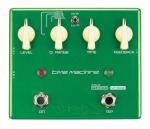
VOX Time Machine Delay Pedal


Summary: If you’re looking for a super-quiet, dynamic and versatile delay that will cover a lot of territory, look no further. The Time Machine rocks!

Pros: Absolutely quiet, with no line noise at all. It is so easy to dial in great delay sounds with the Time Machine, it’s almost scary. I like the fact that it has more features than a basic delay pedal, but not so many that you spend all your time tweaking. Oh yeah… It sounds absolutely fantastic!

Cons:None.

Features:

  • Controls:  Level, Delay Range, Time, Feedback, ON SW, Tap & Modern/Vintage SW, Hi-Fi/Lo-Fi SW
  • In/Outputs: 1 x  INPUT, 1 x OUTPUT, 1 x DRY OUT, 1 x DC9V
  • Max Delay Time: 5800 milliseconds via Tap-Tempo, 1000 milliseconds via Delay control
  • Input Impedance: 1M-ohms
  • Output Impedance : 1k-ohms
  • Power Supply:  9V alkaline battery(6LF22/6LR61) or AC adapter(sold separately)
  • Current Consumption: 60mA
  • Dimensions: 143(W) x 121(D) x 58(H) mm / 5.63”(W) x 4.76”(D) x 2.28”(H)
  • Weight: 600g /1.32 lbs (without batteries)
  • Included Items: 9V alkaline battery (included)
  • Options: 9V AC adapter (not included)

Price: $199 street

Tone Bone Score: 5.0 ~ This pedal has ended my search for a delay. It really is as good as it’s advertised.

I tend to be a little wary of “signature” pedals because I’m really not one who wants to sound like someone else; besides, I’m not nearly as capable on the guitar as said artists. But now and then, I come across signature gear that forces me to take a good, long look: Not just because of the name behind it, but simply because it’s just a great piece of gear! Such was the case with the VOX Time Machine. When it first came to market, I have to admit that I was excited because I know that Joe Satriani is a real tone freak, and I figured that any kind of gear in which he has design input is bound to be pretty good. But the flip side of that is that I’ve had experience with other signature pedals that were really geared towards the artist and their playing style specifically, and frankly, that stuff has left me frowning. Not so with the Time Machine, which took me completely by surprise!

I’ve been in the market for a delay for almost a couple of years, when I gave away my crappy Boss DD-5 that had such perfect and precise delay that it just felt processed. It was nothing like my former DD-3 that actually sounded pretty good, but I lost that pedal after playing in an orchestra for a musical theatre gig (I didn’t have a board at the time, and only carried a couple of pedals). Needless to say, during that time, I’ve evaluated several delays, but none have really caught my fancy. They were either too dark sounding, as in the case of most analog delays, or they sucked tone, as in the case of many digital delays I’ve tried. My surprise with the Time Machine is that in either mode, modern or vintage, my basic tone was retained! But I’m getting a bit ahead of myself.

In my search, I came up with some criteria that had to be fufilled 100% before I’d even consider buying one. Here they are:

  • First, I wanted Tap Tempo. I’ve always hated having to bend over to tweak knobs; but moreover, I wanted to be able to match tempos with my drummer on the fly.
  • Secondly – and I know this is purely subjective – I wanted a good balance between tweakable settings and ease-of use. In other words, I wanted to have the flexibility to dial in a number of delay settings but not have so many that I’d be spending all my time tweaking knobs.
  • Thirdly, I didn’t want to ever have to refer to a reference manual to make sure I was using the pedal correctly. The “don’t make me think” rule had to apply. I should be able to dial in great tones in a matter of a few minutes, if not earlier.
  • Finally, and most importantly, the pedal could not suck tone, and had to be reasonably transparent. In most cases, I don’t mind a pedal putting an emphasis on a particular EQ range (like my Kasha overdrive does), but it should never remove a range or “feel” like it narrows the bandwidth of the signal.

There are lots of delay pedals I’ve evaluated that were particularly good in most areas, but none until I played the Time Machine ever fulfilled all four criteria. That’s how great this pedal is!

It’s Mean When It’s Green

I love the shiny, green apple finish of the Time Machine. Of course, the paint job doesn’t make the pedal. But the Time Machine is built like a tank, and is certainly gig-worthy. I imagine that JS had that in mind when providing his design input. The chicken head knobs give the pedal a cool vintage vibe, but not only that make it very easy to see where you’re at with your settings. The stomp switches are nice and smooth, and the pedal engages without producing any noise.

How I Did My Evaluation

I didn’t just test the Time Machine in isolation. I’ve learned that one of the best ways to evaluate pedals is to do A/B tests against other pedals of like kind to make a comparison. So I compared the Time Machine against a Way Huge Aqua Puss and a TC Electronic Nova Repeater at my favorite shop, Gelb Music in Redwood City, CA. My thought was to compare it against an analog and another digital delay. Sorry, but no clips because I was in a shop.

All my tests in the shop were done with a Fender Custom Shop Tele, plugged into the pedals (hooked together so I could quickly make a comparison without swapping), and into an absolutely superb-sounding and -looking Dr. Z Maz 38 with draped in blonde tolex. Mm mm good. 🙂 I chose a midrange wattage amp because I wasn’t interested in creating grind. I’ve never been one to use delay with overdrive – maybe a little. But in this case, I wanted to have an ample amount of clean headroom to work with, and the Maz 38 worked perfectly for that (for the record I REALLY want a Dr. Z Remedy).

Aqua Puss and Nova Repeater

I will most likely have reviews on the Way Huge Aqua Puss and TC Electronic Nova Repeater in the near future, but I’ll give you a quick run-down of the pedals. If you’re looking for a dark, swampy, blues delay. The Aqua Puss delivers that in spades. It has this certain ethereal quality that made me think of drifting on a boat in the middle of the Everglades. I actually really liked the pedal, but I was after something else entirely with my delay search – much more versatility – and the Aqua Puss was a one-trick pony. It does what it does exceptionally well, but don’t ask for much in terms of usability in a variety of styles.

I was very sadly disappointed with the Nova Repeater. It packs a TON of features in its box, but for me, I was a little concerned that were just too many features. But despite that, it was easy to get a usable delay tone almost right away. The folks at TC Group certainly know how to pack in features, but they make them readily accessible, and very easy to understand. I actually had my heart set on getting this pedal after reading many reviews and listening to clips and watching video; and I almost purchased it a couple weeks ago. But I’m glad I compared it head-to-head with the Time Machine.

The Time Machine may not have all the features as the Nova Repeater, but out of the box, it wins hands-down in the tone department. The Nova Repeater sounded bland and dry – processed – when played in an A/B test between it and the Time Machine. And I detected a distinct loss in both highs and lows; in other words, bandwidth narrowing. That was not at all pleasing. That said though, the Repeater is still a great pedal, and apparently there’s an internal pot to calibrate the tone to your rig, so that’s a plus. But frankly, I’m not one to tweak that deeply. I probably would’ve still bought it if I didn’t do the A/B test. The tone is usable and really not as bad as I may have painted it, but it’s not as good as the Time Machine’s tone in my opinion.

Playability

If it’s any area where the Time Machine simply shined above the other pedals was how absolutely responsive it was to picking dynamics. Play lightly, and the delay is super-subtle; you almost feel as if it’s not there. Dig in a bit, and the pedal responds. I did a few lead lines to experiment with this, and was totally blown away. I set the Level control so I’d really have to dig in to get the delay effect, but for most runs, picked or legato, what I got was a more ambient effect – almost like reverb. Wow! That kind of pick response is probably what sold me the most.

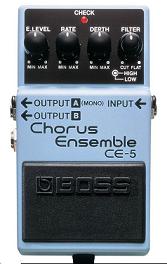
In addition to dynamics, I just loved how easy it was to dial in various settings. The knobs are very nicely NOT over-sensitive, so moving a knob doesn’t result in dramatic changes in the effect. The net result is that you can get into a general area on the sweep of a particular knob, and make a couple of slight changes to zero in. How many pedals have we played where just turning a knob ever-so-slightly drastically changed the effect? It’s probably why I’ve liked my Boss CE-5 chorus for so long, and even though I’m currently bidding on a CE-2 on EBay, if I don’t win the auction, all won’t be lost because the CE-5 has a nice, consistent sweep on its knobs.

How It Sounds

Like I mentioned, the Time Machine is simply transparent. The Modern mode is truly transparent – at least to my ears – while the Vintage mode darkens the tone ever so slightly and adds some subtle modulation (it’s chorus-like) like you’d expect with an analog delay. But unlike many analog delays that I’ve played, the darkening with the Time Machine does more of a lower-mids EQ emphasis, whereas I’ve felt that analog delays cut highs. The Aqua Puss certainly felt like it was cutting highs, though it definitely compensated for it with some overall great tone. Back to the Time Machine, the net result is that in vintage mode, the tone becomes slightly more rich and lush.

I liked both modes equally well, though I’d probably tend to use the Vintage mode when playing absolutely clean, as it also adds a tiny bit of hair to the signal. It’s almost imperceptible, but it’s there. I loved doing some simple chord comps up on the neck in Vintage mode.

Modern mode, on the other hand, is like the Swiss Army Knife of the Time Machine, making it capable of fitting into any style of playing, from syncopated rhythms ala The Edge, to heavy chunk where you want to have a bit of slap-back.

The Time Machine also has a toggle switch for Lo-Fi and Hi-Fi modes, in addition to the Modern and Vintage modes. Hi-Fi apparently maintains tonal transparency, whereas Lo-Fi includes High- and Lo-cut filters. The difference between the two fidelity modes was subtle at best. I didn’t detect much of a cut in either highs or lows when engaging Lo-Fi; the EQ changes ever so slightly, but the bandwidth didn’t change at all. Again, I feel like it’s more of an EQ emphasis rather than a removal of portions.

Overall Impressions

I’m glad I took so much time to find a new delay pedal. As you can tell from my review, I love the Time Machine. It fulfilled all my criteria for what I wanted in a delay pedal. To me, it has enough adjustable settings to keep any tweaker happy, but it’s also super-easy to quickly dial in the right amount of effect. But not only that, it just sounds damn good!

Read Full Post »

The HAO OD-16, that is…. 🙂

Godlyke Distribution, which represents several boutique pedal manufactures has just released the HAO OD-16 overdrive pedal. Oh yeah… yet another overdrive pedal. But who cares? As the dean of my college once told me, “There’s room in this world for people who are good,” and as far as guitar gear is concerned, there’s certainly room in this world for good gear, and the HAO OD-16 (pr. “how”), promises to be a pedal that will make gear freaks make room for this pedal on their boards.

Designed and built by HAO in Japan, the OD-16 is a very cool take on the traditional overdrive. It’s ostensibly a Tube Screamer type of overdrive, which might ellicit a “so what” kind of reaction. However, with it’s internal voltage doubling circuit that takes a standard 9V and boosts it internally to 16V (hence the numeric designation), what the engineers were after was more headroom, and much more drive. And baby, this thing delivers all sorts of drive! Check out this demo video:

I dig the fact that you can bypass the internal tone pot to get more “bite” out of the pedal, and of course, true bypass is always appreciated. 🙂 Don’t know about you, but that video is causing me some SERIOUS GAS!!! Oy-Vay!!! Great tones – even out of low-res audio from the vid! I think I need to install a lock on my back pocket.

For more information, check out the Godlyke web site!

Read Full Post »

Awhile back, I wrote a fairly quick review of this pedal. That was back in October of 2007. I bought it because I was tired of using modelers and software chorus in my recordings, and also wanted to use a chorus live, which I hadn’t done much of since I had sold my Line 6 Flextone III which has it built in.

At the time, I figured it couldn’t be a bad investment, especially since I paid something like $79 for it. So, after a couple of years, what’s the verdict? It’s a solid pedal, and there’s a reason I haven’t removed it from my board yet (I’m currently looking to get a vintage CE-2): I love the Roland chorus sound!

I suppose you use what you’re used to. For me, using chorus started with the old Roland JC-120. What a great amp, and the stereo chorus was to die for! It was thick and lush, yet ringy and vibrant. Since I didn’t have access to that amp all the time (it was my brother’s), I settled on the CE-2, which I kept into the mid-90’s when I traded it for a DigiTech multifunction pedal – big mistake. Oh well…

In any case, after awhile I needed to get a chorus pedal for my Fender Hot Rod Deluxe. I didn’t even think about it what pedal I’d get. I knew it had to be a Boss. My thought was: How different could it be compared to my trusty old CE-2 which, after all, was a pretty cheap pedal when I bought it, and besides that, Roland chorus was the standard for me. I’d heard some great chorus sounds, but to me, the Roland chorus was where it was at, so I went to my local music store and purchased a CE-5

Well, to make a long story short, once I played around with the pedal, I realized that while it had that Roland chorus tone, the digital version was almost too perfect, and not nearly as warm as I remembered the CE-2 being. It seemed a little sterile. But I kept at the tweaking and was finally able to dial in some very nice, rich tones that came close to what I remembered. After all this time, here’s what I’ve come to observe about the CE-5:

  • The CE-5 doesn’t do extreme settings very well. In fact, they can be downright ugly; especially if you crank up the rate and depth knobs. But as they say, do things in moderation, and with moderate settings, the CE-5 can produce wonderful tones! The best operating range I’ve found for Level, Rate and Depth are no less than 9am and no greater than 2:30. At the high-end, you can get some very cool leslie effects by upping the depth, reducing the rate and upping the level. In general though, I don’t tend to stray too far away from 10 to 2 on the sweep.
  • All the knobs interact well with each other – almost too well – as minute changes on one knob really effect the others, making you have to compensate to keep the tone under control.
  • The Hi/Lo cut combo knob is killer – something I wish the CE-2 had. What they do is subtle, but very useful.
  • Even for as simple as it is, you really have to play with the settings before you find the right tones. I’ve had a few years with this pedal now, so I know where to set the knobs for the effect I want. But it did take time.

Given all that, don’t take it as a negative. My feeling is that hard work is rewarded, if you’re willing to do it. I took the time, and now that I’ve got the tones dialed in, I really like the pedal, which is why I’m not in a real big rush to replace it.

Here’s a clip I recorded with different settings. There are three sets of recordings, starting with my dry signal, then activating the chorus. The chorus sounds go from moderate-heavy to moderate to light in the final chord progression. I used my Gibson Nighthawk 2009 into an Aracom VRX22 amp. Here’s the clip:

I recorded the guitar completely dry, with the mic (e609) about 1/2″ from the grille cloth.

Granted, the Roland chorus sound isn’t for everyone. There are so many great ones out there, but for me, I’ll stick to the familiar. Rock on!

Read Full Post »

I’ve known about Handwired-Effects for a few weeks now, but didn’t really talk about it too much because their site didn’t have much on it, and they only had a single pedal. But now that they’ve got a few, I felt it was time to talk about them. Handwired-Effects has pretty much come out of nowhere with their pedals. Their initial offering is pretty straight-forward: a chorus, an overdrive, and a limited run “preamp overdrive” custom made for Dario Lorina.

I know… New pedal companies are started all the time so what has piqued my interest in Handwire-Effects? It’s actually not their products but their location that made me raise my eyebrows. Most new pedals seem to come primarily out of the US and Japan. Handwired-Effects is based in Switzerland. In all my years of buying gear, I’ve never used a guitar product made in Switzerland. No, I’m not thinking that these pedals may be better because of the “Swiss watch” thing. 🙂 But it sure is interesting that it’s located there…

Unfortunately, they don’t have any clips of their products, save a poor-quality video of Dario Lorina playing the Dario Lorina custom box at NAMM. We’ll just have to wait and see…

Read Full Post »

You know… For the most part, I have few regrets about my life. Yeah, I’ve made my share of mistakes, and have learned from them, but there are some things that just seem to stick in my craw, especially when I reminisce about gear that I’ve had.

Back in the 80’s, I was a big Michael Hedges fan, and must’ve seen him play live more than 50 times. I remember the day I saw him and he had added chorus to his chain. Mind you, he was an acoustic guitarist, and before he became widely known, it had always been Michael and his guitar, straight into the PA. Then he added a rather sophisticated EQ. But what struck me the hardest was when he added a chorus. For as much of a fan that I was, I don’t know which one he had. But when he came out with “Breakfast In the Field” in 1981, and used the chorus to amazing effect on songs such as “The Magic Farmer” and “Rickover’s Dream” which, incidentally, I had already heard live before the album came out, I knew I had to get a chorus!

At the time, I didn’t know an amp from a refrigerator. I was your classic folk acoustic player who happened to know cowboy chords. Be that as it may, I saved some money and went down to Guitar Center where I bought a cheap in-hole pickup for my guitar (which I still have 30 years later – it’s a Yamaha FG-335), a Roland 25 amp, and a Boss CE-2.

Even through all that cheap equipment, there was something special about the CE-2. It had just two knobs: Rate and Depth, and you could dial up incredible chorus tones with it! I can recall the warmth of the tone, and the magical way notes danced in the air. Hey! I sucked at the time, but I remember the feeling I got. Perhaps part of it was due to the satisfaction that I could cop some similar tones to Michael Hedges (though I could never play like him). Who knows? But that was one special pedal. And I traded it back in the late 80’s for some DigiTech multi-function reverb/flange/chorus pedal that I thought was “neat.”

Okay, hindsight is 20/20. Who could’ve known at the time that a cheap $79 pedal could define the chorus tone. I don’t care what other people say about other choruses that have since come out. I recall someone “correcting” me in the early days of this blog about the TC Electronic chorus being more of a standard. I was pretty new to the blog scene and didn’t want to piss anyone off at the time, so I didn’t really come back with anything. But had I more balls at the time I would’ve said, there’s a reason why people are paying for the MIJ green and black label choruses for over twice the price of the original. There was something extremely special about that Roland JC-120 chorus circuit. Everyone else who followed with their own version just did a tweak. Mind you, there are some GREAT choruses out there. But in my mind, the CE-2 had the goods!

EBay here I come!!!

Read Full Post »

I dig the folks over at Catalinbread, and even though I haven’t gotten any of their gear – yet – I do like what they produce. Earlier this month, they released a second version of their WIIO overdrive pedal. Admittedly, I didn’t even know they had a first version, but it’s here.

From what I could gather about the WIIO, it’s supposed to be a Hiwatt in a box – very cool – and apparently, it is designed to be super-responsive to pick attack and volume knob levels; much like an amp. Here’s a demo video I found:

Sounds very nice indeed… 🙂


Read Full Post »

« Newer Posts - Older Posts »