Feeds:
Posts
Comments

Posts Tagged ‘guitar gear’


Like most people, I’m intrigued by controversy – especially when it has to do with our beloved instrument, the guitar…

Les Paul is generally credited with creating the first solid-body electric guitar he called “The Log,” though it was Leo Fender who made the solid-body electric guitar available to the masses through mass production with the “Fender Broadcaster.”

Interestingly enough, there’s a lot of controversy that surrounds just who actually invented the solid-body electric guitar, some documented, and a lot of it not. I’m going to stir the pot a bit here, and share something that I just heard this morning from a friend of mine.

Every morning before heading off to the office, I go to a local coffee house to go through e-mails and review my day’s calendar. By the time I finish that, a couple of friends usually join me and we shoot the breeze before we all head into our respective places of work. This morning, I brought along the guitar I spec’d out for Saint Guitar Company (don’t worry, I’ll have pictures and a full review in the next couple of days…) to show my friend Phil from Phil ‘N The Blanks, a local cover band here in the Sillycon Valley.

Phil and I were discussing the guitar, when our friend Kim sat down with us. She noted the beauty of the guitar, and said, “Hey! You wanna know a cool story?” And she then recounted a tale of how her grandfather, Kenneth Clark, had known Les Paul back in the day, and had shared with him his ideas behind building a solid-body electric guitar. Soon after, Kenneth contracted a disease that left him in quarantine for five years! Yikes! But during that time, Les apparently ran with the idea, and successfully created what is generally recognized as the first solid-body electric guitar.

Who knows whether or not this is true? None of this is documented, but it sure stirs the pot, doesn’t it? Of course, let’s not take anything away from the venerable LP. Without him, we wouldn’t have multi-track recording or reverb. Even Leo Fender is accused of stealing ideas for creating the Broadcaster, but he created an industry where none had existed. Is this an apologia? Not really. But it does go to show that the people who are attributed with inventing something usually are the ones who’ve gotten their invention to the public first.

Read Full Post »

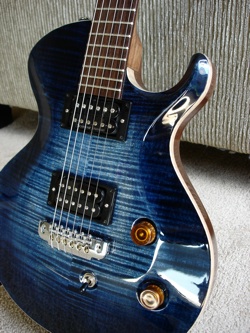
SAINT Guitar Company - Faded Blue Jean Benchmark Guitar

SAINT Guitar Company - Faded Blue Jean Benchmark Guitar

I’m honored. I’m awed. Completely dumbstruck. Adam Hernandez from Saint Guitar Company e-mailed me yesterday with the news that he finished the guitar that I spec’d out for him. It’s not my guitar, but most everything I specified is on there. I’ll have a full update on the guitar, replete with pictures in the next day or so, but I just couldn’t wait to talk about it!

In any case, look at the finish! It’s absolutely gorgeous. Real quick though, this is a solid walnut body with a flame maple top. It has a rosewood fretboard and a koa headstock. Like I said, I’ll have complete specs in the next day or so. I’d list them all out here, but I’ve only got a limited amount of time. For more info on Saint Guitar Company, visit the web site.

BTW, I’m working on a new look for the Saint Guitar Company site. I’d love your feedback!

Read Full Post »

Jacques Overtube Vintage Pro Overdrive Effects Pedal

Jacques Overtube Vintage Pro Overdrive

The Dawg likes to sniff around for new and interesting gear all the time. Unfortunately, I don’t always have time to write or test stuff out. But I do love it when I come across some potentially awesome gear, and I take the time to share it here. The Jacques Overtube Vintage Pro Overdrive most definitely fits the bill in that department. By the way, think “Jacques Cousteau” when pronouncing the name… 🙂

The Overtube is supposedly a faithful reproduction of the original TS-808 Tube Screamer circuit. Now you might be thinking, as did I, that that is nothing special. But what is special about this pedal is that little toggle labeled “CASC” between the Tone and Drive knobs. “CASC” stands for “cascade” and it’s meant to simulate running two TS-808 pedals simultaneously ala SRV!

Check out this video on Guitar Player TV. I’ll be damned if that pedal doesn’t do a Tube Screamer exceptionally well! And with the cascade on, this pedal sounds sweet as can be with lots of thick mid-range wail!

As many of my readers know, I’m a big fan of the mid-rangy kind of drive distortion, so I’m gonna be hard-pressed not to give this pedal a whirl.

It’s a steal at $139!!! Check it out!

Read Full Post »

Sorry, but sometimes I just have to vent. I know lots of dudes who call themselves guitar players who are just wankers in disguise. They’re wankers because they have some kickass and expensive gear, which they don’t hesitate to let you know how much they spent, but they couldn’t play it if their life depended on it! Sorry, but it kind of grates on my nerves because when I run across a wanker, I find myself thinking, “Damn! If I had that guitar, I could make that bad-boy SING!” Maybe I’m crossing the line here of being the supportive web site host, into a petulant and honory SOB, but even though I realize that I’m not the greatest guitar player in the world, at least I can play my friggin’ axes and make some decent sounding music!

To me, a great guitar or amp will just help inspire me to explore tonal landscapes I haven’t been to before; and help me express my music to an even greater degree. And a great piece of gear is like having an expensive screwdriver from Mac or Snap-on Tools. Functionally, it’s no different from the cheap one you can buy for a buck ninety-nine at the corner drugstore’s hardware department. But that good screwdriver makes work so much easier because so much care and consideration were put into making that tool work so much better for the job, with high-grade materials, and ergonomic design. But wankers really don’t know the difference. They just think that expensive must be better. But so many great players have proven you don’t need the expensive gear to create a good tone (think Eddie Van Halen, Willie Nelson, etc). With a wanker, it doesn’t matter what they play: They still sound bad!

I know, I’m being really harsh and probably incredibly arrogant, but I get sick and tired of wankers who insist on playing the “my dick is bigger than yours” game with their bankrolls. Show me you can play that thing, and maybe I’ll show you some respect. In the meantime, keep your mouth shut, and learn how to use your gear!

Read Full Post »

Ibanez Jemini Distortion Pedal

Ibanez Jemini Distortion Pedal

Does the guitar playing world need yet another distortion pedal? That’s almost like asking if your town needs another Starbucks. Hmmm… maybe that’s a bad analogy because while we could probably do without yet another coffee commodity, I for one don’t ever mind seeing another distortion pedal hit the market.

And just when I thought I’d heard all the variations of distortion around, and that not much else could be done, along comes Ibanez with yet another mind-blowing distortion box, designed by none other than one of my guitar heroes, Steve Vai. I gotta admit it: I’m really impressed with this latest offering from Ibanez – at least as much as I was impressed with the Vox Satchurator. Don’t get me wrong; it’s not because of Steve Vai, or because I’m a Vai wannabe. It’s because there’s something about a great distortion sound that evokes a visceral response inside of me. It’s hard to explain. So I’m more than pleasantly surprised about the Jemini because it produces a GREAT distortion sound; at least from what I could tell from this video starring Steve Vai and Steve Vai – you’ll get the joke once you watch it:

Leave it to Steve Vai to not only demonstrate his mastery over the guitar, but the eternal showman manages to make the video a joy to watch. I was laughing my ass off at his antics! He’s so likeable!

Okay… now for a reality check… I really would like to get this pedal, but at $199, it’s a bit out of my price range right now. But being two distortion pedals in one for that price, it’s a hundred bucks a pedal. That’s actually not bad at all. But I have to admit, I have my sights set on a Satchurator right now. I kind of go for the more mid-rangy type of distortion. But I’m not going to let that keep me from taking one out for a spin.

On a final note, what’s been really great as of late is that big-name gear manufacturers are finally producing what could be considered boutique-type pedals. Having played with the Satchurator, that thing is built like a tank, and it just kicks ass. The Jemini appears to follow suit of well-made, gig-worthy quality. That’s very pleasing to me, because I’m a big proponent of getting great sound without breaking the bank.

Read Full Post »

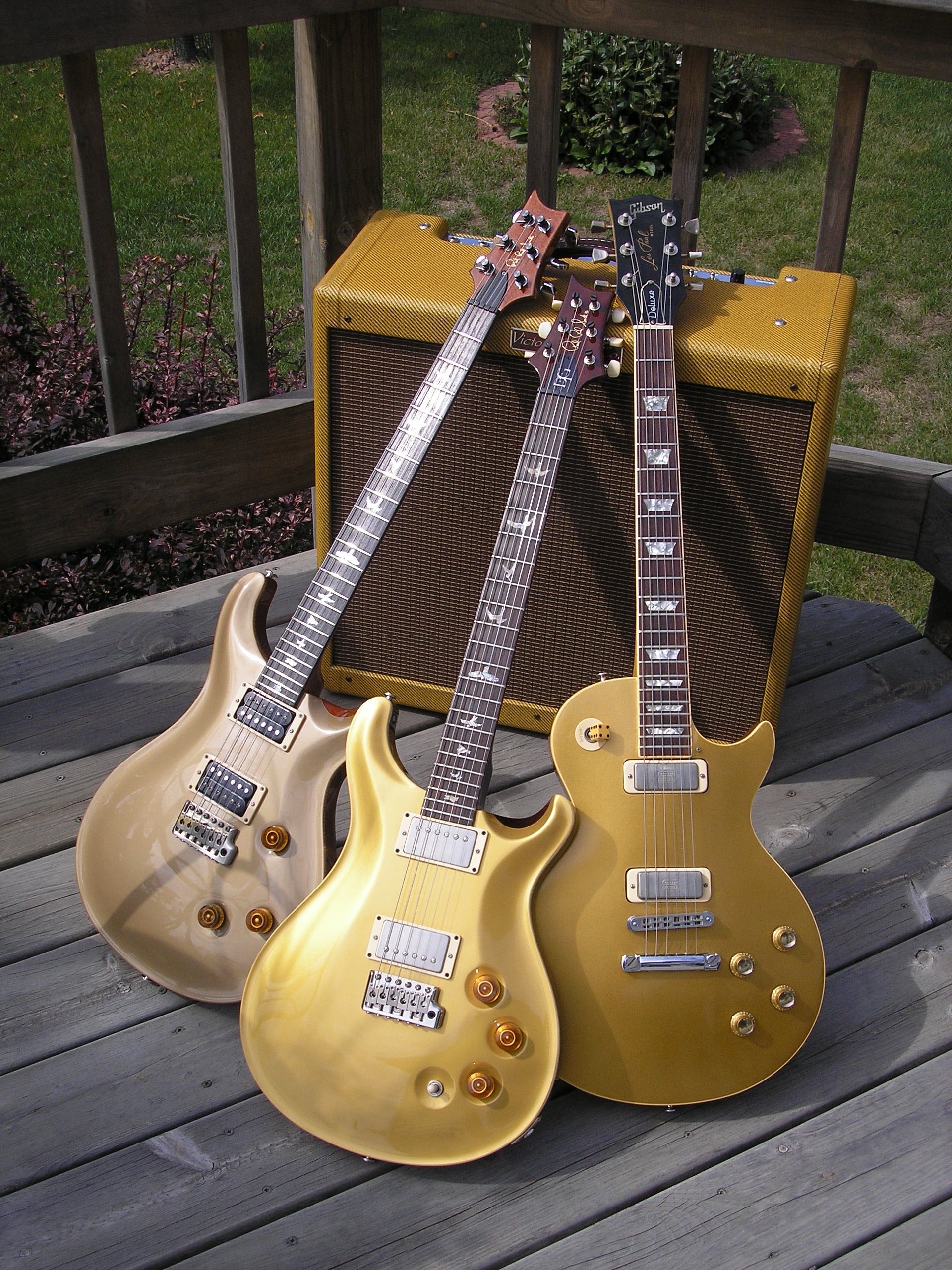
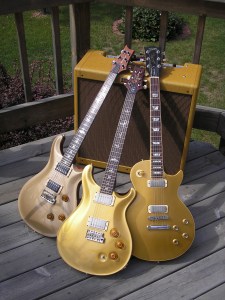
Tweed Demon's Goldtop DGT

Tweed Demon's Goldtop PRS

There’s nothing like someone sharing their personal experience with gear. This post comes courtesy of Paul Garvey, aka “Tweed Demon,” a Guitar Gear reader who shares our passion for gear. Read on!

BTW, the picture is of his personal gear – I love the Victoria amp!

——

I’ve always loved goldtops from the first time I was 12 years old and sneaked my way into a high school dance just to watch the band. I was transfixed on the guitarist who was wielding an early Les Paul Deluxe with soapbars… I thought that was about the coolest looking guitar I’ve ever seen. I saved my nickels and dimes bagging groceries until I had enough money to buy my own a few years later (that was in ’78). I bought my first PRS about a decade later after getting that same feeling watching that guitarist with Joe Ely’s band who everyone now knows- David Grissom. Then in ’92 my wife gave me a goldtop PRS Custom 24 for my wedding anniversary present (yup, she’s a keeper). Needless to say, I’ve always loved goldtops and I’ve always loved the versatility of PRS instruments as the name PRS has become synonymous with quality high-end production guitars. For a guy that plays a lot of covers, I always felt these guitars were a necessity for anyone who doesn’t want to carry a carload of axes to every gig. I’ve always been a believer that good tone comes from the hands….a great amp helps…and big strings equals big sound. Then in 2007 when I read that PRS was coming out with a David Grissom signature model I felt intrigued.

I’ve tried all the PRS models to date and frankly, I liked the McCarty’s, but I felt the pickups were a bit vintage sounding to my ears and lacked a bit of clarity. In addition, I like the spongy feel to string bending that a trem can give a guitarist – particularly one who uses heavier strings (I use 11s on all my guitars, 12s on my ES-175). So when I read the specs on the DGT, new neck carve, jumbo frets, more open sounding pickups, added a trem, twin volume controls, and it comes in a goldtop… I knew I had to have one.

When I picked up my DGT at my dealer, the first thing I noticed was the finish. This is a nitrocellulose lacquer finish over a poly seal coat. The finish on this guitar is truly amazing. I have a nitro re-issue Fender, and that finish is downright soft by comparison. The finish on the DGT is very thin and hard…very hard. Hard like glass. I tapped on the back of the neck with my knuckle and the wood rings like a bell. Acoustically, I would describe it in a word- “resonant”. The gold was much deeper and brighter than my other goldtop PRS which appeared almost beige or buff colored by comparison (see attached photo). The deep gold with the mahogany back and neck really look like those great Gibson’s from the mid to later ’50s. Very cool. One drawback is that the finish is very fragile and will pick up a few dings very easily. On the flip side, it will break-in nicely and you can “relic” it the old fashioned way…by playing it.

The bigger frets (6100s) are great. I’m used to using 11guage strings, but these frets make 11s seem like 10s from a bending perspective. The neck again is much more “vintage Gibson-like” than any other PRS I’ve played. I would compare it closer to the D-carve on my Custom 22 Soapbar only narrower. The feel was very comfortable, and it almost immediately felt like an old friend. If you’re not used to a nitro finish, you will notice a bit of stickiness to the feel, which will fade with time as the guitar breaks in. And if you’ve never smelled newer nitro, it gives off a scent all its own – which may take some getting used to in a small practice area. But that too, should get better with time.

The phase II locking tuners are top notch. I have the same tuners on my CU22 and love them. The only difference is the “Kluson-type” vintage look to the ivory buttons. In addition to the cool look and function, they seem to keep this guitar well balanced by reducing a bit of weight in the headstock area.

My first night out with the DGT I would have to give it the grade: Incomplete.

Half way through my first set I was really starting to open up with this instrument. Then I felt like I wasn’t playing in tune and it was driving me nuts. My intonation was really whacked. I picked up my CU22 Soapbar and finished the set. On break I noticed two of the screws holding my saddles in place loosened up, one fell out completely, and the hex nut holding my trem was 80% out of its threads. Wha the? I did manage to find the lost screw, but the DGT rode the bench the rest of the night. Anyway, to fix the problem, I added a dab of medium (blue) threadlock to the bridge screws and re-intonated the guitar. Problem solved. A word of advise – let all threads dry first if you use threadlock, it will take off the finish if the chemical comes in contact with any painted surface. I use this stuff on my motorcycle everytime I replace any screw. Maybe PRS should start using threadlock in its production process. If I only had one guitar with me, I would have been screwed…literally.

The second night out with the DGT was with much better results…Grade: A. The first thing you notice about this guitar is just how spot on David Grissom was with his pick-up design. I understand about a years worth of R & D went into them. The pick-ups quite frankly are the best sounding PAF-like pickups I’ve ever played. The picks are very balanced with incredible clarity. Comparing them to my CU24, I would say clearer, more pronouced lows and highs and very open sounding pleasing harmonics, with far better sustain, which surprises me do to the clear clean sounds. The split coil sounds are also very clear and open. I would say the split bridge pickup delves more into Telecaster territory rather than Strat. Very snappy. The split neck can give you some nice strat-like neck tones. However, if you’re looking for the strat out of phase “quack” sounds, they’re not here. You may better appreciate a Custom 24, Swamp Ash Special, CU22 Soapbar, or a 513. But, if you want the beautiful open sounds of a great PAF, with some tele spank, this is THE guitar.

Another interesting and well thought out feature of this guitar is the dual volume controls. The versatility with this feature is endless and I found myself immediately using it. One of my favorite positions in the single coil mode, dual pickups is to roll the neck pickup back to about 8.5 or 9 just to give the mellow center position a little more snap. Very cool.

Looking under the hood on the DGT you will notice that the volume pots each carry an extra capacitor used as a treble bleed. There had to be a lot of research and trial for the proper values used here. The volume controls ARE volume controls! No loss of tone. You can roll the volume back with incredible clarity. It made me realize what I was missing all these years. It was a real eureka-type moment. A great feature for old school surfing of that saturated zone with a great cranked low-wattage tube amp- just by manipulating that volume control. What fun.

I normally don’t feel compelled to write these kind of reviews for any new piece of gear. But, I feel this guitar is special. I used to think the Modern Eagle was PRS’s crowning achievement in production-level guitar. The DGT almost gave me an epiphany of sorts. I really believe the DGT is this generation’s 59 Les Paul Standard only incredibly more versatile. In fact I felt so strongly on how great this guitar was, that I e-mailed David Grissom himself and told him job “well done”. David e-mailed me back and said how much he appreciated my comments and that he likes to see his guitar in the hands of “players”. Somehow I know he’s going to get his wish – in big way.

(any guitar gear heads can email me with questions/comments at: pgarvey222 (at) yahoo dot com.)

—————

Okay… jealousy sets in… 🙂 Thanks to Paul for this wonderful, personal analysis!!!

Read Full Post »


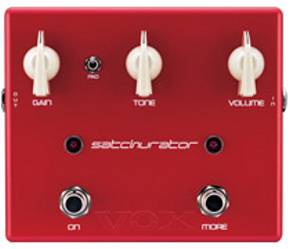
A few months back, I had heard some buzz about Joe Satriani teaming with Vox to come up with some new pedals, and just recently caught wind of the first pedal from this partnership called the “Satchurator.” When I first read about it, I was thinking to myself, “Now this is cool…” I’ve known about Satch being a pedal freak for awhile, so I figured that having his input into a new pedal would be worth a look; and based on my few hours of research, and listening to samples and watching videos (I’ll insert a couple below), this pedal is worth more than just a look. It looks like I’m gonna get it!

Okay, just what I need… yet another drive/distortion pedal. But there’s something very very cool about the sound that this pedal produces, and from my perspective, it has nothing to do with trying to sound like Satch (even though people say that this is Joe’s tone in a box). For instance, I’d rarely, if ever crank the gain full. My stuff is more on the bluesy side of things, and the distortion this pedal produces can be really thick at higher gain levels from what I’ve heard. Nah, this is a different brand of distortion altogether. It’s not as mid-rangy as a Tube Screamer, but it’s also a little thicker than an OCD – it’s kind of hard to describe.

Of course, I’ll have to do a test drive before I actually buy it, but it sure looks like a winner to me. Let’s look at the features (from Vox):

  • Analog distortion pedal designed under the complete supervision of Joe Satriani
    Controls for Gain, Tone and Volume
  • ‘More’ gain boost switch enables two footswitchable distortion sounds in one pedal. This gain boost is dramatic when gain knob is set low, and is a subtle solo boost when gain knob is set to maximum.
  • ‘Pad’ switch pads down input to allow for high gain pedals (such as modern wahs) placed before Satchurator. Up is pad ‘ON’. Down is pad ‘OFF’ for full Satchurator effect.
  • High gain, low noise design provides vintage to modern distortion sounds
  • Dynamic circuit is highly responsive to rolling off the guitar’s volume and preserves the guitar’s high end when the volume is rolled off. (NOTE: This means it cleans up nicely when you lower your guitar’s volume – SLICK)
  • Cream chicken-head knobs for precise positioning and high visibility on dark stages

Now get this: THIS BOX IS STREET PRICED AT $129.00!!! Holy Simolians, Batman! That’s incredibly affordable! I am totally blown away by the price of this pedal! I’d kind of come to expect paying a steep price for something from Vox (can you say “Virage?”), but this just blows me away. Anyway, here a couple of videos I found while surfing:

Guitar World Review

Vox Demo

And from Joe himself…

Read Full Post »

Peavey Windsor Studio

Peavey Windsor Studio

At-A-Glance: 15-20 Watt Class A tube amp, 12″ speaker, balanced XLR out with mic simulator.

Price: $399.00 (street)

Features:

  • Class A Power Amp can use various octal power tubes including EL34 (stock), 6L6GC, 6550, 6CA7, KT88, KT66, or any variation on these types
  • Two 12AX7/ECC83 Preamp tubes
  • 15-20W (rms) into 4, 8, or 16 Ohms with “Power Sponge” output power attenuator
  • No negative feedback in Power Amp
  • High & Low Gain Inputs
  • Preamp Volume
  • Low, Mid, and High EQ
  • Footswitchable Boost function
  • Footswitchable Effects Loop
  • Spring Reverb
  • Transformer balanced XLR Recording Output w/passive mic simulator
  • XLR Ground Lift switch
  • Dual Speaker Outputs
  • Impedance Selector
  • 1/4″ TRS footswitch jack for Boost and Loop defeat
  • 12″ Blue Marvel Speaker

I’ve never been much of a Peavey fan, but there’s something VERY cool about this little amp. For starters, I dig the fact that you can use different pentodes with it – and you can switch them with out re-biasing! Imagine getting that glassy sound with a 6L6GC (standard in Fender deluxes), then switching over to a KT88 for a more compressed overdrive sound. That feature alone makes it really attractive. But on top of that it also has a built-in attenuator!

This ain’t a giggin’ amp – least not for anything more than a small venue. As the name implies, it’s made for the studio, and with its included features, it’s clear that that is what it’s made for. For home recording stiffs like me, this amp seems like an ideal amp to have in my home studio. I used to be really dubious about low-power amps, but for low volume applications, you just can’t go wrong with a low power amp. Why? Simply because you can get low wattage amps into breakup at a much lower volume than with higher output amp. And with the right mic placement, in many cases you can’t tell just how little that low wattage amp really is. 🙂

But here’s the real kicker for me: It costs $399 retail. You can find it on EBay for even less! That alone is worth a look. Now I know that you might be thinking that this is just a cheap amp. Maybe it is, but based upon the demo below, I think this amp may deliver WAY more value than for what it’s selling. Check it out:

I’m going to have hit a Guitar Center or another local shop that carries one to try it out. If you’ve got or played one, I’d love to hear your insights!

Read Full Post »

…to sell off gear.

Yesterday, I sold “Rusty,” my Gibson ES-333. I hadn’t played Rusty much for the last several months, and even though I used him on a recording recently, I just didn’t feel that attached. It was a bit of a sad occasion, but I’m looking forward to replacing him with something else. Besides, testing new models from SAINT Guitars will be absolutely awesome!!!

Read Full Post »

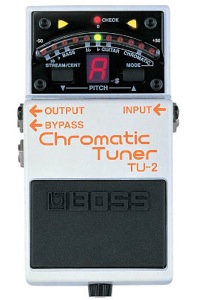
BOSS TU-2 Chromatic Tuner

BOSS TU-2 Chromatic Tuner

BOSS TU-2 Chromatic Tuner
Summary: Basic, no-frills chromatic tuner in a convenient stomp box that can also double as a power source.

Pros: Super-convenient stomp box makes on-stage tuning a breeze. Tuning mode automatically cuts off signal to the rest of your board for relatively “silent” tuning.

Cons: Only has 11 total LED’s, so fine adjustments aren’t possible.

Price: New $99 Street

Features (fr. BOSS site):

  • BOSS world-renowned TU-Series tuner accuracy in a convenient stompbox design
  • Mute/Bypass select for silent tuning with a single stomp
  • 11-point LED indicators and new “stream” meter display tuning discrepancy via speed and direction of LEDs (speed of LED movement gets slower as pitch becomes more accurate)
  • 7-segment LED displays string and note names, easily visible on dark stages
  • Seven easy tuning modes include Chromatic, Guitar Regular, Guitar Flat, Guitar Double Flat, Bass Regular, Bass Flat, Bass Double Flat
  • Tuning mode setting and display style choice stored in memory
  • Adjustable reference pitch from 438 to 445Hz
  • 8-octave tuning range–the widest in its class
  • Footswitchable Tuner Off mode preserves battery life by disabling LEDs

Let’s face it: Tuning is a fact of life when you play any musical instrument. And if you’re like most gigging musicians, you don’t have a guitar tech at your gigs to tune your guitars in between songs. For that, you need a tuner. For years, I used a cheap, hand-held analog tuner with a sweep meter for tuning. It was very accurate and did the job well, but as I started to gig more and more, having to turn the volume down on my amp to tune soon became irritating.

So I decided to get a stomp box tuner, and went down to Guitar Center and bought the TU-2. Now I will be the first to admit that I didn’t do much research before buying the TU-2. I’d recently read an interview with Joe Satriani and he had a TU-2. I figured if something’s good enough for Satch then it’s definitely good enough for me. It was a safe bet then, and it’s a safe bet now. The TU-2 is solid performer that’s fairly accurate, though no LED-based tuner could even possibly suss the accuracy of a strobe or analog tuner. But for what it does, I’m pretty satisfied with it.

Another nice feature about the TU-2 is that it can also act as a power source for up to either other pedals. I power up my board with a Dunlop DC Brick, but once I used up the 6 available 9V ports, I couldn’t add more
pedals without having to get another brick. For one or two pedals, that’s just not a good justification when you’re spending 100-bucks. The TU-2 comes with both a DC-in and a DC-out port. You can use a standard 9V cable to hook up another pedal, but it probably makes more sense to spend  the $12.99 and buy the BOSS PCS-20A power cord, which will route power up to eight pedals. Caveat: The cable runs between connectors are short. BOSS assumes you’ll be using nothing but BOSS pedals, but with tone freaks, that’s rarely the case. But it is a cheap, convenient solution nonetheless.

So what’s my verdict? I wouldn’t have it if I didn’t think it was useful. It’s not in any way, shape, or form something to do cartwheels over, but it’s a solid pedal that gets the job done. At Harmony Central, when you write a review, they ask you what you’d do if it the gear you’re reviewing gets broken or lost. Were I to review this pedal there and answer that question, I’d probably take a serious look at the Korg stomp box tuner that sports more LED’s and is a bit more accurate than the TU-2. The only thing that would probably keep me from switching is the ability of the TU-2 to provide power to other pedals.

Rock on!!!

Read Full Post »

« Newer Posts - Older Posts »