Feeds:
Posts
Comments

Posts Tagged ‘guitar pedals’

Awhile back, I mentioned that one of the next pedals I was going to get besides my Timmy was an envelope filter. I was really digging the Electro-Harmonix pedals, but then got contacted by Jeff at Source Audio who was saying that they were working on a new guitar envelope filter, following the bass envelope filter they recently released.

If you’re not familiar with Source Audio, they build the SoundBlox line of pedals. What makes these pedals different is that they can be manipulated on the fly with a motion sensor ring called the HotHand Motion Controller ring. I’ve always been intrigued by these pedals, but haven’t had the chance to try any out. Until now. I hopefully will be getting a couple of their pedals for review soon, and I have to tell you, I’m excited!

The envelope filter has a TON of cool sounds, so you can get all sorts of vowel tones out of it. With the motion controller ring, you can even get variable wah sounds! THIS IS COOL STUFF!

In any case, here’s the demo video they just released of the new guitar envelope filter:

Read Full Post »

You gotta dig the folks over at EHX. They take classic designs then put their own unique twist on them. I’ve been considering getting one of their envelope filter pedals forย  awhile, but then they recently released a harmonizer pedal called the Voice Box that is very intriguing. I myself have been using DigiTech’s Vocalist Live 4 for a few years, and it has served and continues to serve me well. But after a few years of gigging, things are starting to wear down, and some buttons are just plain broken.

As such, I’ve been looking at either getting a new VL4 or going with a completely different unit altogether. The TC Helicon VoiceLive Touch seems pretty cool, but this new entry by EHX warrants a deep investigation; especially as it is priced at under $220 street, where the VL4 and VoiceLive Touch run about $500.

Granted, the Voice Box doesn’t have many tweaking features, and it doesn’t have nearly the amount of presets as the VL4 or VoiceLive. However, from what I could gather from watching a couple of videos, the sound quality of the harmonies is great, and it includes a vocoder! Now THAT is cool!

For me as a solo gigging musician, a harmonizer has been an important part of my rig. And after years of use of my VL4, I have to admit that I only use four of the 100 presets of my VL4 – just four! So with the EHX’s nine presets, if I can get the harmonies that I use most often, then I may just have to get it. Besides, at around $220, it’s not going to run me broke. It also means that as a pedal, I can mount it on my pedal board, and not have a big unit that I have to run separately into my board. As I only use three effects on my board, there’ll be plenty of real estate to take this pedal!

Here’s a video:

Read Full Post »

I suppose I’m not the only one who has a bucket list, but I thought I’d share mine. And no, I’m not thinking about my life ending, but the other day I thought about things I’d like to do, see, or have before I die. So here goes (not in any particular order):

  • Build a huge wine cellar devoted to my favorite wine, Pinot Noir; focused specifically on California, Oregon, and Washington, categorized by region and appellation. Oh, I’d also stock it with French Burgundy as well. I suppose I should share that I also have a blog about Pinot Noir called The PinotPhiles.
  • Play a real ’59 Les Paul, if not outright own one. And it wouldn’t sit in a glass case. I’d play it.
  • Own an original Marshall JTM-45 and an original Plexi 50
  • Have all classic Les Paul Reissues: R7, R8, R9, and R0
  • I’d really like a Corvette Z06.
  • Speaking of automobiles, one of my dreams is to see the F1 Monte Carlo Grand Prix, and have a room that is on the Casino Turn, overlooking the race course.
  • Back to music, once the kids are grown up – or maybe earlier – I’d love to build a nice studio/sound stage in my back yard.

Well, that’s all I can think of for now… ๐Ÿ™‚

Read Full Post »

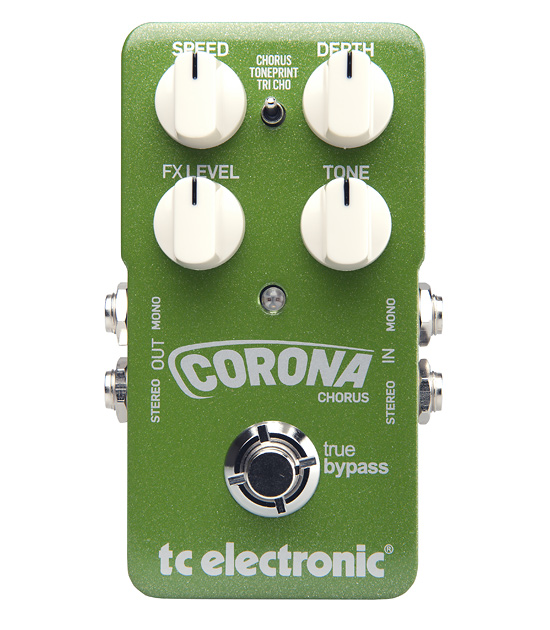
I took the Corona to my weekly solo acoustic gig last night to give it a gig test. From the moment I started playing it, I was in love with this pedal! I actually got to my gig a little early so I could play around with the settings and find a “standard” setting that I could use. My thought behind this was that the pedal would just stay on all the time, except for specific songs that I just want my raw guitar sound.

My standard setting was Speed at 11am, Depth between 12 and 1, FX Level at just past noon, and Tone right in the middle. This produced a super smooth, lush, liquid, and sensual tone that also added a three-dimensional quality. It was total ear candy!!! Not only that, I was using no other processing, doing straight into the restaurant’s board and relying on the high ceiling to get my reverb. The result was absolutely stupendous!

I used the “standard” setting for the songs I play fingerstyle, which is most of the time. For songs where I was strumming, I backed the depth to noon. It’s a very subtle change, but an important one, as any chorus can muddy up your tone when you’re doing fast strums. I do this with all my chorus pedals. But the interesting thing with the Corona is that when I wanted to do any kind of adjustment, I didn’t have to move the knobs nearly as much as I would with other pedals. With the Corona, all the controls are interlinked, so it only takes minute adjustments to affect the overall tone. This is totally cool!

I didn’t use the TonePrint or TriChorus modes at all last night. I just didn’t feel a need to use them. As I mentioned in my review of the pedal yesterday, if the Corona only had the standard chorus mode, I’d still buy it. It sounds that good! I could get super-subtle chorus tones to gorgeous, liquid tones ala Andy Summers with this mode. In fact, I played “Every Breath You Take” last night, and just loved the chorus sound that the Corona produced for that.

Finally, a question I asked myself last night was: With how much I love the Corona, will it possibly replace my beloved Boss CE-2? Probably not. Not because the CE-2 is a better chorus, but simply because it has a distinctive tone that no other chorus I’ve every played can cop. Besides, I also like the slight gain boost that the CE-2 gives me when engaged. For bluesy stuff, that gain boost actually comes in handy. But for general chorus duties, I’ve found my go-to chorus pedal. This thing absolutely RAWKS!!!

Read Full Post »

TC Electronic Corona Chorus

Summary: Part of TC Electronic’s new Compact line, this is just about the most tweakable chorus I’ve ever played. Standard chorus most offers a wide range of chorus tone from subtle, ringing tones to thick leslie-like warble. But with TonePrint and TriChorus, you’ve got even more chorus sounds at your fingertips.

Pros: For the chorus lover, the Corona is a tone tweaker’s wet dream! There’s so much you can dial in with this pedal, and guess what? It all sounds great! Great TC sound in a standard-size enclosure? No problem, mahn!

Cons: None. Granted, I haven’t played with it much, but I just can’t think of anything NOT to like at this point.

Features:

  • TonePrint – instant access to custom pedal-tweaks made by your idols!
  • 3 chorus types – expansive tonal options from glassy shimmer to mind-boggling swirls of sound
  • Speed, Depth, Color and Level controls – sculpt your chorus sounds from subtle to extreme
  • Stereo in & out – for added flexibility to your set-up
  • True Bypass – zero loss of tone
  • Analog-Dry-Through – maximum tonal integrity and clarity
  • ToneLock – protects your presets under all circumstances
  • Easy battery access – makes changing batteries fun! (well, almost)
  • Small footprint – save precious pedalboard space
  • High quality components – only the best will do when it comes to tone
  • Road-ready design – ready to follow you wherever your playing takes you

Price: $129 Street

Tone Bone Score: 5.0 ~TC Electronic is finally coming down from the stratosphere. In the past, price was a big barrier to entry, but with the Compact line of pedals, that’s no longer the case. You get great TC tone at an absolutely affordable price.

Selling Like Hotcakes

I called up my buddy Jordan over at Gelb Music in Redwood City today to see if he had any of the TC Electronic Compact Line in stock. He said he had one chorus and one delay left. He had three of each two days ago, and people are calling, so he has a bunch on order. I’ve been reading the buzz about these pedals for the past couple of days, and it seems that dealers sell them as soon as they get them; and for good reason: At least for the Corona, the pedals sound INCREDIBLE! As soon as Jordan told me he had a Corona (which is what I was originally interested in), I told him I’d be down in a few minutes and he said he’d pull the pedal. He knows me too well; if I like and bond with some gear, I’ll walk out the store with it.

Well, such was the case with the Corona. As soon as I got to the shop, Jordan handed the pedal to me. I took it and got set up to test it. I tested it through a 100 Watt Sebago Double Trouble with a Gretsch Electromatic at the shop and immediately fell in love. This is a keeper, and will be going on my board – today! Let’s get to the review, shall we?

Fit and Finish

Can you say, “built like a tank?” ๐Ÿ™‚ The enclosure is absolutely solid. The knobs feel totally sturdy, and the bypass switch (yes, it’s true bypass) feels solid. In other words, if the Corona is any indication of the rest of the line, these pedals will be gig-worthy.

How It Sounds

Sorry, no clips yet as I have yet to bring it home. ๐Ÿ™‚ But all I can say is that the chorus is simply silky-smooth. The “Analog-Dry-Through” (ADT) technique that they’re using really works. Basically, with ADT, the dry signal stays untouched in the pedal, and the effect is simply blended in. I really like this technique, as it ensures that your signal retains its integrity. So there’s no signal loss, and no gain boost like you get with other pedals that modify the dry signal directly. It also gives you a lot finer control over how much effectย  you want.

I tested all three modes: Chorus, TonePrint, and TriChorus. Here’s a synopsis of each:

Chorus Mode ~ If the Corona only had this mode, I still would’ve bought it. Based upon TC’s classic SCF circuit, this is a smooth, sexy chorus. There’s nothing bell-like with this mode, but it just adds some very beautiful character to your sound and it doesn’t sound at all processed. Based upon my initial test, this will most probably be the mode I use the most.

TonePrint Mode ~ This mode, of course, offers the ultimate in tweakability. Out of the box, the default TonePrint is an asymmetrical TriChorus that has some really cool swirls. But if you don’t like that, just hook the pedal up to your computer via the included USB cable and print a chorus sound you like. You can download TonePrints from the TC Electronic site, where they’ve had some major artists provide TonePrints. Want a Bumblefoot chorus sound? How ’bout one from Orianthi? Pretty cool stuff!

TriChorus ~ For me, used subtly in mono, this mode out of the box will give you very cool leslie-like tones. Apparently, it’s best used in stereo. While I liked it, it was the least of my favorites, but I can actually see where I can use it in one of my songs. It’ll work perfectly for that.

Overall Impression

As I entitled my previous article on the Corona chorus, I really thought I was done getting chorus pedals. But this is a must-have for me as I wanted to have another chorus pedal that could do sounds that me Boss CE-2 can’t do. The CE-2 is a really in-your-face type of chorus, while the Corona can be dialed back for a much more subtle chorus tone. I’ll be using this pedal – A LOT!!!

Read Full Post »

At Winter NAMM 2011, under the “Compact” line of pedals, TC Electronic released seven new pedals in a more standard footprint. I spoke about about the Corona Chorus in my previous article, and it is very promising. Now you might say, “So what? There were lots of pedals release at NAMM.” True, but from my standpoint, this is a major departure for TC Electronic; not in terms of engineering and quality, but of its movement into the mainstream.

Think about it: For years TC Electronic has been producing incredible effects that are always highly rated, and known for their high quality. The only problem for me, and while it might not seem like a big thing to others, but it is a big thing to me, was the form-factor of TC pedals. I have always had a problem with their size and shape.

People might say that it’s the tone that should matter and not the form-factor, and I would agree to a point. But from a practical perspective, because of their size and shape, I’d have to sacrifice too much real estate on my board to accommodate an original TC pedal. So though I’ve loved the pedals for their tones, I’ve always passed on them purely because of I’d have to change my board. That is definitely changed with TC Electronic’s new Compact Line.

The Compact Line in a Nutshell

As I mentioned above, the Compact line includes seven pedals. It’s great that TC came out with all of them at once as opposed to staging the releases. It definitely makes a bigger splash. One thing that I can say about the Compact line is that TC had versatility in mind with these pedals. All the modulation effects include TC’s new TonePrint feature, which lets you load settings by major artists into the pedal directly via a USB connection. How cool is that?

Anyway, here are video clips I found on YouTube that really demonstrate the pedals’ capabilities:

Flashback Delay

Corona Chorus

Vortex Flanger

Hall of Fame Reverb

Shaker Vibrato

Mojo Mojo Overdrive

Dark Matter Distortion

The pedals that really catch my ear are the Corona Chorus and the Vibrato, which is VERY cool. Unlike tremolo, vibrato is a pitch modulation, where tremolo is a volume modulation. That could really come in handy!

Read Full Post »

TC Electronic comes out with the Corona Chorus (announced at Winter NAMM 2011). From what I’ve been reading and watching about this chorus pedal, it’s a winner! Very tweakable, with three different modes including their classic SCF chorus, Tri-Chorus, and TonePrint, which allows you to download settings directly into the pedal via a USB connection to your computer.

I have never owned a TC Electronic device; though I’ve tested a few of the Nova line pedals, and they sound great, one thing that has turned me off in the past is the size of the pedals I tested. Now with TC Electronic’s new compact pedal line, all that tonal goodness TC Electronic is known for can be had in a more standard form factor!

I don’t have a lot of chorus pedals; in fact, I only have two (BOSS CE-2 and a Homebrew THC), and I love them both. I use the THC for acoustic guitar, and use the CE-2 for electric. But I was just thinking that I’d like to have a more tweakable chorus to accompany my CE-2, as it’s kind of on the bright side, and sometimes I want something much darker, plus the versatility of the Corona would be awesome to accompany the CE-2 on my board. And no, I wouldn’t remove the CE-2 because it has a very distinctive tone that I have not been able to duplicate with any other pedal – ever.

From the techie side of things, the Corona is true bypass, and as TC Electronic puts it, Analog-Dry-Through, which simply means that the dry signal through the pedal stays dry and the effect is blended in. Very nice. That would definitely make it easy to put in front of an amp.

In any case, as usual Andy at ProGuitarShop.com has created a demo video. It’s pretty sweet:

Read Full Post »

For years I was on an Overdrive kick. I still kind of am. I love dirt pedals despite the fact that I don’t use them nearly as much as I used to, and am patiently waiting for my Timmy to arrive. ๐Ÿ™‚ But ever since I went on my quest to get an original BOSS CE-2 chorus, I’ve kind of gotten on a chorus kick as well; not as bad as my overdrive kick, but every time I see a new chorus, I have to at least listen to it. And if I REALLYย  like it, I might just buy it. That’s how it was with my Homebrew THC. It just came along at the right place at the right time.

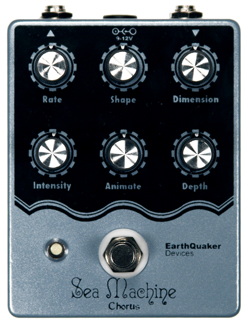
Truth be told though, while I’m not currently in the market for another chorus pedal, the Sea Machine Chorus from Earthquaker devices does give me pause. One thing that always turns me on with respect to gear is versatility, and the Sea Machine certainly cannot be blamed for lack of it. In addition to the tradition, Rate, Depth, and Intensity knobs, the Sea Machine also boasts three other knobs:

  • Animate – adjusts the width of the chorus pitch shift
  • Shape – adjusts the shape of the LFO
  • Dimension – which adds reverb/delay-like ambience to the tone.

This is impressive because from demos I’ve seen, this pedal is capable of producing TONS of different tones from your traditional chorus to leslie to vibe to all-out tweaked!

The pedal retails for $215 online. Here are some demos for your viewing/listening pleasure:

I totally dig Andy at ProGuitarShop.com’s demo as he demonstrates AND explains what the pedal can do, which is a lot. The Dimension feature is absolutely awesome!

If I had to do it over again, and I hadn’t purchased the Homebrew THC, I probably would’ve picked up the Sea Machine. Great chorus!

Read Full Post »

A few years ago, I was perusing a popular guitar-related forum when I came across a post about a particular pedal, and how people were waiting up to three years to get one. I remember at the time that I’d never do that, and I kept to my word; at least until I got on the list to get a Timmy Overdrive. That wait will only be about 6 months, and since I wasn’t in a rush, AND I didn’t have to give Paul Cochrane a down payment, it was a no-brainer putting my name on the list; especially after poring over reviews and sound clips and speaking with Paul directly. There’s other equipment out there that has a long waiting list as well. Analogman’s King of Tone is over a year long. The Faustine Phantom waiting list has been over a year for people who got on the earlier lists (though apparently Tim now has a new production partner and his production times are supposedly going down).

What prompted me to put out this question was that I was thinking about my Timmy on order. Then I thought: What was the impetus for getting on a waiting list? To be completely honest, I’m not sure. But probably a big reason was that I didn’t have to take any financial risk by giving Paul a down payment. Plus, the pedal’s only $129 shipped so it’s kind of hard to go wrong. I _might_ do the same with the King of Tone, but I’m really not sure I’d wait a year or more for a pedal. I guess for me, there has to be a good balance between wait time and financial risk.

Read Full Post »

For a long time I was – and pretty much still to this day – an overdrive pedal lover. I have several, and am waiting for my new Paul Cochrane Timmy to be completed and delivered in the next few weeks. I’ve been wanting one of these for awhile now, and finally bit the bullet and got on the waiting list. So excited! But using an attenuatorย  – specifically the Aracom PRX150-Pro – changed the way I use overdrive pedals.

In the “old days” before I used an attenuator, I used an overdrive pedal to get grind through a clean amp. Early on, I was using my Fender Hot Rod Deluxe that was all about loud, clean headroom, and I couldn’t get the volume above 2 or 3 before it would be just too damn loud; not to mention, the tubes weren’t working that much at all at that level. Yeah, I could crank the volume then set the Master to about 1/2 to get some dirt, but the pre-amp only distortion of that amp never really appealed to me. So I used overdrive pedals to get that soft-clipping on the front-end, and especially looked to pedals that provided a bit of color.

But once I got an attenuator, the entire game changed. I was able to crank my amps to get both the preamp and power amp sections saturated. For a long while, I actually stopped using overdrive pedals altogether because I was getting all the drive I wanted. I still sometimes just go to my gigs with only a tuner pedal and just plug directly into whatever amp I’m using, though I’m now starting to introduce overdrives to add gain stages to my chain.

But that brings me to the crux of this post… I used overdrives because I couldn’t get sufficient grind at reasonable volumes. But once I got a real transparent attenuator like the PRX150-Pro (I had an AirBrake and tested several), I could finally hear what my amps sounded like fully cranked. But here are some things I discovered once I was able to crank up my amps that I’d like to share:

  • I have 8 amps, and with the exception of two, once I cranked them up, I did not like their fully cranked up tone.
  • A common thing that I found among all the amps where I didn’t like their cranked up tone was a certain harshness or in some cases “fizz” that was not at all pleasing to me.
  • As opposed to getting rid of the amps, I swapped tubes and speakers until I was able to balance out their tone. For instance, with my Aracom PLX BB 18 combo, which is a replica of a Marshall 18 Watt Blues Breaker, the cranked tone was horrendously fizzy to me. So I replaced two preamp tubes with NOS Mullard and GE tubes, and to tame the natural brightness of the amp, replaced the stock Eminence Red Fang with a Fane Medusa 150 which really emphasizes the low-end. It’s now gorgeous, and I use that amp regularly!

The point to all the items that I shared was that once I was able to crank up my amps, most of them just didn’t sound all that good. Lots of folks who are new to attenuators complain about different artifacts being introduced by the attenuator, but based upon my experience, I think a lot of those “artifacts” have a lot to do with them never having cranked their amps all the way up. To me, it’s definitely a case of “you may not like what you hear…”

So if you ever do get a hold of an attenuator, and you crank your amp up, if you don’t like the tone, don’t immediately assume that it’s the attenuator. Especially with the latest generation of attenuators that are much more transparent than the traditional ones, the likelihood that they’re introducing artifacts is pretty low. Look to your amp first, and see what you can do to adjust it to deal with its cranked tone. Personally, I’d start with tubes first; especially replacing new production tubes with NOS pre-amps. I know, they’re getting more and more scarce, but I’ve gotten the best results in smoothing out my tone with NOS pre-amp tubes.

Read Full Post »

« Newer Posts - Older Posts »