
Feeds:
Posts
Comments

Posts Tagged ‘guitar’

Wow! Just got finished playing a little gig with me mates at the church for Saint Paddy’s Day. Lots of fun drinking Guinness, playing tunes, and watching my daughters do some jigs and reels (they’re Irish dancers via their Irish mama). ๐Ÿ™‚ So, I got to thinking, who were some influential Irish rockers through the decades. So I want to celebrate Irish Rockers on Saint Paddy’s Day! Here’s a quick list:

Van Morrison
Rory Gallagher
Thin Lizzy
The Boomtown Rats
Sinead O’Connor
Gary Moore
U2
The Pogues
The Cranberries
Ash
Snow Patrol

I love the derivation of The Pogues’ name which is short for the Irish “pogue mahone” which in Gaelic is: pรณg mo thรณin which means “kiss my arse.” ๐Ÿ™‚ From what I heard from an Irish friend, they had to shorten their name for the record company so as not offend the public. Too bad. It’s a great friggin’ name!

Anyway, let’s raise a pint to those great Irish Rockers!

Read Full Post »

If you’ve read this blog with any regularity, you’d know that I’ve lamented trading away my original BOSS CE-2 Chorus for a Multi-function DigiTech pedal. Hey! I didn’t know better at the time. The CE-2 was cheap when I got it new back in the early 80’s, and so I figured, what would be the harm in trading a cheap pedal for another cheap pedal, especially if the new cheap pedal was all-digital! Oh well, I’ve redeemed myself. I finally got a CE-2, and for a GREAT deal on EBay!

To me, THIS chorus sound is the chorus sound that defines the entire gamut of chorus pedals. Say what you want about the others. While they’re all good – and I’ve heard and played many – the CE-2 chorus is the sound I grew up with as a young guitarist. To me, nothing matches its warmth and the liquidity of its tones. This is pure analog Chorus goodness.

I did some really quick demos about fifteen minutes ago. All clips were played clean with my Squier CV Tele 50’s running into my pedal board and into my Aracom VRX22. Excuse the 60Hz hum from my Tele and the ambient background noise of my fridge. ๐Ÿ™‚ Each clip starts with a dry version then the CE-2 is engaged.

First up is a little clean blues groove. The chorus, when engaged is set to 3pm on both Rate and Depth to get a sort of vibey effect:

Next up is a simple chord progression done finger style. The CE-2 has both Rate and Depth set to noon:

Finally, the last clip demonstrates how well the CE-2 plays with other modulation effects. It first starts out with my VOX Time Machine and Hardwire RV-7 Reverb. When I play it over with the CE-2, the CE-2 is set to my favorite setting, with Rate at noon, and depth at 2pm (some things are just etched in your memory):

Of course I realize that appreciation of tone is an entirely subjective matter. But even after all these years, I just can’t get over how much I love this chorus sound and thick and liquid it can get, but still be crystal clear and articulate. My CE-5 did a great job for real subtle chorus, but cranked up, it was unusable. But with the CE-2, there are usable tones, no matter where you set it!

I have to admit that I am absolutely emotional right now. I’ve got all these memories flooding through my head from almost 30 years ago when I first bought it: Memories of watching a young Michael Hedges work his magic on his acoustic; trying to cop Andy Summer’s tone; late nights in my parents’ house plucking away at my guitar; lots of memories, both good and bad. Wow!

This pedal will NEVER leave my board again!

Read Full Post »

…your lead sheets, that is…

I’ve been writing music for a very long time, and I’ve used a variety of methods to get my songs written down, from notating on staff sheets to using full-blown music notation software. The notation software I’ve used extensively in the past is called “Mozart,” and it provides a full range of staff-based and even guitar tab notation features. I’ve used it for orchestral work and songwriting, and it has been a real life-saver. But as guitar is my primary instrument, Mozart is a little overkill, especially when all I want to do is put a lead sheet with chords together for my band. Furthermore, nothing can shake me out of my creativity when I have to focus on the minutiae of notes. So having a quick way of putting lead sheets together so I don’t lose my creative spark is critical.

Enter ChordPro

This is where a text-based notation system called “ChordPro” has been so instrumental for me in quickly assembling lead sheets. ChordPro is a very simple markup “language” similar to wiki markup, but far more limited. All it does is provide formatting directives to programs that can parse the ChordPro markup for easy output, either to print or PDF (depending upon your system setup). If you look at the ChordPro format, you can see that there just aren’t that many formatting commands. But that’s its power. Why be inundated with a bunch of features? That’s just more to learn, and the point is to get a lead sheet together quickly.

The most sophisticated feature of the ChordPro format is the ability to define chord shapes. Not all ChordPro parsers are created equal, but one thing they all do is optionally print chord shape grids, and if you use alternate or altered chords, having the ability to notate them is vital – especially if you’re sharing your songs. In my latest song, “The Breakup,” I needed to get a lead sheet together to send to people to look over. In that song, I used both alternate and altered chords, and needed a way to show them.

For instance, I have a B7b9 in the song. People who know altered chords could easily figure it out, but it’s so much easier to see a grid. In that case, I notated the following {define:B7b9 base-fret 1 frets x 2 1 2 1 0} to tell the parser to draw out the chord. The syntax is very simple:ย  define:<chord name> base-fret <fret of the lowest fretted note> frets S6 S5 S4… <position of fretted notes relative to the base fret. The base-fret is one (1), not zero. So for the B7b9, the base fret is the first fret, or 1, then I set the fret positions of each string relative to that position. Zero (0) denotes an open string, while x denotes a muted string.

Here’s the whole song notated in ChordPro format:

{t:The Breakup}
{st:Brendan Delumpa}
#Chord definitions
{define:B7b9 base-fret 1 frets x 2 1 2 1 0}
{define:F#7#9 base-fret 8 frets x 2 1 2 3 x}
{define:C#m7b5 base-fret 4 frets x 1 2 1 2 0}
{define:Em7 base-fret 7 frets 0 1 3 1 2 1}
{define:Cmaj7 base-fret 3 frets x 1 3 2 3 1}
{define:Am7 base-fret 5 frets x 1 1 1 1 1}
{c:VERSE 1}
[Em7]Why don't you say just what's 	[Bm7]on your mind
[Em7]instead of leaving clues for [Bm7]me to find
Been on the [Cmaj7]trail to your [Bm7]heart but I'm [Am7]lost from no [B7b9]direction
[Em7]you've been turnin' me a[B7b9]round[F#7#9]

{c:VERSE 2}
[Em7]The way to your heart used to [Bm7]be so clear
[Em7]Now I can't see past this fog of [Bm7]doubt and fear
I'd like to [Cmaj7]reach out to [Bm7]you but you've [Am7]left me in iso[B7b9]lation
[Em7]I don't know where to turn... 

{c:CHORUS}
{soc}
We've taken our [Cmaj7]hearts as [Bm7]far they will [Em]go
our summer of [Cmaj7]love has turned to [Bm7]rain and snow[Em]
no more [Cmaj7]rays of hope to guide us
there's [C#m7b5]nothing left to hide [B7b9]behind[B7] (let it ring)
{eoc}
{c:Chorus Endings}
1st: You take yours and I'll take mine...
2nd: We wasted all this time...

{c:VERSE 3}
[Em7]Expectation was our [Bm7]deadly sin
[Em7]It's a game that we could [Bm7]never win
"You can [Cmaj7]do what you [Bm7]want, just make [Am7]sure you do it [B7b9]my way."
[Em7]You know I'm always [B7b9]right...[F#7#9]

{c:VERSE 4}
[Em7]We see the world from our [Bm7]point of view
[Em7]Where nothing changes, nothing's [Bm7]ever new
We hold [Cmaj7]on to a [Bm7]vision and [Am7]never seek a [B7b9]better way
[Em7]and we never see the light...

{c:CHORUS}

{c:VERSE 3}
[Em7]Here's to the end, here's to [Bm7]being free
[Em7]No more blame for each other's [Bm7]misery.
I will be [Cmaj7]strong and sur[Bm7]vive and I [Am7]won't be shedding [B7b9]any tears[Em]
I will be [Cmaj7]strong and sur[Bm7]vive and I'll [Am7]fly from all these [B7b9]wasted years.[Em]

{c:Brendan Delumpa}
{c:(c)2010 Brendan Delumpa}

Pretty simple, right?ย  When I’m first constructing a lead sheet with chords, I normally insert the chords first into the lyrics, then do the chord definitions, then add the rest of the formatting. It keeps the process fairly simple.

Another advantage of having a standard notation method is that band members can quickly put together lead sheets to share with their bandmates. If everyone has a ChordPro parser, they can easily print out stuff someone else in the band has sent them. Now that’s really powerful!

Songsheet Generator by Ten By Ten Software

There are number of ChordPro parsers on the market right now, but the one I like to use is called “Songsheet Generator” by TenByTen Software that runs on both Mac and Windows. Click here to see the PDF of the output that Songsheet Generator produces. As I said, parsers are not all created equal, but Songsheet Generator has some good formatting options that make customizing your output a breeze; not to mention that it’s donation-ware, so you have the option of paying for it. It’s only $18.00, so I recommend supporting the creator. I sure am. It makes the printing and managing of songbooks so easy.

I realize that some people might be turned off by doing things so manually, but believe me, using ChordPro notation is MUCH faster than pointing and clicking.

Read Full Post »

No, I’m not talking about a resonator guitar. This is an effect. It essentially adds tons of sustain and feedback kind of like one of those Moog guitars, but in a pedal connected to a gooseneck stand that appears to have an optical scanning device attached to the end that “reads” your strings, then processes the vibrations. It’s interesting to say the least, and Uli Jon Roth apparently uses it.

That said, I like the idea of having something like this to get super-sustain and feedback, and totally get that you don’t have to spend an arm and a leg to get at least part of what the Moog guitar does, but it’s another piece of equipment to lug around. Don’t know how I feel about that.

Don’t know how practical it is, but I’ve seen worse things.

Check out the Vibesware site for more information!

Read Full Post »

…I gotta go with it! I just got home from playing a three hour solo acoustic gig. I’m physically tired from playing and singing, but I’m going to go out to my garage and play some more after I write this entry! I’m on a real high from getting a great evaluation back from my latest song, “The Breakup,” and my gig tonight was really magical because I had breakthrough with letting my emotions pour out while I was performing. I’ve been doing this gig now for almost 8 years, week in and week out (except for vacations), and even after all this time, all I want to do is sling my axe!

Call it an obsession, but I could think of a lot of worse things to be obsessed with…

I’ve been trying to develop an idea for a new song. It’s a softer one, but I don’t necessarily want it to turn into a ballad…. oh well… Like I said, I’ll just go with the flow for now and see where this latest burst of creativity takes me. I guess that’s the point of this entry, just going with it. Tonight at my gig, I was feeling really passionate about playing. Normally I restrain myself from letting it all hang out emotionally, but tonight I just said, “Screw it. I’m feeling this way, so I’m going for it. I’m going to put everything I’ve got into my performance.” What that produced was magic. Normally, diners at the restaurant don’t seem to be paying attention – I get pretty good tips so I know they’re hearing it – but tonight, they really listened, and I think they connected with what I was feeling because the room was unusually much quieter than it normally is when I stick to the background, and I observed people just watching me play. That was so over-the-top cool!

I learned a great lesson tonight, and that is if you play with sincerity and with all your heart, great things can happen!

Read Full Post »

Man, I love it when gear manufacturers build stuff for a cause! Wampler has just re-released their limited run Underdog Overdrive (only 100 were originally made) to help out a friend who has breast cancer, as she can’t pay her doctor bills and apparently can’t get any insurance. All the profits from this re-release are going to help this woman out. It’s great to see this type of generosity!

Here’s a transcript of the press release:


Wampler Pedals has recently re-released their popular “Underdog Overdrive” pedal. Only 100 of the pedals were built originally.

According to Brian Wampler, owner of Wampler Pedals, “A close friend of mine has breast cancer and has no insurance, no family, and the government will not pay any medical costs for her to get the treatment she needs. Now, I’m not rich by any means, but I had to do something to help her. My wife and I came up with the idea of creating a pink pedal that is rich, dynamic, and very tweakable, and donate ALL the profits to her. Out of that limited run, famed country artist Brad Paisley bought one and loved it. A number of guitarists saw the pedal on Brad’s pedalboard and asked me to build one more for them, so I decided to start building more to keep up with demand. We are still donating all the profits to my friend, Ivy East, who is struggling to pay the doctor bills to combat this terrible disease.”

And here’s a video demo of the pedal. Apparently this is one of Brad Paisley’s favorite overdrive pedals:

For more information, visit the Wampler Pedals site!

Read Full Post »

Got a little ambitious tonight and recorded some clips of the VOX Time Machine this evening. All clips were recorded with my trusty Aracom VRX22 amp.

The first is a short song featuring my CV Tele in the rhythm and my Gibson Nighthawk 2009 doing the lead. This was close-miked to a 1 X 12.

With the next four clips, I wanted to a chorus kind of vibe going by hooking up two 1 X 12’s to my Aracom PRX150-Pro’s speaker outs. I didn’t record in stereo. I just used my Sennheiser e609 placed about a foot away from both speakers that were about 75 degrees turned toward each other. Sorry for the background noise that’s the ambient noise in my garage – I had to turn up the input gain a lot to get a decent recording signal.

The first clip is just a simple chord progression done finger style. The pedal is set to about 11am level and 2pm feedback. I tapped in about a 72 bpm tempo.

The next clip has the both level and feedback at about 2pm with a 60 bpm tempo. This is sort of a “space echo” type of thing ala Steve Miller.

With this next clip I wanted sort of a heavy slap-back type of vibe doing a rhythm part on the 5th and 6th strings. At the end I play an Em chord very lightly to demonstrate how the pedal reacts to pick attack. The Time Machine is set to about noon on the level and 11 am on the feedback. I’ve got about a 90 bpm tempo.

Finally, I did another short song to demonstrate how the Time Machine works well to get a gorgeous, spacious tone for clean leads. Here I set the level at 10am and feedback at 2pm, and also engaged the vintage mode, which produces a bit thicker of a tone. The rhythm was just recorded with a reverb.

This is a fairly good representation of how the pedal sounds with a clean tone. Again, sorry for the background ambient noise. Maybe if I had a “proper” studio… ๐Ÿ™‚

Read Full Post »

Keith Richards
Late in the game, I’m tired as hell
Got a mortgage, three cars and a dog.
I ride a desk in the light
Then sling an axe at night
And I’ll rock through the dark to the dawn.

Laugh all you want, call names at my face
I refuse to come into your fold
But when it’s time to get down
you better stick around
coz I’ll prove that you’re NEVER TOO OLD!

Someone jokingly/seriously asked me, “Don’t you think you’re a little old to be doing that?” when I mentioned that I’m trying to start a band. Luckily I didn’t know this person too well, otherwise I probably would have seriously ripped on them. I just calmly replied, “No,” and smiled. That pretty much ended the conversation (though I had some VERY choice words that I held back out of politeness).

I guess the point to all this is that at least to me, being too old to do something is really a state of mind. My thought is if you have the desire and the skills. Why the f$%k not go for it?

Look at Keith Richards! That dude still rocks after all these years…. and transfusions and drug abuse and alcohol abuse… He’s still standing, he can still play. So he does. I’m not too big of a fan of his lifestyle, but I am a fan of his never-ending desire to play. To me, that’s what rockin’s all about.

Don’t ever let anyone tell you you’re too old to rock. You’re NEVER too old to rock and roll!

Read Full Post »

As many might know, one of the first places I test out new gear is at my weekly church gig. Church services are especially great for testing gear that you normally use clean or with just a little grit, and it proved to be a great venue for testing out the Time Machine.

All I can say about the Time Machine is, “Wow!” It really was made for being run in front of an amp! I know that some people don’t like it because it can’t be used in an effects loop, but in front of an amp, it works great! Don’t know how VOX did it, but it doesn’t seem vary the output gain – at least as far as I could tell – so it didn’t give me pulsing grind when I set my amp at just the edge of breakup. That really blew me away because I was concerned about that happening as I always set my amp on the edge of breakup, so increases in gain, whether due to volume knob or attack will give me some light dirt. Amazingly enough, the Time Machine didn’t push my amp over the edge at all.

That gave me tons of confidence to really experiment with the pedal. As with most church services with contemporary christian music, the flavors of songs change throughout the service. This provides ample opportunity to test gear. Whether used in smooth ballads or rockin’ with some slapback, the Time Machine delivered on all fronts. I was particularly impressed with using the Time Machine on slow songs where I could dial in a real long delay (it can get a delay time of up to 5800 seconds). Setting the feedback to about noon and the level to around 11am, I was able to get this great ambient, ethereal tone with an approximate metronome setting around 58-62 bpm by using the tap tempo toggle.

I dig the tap tempo on the Time Machine. It’s always on, so making midstream tempo adjustments is simply a breeze. In one of our songs this evening, the group sped up for some reason, and it really threw off my delay tone. But a quick tempo adjustment – while I was still playing, mind you – got my delay back in sync. That was so incredible!

As I mentioned in my review of the Time Machine, I’ve been waiting for a couple of years to get a new delay after I gave my old DD-5 away. I’m glad I took the time to wait. The Time Machine is the bomb!

Read Full Post »

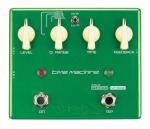
Click on the picture to see an enlarged view.

VOX Time Machine Delay Pedal


Summary: If you’re looking for a super-quiet, dynamic and versatile delay that will cover a lot of territory, look no further. The Time Machine rocks!

Pros: Absolutely quiet, with no line noise at all. It is so easy to dial in great delay sounds with the Time Machine, it’s almost scary. I like the fact that it has more features than a basic delay pedal, but not so many that you spend all your time tweaking. Oh yeah… It sounds absolutely fantastic!

Cons:None.

Features:

  • Controls:ย  Level, Delay Range, Time, Feedback, ON SW, Tap & Modern/Vintage SW, Hi-Fi/Lo-Fi SW
  • In/Outputs: 1 xย  INPUT, 1 x OUTPUT, 1 x DRY OUT, 1 x DC9V
  • Max Delay Time: 5800 milliseconds via Tap-Tempo, 1000 milliseconds via Delay control
  • Input Impedance: 1M-ohms
  • Output Impedance : 1k-ohms
  • Power Supply:ย  9V alkaline battery(6LF22/6LR61) or AC adapter(sold separately)
  • Current Consumption: 60mA
  • Dimensions: 143(W) x 121(D) x 58(H) mm / 5.63โ€(W) x 4.76โ€(D) x 2.28โ€(H)
  • Weight: 600g /1.32 lbs (without batteries)
  • Included Items: 9V alkaline battery (included)
  • Options: 9V AC adapter (not included)

Price: $199 street

Tone Bone Score: 5.0 ~ This pedal has ended my search for a delay. It really is as good as it’s advertised.

I tend to be a little wary of “signature” pedals because I’m really not one who wants to sound like someone else; besides, I’m not nearly as capable on the guitar as said artists. But now and then, I come across signature gear that forces me to take a good, long look: Not just because of the name behind it, but simply because it’s just a great piece of gear! Such was the case with the VOX Time Machine. When it first came to market, I have to admit that I was excited because I know that Joe Satriani is a real tone freak, and I figured that any kind of gear in which he has design input is bound to be pretty good. But the flip side of that is that I’ve had experience with other signature pedals that were really geared towards the artist and their playing style specifically, and frankly, that stuff has left me frowning. Not so with the Time Machine, which took me completely by surprise!

I’ve been in the market for a delay for almost a couple of years, when I gave away my crappy Boss DD-5 that had such perfect and precise delay that it just felt processed. It was nothing like my former DD-3 that actually sounded pretty good, but I lost that pedal after playing in an orchestra for a musical theatre gig (I didn’t have a board at the time, and only carried a couple of pedals). Needless to say, during that time, I’ve evaluated several delays, but none have really caught my fancy. They were either too dark sounding, as in the case of most analog delays, or they sucked tone, as in the case of many digital delays I’ve tried. My surprise with the Time Machine is that in either mode, modern or vintage, my basic tone was retained! But I’m getting a bit ahead of myself.

In my search, I came up with some criteria that had to be fufilled 100% before I’d even consider buying one. Here they are:

  • First, I wanted Tap Tempo. I’ve always hated having to bend over to tweak knobs; but moreover, I wanted to be able to match tempos with my drummer on the fly.
  • Secondly – and I know this is purely subjective – I wanted a good balance between tweakable settings and ease-of use. In other words, I wanted to have the flexibility to dial in a number of delay settings but not have so many that I’d be spending all my time tweaking knobs.
  • Thirdly, I didn’t want to ever have to refer to a reference manual to make sure I was using the pedal correctly. The “don’t make me think” rule had to apply. I should be able to dial in great tones in a matter of a few minutes, if not earlier.
  • Finally, and most importantly, the pedal could not suck tone, and had to be reasonably transparent. In most cases, I don’t mind a pedal putting an emphasis on a particular EQ range (like my Kasha overdrive does), but it should never remove a range or “feel” like it narrows the bandwidth of the signal.

There are lots of delay pedals I’ve evaluated that were particularly good in most areas, but none until I played the Time Machine ever fulfilled all four criteria. That’s how great this pedal is!

It’s Mean When It’s Green

I love the shiny, green apple finish of the Time Machine. Of course, the paint job doesn’t make the pedal. But the Time Machine is built like a tank, and is certainly gig-worthy. I imagine that JS had that in mind when providing his design input. The chicken head knobs give the pedal a cool vintage vibe, but not only that make it very easy to see where you’re at with your settings. The stomp switches are nice and smooth, and the pedal engages without producing any noise.

How I Did My Evaluation

I didn’t just test the Time Machine in isolation. I’ve learned that one of the best ways to evaluate pedals is to do A/B tests against other pedals of like kind to make a comparison. So I compared the Time Machine against a Way Huge Aqua Puss and a TC Electronic Nova Repeater at my favorite shop, Gelb Music in Redwood City, CA. My thought was to compare it against an analog and another digital delay. Sorry, but no clips because I was in a shop.

All my tests in the shop were done with a Fender Custom Shop Tele, plugged into the pedals (hooked together so I could quickly make a comparison without swapping), and into an absolutely superb-sounding and -looking Dr. Z Maz 38 with draped in blonde tolex. Mm mm good. ๐Ÿ™‚ I chose a midrange wattage amp because I wasn’t interested in creating grind. I’ve never been one to use delay with overdrive – maybe a little. But in this case, I wanted to have an ample amount of clean headroom to work with, and the Maz 38 worked perfectly for that (for the record I REALLY want a Dr. Z Remedy).

Aqua Puss and Nova Repeater

I will most likely have reviews on the Way Huge Aqua Puss and TC Electronic Nova Repeater in the near future, but I’ll give you a quick run-down of the pedals. If you’re looking for a dark, swampy, blues delay. The Aqua Puss delivers that in spades. It has this certain ethereal quality that made me think of drifting on a boat in the middle of the Everglades. I actually really liked the pedal, but I was after something else entirely with my delay search – much more versatility – and the Aqua Puss was a one-trick pony. It does what it does exceptionally well, but don’t ask for much in terms of usability in a variety of styles.

I was very sadly disappointed with the Nova Repeater. It packs a TON of features in its box, but for me, I was a little concerned that were just too many features. But despite that, it was easy to get a usable delay tone almost right away. The folks at TC Group certainly know how to pack in features, but they make them readily accessible, and very easy to understand. I actually had my heart set on getting this pedal after reading many reviews and listening to clips and watching video; and I almost purchased it a couple weeks ago. But I’m glad I compared it head-to-head with the Time Machine.

The Time Machine may not have all the features as the Nova Repeater, but out of the box, it wins hands-down in the tone department. The Nova Repeater sounded bland and dry – processed – when played in an A/B test between it and the Time Machine. And I detected a distinct loss in both highs and lows; in other words, bandwidth narrowing. That was not at all pleasing. That said though, the Repeater is still a great pedal, and apparently there’s an internal pot to calibrate the tone to your rig, so that’s a plus. But frankly, I’m not one to tweak that deeply. I probably would’ve still bought it if I didn’t do the A/B test. The tone is usable and really not as bad as I may have painted it, but it’s not as good as the Time Machine’s tone in my opinion.

Playability

If it’s any area where the Time Machine simply shined above the other pedals was how absolutely responsive it was to picking dynamics. Play lightly, and the delay is super-subtle; you almost feel as if it’s not there. Dig in a bit, and the pedal responds. I did a few lead lines to experiment with this, and was totally blown away. I set the Level control so I’d really have to dig in to get the delay effect, but for most runs, picked or legato, what I got was a more ambient effect – almost like reverb. Wow! That kind of pick response is probably what sold me the most.

In addition to dynamics, I just loved how easy it was to dial in various settings. The knobs are very nicely NOT over-sensitive, so moving a knob doesn’t result in dramatic changes in the effect. The net result is that you can get into a general area on the sweep of a particular knob, and make a couple of slight changes to zero in. How many pedals have we played where just turning a knob ever-so-slightly drastically changed the effect? It’s probably why I’ve liked my Boss CE-5 chorus for so long, and even though I’m currently bidding on a CE-2 on EBay, if I don’t win the auction, all won’t be lost because the CE-5 has a nice, consistent sweep on its knobs.

How It Sounds

Like I mentioned, the Time Machine is simply transparent. The Modern mode is truly transparent – at least to my ears – while the Vintage mode darkens the tone ever so slightly and adds some subtle modulation (it’s chorus-like) like you’d expect with an analog delay. But unlike many analog delays that I’ve played, the darkening with the Time Machine does more of a lower-mids EQ emphasis, whereas I’ve felt that analog delays cut highs. The Aqua Puss certainly felt like it was cutting highs, though it definitely compensated for it with some overall great tone. Back to the Time Machine, the net result is that in vintage mode, the tone becomes slightly more rich and lush.

I liked both modes equally well, though I’d probably tend to use the Vintage mode when playing absolutely clean, as it also adds a tiny bit of hair to the signal. It’s almost imperceptible, but it’s there. I loved doing some simple chord comps up on the neck in Vintage mode.

Modern mode, on the other hand, is like the Swiss Army Knife of the Time Machine, making it capable of fitting into any style of playing, from syncopated rhythms ala The Edge, to heavy chunk where you want to have a bit of slap-back.

The Time Machine also has a toggle switch for Lo-Fi and Hi-Fi modes, in addition to the Modern and Vintage modes. Hi-Fi apparently maintains tonal transparency, whereas Lo-Fi includes High- and Lo-cut filters. The difference between the two fidelity modes was subtle at best. I didn’t detect much of a cut in either highs or lows when engaging Lo-Fi; the EQ changes ever so slightly, but the bandwidth didn’t change at all. Again, I feel like it’s more of an EQ emphasis rather than a removal of portions.

Overall Impressions

I’m glad I took so much time to find a new delay pedal. As you can tell from my review, I love the Time Machine. It fulfilled all my criteria for what I wanted in a delay pedal. To me, it has enough adjustable settings to keep any tweaker happy, but it’s also super-easy to quickly dial in the right amount of effect. But not only that, it just sounds damn good!

Read Full Post »
« Newer Posts - Older Posts »