Feeds:
Posts
Comments

Posts Tagged ‘guitarists’

Ibanez Jemini Distortion Pedal

Ibanez Jemini Distortion Pedal

Does the guitar playing world need yet another distortion pedal? That’s almost like asking if your town needs another Starbucks. Hmmm… maybe that’s a bad analogy because while we could probably do without yet another coffee commodity, I for one don’t ever mind seeing another distortion pedal hit the market.

And just when I thought I’d heard all the variations of distortion around, and that not much else could be done, along comes Ibanez with yet another mind-blowing distortion box, designed by none other than one of my guitar heroes, Steve Vai. I gotta admit it: I’m really impressed with this latest offering from Ibanez – at least as much as I was impressed with the Vox Satchurator. Don’t get me wrong; it’s not because of Steve Vai, or because I’m a Vai wannabe. It’s because there’s something about a great distortion sound that evokes a visceral response inside of me. It’s hard to explain. So I’m more than pleasantly surprised about the Jemini because it produces a GREAT distortion sound; at least from what I could tell from this video starring Steve Vai and Steve Vai – you’ll get the joke once you watch it:

Leave it to Steve Vai to not only demonstrate his mastery over the guitar, but the eternal showman manages to make the video a joy to watch. I was laughing my ass off at his antics! He’s so likeable!

Okay… now for a reality check… I really would like to get this pedal, but at $199, it’s a bit out of my price range right now. But being two distortion pedals in one for that price, it’s a hundred bucks a pedal. That’s actually not bad at all. But I have to admit, I have my sights set on a Satchurator right now. I kind of go for the more mid-rangy type of distortion. But I’m not going to let that keep me from taking one out for a spin.

On a final note, what’s been really great as of late is that big-name gear manufacturers are finally producing what could be considered boutique-type pedals. Having played with the Satchurator, that thing is built like a tank, and it just kicks ass. The Jemini appears to follow suit of well-made, gig-worthy quality. That’s very pleasing to me, because I’m a big proponent of getting great sound without breaking the bank.

Read Full Post »

I don’t plug other web sites often, mainly because there are so many out there, it’s difficult to keep up. But a new site, called TonePedia is so interesting in its concept, I just had to share it! The basis of the site is for members to share the tone of their rigs through sound bites they share with the community. Want to know what an LP sounds like through a Crate amp? It’s there on the site.

What a cool idea! Check it out! I’m going to post a few samples myself! Er… Once I find some time… 🙂

Read Full Post »

The mags and rags of the guitar playing world seem to have forgotten about the absolutely amazing virtuosity of Greg Howe who, in my maybe not so humble opinion ranks among the best guitarists in the world, hands down. He’s as fast as Yngwie or Paul Gilbert, but in my opinion covers a lot broader musical territory. But the guy’s not only a speed demon, his solos are incredibly expressive, employing a lot of phrases that you’d expect to hear in jazz.

I’ve been amazed by Greg Howe’s mastery over the guitar for years, and I actually feel bad that I hadn’t acknowledged him here. Maybe it’s because he’s considered to be more of a fusion artist more than a rock and roll dude… Who knows? Actually, who cares? Greg Howe KICKS ASS!

Here’s a video that displays just some of that musicality and other-worldly technique. Please view it to the end. When he starts out, you’ll think it’s nothing special… Wait until he hits his stride! Aiyeeeeeee!

Click here to see more on YouTube!

Read Full Post »

I was reading several interesting threads about technique and improv the other day. I have to admit that I was quietly embarassed by the fact that I don’t have a large library of techniques that I can tap into while I read the posts and articles. There are so many things to learn with respect to technique out there that it’s daunting!

But after reading those articles, I realized that a lot of the technique I have developed – especially over the past couple of years – has come from stumbling upon how to play a certain phrase through experimentation. I’ll be the first to admit that I’m not a disciplined improv dude that can instantly tap into a library of patterns and apply them. I’ve never taken guitar to that intellectual level. My approach to soloing tends to be fairly experimental; primarily because I don’t have a lot of techniques on which to fall back. But that doesn’t mean the process of experimentation isn’t cool in an of itself.

In fact, that process, at least for me, has been absolutely rewarding, and after I’m done with an “experimentation” session and play back the different takes, I often say to myself, “Did I actually play that?” It’s mildly amusing, but it’s also a bit scary because I’ll eventually have to play that or at least something similar to that when I play the song live. But that gets me to practice the technique until I have it down.

For instance, early on when I started my experimentation, I stumbled upon the minor pentatonic scale just by playing what fit. At the time, I didn’t know that it was the minor pentatonic scale. I just know that what I played fit with the song. I’ve since learned the other patterns of the minor pentatonic, and it’s something I tap into regularly. In another instance a few years ago, I was playing a solo, and one of the other musicians in my band asked, “Hey man, did you just do that in Mixolydian mode?” I replied, “Mixo-what? I don’t know, I just thought that it would be cool to start the lead a fifth above the root and play within that relative area.” Mind you, I still don’t know all the modes by heart – I think I stick to Dorian and Mixolydian a lot, or often start playing a minor pentatonic in the relative minor of the root chord (if it’s a major chord).

The point is that I don’t go out to specifically learn and practice a technique or mode or scale. Admittedly, that has probably slowed my technical advancement to a large degree, and I’ll have to admit that for the more organized and discplined among us, that approach is probably unacceptable, but it works for me, and I’ve learned a lot of things that I was later able to identify as formal techniques.

I know that there thousands of guitar players who are a whole lot better than me, but here’s a glimpse into my experimentation process:

  • GarageBand or some other package where you can easily set up loops and record rhythm parts is kind of essential. Having this is akin to having a basic chemistry set to mix chemicals.
  • Once you come up with a loop, play it continuously and jam to it to see what falls out of your experimentation. Never mind trying to be intellectual – just let it flow.

I’ve literally spent hours at a time practicing using this method, and a lot of these progressions have turned into songs.

To get you started, here’s a Jam Track that you can use. It’s a simple, 3 minute track in the key of A. I laid it down because I wanted to practice chord soloing… er… actually to see if I could do it. 🙂 In any case, have a go!

Read Full Post »

Just got my latest issue of Guitar Player, and as usual, went to the gear section first to see if there were any new and interesting pieces of gear. Normally, the stuff there is pretty tame, but I got really intrigued by a short product review on the Harmonic Capo. Unlike a normal capo that you place on a particular fret to play open chords at a particular fret position, the harmonic capo is placed at a harmonic fret: 12th, 7th, or 5th, and it will play the harmonic there. But the really cool thing about this is that unlike a normal capo, where you can only play the frets above the capo’d position, with the harmonic capo, you can play at frets above AND below the fretted position of the capo. It’s a very interesting concept that can yield some very interesting tonal possibilities. Check out this video by the inventor:

Read Full Post »

If you’re a member of Facebook, I’ve just created a new group called “The Guitar Life” to share experiences of living the guitar life. This is a totally open group, and I like to invite everyone to join and share!

Click here to join!!!

Read Full Post »

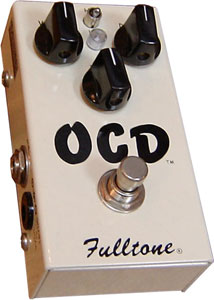
Fulltone OCD Drive Pedal
There have only been a few times in all the years that I’ve been playing guitar that I’ve had an epiphany with a pedal, where after just playing a few notes, a light bulb would go off in my head, and I’d exclaim, “That’s the sound I’m after!” The Fulltone OCD did that to me this afternoon. I just love when that happens! Here are some of the features of this little beast:

  • First off, it has a true bypass switch, so when it’s off, it’s off, and you don’t have to remove the battery if you’ve got it plugged into a 9 volt power source.
  • Volume knob – speaks for itself. But here’s a real treat: The volume knob can give you up to 30dB of boost!!! Need a clean booster? Here it is, plus you can get that sexy, smooth distortion out of it as well. Special note for my friend IG over at igblog: Here’s your clean booster, and you get a freakin’ amazing distortion box to boot!!!
  • Tone knob – according to the manual (and I confirmed this as well), the tone knob only affects the high frequencies, but you can use it to sweeten up a lead or get a more squishy, punchier sound – very cool.
  • Drive knob – again self-explanatory. It’ll give you more or less distortion depending up on the position you set it to.
  • HP/LP switch. This is unique to this pedal. Set it to (H)igh (P)eak and you get glorious sounding bottom end and increased dynamic range, plus more distortion throughout various volume levels. Set it to LP, turn down the drive, and the pedal acts as a clean booster with the volume knob.

How it sounds

  • Whether you’re in HP or LP mode, the thing that I noticed the most was the amount of sustain it added to the notes I was playing. One thing that can be a bit of a frustration for me when playing my Strat is when I bend a high note (above the 12th fret), there’s just not much sustain in the guitar itself (of course, unless I crank my amp). But the OCD adds a lot of sustain with hardly any tonal interference (that makes your sound really muddy).
  • As far as distortion is concerned, the OCD will not muddy your tone – especially at lower volumes, and you get all the juicy, complex harmonics that you get out of a cranked amp. With the OCD, your tonal clarity is retained, even with heavy distortion, AND you get those overtones and harmonics – EVEN AT BEDROOM LEVELS!!! Think of the OCD’s distortion as an extension and enhancement of your tone. It’s very much in character with a box like the Ibanez TS-808, another overdrive box that I have that I love for its transparency.
  • With the OCD, you also get the touch sensitivity you’d expect out of a cranked amp. That’s yet another amazing thing about the OCD, it’s sensitive as all get-out even at lower volumes.
  • I haven’t confirmed this, but from other reviews I’ve read, and from the dude that sold me the pedal (I trust him mightily), the more voltage you run through the OCD, the better it sounds. I only have a 9 volt power supply, but it’ll take up 18 volts, though I’ve read that 12 volts is probably the best.

In a nutshell, if you’re looking for a distortion box that will make your good tone sound even better, this box is for you. That said, before Mike Fuller released this box, there was A LOT of hype surrounding it. Once it was released, a lot of players were disappointed, thinking that this would be the be-all, end-all of distortion boxes. It’s not. It has a different character; actually, a VERY unique character, that will endear it to some, and ward off others, especially those who are expecting a real low-end oomph. The OCD has that, but that’s not its strength. As I mentioned, it’s a tone enhancer, that will break up your signal as much or as little as you want. It won’t pour on oodles of low-end, especially if your setup is on the thin side.

An important note: The OCD works best with a single channel Class A amp, or on the clean channel of a multiple gain stage amp. It does not sound good when used in the drive channel, which already breaks up your tone. That said, if you do use it with a drive channel, either let it do the driving, and turn your amp’s boost down, or turn down the OCD’s distortion, and pump up the volume knob on the box. Otherwise you’ll get a very rough (read: ugly) distortion. A lot of folks have complained about this pedal clipping too much with their amps. Most likely, they’ve tried to use it in the way I described above.

Comparisons? Well, I’m never one to say this box is better than this box, unless the tonal quality is perceptibly that much better. The closest box I can think of to compare the OCD to off the top of my head would be the box I mentioned above: The TS-808 Tube Screamer. But where the Tube Screamer is more of a midrange booster, and it produces a much more crunchy tone, the OCD has much smoother distortion characteristics, and has way more inherent sustain than the Tube Screamer. Which one is better? Neither. For me, they both have their uses, though I’ll have to admit that the Tube Screamer will most likely be my go-to box for crunchy rhythms, and the OCD will be used for leads and more funky rhythm parts played high on the neck.

Sometimes, it’s just in the stars…
I stayed home from work today to take care of my toddler who has an ear infection. He’s been cranky all day with a fever, and of course, the incessant annoyance of the inner ear infection. So to calm him down, and help him take a nap, I took him for a drive. I wasn’t actually intending to go to my local guitar gear shop but I ended up exiting the freeway on the street that the shop was on, and just happened to drive in the direction of the shop (I really wasn’t meaning to go there, dammit! 🙂 ) Anyway, as I was driving, I noticed the “Guitar Showcase” sign, and turned into the parking lot. I figured I could browse around in the nice, air-conditioned space, which would be great for my little boy with a fever. So I put the baby in the stroller and entered the store.

Once I entered the store, I noticed that Peter, who sold me my Fender Hot Rod Deluxe was working behind the counter, so I struck up a conversation with him. He’s a touring musician, so I asked him how the gigging was going, and we swapped stories. Then it occurred to me to ask him about a good drive/distortion pedal that I could use in conjunction with my TS-808 (which he also sold me and also plays through). He said, “Man, here it is: The Fulltone OCD. This’ll do the job for you. You can use it as a clean boost, but you’ll get the sweetest, creamiest distortion you’ve ever heard. Other pedals, can sometimes make your tone turn muddy, but this will break up your signal and retain your clarity.” Peter knows what I play through, and the guitars that I have, so he knows how important my tone is. With that, I replied, “You know, I wasn’t banking on buying any gear today, but based on what you’re saying, I’ve got to try this pedal out.”

So Peter hooked me up to a Hot Rod Deluxe. I played one simple phrase: An ascending minor scale in E. Actually it was more like 4 notes with a bend and vibrato at the end, and my jaw just dropped!!! I couldn’t believe the sexy tones that came out of this little box! It was like the sea had parted and the way was made clear! Then Peter twiddled the knobs a bit, then told me to play some funky rhythm line, and it’s like the song just came to life! I swear, within a minute of playing through the OCD, I just turned to Peter and said, “Sold. I’m gonna play a bit more, but you can start writing up the order. I’m not leavin’ the store without one.” So, I am now the proud owner of a Fulltone OCD.

Read Full Post »

« Newer Posts