Feeds:
Posts
Comments

Posts Tagged ‘Guitars’

Oo-la-la! T-Rex will soon be releasing a new distortion pedal called the Tonebug Distortion. Not much info on it yet, but it is supposed to lay on tons of gain. I was fortunate enough to see a video from the folks at GearWire that quickly demonstrates what this pedal can do.

Admittedly, I’ve preferred overdrives over distortion boxes, but I’m really liking the tone from this puppy! Don’t know if I’d shell out $399 for it, though. But T-Rex pedals are premium pedals, so that’s not a surprising price.

For more information, check out the T-Rex site!

Read Full Post »

or… Doc Brown in Back to the Future saying, “I finally invented something that works!” Speaking in reference to the Flux Capacitor. Nah, it’s nothing of the sort, but it is by no means less cool. The Flux Density Modulation Speakers are a new approach to attenuation where the attenuation happens right at the speaker! Giving you up to -9 dB attenuation, while keeping your tone, that is what I call cool, and something I must check out! You know me, I’m an attenuator fan, and something like this has me absolutely GAS-ing! From what I could tell from the videos below, the tone is really preserved. Now, mind you that -9 dB of attenuation won’t get you down to conversation levels, but it’ll sure provide enough attenuation to take the bite off the volume. If you need to go lower, hell! Get an Aracom attenuator, and get it down REAL LOW! Check out the NAMM vids!

and from GuitarWorld…

Read Full Post »

I was persuing YouTube today to check out some cool stuff from NAMM, so I got a few vids that I thought were worth sharing.

The first if from Fender (yeah, I know, it’s mainstream, but Fender has been doing some interesting stuff). This is Acoustasonic Tele, which is a half acoustic / half Tele. As you know, I have the Acoustasonic Strat, but this looks like it’s even better! Check it out:

Here’s a really cool thing for acoustic guitars – no more string pegs!

Ever wanted a Tube Screamer in an amp? Well Ibanez has come out with a 15 Watt amp they appropriately call “The Tube Screamer.” It features an authentic Tube Screamer circuit in the front end, and has a half-power switch (pentode-triode) switching. It will only cost $299. Probably mostly solid state, but it has 2 X 12AX7’s in the pre-amp stage and a pair of 6V6’s to power it up. Interesting. Here’s a demo… At least the amp sounds decent (read: I don’t necessarily like how it’s being played): 🙂

And here’s a new overdrive… the HAO OD-16, handmade in Japan. The NAMM vid I found on this was private, so I did a search for another. Apparently it has a street price of $300… yikes! I’ll do a bit more research on this one. Sounds very nice!

That’s it for now. If I find more stuff, I’ll post it here. There are lots of videos to wade through….

Read Full Post »

I’ve been using the Aracom PLX18 BB Trem in my studio for the past couple of months, and it is simply a great amp. As I’ve written in the past about this amp, I’ve made some modifications to it such as replacing all the stock pre-amps with NOS (the JJ EL84’s are killer in this amp, so no need to even look for NOS for these), and replacing the stock speaker with a Fane Medusa 150.

As most GuitarGear readers know, my go-to gigging amp is my beloved, customized Aracom VRX22. But every now and then, I like to take my other amps out for a spin. For this evening’s church gig, I took the PLX18. Based upon tonight’s experience, it looks like I’m going to gig with this amp a lot more.

One thing that I’ve come to love about Jeff Aragaki’s amp designs, is that he has got the vintage Marshall mojo down. Mind you, he doesn’t make clones. He takes the original circuit designs and innovates on top of them. The PLX18 BB started out as a classic “Bluesbreaker” design, but with improvements to the circuit to make it much more efficient. The result is a real smooth-sounding amp that – like the amp it is modeled after – has tons of clean headroom, and needs to be absolutely cranked to get grind. But when it grinds, it’s so rich and smooth and dynamic, you just close your eyes and let your fingers do the talking!

Such was the case tonight. About a year ago, I re-arranged a classic Catholic hymn and gave it a bluesy, folk-punk vibe (think a cross between Death Cab and Clapton). I know, it sounds like a weird mix, but amazingly enough, it works. People know the song really well, but this arrangement gets them nodding their head in time – it’s cool to see! In any case, I also arranged it so that there was plenty of room in between verses for little solos. It’s a somewhat slow song, so you can’t go overboard, but the phrasing really lends itself to a lead played with an amp just at the edge of breakup, with lots of bends and vibrato.

And it helps to have an amp that has a lot of natural sustain. The PLX is just so damn good at that! I played the amp in the “clean” channel that I had almost cranked up all the way, since that’s where a vintage Marshall sounds great, and of course, it was plugged into my attenuator so I could crank it and still have a manageable volume level. The PLX is so responsive to attack and volume knob adjustments that it makes playing just a dream. Throughout the song, I just closed my eyes and got into pure expression mode. It was one of those occasional experiences where the tone just takes you right into the Zone! When you’re in the Zone, you just can’t do wrong. Hearing the PLX sing with my Squier CV Tele – I just floated away in absolute bliss.

For our closing song, I actually didn’t play, and gave “Blondie” over to my guitar cohort Dave so I could thump out on bass. For that song, I activated the wonderful Kasha overdrive pedal, in the Hot channel to really slam the amp with gain. The great thing about the Kasha overdrive is that it’s a really transparent overdrive pedal, and allows you amp to do it’s magic. With the OD engaged, the PLX took on this incredible character. It’s a bright amp by nature, but the tone became really jangly and ringy, with just a touch of compression coming from the EL84’s. It helps that I replaced the original JJ pre-amps with the NOS ones. In any case, talk about creamy smooth but articulate overdrive! Listening to that just got me thumpin’ out on the bass! We had a lot of fun with that song. Kind of felt like the White Stripes as we only had two instrumentalists (though it was two guitars, or a bass and guitar – no drums). It was raw and edgy, but oh so cool! You gotta just dig moments like this!

As I’ve mentioned, the PLX18 BB Trem is Jeff’s oldest amp design and unfortunately, his least-known amp. It’s tough to compete in the market when there are so many boutique, vintage Marshall-style amps on the market. I’ve played many, but the PLX18 BB is special. Others who own one of these will attest to just how special this amp sounds. Even though it’s not quite as versatile as the VRX22 that can get me over-the-top gain, for what it does, I can’t think of a better amp. Mind you, this ain’t just a one-trick pony. For blues, classic rock, and country, it’s simply killer. So if you’re looking for that classic “Bluesbreaker” tone at a price that won’t break you at the same time (the head is $1345, and the combo – which I have is $1750), I encourage you to check this amp out! And if you do get it, you won’t regret it in the slightest!

As far as equipping it, pay the extra for NOS pre-amps (the JJ EL84’s are just fine – I actually prefer them), and even though Jeff recommends an Eminence Red Fang Alnico to be paired with the PLX18 BB, for my personal tastes, I prefer something with a bit tighter bottom end; hence, the Fane Medusa that I swapped in. If you still want bright tone, then an Eminence Governor works insanely well, and will give you nice mids and high-mids, and I hear the Celestion Gold sounds killer in the the combo! YMMV…

For more information on this wonderful amp, check out the Aracom Amps site!

Read Full Post »

Toadworks AjaxBeing sick sometimes has its advantages because even though I’m half brain-dead with a head cold, I can take some time to surf the web in search of gear. This morning, I read a press release on Harmony Central about the new Toadworks Fat City Dual Overdrive. Being a big fan of overdrive pedals, I went to the Toadworks site to read about this new pedal.

I had tried a Mr. Ed distortion awhile back – it was okay – but I wasn’t thrilled – but I’ve always dug dual overdrives and stacking, so this looked promising. I read about the pedal, and it sounds really cool. All hand-wired with high-quality components. Also, a little out of my price range at around $300. Still, it looks like it’s worth checking out just to see how it sounds.

While I was on the site, I started looking at all the other pedals Toadworks offers, and the one that REALLY caught my eye was the Toadworks Ajax. Rather than try to explain it (since I’ve never even used one), here’s the product summary from the Toadworks site

Ajax is essentially a 2-channel line mixer, combined with a buffered Y-splitter, with the ability to invert (180°) the phase of one input signal, as well as one of the output signals.

Ajax has a wide range of uses, including:

– Two-channel mixer – With independent input level controls, Ajax can act as a simple 2-channel mixer.
– Multi-guitar interface – Ajax has two buffered inputs, allowing you to connect (and play) two different instruments at the same time.
– Input phase correction – When combining two signals, there is always the possibility that the signals may be out of phase with each other. Ajax can invert the phase of one input to eliminate unwanted frequency cancellation.
– Multi-amp interface – Ajax has two output jacks, allowing you to send the signal to two different amplifiers simultaneously.
– Output phase correction – When connecting the two output jacks to two separate amplifiers, you may find that the amplifier outputs are out of phase with each other. Ajax can invert the phase of one output to eliminate unwanted frequency cancellation.
– Stereo expander – when using two amplifiers (or recording direct to a stereo interface), it can be desirable to invert the phase of one of the amplifiers, creating an ‘expanded’ sound – this is especially useful with modulation effects such as chorus, flanger, etc. The output phase inversion is performed using the stomp switch, so this can be done on the fly.
– Effect Combination – If you are lucky enough to have two Ajax devices, you can split the output signal of the first unit, applying varying amounts of effects to each signal indepentently, and recombining the signal using the second Ajax. Using this method, you will have access to new sounds and effect combinations that are otherwise impossible.
– Simple buffer – Putting Ajax first in your signal chain will provide a simple buffer, eliminating concerns about signal loss in true-bypass effect chains.
– Clean boost – Both the input and output Level controls are capable of linear boost, making Ajax a simple clean boost with no frequency attenuation.

This pedal is very intriguing to me, as I’ve recently been experimenting with playing two amps simultaneously. I know, you can do that with an ABY pedal, and I do that, but I really like the phase inversion and the input and output boost. This has lots of possibilities. Funny though, this pedal has been out for a year, and there is very little information or reviews on it.

Read Full Post »

13 years old and can play like Paul Gilbert! This kid rocks the house! He’s the real thing fo-sho! Not just your mechanical prodigy, this kid has feel. Check it out!

Read Full Post »

I announced the Skull Crusher back in September when it first came out. Based upon the KASHA overdrive (but with some upgraded wiring and electronics), it has since gotten the attention of several prominent guitarists. Now George Lynch is playing through it, and HE LOVES IT! Check out this video:

How’s that for an endorsement. I’ve said all along that the KASHA overdrive is just about the best overdrive I’ve ever played, and I’m not alone in saying that. With guys like George Lynch touting how good the Skull Crusher is, you owe it to yourself to check it out! I know, some people don’t go for the look, but it’s the tone that matters.

For more information, go to The Tone Box site!

Read Full Post »

I’m not ashamed to say that I’m very involved in my church’s music program; and I also play music for my kids’ school masses as well. I’ll admit that a primary driver of my involvement comes from my sense of duty to my parish community, but much of it also comes from just wanting to play guitar – ALL THE TIME! So even though it’s a church service, I don’t care; at least I get to play. 🙂 Today, for instance, was my turn to do music for my kids’ school’s weekly mass. I usually do it solo, but this time I invited a couple of my cohorts from Mass Hysteria, my Sunday Mass band to play. Only one of them showed, which was no big deal. The point was to play some music together, and get the kids rockin’!

And that’s exactly what we did. With my buddy Dave on acoustic, and me on piano and Blondie, my Tele, we just played our hearts out, both in praise, but also because at least for us, it’s pure enjoyment. Dave and I have been playing together for years, so we inherently know how either of us is going to react to pretty much any situation. There are no expectations, no judgments. It’s just loving to play music together, and sharing that love with whoever’s listening! Today was particularly special because the kids (about 500) really sang their voices out with us, and clapping their hands, and rockin’ the house. It was such a charge that it made my whole day.

And I guess that’s the point of me wanting to play so much. I just want to share the joy that I get from playing music. It’s not about image or how good or bad I am relative to others. If I can spread a little joy, maybe that’ll have an effect on others, and they in turn will share their joy with even more people.

You see, playing music to me is like a drop of water falling into a still pond. The drop might be insignificant in and of itself, but once it strikes the surface of the pond, its impact sends ripples in all directions, affecting the entire pond. For me as a musician, I’ve always been aware of that effect that music has on people. Joy is contagious. And joy spread through a medium like music can change the world.

Read Full Post »

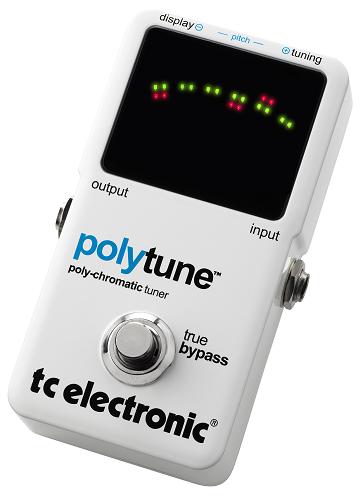
Could this be the last tuner pedal you’ll ever need?

I don’t see how I missed this! I scour the ‘net daily for new stuff, especially from companies that are known to create really high-quality stuff – like TC Electronic. These Scandinavians are incredible inventors, and I haven’t seen or played one one thing of theirs that I didn’t like – though I could rarely afford it. But they’ve come out with a new tuner – yes, a tuner, of all things – that is completely different from any other tuner on the market. It’s called the “Polytune.” As its name implies, it is a polyphonic tuner; that is, the tuner can detect all your strings at once, and you can see which ones aren’t in tune at the click of a foot switch. Unlike traditional tuners that require you to check each string individually, with the Polytune, you strum your open strings. The LED’s will show you which strings are in tune and which aren’t.

In my experience, more likely than not, at any given time only one or two will be out of tune. So imagine the time you save by NOT having to check and tune each string – only the ones that need it! Check out this video to see how it works!

And at $99 bucks… SOLD!!!

Here are some features:

  • 0.5 cent accuracy
  • Standard size box
  • Tune by strumming
  • Can automatically switch between chromatic and polyphonic tuning (it will detect if you’re hitting a single string)
  • Customizable preference settings
  • Has a 9V output jack for powering other pedals
  • True bypass
  • Adjustable reference pitch from 435Hz to 445Hz
  • Supports drop tuning all the way down to B!
  • Works with 4 and 5 string basses as well

It may not have the accuracy of a TurboTuner, but who the hell gives a flying f$%k! .5 cent accuracy is nothing to shake a stick at, and the fact that you can see the tuning of all your strings at once is incredible! Can  you say KICK ASS!!! I’ve never even seen this thing and I want to give it 5 Tone Bones! Check out the TC Electronic web site for some detailed information!

Could this be the last tuner I’ll ever want? Until someone comes out with something better – and at a better price, for that matter, probably not. I want to get one right now. Unfortunately, they’re only available for pre-order. Hmm… oh well, I supposed I can wait. 🙂

Read Full Post »

Though I’m quite a bit out of shape to play nowadays, I’ve always had a love for the game of tennis; especially watching the tennis greats over the years, and thoroughly enjoying the pure artistry in their playing. Having played a bit of competitive tennis myself – albeit, nowhere the level of my tennis idols – I have a good idea of the hard work that goes into being good. These guys and gals make the game look so effortless that it shadows the fact that they literally spend hours each day developing their craft.

Within the past couple of decades, I have been privileged to witness history being made in tennis. In the 90’s it was Pete Sampras who had won an unprecedented 14 major singles titles. That guy was an absolute machine! No one at the time could even match that! But early Sunday morning, between 12:30 am – 3am PST, I witnessed Roger Federer become the first man to win his 16th major singles title, and the thing that hit me afterward was that I’ve had the fortune to live in a time to watch the greatest tennis players to ever walk the planet play.

Watching these guys play, the one thing that strikes me is their absolute calm and focus on the job at hand. Few visible outbreaks of emotion. Just patiently playing and doing their thing – and this is important: Responding, not reacting, to different situations; adapting their games to fit with the current conditions. It’s as if – though I’d say there’s a bit of truth to this – they are hyper-aware of everything that is going on around them, and sculpt their play in response to whatever may come at them. It’s thought-filled as well as instinctive.

The Zen term for this hyper-awareness and “intuitive instinct” is called “satori,” which literally translates to “understanding.” Satori is the first step of enlightenment to achieving nirvana. Japanese martial artists liken this state of satori as thought being the equivalent of action. Western cultures refer to this state as “being in the Zone.”

The Zone is a state of duality: Extreme focus and hyper-awareness; analysis and action; emotion and stoicism. In other words, being completely centered in your consciousness. We’ve all experienced “being in the Zone” in some way, whether we’re writing, running, or just sitting quietly, though it is most often associated sports or something active. But here’s the rub about being in the Zone: It doesn’t require any expertise at a particular activity. And while many people have experienced this sporadically and spontaneously, it is actually possible to get into the Zone at will.

Okay, I’ll pause for a moment and ask the question you’re all probably thinking: What does have to do with guitar? 🙂

Simple. Playing guitar in the Zone – no matter your experience level – is the difference between playing purely mechanical and playing with true expression – what’s really inside you. I know that people may argue that you should have some expertise and mastery of your current level of playing to really get into the Zone, but remember, being in the Zone is completely independent of any mechanics. It’s a state of mind, and that doesn’t require any expertise. Furthermore, I will also posit that playing in the Zone makes learning much easier because your heightened awareness and “centered-ness” makes you more open and much less analytical.

So given that, as I mentioned above it is possible to actually get into the Zone at will. But this takes a bit of practice, and a bit of mental preparation. People have different ways of getting into the Zone, but there are some fundamental things that you can do to get you on your way.

  1. First, breathe. It’s amazing how much we constrict our own breathing. I won’t give you any breathing exercises, but take note of and be aware of how you’re breathing. The more even the better.
  2. Relax your mind. Relaxing your mind is not that you block out everything going on around you, you just don’t allow your mind to wander onto things that are outside of your focus. This is a key of getting into the Zone.  From a neurological point of view, relaxing your mind means quieting your alpha waves, so your more creative beta waves take precedence.
  3. Relax your body. This doesn’t mean go limp. You could be jumping around on stage and still be relaxed. More to the point, relax your chest, which most of us have way too constricted.

Simple things, and I know they may sound a bit nonsensical, and for those of you who are more familiar with relaxation techniques, these steps are akin to getting into a meditative state. Being in the Zone is very much like being in a meditative state. Your mind and body are relaxed, and your attention is focused. But at the same time, you are completely aware of what is happening in the periphery of your consciousness.

To practice this with guitar, pick a piece that you know really well. But this time, do those preparation steps to quiet your mind a bit, then try to play it with your eyes closed. I suggest this so you’re playing completely by feel. Listen to what you’re playing, and just for shits and giggles, play the piece in response to things you hear around you, trying to express the emotional imagery you get when you hear the sounds. I do this occasionally when I’m trying to work out a phrase in a song, and I’m just not “feelin’ it.”

Don’t buy it? I’m not surprised. But there’s a reason that martial artists have practiced relaxation techniques for thousands of years. A quiet mind allows you to respond to any given situation with clarity; with a mind not cluttered by things it shouldn’t be thinking about – especially in the heat of battle where even a slight hesitation due to mental distraction could mean the difference between life and death.

Granted, with playing guitar, we’re not talking about a life or death situation. But imagine the level of expression – no matter your level – that you could experience when your mind is quiet, and you’re playing with the intensity of purpose that comes from absolute focus. That’s never a bad thing.

Give it a try. You may surprise yourself at what you create. From my own personal experience, whenever I’ve been in the Zone, I’ve created my best music be it on stage or in the studio.

Read Full Post »

« Newer Posts - Older Posts »