Just got my latest issue of Guitar Player, and as usual, went to the gear section first to see if there were any new and interesting pieces of gear. Normally, the stuff there is pretty tame, but I got really intrigued by a short product review on the Harmonic Capo. Unlike a normal capo that you place on a particular fret to play open chords at a particular fret position, the harmonic capo is placed at a harmonic fret: 12th, 7th, or 5th, and it will play the harmonic there. But the really cool thing about this is that unlike a normal capo, where you can only play the frets above the capo’d position, with the harmonic capo, you can play at frets above AND below the fretted position of the capo. It’s a very interesting concept that can yield some very interesting tonal possibilities. Check out this video by the inventor:
Posts Tagged ‘Guitars’
New Gear: Bob Kilgore’s Harmonic Capo
Posted in gear, gear reviews, guitar, guitar gear, guitarists, Guitars, Music, musicians, tagged capo, gear, gear reviews, guitar, guitarists, Guitars, musicians on September 22, 2008| 3 Comments »
Review: VOX Satchurator
Posted in Effects, GAS, gear, gear reviews, guitar, guitar gear, guitarists, Guitars, musicians, pedals, tagged Effects, GAS, guitar, Guitars, pedal, Satchurator, stomp box, vox on September 11, 2008| 35 Comments »

 Vox Satchurator |
Summary: From grind to snarl, the Satchurator can deliver it. Built like a tank, with chicken head knobs, and a fire engine red paint job. Definitely gig-worthy! “More” switch is awesome!
Pros: Incredibly versatile, this box has the ability to deliver a wide variety of tones. Cons: Just a nit: True character of this pedal doesn’t come out until you’re at gig levels in volume. Price: $129 Street Features (fr. VOX site):
|
I am not shredder; never was, never will be. It’s just not my style. But that doesn’t mean I don’t love the sound of distortion and playing with a distorted sound. In fact, to me, there’s nothing like the sweet, sustained, and compressed tone of saturated power tubes, or the dirty color that comes from a great overdrive or distortion box. Thus, I’ve had several stomps over the years from DS-1’s to MXR’s to my current line up of a Tube Screamer, Bad Monkey and an OCD. Each pedal has its own unique character, and I employ all of them either individually or by chaining a couple together. It now looks like I’m going to add to my lineup.
When I first heard about the VOX Satchurator, I got excited. I figured anything that was designed and built to Joe Satriani’s specifications had to at least be something to take a good look at, if not outright buy. Plus, with VOX being known for high-quality, I knew that whatever was produced from this partnership would not be crap. So I knew that it would be a good bet that I’d get this pedal. In fact, I’m writing this review right after my test. But luckily, I’m not THAT impulsive that I left the store with one in hand – though I have been known to buy first think later. Luckily I have my trusty GAS Calculator to keep those impulses in check. 🙂 I scored a 5, which is on the high side of still considering the gear and just one point below of getting it, but I didn’t score a 6 or above, so I held back on my purchase for now (honestly, it’s a matter of available funds 🙂 ). Now back to our regularly scheduled program….
Okay… if you read no further, please read this:
THE SATURATOR WILL NOT MAKE YOU SOUND LIKE JOE SATRIANI!!!
No one sounds like Satch, but Professor Satchifunkilus himself. You may use the exact same equipment (I used a JSX for my test, but I used a PRS SE Custom Semi-hollowbody for one of the guitars and a Strat and Epiphone Les Paul for the others). You may even have incredible technique that matches or surpasses the maestro, but you will not sound exactly like him. I’m only saying this because I don’t want you to get your hopes up. What you do get though, is the same TYPE of distortion tone that Satch gets. What you do with that is entirely up to how you play; and that is a good thing. Okay, ’nuff said.
Here’s my take on the Satchurator: Forget about how cool it looks – it looks AWESOME, by the way – the Satchurator is an incredibly versatile distortion box that can serve up mild grind to unadulterated, in-your-face, lewd, crude, with a mouth full of food snarl (got that saying from Guitar Player mag 🙂 ). It also has incredible attack and volume knob sensitivity at any volume level.
The Satchurator is also not for the faint of heart. Once you switch on the box, you get breakup, even with the gain swept to zero. In other words, once it’s on, you’re committed to having even modest amounts of distortion in your signal. To coin a phrase from a close friend, “This ain’t for pussies.” But the cool thing is that the distortion is highly controllable based upon your guitar’s volume knob and how you attack the strings. From a volume knob perspective, I just DIG how the Satchurator responds to volume knob settings. Want less distortion, just sweep your volume down. Want more bite, do the opposite.
When I test pedals, I usually start out with everything set in the 12 o’clock setting. Through my test, which was about 45 minutes, I only moved the gain knob twice: All the way down to get a gorgeous bluesy breakup, then all the way up to see how bad the pedal clipped, which surprisingly enough, it didn’t do. For the rest of the test, I just kept the gain set at the centerline, then used a combination of attack and volume knob sweeps to dial in the right amount of distortion that I wanted. From a gigging standpoint, the less you have to bend over or crouch to set pedals, the better.
It has been noted that Satch actually plugs the Satchurator into a clean amp, then sweeps the gain knob. Personally, I like the sound that power tubes produce, so I set the JSX into the first gain stage, but left it pretty clean, allowing the Satchurator to drive the tubes into breakup. I do have to say that I loved that combination of tube breakup along with the Satchurator distortion.
More really is more…
There’s an interesting switch on the right side of the pedal called “More.” This switch provides even more gain when you switch it on. It’s great for cutting through a mix. The interesting thing is that the boost effect is less dramatic with higher gain settings on the pedal. With the gain knob pegged, pressing More definitely adds more, but it’s just a bit more, like going from 10 to 11 on your amp. Where I had it set at 12 o’clock, the More switch was nicely dramtic, and it’s something that I’ll definitely be using when I gig.
Will play nice with the other kids...
I didn’t get to try this feature out, but the Satchurator also includes a toggle switch called “Pad.” Apparently, this allows the pedal to play well with high output pedals like wah pedals and not change your tone. It essentially “pads” their signals so the Satchurator’s tone doesn’t fluctuate wildly. I’ve never seen a pedal that had this feature. Very, very useful. Once I put the Satchurator in my chain, I’ll definitely be using the “Pad” to help tame my vibe pedal that could potentially cause wild tonal fluctuations, which it does with my OCD, which doesn’t like to be played with the vibe.
So how did it REALLY perform…
I wish I had more time to try out a couple of other amps, but alas, I just didn’t. But I did try it out with three guitars, so that’s good. Here’s my synopsis:
- The first guitar I played it with was PRS SE Custom. This is a semi-hollowbody guitar. I’m glad I switched to another guitar because I wouldn’t buy the pedal if I just did my review with just that guitar. It’s not that the guitar was bad, and it wasn’t that the tone that was produced was bad. It’s just that the combination of this particular guitar with the Satchurator was uninspiring. I wasn’t blown away.
- After the PRS, I switched to a Strat, and my inspiration meter went through the roof! The sound was FAN-FREAKIN’-TASTIC!!! I had the same result with Epi LP I plugged in. In other words, at least from my perspective, the Satchurator sound best with solid body guitars. To be fair, I probably could’ve coaxed a great sound using the PRS, but with limited time, I didn’t have the patience. And in a gigging situation, the last thing you want to do is tweak.
Wrapping it up
As I mentioned above, this pedal will not make you sound like Satch, but it will give you the same kind of distortion Satch employs. I love that kind of distortion. It’s not super-compressed, but it’s also not so open that it comes across as hollow. As with Baby Bear’s porridge in “Goldilocks and the Three Bears,” it’s just right!
Review: Roland Cube 60 Amplifier
Posted in amps, gear, gear reviews, guitar gear, Guitars, Music, musicians, recording, tagged amps, guitar, guitar gear, Guitars, Music, recording on August 20, 2008| 1 Comment »
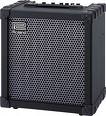 Roland Cube 60 Amplifier |
Roland Cube 60 Amplifier Summary: Built like a tank, great-sounding and versatile, the Roland Cube 60 is at home on the road and in the studio. Pros: Built-in Roland COSM modeling technology to mimic 9 British, Vintage and Modern amps, plus an added Acoustic mode. The Cube 60 also sports Recording Out, Line Out and Speaker Outs, plus a Tuner Out that can feed a Tuner independent from Volume control. Very loud for a small amp! Cons: Reverb sounds hollow and a muddy at higher settings, with a definite loss of clarity. Price: New $300-$359 Street ($250-$275 used) |
When I bought my Cube 60 a three years ago, I wasn’t even looking for an amp. At the time, I was using a Line 6 Flextone III that served my purposes beautifully. But when you’re a gear freak and you just happen to have a bit of coin to spend well, some things just can’t be passed up.
Such was the case when I was perusing my favorite local gear store. I sauntered into the cramped guitar area, and saw this tiny black cube amp sitting against the wall. Intrigued, I picked it up by its handle and marveled at not only its diminutive size, but also its light weight (it weighs only 25 lbs.). Then Jordan, the guitar guy walked up and said, “I just got me one of these. It sounds awesome, and you can use it anywhere.” Normally, when I hear stuff like this coming from a salesperson’s mouth, I just nod, smile and say, “Cool.” But I’ve known Jordan for awhile, and I’ve learned to trust him. After all, he’s a gigging guitarist who knows his gear. When I hear him even slightly rave about something, I know it has got to be something cool (not that I can always afford the stuff he says is cool, but that’s another story).
So instead of my usual reaction, I silently pulled a Strat down from one of the hangers while Jordan went to fetch a cord. Big mistake! 🙂 It took me no longer than 10 minutes to know that I had to have this amp. Plus it was on sale for the Christmas season, so I got it for $50 less than normal retail!
I won’t go into the technical details of this amp because you can google for them. Let me just say this: This amp kicks ass! While I use my Fender Hot Rod for my electrics on stage, I use this with my acoustic, and it’s a dream. There’s something about the Acoustic channel on this amp that makes my Ovation sound like a Martin dreadnought! It’s that sweet
But in the studio, I use this amp a lot for recording backing rhythm parts. Even though it’s a modeling amp, which I normally don’t really get too wild about, this amp produces really nice tones in all of its amp modeling settings. And with its recording out jack, which shuts off the speaker, I can safely record deep into the wee hours of the morn without worrying about waking the neighbors. Surprisingly enough, it sounds great going direct into my DAW. In fact, I recorded this song using nothing but my Roland Cube 60. Of course, there’s nothing like the sound that a cranked tube amp produces, but late in the night, when you’ve got the inspiration, having the convenience of an amp that sounds great going direct is very nice!
Finally, did I say this amp is LOUD? You’d never expect the kind of volume that this amp is able to produce. At home, I rarely take the amp above 9am on both the Gain and Volume knobs. Any louder, and I’d start getting calls from the neighbors and complaints from my wife! 🙂 One of my close friends uses this amp for gigging, and he loves its versatility. Mind you, this is a guy who has tons of gear. His amps include a Marshall JCM half stack, and a gorgeous ’71 Fender Twin. But he likes to gig with the Cube because it’s so versatile AND it’s incredibly light! Weight matters when you’re hauling gear.
This amp is definitely worth a look.
Rock on!
 Guitar Gear