Feeds:
Posts
Comments

Posts Tagged ‘instruction’

Greg HoweLooks like guitar maestro Greg Howe is getting into the act and offering lessons via Skype. I wrote about guitar great Charles Sedlak doing it, but Greg Howe? Awesome. The price isn’t outrageous either: It costs $75 for a 1-hour lesson. That’s significantly more than what Charles charges, but hey! It’s Greg Howe!

This lessons on Skype are really intruiging to me. Apparently they work, otherwise people wouln’t be offering them. For more information, check out: Greg Howe – The Official Website.

Read Full Post »

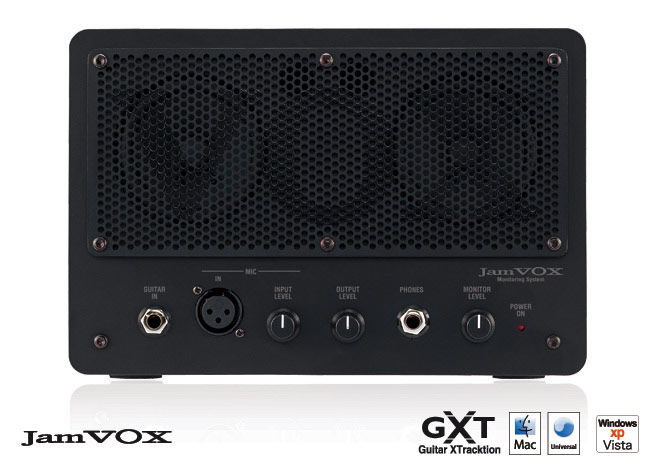
JamVOX Front View

JamVOX Front View

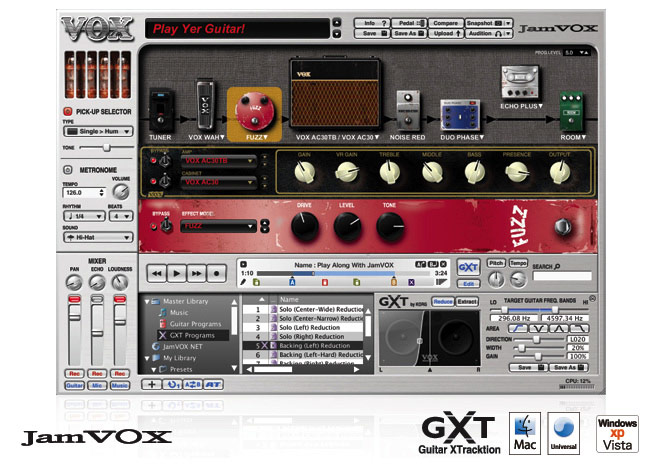
JamVOX User Interface

JamVOX User Interface

Even though I have some patterns and scales that I practice, I usually end up jamming to jam tracks that I either write myself or download. But I also like to jam to music from popular bands. The only problem with this is that the guitar parts are already printed, and it’s tough to jam over recorded stuff.

But VOX has just come out with the JamVOX, a jam and practice tool consisting of softare and a mini practice amp to play along with any MP3. The software apparently extracts the guitar part from any MP3, and you can rip away! I don’t think this is the first of its kind, but compared to the solutions I’ve seen in the past, this looks like it is the most well-integrated software/hardware solution to date. I’m definitely going to check it out as soon as I can! Here are the features from the VOX site!

  • Revolutionary new GXT (Guitar XTracktion) function lets you cancel or extract the guitar part of an existing song.
  • 19 famous guitar amps and 54 effect units ranging from vintage to modern are provided as software.
  • Easy-to-use “drag and drop” interface enables guitarists to create their “dream guitar rig” without any advanced knowledge of amps or effects. Sound famous fast!
  • A music player feature with convenient functions for jam sessions or practice.
  • Import music files to jam along with from your favorite CDs, music library or MP3 player.
  • A dedicated USB monitor speaker is included, and there’s no need for complex wiring or specialized knowledge of computer music.
  • Two guitar play-along CDs containing 28 famous rock classics.

Check out a few videos:

After watching the videos, I’m REALLY stoked about JamVOX!!! And at $249.00, it’s a great deal!!! Can’t wait to give it a whirl!

Read Full Post »

Ran across this site today called SpeedPicking.com that actually looks pretty interesting. In their words:

The Speed Picking Workshop is for any Guitarist looking to vastly improve their Speed, Accuracy and Coordination using an alternate picking technique. The online workshop allows you to develop this technique using a measured and methodical approach. This method promises fast, solid and measurable results for the guitarist that demands real progress and has the determination and patience to achieve their goals.

Wonder if you could get the same stuff from a book… Check it out at: http://www.speedpicking.com

Read Full Post »

There’s a new site called “I Perform 3D.” Check it out! It’s a trip! http://www.iperform3d.com/.

Don’t know if I’d join, but I’ve never seen anything quite like it! 🙂 Here’s a video:

Read Full Post »

As GuitarGear.org has grown, so has its readership, but trying to keep a constant feed of fresh content isn’t as easy you might think, considering that it has only been me doing it for the past couple of years, with a couple of contributions from folks like Tweed Demon in the past. One of the areas that I wanted to expand to was providing more education pieces; partly because I’ve started teaching beginning to intermediate guitar players, but also because music theory is something that really interests me. But far be it from me to share any formal knowledge – I’m self-taught. I can only describe theory in terms of how I’ve experienced it, not in any real academic ways.

So it comes as a real pleasure to introduce to you GuitarGear’s newest author, “wesman.” Wesman started commenting on the site a couple of months ago, and his feedback has been both honest and insightful. So after he “corrected” me in a recent post about music theory, I felt compelled to contact him and ask him to contribute his knowledge to the site. He gracefully accepted. Here’s a transcript of a quick interview I gave to him:

How did you discover GuitarGear.org?
It was suggested to me in google reader

What’s your musical background? Did you study formally or organically?
I started playing guitar around the age of 10.  I took fairly standard guitar lessons in that they were lax on theory.  I never learned notation and only minimal (practical) theory.  In high school some friends and I were able to persuade the school to do a theory class for the 6 of us as an elective and that was my first exposure to “real” theory.  My the time I graduated I was competent on guitar, bass and drums.  I took a few classes in theory, history and composition in college while majoring in computer science and worked on my playing in various bands.  I picked up the harmonica and also started experimenting with a cassette 4-track which started my love of recording.  Since college I’ve become proficient on piano and organ, honed my guitar skills and focused on composition and live performance.  I’m working on picking up the sax now!

What styles of music do you play or write?
I play primarily rock music – typically fast, loud stuff – punk, not metal or anything too evil sounding – I have done a lot of intimate quiet recordings as well, but I usually prefer uptempo music when playing in a band – I’ve got some demos on my myspace:  myspace.com/angoraluvu <http://myspace.com/angoraluvu&gt; .

What’s in your rig?
oh man – I love talking about this stuff – my main amplifier for live use is the mesa/boogie mk iv which I think is nearly perfect.  at home I have a mid-70s Fender Vibro-Champ.  For guitars, I primarily play a les paul classic and my backup is a double cutaway les paul special.  I also have a 70’s RI strat and some foreign-built epiphone casino (the label came off – I think it’s indonesian or something, but it is nice for playing at home).  live, I typically use just a fulltone clyde deluxe wah pedal though lately I’ve been bringing a line6 FM4 which I use for uni-vibe, flanger, tremolo and ring modulator effects.  For acoustics, I have a beautiful 1970’s gibson j-200 artist and a seagull m12 12-string. I play bass in a band as well – I use a 1982 gibson ripper and a recent rickenbacker 4001 through an ampeg v4b that, I think, is from the 90s

Read Full Post »

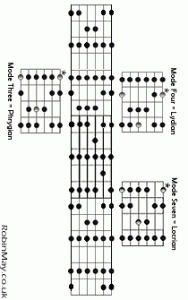
modesfig2

Note: This isn’t going to be an instructional piece… just a sharing piece… mostly…

I’ve been playing guitar for over 35 years, but it hasn’t been until the last couple of years – actually the last few months – that I’ve really started focusing on scales and modal theory. Chord theory I had down cold, but I really didn’t focus on the scales part of the equation. I figured that if I could get some lead patterns and tricks down, I’d be in pretty good shape; and for awhile, that worked just fine.

But then I realized that in many of my recordings, I was using the same patterns and tricks, albeit in different keys and in different combinations, but the same stuff nonetheless. This prompted me to rethink how I approached playing solos, so I started out by learning major and minor scale patterns. I got a couple of books to help me along, and I proceeded to practice them.

But in the back of my mind was this idea of modes. I’d heard them bandied about for years, and pretty much ignored them partially out of the thought that as a rhythm player, they weren’t too important; though that really masked an innate fear that modes were WAY beyond my ability to grasp. But during this past weekend’s study/practice session, I realized that modes are not difficult at all! The names of the modes just scared the livin’ crap out of me! 🙂

Think about it: The mode names are all in Greek: Ionian, Dorian, Phrygian, Lydian, Mixolydian, Aeolian, and Locrian. From my previous life as a bio-sciences major, terminology in Greek or Latin would evoke feelings of anxiety similar to, “Oh shit! More frickin’ terms to memorize just to regurgitate later on.” 🙂 Such was the case when faced with modes.

I now feel a little foolish about my anxiety with modes. Once you understand what they represent, they’re totally easy to play!

Here’s my explanation in a nutshell, just in case you too have the same anxiety about modes as I did:

  1. Modes are simply starting points within the scale of a particular key.
  2. For instance, if you’re playing in the key of C and want to play in the Mixolydian mode, you’d start and end on the 5th degree of the C scale which is G.
  3. Now don’t get confused here: You don’t play a G scale. You merely start at G, and play the notes of the C scale, so: G A B C D E F G

So what’s the big deal? Lots of players don’t give a whit about this stuff. For me as a teacher, this stuff is pretty important. But from a player’s standpoint, it gives you a much deeper understanding of the fretboard, and also, playing in a mode gives you a different tonal center to play from, which actually has an effect on how a solo sounds and feels.

I found that a great example of this is to play the Lydian mode. The Lydian mode starts on the 4th degree of a scale. Going back to the C scale, this means that the Lydian will be F. If you’re familiar with chord theory, a chord with an added 4th is notated as Csus4. The sound of this particular chord connotes a feeling that the chord must be resolved – it’s not something you’d finish with; you’d typically use a “sus4” chord before either the major root chord or minor root chord. In our case of a C chord, we’d do something like: Csus4 – C. In playing in the Lydian mode, you’ll evoke a sense that you have to resolve your scale somehow. After all, starting and ending on the 4th creates a feeling that your phrase is unfinished. The point of all this is that where you start will have a huge effect on the general coloring of what you’re playing.

Note that this discussion only brushes the surface of modal theory. For a much deeper discussion, check out Guitar Noise or this excellent article that I found on Modes of the Major Scale.

Read Full Post »
teachwombat-banner

One of GuitarGear.org’s readers recently plugged his guitar instructional site, Teach Wombat, in one of my articles about moving into a new chapter of my guitar life. I normally don’t like random product plugs, but being a teacher, I’m always looking for teaching aids and resources, so I checked out the site, and it definitely showed promise. A little later after Ken left his comment, like a good businessman, he offered to let me review his material, so I did, and all I have to say is, “WOW!” This stuff is GREAT! Ken’s primary product, the Guitar Teacher’s Toolkit includes over 100 professionally produced handouts covering the C-A-G-E-D system and scalar modes, plus a bunch of other awesome diagrams.

As a new guitar teacher, producing my own handouts has been a very laborious and tedious task, but with the Guitar Teacher’s Toolkit, I’ve got pretty much everything I need for teaching. It even comes with blank neck diagrams for ad hoc instruction!

But I wouldn’t limit this just to teachers. Players of all levels and skill will find lots of value from the diagrams and can use them as quick references. Hey! For $12.00, you can’t miss! So do yourself a big favor and go to TeachWombat.com today and buy Ken’s Guitar Teacher’s Toolkit!

Read Full Post »

« Newer Posts